×

Guinea-Bissau🇬🇼 | best national parksWhere to Find the 5 Best national parks in Guinea-Bissau

Guinea-Bissau’s national parks are wild, wet and lightly visited, with almost no signs, ticket booths or crowds. The Bijagós archipelago means salt wind, mangrove mud and boat engines, while the mainland parks bring red laterite tracks, cicada noise and woodsmoke. Costs stay low but logistics eat time. Backpacking here suits independent travelers who accept slow canoes, patchy phones and local guides.

By Johan Kruseman 🇳🇱 | Updated October 23, 2026
Explore the best beaches in Guinea-Bissau

Why go?What Makes Them Special

Guinea-Bissau protects a large share of its land and coast, and that is unusual for one of the world’s poorest countries. The reason is geography. A tangle of tidal mangroves, river estuaries and island groups made large-scale development hard, and decades of political instability meant few roads, hotels or plantations reached these areas. The result is raw, uncrowded nature where forest elephants, hippos, manatees and migratory birds still live close to villages that follow traditional rules about sacred groves and fishing grounds.

Before choosing the country for its parks, know the limits. Infrastructure is thin: few paved roads, scarce fuel, unreliable power and little formal visitor service. Trips depend on local guides, boats and community camps, so plan slowly, carry cash in West African … read more 👉
Guinea-Bissau protects a large share of its land and coast, and that is unusual for one of the world’s poorest countries. The reason is geography. A tangle of tidal mangroves, river estuaries and island groups made large-scale development hard, and decades of political instability meant few roads, hotels or plantations reached these areas. The result is raw, uncrowded nature where forest elephants, hippos, manatees and migratory birds still live close to villages that follow traditional rules about sacred groves and fishing grounds.

Before choosing the country for its parks, know the limits. Infrastructure is thin: few paved roads, scarce fuel, unreliable power and little formal visitor service. Trips depend on local guides, boats and community camps, so plan slowly, carry cash in West African CFA francs and expect humidity, mosquitoes and sudden changes of plan.
Behind the Scenes of Selection
The list of best national parks in Guinea-Bissau is created based on landscapes, wildlife, adventure opportunities, facilities, and overall experience. If you feel a national park is missing in this list, please let us know.

When to go?Best Time to Visit Guinea-Bissau for national parks

Best months and dry-season conditions: The best months are December to April, when the dry season brings clear skies, calmer boat crossings and passable laterite tracks. Daytime temperatures run about 28 to 35°C, with hot afternoons and cooler, dusty-smelling mornings in the interior. Harmattan haze can soften the light from December to February.

Shoulder and wet seasons: November and May are shoulder months: fewer visitors, warmer air and the first heavy storms. From June to October the rainy season brings roughly 1,500 to 2,000 mm of rain, especially along the coast. Tracks turn to red mud, rivers swell, mosquitoes multiply, and boat transfers can be delayed or canceled. Prices change little because tourism is small, but guide and boat availability drops. The Bijagós islands are the most … read more 👉
Best months and dry-season conditions: The best months are December to April, when the dry season brings clear skies, calmer boat crossings and passable laterite tracks. Daytime temperatures run about 28 to 35°C, with hot afternoons and cooler, dusty-smelling mornings in the interior. Harmattan haze can soften the light from December to February.

Shoulder and wet seasons: November and May are shoulder months: fewer visitors, warmer air and the first heavy storms. From June to October the rainy season brings roughly 1,500 to 2,000 mm of rain, especially along the coast. Tracks turn to red mud, rivers swell, mosquitoes multiply, and boat transfers can be delayed or canceled. Prices change little because tourism is small, but guide and boat availability drops. The Bijagós islands are the most weather-sensitive, while inland areas near the Guinea border are slightly drier.

national park hoppingTips for Visiting Multiple Destinations

How many days to allow: A trip combining several parks needs 7 to 12 days, because every transfer involves slow roads, river crossings or boats. Bissau is the practical hub for all onward travel.

Grouping regions and pacing: The southern coast pairs well with the nearby mainland forests, while the Bijagós islands work best as a separate segment. Travel from Bissau to the south or the islands usually takes 3 to 8 hours by shared taxi, road and boat, depending on tides and road condition. Allow 2 to 3 nights per stop so that a delayed canoe does not wreck the schedule.

The common mistakes are cramming too many stops into a week, ignoring tide timetables and arriving without cash or fuel. Instead, book guides ahead, leave buffer days around departures and accept that red dust, engine noise and long waits are part of the journey.

The ListTop national parks of Guinea-Bissau

1 Orango National Park

Saltwater hippos, Eticoga groves, pirogue creeks, western beaches

Watch hippos at low light, glide through mangrove channels and walk sandy village tracks beneath oil palms with a local guide beside you.

2 João Vieira and Poilão Marine National Park

Green turtle nesting, Poilão forest, pale-sand islets, tidal flats

Watch turtles come ashore after dark on a sacred Bijagós island, then spend daylight on empty beaches and sandbanks reached only by boat.

3 Parque Natural dos Tarrafes do Rio Cacheu

Cacheu fort, colonial statues, mangrove pirogues, estuary birds

Tour a 17th-century riverside fort and its relocated statues, then take a pirogue through tidal tarrafes to look for hippos and waders.

4 Cantanhez Natural Park

Chimpanzee calls, village homestays, Cacine mangroves, cashew orchards

Follow local guides along forest paths between Tombali villages, listening for chimpanzees, then paddle mangrove creeks and finish evenings over palm wine.

guinea-bissau-national-park-cantanhez-natural-park
© Google |

5 Dulombi-Boé National Park

Forest elephant signs, savanna woodland, Fula villages, roan antelope

Walk red-soil tracks through dry grassland and river forest, reading dung, nests and tracks while hornbills call overhead and guides lead the way.

Loading the map 🌍

Expert viewExpert Commentary on national parks

How many parks to visit: I advise two parks, or three if you have more than ten days. Transfers are slow and unpredictable, so fewer stops mean more time among mangrove channels, forest edges and village landings rather than sitting in vehicles. The payoff is a trip with real animal tracks, bird calls at dawn and unhurried evenings.

Choosing the kind of park: Choose island and coastal parks if you like boats, beaches and birdlife, and expect salt spray, mud at low tide and sun that hits hard by 9 a.m. Choose mainland forest or savanna parks if you prefer walking, with leaf litter, termite mounds and shade, and a better chance of tracks and calls than direct sightings. Budget travelers should favor places with simple community lodging; those with extra money can pay for private boats, which … read more 👉
How many parks to visit: I advise two parks, or three if you have more than ten days. Transfers are slow and unpredictable, so fewer stops mean more time among mangrove channels, forest edges and village landings rather than sitting in vehicles. The payoff is a trip with real animal tracks, bird calls at dawn and unhurried evenings.

Choosing the kind of park: Choose island and coastal parks if you like boats, beaches and birdlife, and expect salt spray, mud at low tide and sun that hits hard by 9 a.m. Choose mainland forest or savanna parks if you prefer walking, with leaf litter, termite mounds and shade, and a better chance of tracks and calls than direct sightings. Budget travelers should favor places with simple community lodging; those with extra money can pay for private boats, which give flexible timing and quiet channels at sunrise.

Costs: Plan US$35 to 70 a day including food, basic lodging and local transport. Park fees are typically about US$5 to 20 per visit. Local guides cost around US$15 to 40 a day, and boat charters run roughly US$60 to 200 depending on distance and fuel. Cash is essential, since cards and ATMs are rare outside Bissau.

Safety and culture: Health matters most: take malaria prophylaxis, carry water purification and bring strong insect repellent for dusk. Roads can be rough and checkpoints are common, so keep copies of your passport and visa. In many villages, some groves, beaches and ceremonial sites are sacred, and entering without permission can offend the community. Ask your guide before photographing people or ritual places, greet elders first and dress modestly. Politics can change quickly, so check current travel advice before departure.

✈️ The backpacker research shortcutGuinea-Bissau Travel Guide

An offline-friendly backpacking guide with optimized travel routes, ranked highlights, transport advice, and the best areas to stay.
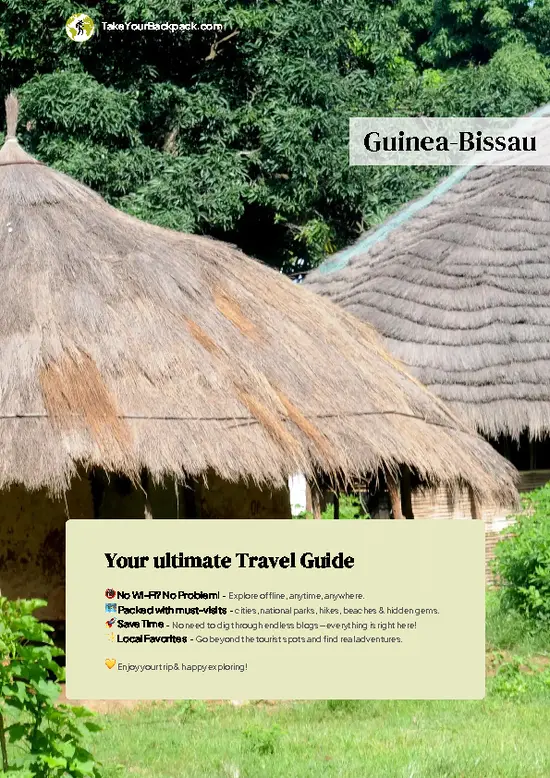
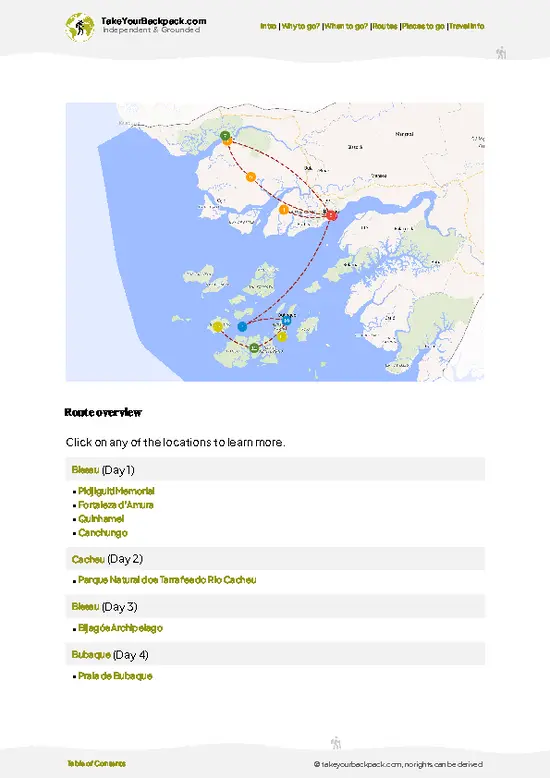
example page 0 from our offline Travel Guide for Guinea-Bissau
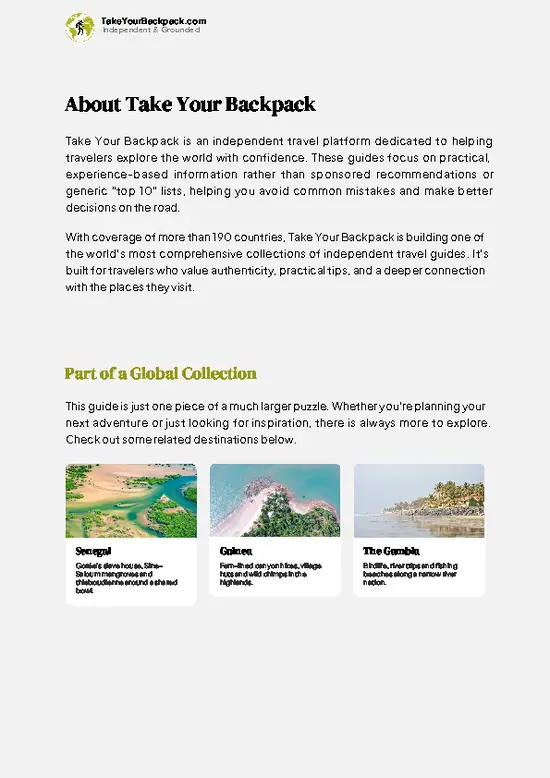
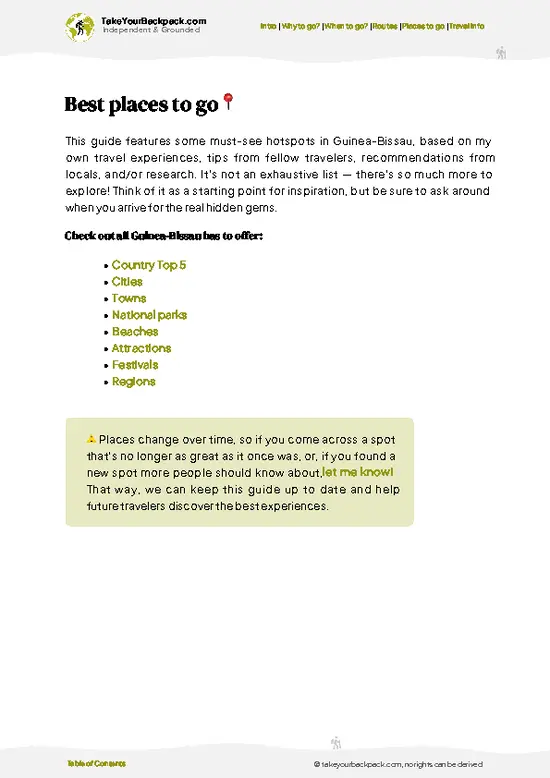
example page 1 from our offline Travel Guide for Guinea-Bissau
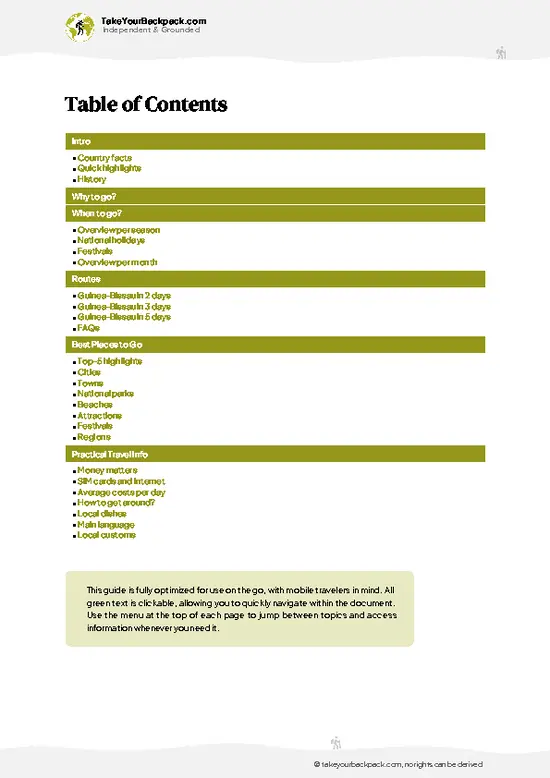
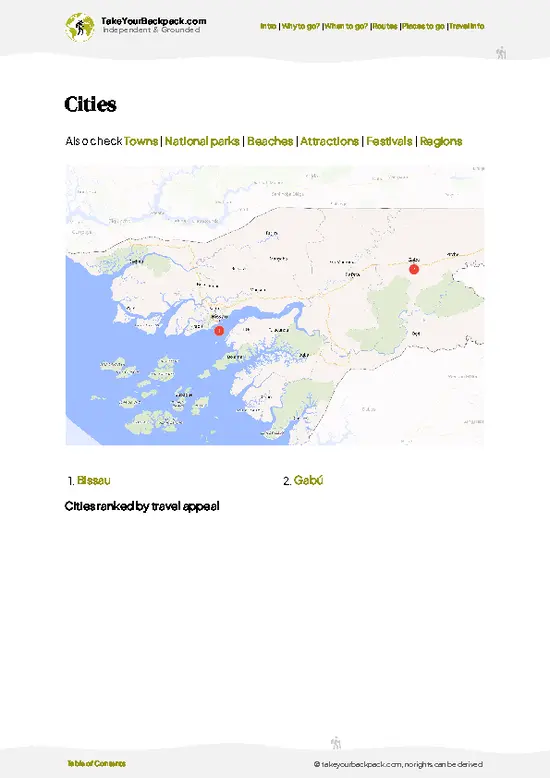
example page 2 from our offline Travel Guide for Guinea-Bissau
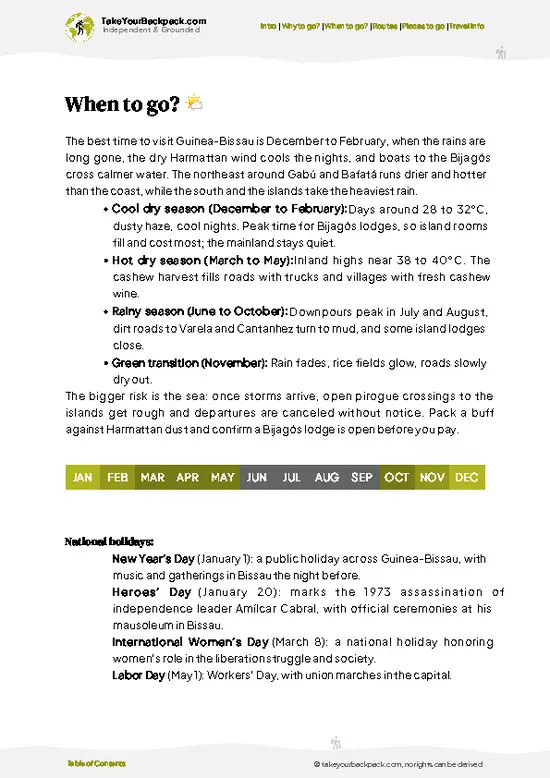
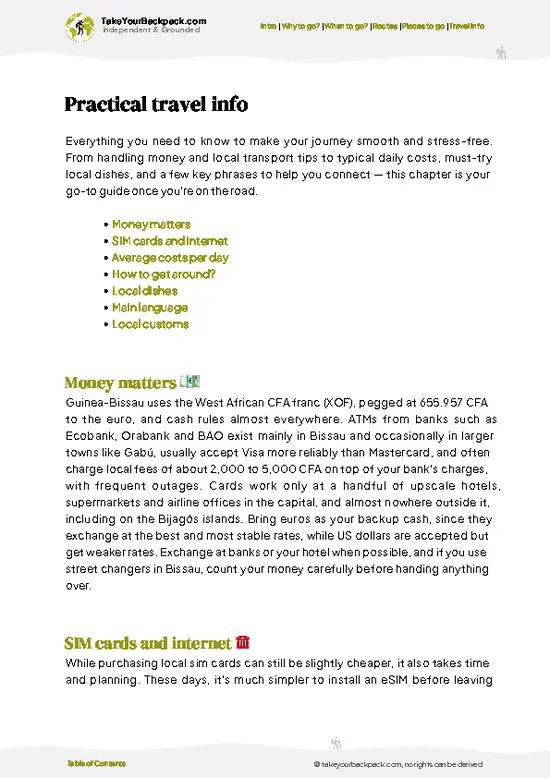
example page 3 from our offline Travel Guide for Guinea-Bissau
example page 4 from our offline Travel Guide for Guinea-Bissau
example page 5 from our offline Travel Guide for Guinea-Bissau
example page 6 from our offline Travel Guide for Guinea-Bissau
example page 7 from our offline Travel Guide for Guinea-Bissau
The digital guide (214 pages) contains:
✅ 48 highlights, ranked by travel appeal
✅ Optimized 2, 3 & 5-day travel routes
✅ Cities, national parks, landmarks, beaches
✅ How to get around
✅ Offline-friendly for travel without Wi-Fi
👉 Click to see all 30+ guide features

📅 Plan smarter in minutes, not weeks
✅ Month by month travel advice
✅ Festivals & national holidays
✅ Budget expectations

🗺️ Go to the right places, skip the overrated ones
✅ Honest pros & cons of destinations
✅ Top hikes, parks & viewpoints
✅ Lesser-known places most travelers miss
✅ Clear “worth it vs skip it” guidance

🛏️ Travel smoothly without rookie mistakes
✅ Best areas to stay
✅ Transport systems explained simply
✅ Common scams & safety advice
✅ SIM cards, money & practical tips

🌍 Understand the country, not just visit it
✅ Culture & traditions
✅ 52 Essential phrases & customs
✅ Festivals worth planning around
✅ Traveler-friendly historical context
✅ Insights that make places more meaningful

📱 Built for real travel conditions
✅ Fully downloadable PDF
✅ Works completely offline
✅ Optimized for phone use
✅ Useful in remote areas & buses
✅ Everything in one place
Stop searching, start planning
Get instant access to your full guide. 30‑day money-back guarantee.
+ Add another guide for just

By proceeding you agree to our terms.
Sent to your inbox immediately after payment • 100% Secure Checkout
Best Backpacking Travel Advisor 2025 tourism awardBest Backpacking
Travel Advisor
2025
What others say about Take Your Backpack Guides:
⭐⭐⭐⭐⭐
Fantastic, amazing amount of information!
⭐⭐⭐⭐⭐
My goodness this is amazing, it's what I've been looking for hats off too you!
⭐⭐⭐⭐⭐
I think this is absolutely BRILLIANT
⭐⭐⭐⭐
Very complete and informative. It's still missing places, but I gotta to commend you
⭐⭐⭐⭐⭐
This is truly amazing, thank you, can't wait to explore it with my kids!
⭐⭐⭐⭐⭐
Awesome resource, thank you!
⭐⭐⭐⭐⭐
This is amazing! Can't wait to explore the ones I haven't seen
⭐⭐⭐⭐
I love this! Well done, great idea.
⭐⭐⭐⭐⭐
Thanks for taking the time to make this gem!
⭐⭐⭐⭐⭐
This might be the best website I've ever seen.
⭐⭐⭐⭐⭐
Congratulations, and thank you so much for your work; it's incredibly valuable.
⭐⭐⭐⭐
In all seriousness I think you did a great job pointing out the important spots
⭐⭐⭐⭐⭐
10/10 very good
⭐⭐⭐⭐⭐
As someone who's only just starting to visit regularly this is awesome, thank you.
⭐⭐⭐⭐
Thank you very much! I'm going to visit my dad, it's going to be very useful!
⭐⭐⭐⭐⭐
This is really cool! We'll be travelling for the first time and this definitely come in handy.
⭐⭐⭐⭐⭐
You are now our minister of culture, congratulations 👨‍💼
⭐⭐⭐⭐⭐
Just wanted to tell you that this is a pearl! Going to follow your recommendations.
⭐⭐⭐⭐⭐
This is so cool. I'll definitely be using the resource for my travels soon.
⭐⭐⭐⭐⭐
This is very impressive! Good work.
⭐⭐⭐⭐⭐
This is an amazing and informative site. Very well done!

🛏️ Where to stay?Best Places to Stay in Guinea-Bissau

Guinea-Bissau has almost no dedicated backpacker hostels, so budget travelers sleep in simple guesthouses and pensões, with a fan or air-con room usually costing 15,000 to 25,000 CFA (about US$25 to 40) a night. In Bissau, the old port quarter of Bissau Velho puts you within walking distance of the fort, the Pidjiguiti waterfront and the evening bars, but it gets noisy and deserted streets after midnight call for a taxi. The streets around Avenida Amílcar Cabral and Praça dos Heróis Nacionais offer more choice, restaurants and ATMs, while residential Santa Luzia is quieter and calmer but sits a taxi ride from the action. Out on Bubaque in the Bijagós, basic campements and beach huts are the … read more 👉
Guinea-Bissau has almost no dedicated backpacker hostels, so budget travelers sleep in simple guesthouses and pensões, with a fan or air-con room usually costing 15,000 to 25,000 CFA (about US$25 to 40) a night. In Bissau, the old port quarter of Bissau Velho puts you within walking distance of the fort, the Pidjiguiti waterfront and the evening bars, but it gets noisy and deserted streets after midnight call for a taxi. The streets around Avenida Amílcar Cabral and Praça dos Heróis Nacionais offer more choice, restaurants and ATMs, while residential Santa Luzia is quieter and calmer but sits a taxi ride from the action. Out on Bubaque in the Bijagós, basic campements and beach huts are the norm.

If you enjoy meeting fellow travelers, consider choosing hostels with high ratings for atmosphere. On the other hand, if you prefer having your own space, a hotel might be a better option.

Guinea-BissauExplore Guinea-Bissau

👋 Meet the founderWho’s Behind Take Your Backpack?

Johan, backpacker and founder of TakeYourBackpackHi, I’m Johan (Netherlands 🇳🇱), the creator of TakeYourBackpack. Over the past 3 decades, I’ve backpacked through 90+ countries across six continents, gaining extensive experience with independent travel, long-term trips, and overland routes.

This site is built on a combination of firsthand travel experience and carefully curated insights from other backpackers. Many guides are based on places I’ve personally visited, while others bring together tips, observations, and practical advice shared by trusted travelers I’ve met along the way.

The goal is to provide realistic, experience-driven guidance — not generic itineraries — so you can explore destinations with better context, clearer expectations, and more confidence.