×

Guinea-Bissau🇬🇼 | attractionsPalácio PresidencialBullet-pocked facade, Avenida Cabral, shell-marked walls, sentry gate | things to do and best time to go

Explore Centro Cultural Franco-Bissau-GuineenseExplore Pidjiguiti Memorial

Backpacking in Palácio Presidencial
👌 Worth visitingattraction ranked #7
By Johan Kruseman 🇳🇱 | Updated October 22, 2026

Most people come to Palácio Presidencial for one reason: it is the battered symbol of Guinea-Bissau’s power, a big colonial-era building whose bullet and shell damage still tells the story of the 1998 to 1999 war. What gets overlooked is that it sits in a working district, so you see government clerks, soldiers and vendors going about their day around it. The palace stands in Bissau, the capital of Guinea-Bissau, near the old center. Crowds do not exist, and there is no ticket office, which means no cost but also no proper visit inside; this is a sight you view from the street. Expect heat on pale walls, dust, motorbike horns and the smell of charcoal smoke drifting from nearby stalls. Look for the pockmarked, patched stucco and the sentries at the gate.

Discover everything you want to know in the 📖 Guinea-Bissau Travel Guide.


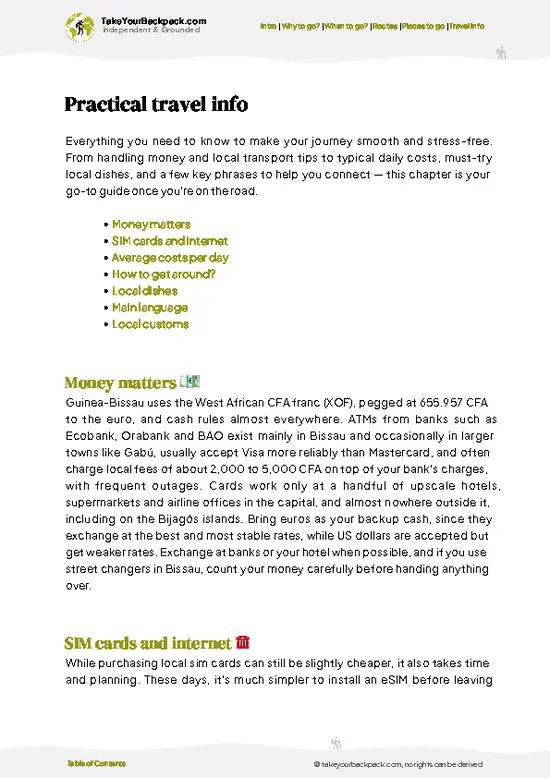
example page 0 from our offline Travel Guide for Guinea-Bissau
example page 1 from our offline Travel Guide for Guinea-Bissau
example page 2 from our offline Travel Guide for Guinea-Bissau
example page 3 from our offline Travel Guide for Guinea-Bissau
example page 4 from our offline Travel Guide for Guinea-Bissau
example page 5 from our offline Travel Guide for Guinea-Bissau
example page 6 from our offline Travel Guide for Guinea-Bissau
example page 7 from our offline Travel Guide for Guinea-Bissau
Loading the map 🌍
CLICK TO FILTER
cities
towns
national parks
beaches
attractions
festivals
regions
SHOW COUNTRY’S BESTSHOW ALL

✨ Why go?
Ranked #7 attraction in Guinea-Bissau
Reasons people choose to visit here

Palácio Presidencial gives you the clearest view of how Guinea-Bissau’s politics and history have left marks on its capital. Go for the 1998 to 1999 war scars that still show on neighboring buildings, and for the way a seat of power sits in the middle of ordinary life, with no tourist crowd between you and it. It is a short, free stop that makes the rest of Bissau easier to read. Pair it with the Pidjiguiti memorial and the old Portuguese quarter, and you get a compact lesson in independence struggle, Amílcar Cabral’s legacy and the country’s unsteady decades since. For a backpacker, the value is context: you arrive at the markets, the port and the music bars knowing what the city has lived through. It also suits first-timers, because it is easy to reach on foot or by a short taxi ride and needs no guide.

💡 HighlightsPlaces and moments you shouldn't skip

  1. The palace facade: the main reason to come. Look at the pale colonial lines, the gate and the damage left from the late-1990s fighting.
  2. War-scarred surroundings: nearby ministries and walls still carry shell and bullet marks, so the whole block works as an open-air history exhibit.
  3. Avenida Amílcar Cabral approach: the broad avenue gives the best angle for photos from a respectful distance, with trees offering shade.
  4. Pidjiguiti memorial: close to the port, it marks the 1959 dockworkers’ strike killings that pushed the independence movement toward armed struggle.
  5. Old Portuguese center: a walk through faded arcades, pastel facades and the cathedral gives the palace its setting.
  6. Street life at the edges: food sellers, moto-taxi drivers and shoe repairers give you the human texture, plus a chance to
… read more 👉
  1. The palace facade: the main reason to come. Look at the pale colonial lines, the gate and the damage left from the late-1990s fighting.
  2. War-scarred surroundings: nearby ministries and walls still carry shell and bullet marks, so the whole block works as an open-air history exhibit.
  3. Avenida Amílcar Cabral approach: the broad avenue gives the best angle for photos from a respectful distance, with trees offering shade.
  4. Pidjiguiti memorial: close to the port, it marks the 1959 dockworkers’ strike killings that pushed the independence movement toward armed struggle.
  5. Old Portuguese center: a walk through faded arcades, pastel facades and the cathedral gives the palace its setting.
  6. Street life at the edges: food sellers, moto-taxi drivers and shoe repairers give you the human texture, plus a chance to try grilled snacks.
All of it fits comfortably into two to three hours on foot.
Spotted a mistake or missing something? Contact us.

🌤️ When to go?Weather, crowds, and seasonal trade-offs

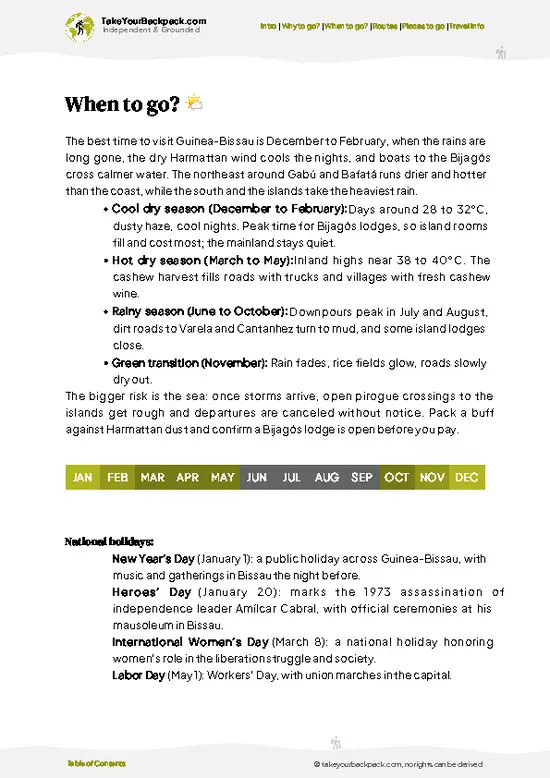
  • Dry Season (November to May): Almost no rain, sunny skies, and highs of 30 to 35°C (86 to 95°F), with cooler mornings near 20°C (68°F) from December to February. This is the easiest window for walking Bissau’s old center, and the ruined palace area photographs well in clear light.
  • Hot Build-Up (April to May): Humidity climbs and afternoons feel heavy, so do your walking before 10 am.
  • Rainy Season (June to October): Daily downpours, 25 to 31°C (77 to 88°F), and flooded streets, with the heaviest rain in July and August. Photos turn gray and sticky, but guesthouse prices stay low.
  • Carnival (February or March): Bissau fills with parades and music, and rooms get scarce and pricier.
Check the carnival dates before booking, and also confirm the political situation locally, since access around the palace can be restricted at short notice.

source: climatestotravel.comJANJanuary: excellent for travelingFEBFebruary: excellent for travelingMARMarch: excellent for travelingAPRApril: excellent for travelingMAYMay: highly recommended for travelingJUNJune: fair for travelingJULJuly: fair for travelingAUGAugust: fair for travelingSEPSeptember: fair for travelingOCTOctober: fair for travelingNOVNovember: highly recommended for travelingDECDecember: excellent for traveling
when-to-go

✈️ The backpacker research shortcutGuinea-Bissau Travel Guide

An offline-friendly backpacking guide with optimized travel routes, ranked highlights, transport advice, and the best areas to stay.
example page 0 from our offline Travel Guide for Guinea-Bissau
example page 1 from our offline Travel Guide for Guinea-Bissau
example page 2 from our offline Travel Guide for Guinea-Bissau
example page 3 from our offline Travel Guide for Guinea-Bissau
example page 4 from our offline Travel Guide for Guinea-Bissau
example page 5 from our offline Travel Guide for Guinea-Bissau
example page 6 from our offline Travel Guide for Guinea-Bissau
example page 7 from our offline Travel Guide for Guinea-Bissau
The digital guide (214 pages) contains:
✅ 48 highlights, ranked by travel appeal
✅ Optimized 2, 3 & 5-day travel routes
✅ Cities, national parks, landmarks, beaches
✅ How to get around
✅ Offline-friendly for travel without Wi-Fi
👉 Click to see all 30+ guide features

📅 Plan smarter in minutes, not weeks
✅ Month by month travel advice
✅ Festivals & national holidays
✅ Budget expectations

🗺️ Go to the right places, skip the overrated ones
✅ Honest pros & cons of destinations
✅ Top hikes, parks & viewpoints
✅ Lesser-known places most travelers miss
✅ Clear “worth it vs skip it” guidance

🛏️ Travel smoothly without rookie mistakes
✅ Best areas to stay
✅ Transport systems explained simply
✅ Common scams & safety advice
✅ SIM cards, money & practical tips

🌍 Understand the country, not just visit it
✅ Culture & traditions
✅ 52 Essential phrases & customs
✅ Festivals worth planning around
✅ Traveler-friendly historical context
✅ Insights that make places more meaningful

📱 Built for real travel conditions
✅ Fully downloadable PDF
✅ Works completely offline
✅ Optimized for phone use
✅ Useful in remote areas & buses
✅ Everything in one place
Stop searching, start planning
Get instant access to your full guide. 30‑day money-back guarantee.
+ Add another guide for just

By proceeding you agree to our terms.
Sent to your inbox immediately after payment • 100% Secure Checkout
Best Backpacking Travel Advisor 2025 tourism awardBest Backpacking
Travel Advisor
2025
What others say about Take Your Backpack Guides:
⭐⭐⭐⭐⭐
Fantastic, amazing amount of information!
⭐⭐⭐⭐⭐
My goodness this is amazing, it's what I've been looking for hats off too you!
⭐⭐⭐⭐⭐
I think this is absolutely BRILLIANT
⭐⭐⭐⭐
Very complete and informative. It's still missing places, but I gotta to commend you
⭐⭐⭐⭐⭐
This is truly amazing, thank you, can't wait to explore it with my kids!
⭐⭐⭐⭐⭐
Awesome resource, thank you!
⭐⭐⭐⭐⭐
This is amazing! Can't wait to explore the ones I haven't seen
⭐⭐⭐⭐
I love this! Well done, great idea.
⭐⭐⭐⭐⭐
Thanks for taking the time to make this gem!
⭐⭐⭐⭐⭐
This might be the best website I've ever seen.
⭐⭐⭐⭐⭐
Congratulations, and thank you so much for your work; it's incredibly valuable.
⭐⭐⭐⭐
In all seriousness I think you did a great job pointing out the important spots
⭐⭐⭐⭐⭐
10/10 very good
⭐⭐⭐⭐⭐
As someone who's only just starting to visit regularly this is awesome, thank you.
⭐⭐⭐⭐
Thank you very much! I'm going to visit my dad, it's going to be very useful!
⭐⭐⭐⭐⭐
This is really cool! We'll be travelling for the first time and this definitely come in handy.
⭐⭐⭐⭐⭐
You are now our minister of culture, congratulations 👨‍💼
⭐⭐⭐⭐⭐
Just wanted to tell you that this is a pearl! Going to follow your recommendations.
⭐⭐⭐⭐⭐
This is so cool. I'll definitely be using the resource for my travels soon.
⭐⭐⭐⭐⭐
This is very impressive! Good work.
⭐⭐⭐⭐⭐
This is an amazing and informative site. Very well done!

🛏️ Where to stay?Choosing the right base

The best base for the palace is central Bissau, around the old Bissau Velho quarter and the Avenida Amílcar Cabral, both within a 10 to 20 minute walk of the Palácio Presidencial. This is where the few backpacker-friendly guesthouses and small pensions cluster, so you can walk to the riverfront, the Pidjiguiti memorial, and the main market without taxis. Evenings here have open-air bars and grilled-food stalls, and you will meet other travelers, aid workers, and local students rather than tour groups.

The Bairro d’Ajuda and Chão de Papel areas, a short taxi hop away, suit you if you want quieter … read more 👉
The best base for the palace is central Bissau, around the old Bissau Velho quarter and the Avenida Amílcar Cabral, both within a 10 to 20 minute walk of the Palácio Presidencial. This is where the few backpacker-friendly guesthouses and small pensions cluster, so you can walk to the riverfront, the Pidjiguiti memorial, and the main market without taxis. Evenings here have open-air bars and grilled-food stalls, and you will meet other travelers, aid workers, and local students rather than tour groups.

The Bairro d’Ajuda and Chão de Papel areas, a short taxi hop away, suit you if you want quieter streets and slightly lower prices, though nightlife is thinner and you will want a ride after dark. Expect dorm-style options to be rare, so budget travelers often share a double room. Choose a place with a generator or reliable backup power, as outages are common. Stay off unlit side streets late at night, and arrange taxis through your guesthouse. Photography near government buildings is sensitive, so ask before pointing a camera at the palace.

👛 Costs (as of 22 October 2026)Money, prices, and spending tips

Palácio Presidencial can be seen from the outside for free, and a realistic backpacker day in Bissau costs about €33 to 45. The building is a working government site and a war-damaged ruin in parts, so there is no regular ticket office. Travelers pay in West African CFA francs, and cash is the norm.
CategoryBudget RangeLocal Reality
Entrance€0Viewing from the street is free. Interior access is not routinely offered.
Accommodation (low season)€14 to 22Basic guesthouse double, often with fan only.
Accommodation (high season)€18 to 28Rooms fill during carnival and dry-season events.
Local transport€1 to 4Shared taxis charge a flat fare per ride, and a private taxi across town costs more.
Food€5 to 9Rice and fish plates at local eateries, with coffee or bissap juice extra.
Guide or fixer€0 to 6Optional,
… read more 👉
Palácio Presidencial can be seen from the outside for free, and a realistic backpacker day in Bissau costs about €33 to 45. The building is a working government site and a war-damaged ruin in parts, so there is no regular ticket office. Travelers pay in West African CFA francs, and cash is the norm.
CategoryBudget RangeLocal Reality
Entrance€0Viewing from the street is free. Interior access is not routinely offered.
Accommodation (low season)€14 to 22Basic guesthouse double, often with fan only.
Accommodation (high season)€18 to 28Rooms fill during carnival and dry-season events.
Local transport€1 to 4Shared taxis charge a flat fare per ride, and a private taxi across town costs more.
Food€5 to 9Rice and fish plates at local eateries, with coffee or bissap juice extra.
Guide or fixer€0 to 6Optional, useful for context on the independence history nearby.
Total Daily Budget€33 to 45Based on high-season accommodation and mid-range eating.


source: presidencia.gw
⚠️ Prices can change and everyone travels differently, so take this as a rough guide. Hope it helps you plan your adventure!

FAQCommon questions from travelers

Plan on 30 minutes to an hour for Palácio Presidencial itself, since you mostly view it from outside. Combine it with the nearby Pidjiguiti memorial and the old Bissau Velho quarter, and a relaxed half day covers everything within walking distance.
Palácio Presidencial charges nothing to look at from the street, so the question is about time rather than money. It is worth a short stop for the colonial-era architecture and its role in the country’s political history. Expect to see the exterior only, and photograph carefully because it is a sensitive government site.
Palácio Presidencial sits in central Bissau, reachable on foot from Avenida Amílcar Cabral or the old town in 10 to 20 minutes. Shared taxis around the city cost roughly €0.30 to 0.80, and a private taxi from Osvaldo Vieira International Airport takes about 15 to 25 minutes for around €5 to 8. Agree on the fare before getting in.
⚠️ Things can change over time, so always validate details locally before you go.

Other Bissau-Guinean attractions near Palácio Presidencial

Explore more nearby:


💡 Not sure where to go next?
Create a personalized itinerary for Guinea-Bissau including Palácio Presidencial and the places that fit your trip.

Generate my itinerary

👉 Discover all attractions

Or checkout all Guinea-Bissau has to offer (think cities, towns, villages, national parks, hikes, beaches, festivals)
Country photo of Guinea-Bissau

We 💚 feedbackIs it worth it?

Palácio Presidencial needs about thirty minutes on its own, so fold it into a half-day city walk rather than a dedicated trip. I would go in the morning, ask before photographing, and keep your phone tucked away near the gate. Spend the rest of the day on the port and markets.

✍️ Help improve this page!
The information on this page is based on in-depth research, insights shared by experienced travelers, and feedback from the local travel community in Guinea-Bissau. While every effort is made to keep the information accurate and current, conditions can change — so if you spot anything incorrect or outdated, please get in touch.


🙋‍♂️ Give feedback

👋 Meet the founderWho’s Behind Take Your Backpack?

Johan, backpacker and founder of TakeYourBackpackHi, I’m Johan (Netherlands 🇳🇱), the creator of TakeYourBackpack. Over the past 3 decades, I’ve backpacked through 90+ countries across six continents, gaining extensive experience with independent travel, long-term trips, and overland routes.

This site is built on a combination of firsthand travel experience and carefully curated insights from other backpackers. Many guides are based on places I’ve personally visited, while others bring together tips, observations, and practical advice shared by trusted travelers I’ve met along the way.

The goal is to provide realistic, experience-driven guidance — not generic itineraries — so you can explore destinations with better context, clearer expectations, and more confidence.