
×

Guinea-Bissau🇬🇼 | beachesPraia de BubaqueWorking port, fish landing, Praia Bruce nearby, island market | things to do and best time to go

Explore Ponta de São JoãoExplore Praia de Orango

Backpacking in Praia de Bubaque
🏆 Top pickbeach ranked #1
By Johan Kruseman 🇳🇱 | Updated October 22, 2026

The sand at Praia de Bubaque sits beside a working port and fish landing, and the island’s postcard beaches are a short ride away. You’ll find it on Bubaque island in the Bijagós archipelago, off the southwest coast of Guinea-Bissau. Expect gray-gold sand with drifts of shell, boat hulls pulled up on the shore, mangrove mud smells at low tide, and the diesel rattle of arriving boats. Swimming is fine at high tide but patchy when the water pulls far out. Crowds are rare, since few travelers reach the islands, though the main town brings generators, motorbike taxis and a pricey feel to anything imported. Snorkel and dive potential is limited here, and there is no surf. What you get is warm light on palms, cashew trees behind the beach, grilled fish and rice in simple eateries, and basic guesthouses. It suits patient, self-sufficient travelers who like raw places. It won’t suit anyone wanting resort comforts or polished sand.

Discover everything you want to know in the 📖 Guinea-Bissau Travel Guide.


example page 0 from our offline Travel Guide for Guinea-Bissau
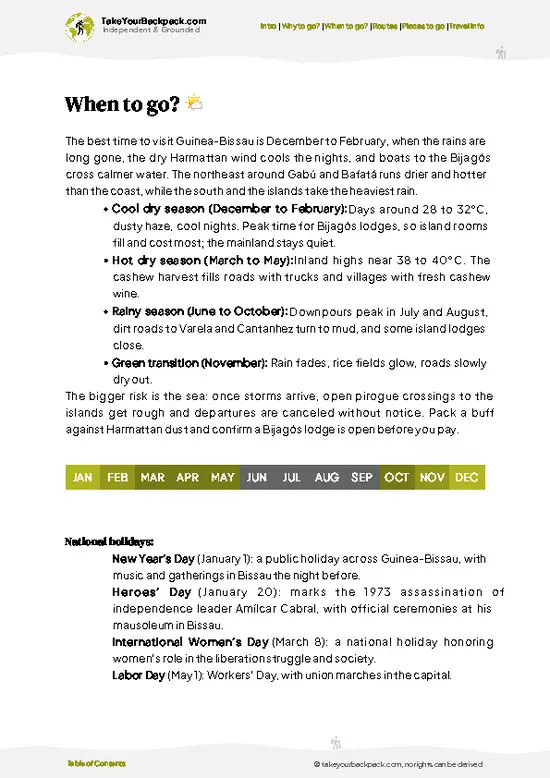
example page 1 from our offline Travel Guide for Guinea-Bissau
example page 2 from our offline Travel Guide for Guinea-Bissau
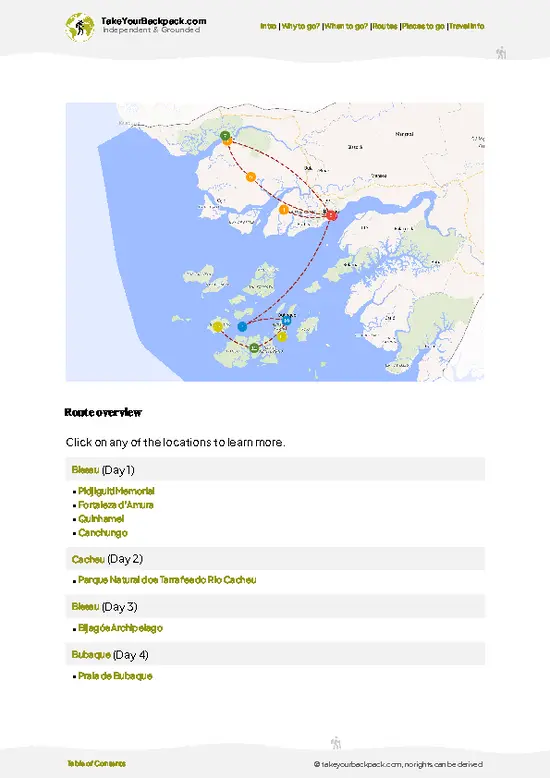
example page 3 from our offline Travel Guide for Guinea-Bissau
example page 4 from our offline Travel Guide for Guinea-Bissau
example page 5 from our offline Travel Guide for Guinea-Bissau
example page 6 from our offline Travel Guide for Guinea-Bissau
example page 7 from our offline Travel Guide for Guinea-Bissau
Loading the map 🌍
CLICK TO FILTER
cities
towns
national parks
beaches
attractions
festivals
regions
SHOW COUNTRY’S BESTSHOW ALL

✨ Why go?
Ranked #1 beach in Guinea-Bissau
The unique appeal for travelers

Praia de Bubaque is the gateway to the Bijagós, and that is the main reason backpackers stop here. Boats from Bissau land at its shore, so you arrive by water, step onto the sand, and find the island’s main town within walking distance. Few other places in the country let you reach an archipelago this easily without a private charter.

The second pull is the social scene, which is small and unforced. Guesthouse porches, a handful of simple restaurants and the evening gathering at the port mean you meet other travelers, aid workers and locals without trying. Conversations tend to turn into shared plans for the neighboring Bijagós islands, some with sacred forests and traditions of the Bijagó people that still shape daily life.

It also works as a pause. After the heat and noise of the mainland, … read more 👉
Praia de Bubaque is the gateway to the Bijagós, and that is the main reason backpackers stop here. Boats from Bissau land at its shore, so you arrive by water, step onto the sand, and find the island’s main town within walking distance. Few other places in the country let you reach an archipelago this easily without a private charter.

The second pull is the social scene, which is small and unforced. Guesthouse porches, a handful of simple restaurants and the evening gathering at the port mean you meet other travelers, aid workers and locals without trying. Conversations tend to turn into shared plans for the neighboring Bijagós islands, some with sacred forests and traditions of the Bijagó people that still shape daily life.

It also works as a pause. After the heat and noise of the mainland, a few slow days here cost little, with fish, rice and cold drinks on offer. From here you can hire a motorbike or bicycle to Praia Bruce for cleaner swimming, then arrange a boat onward. For a country with few beach hubs, this is the one that connects the rest.

💡 HighlightsEssential experiences to have while visiting Praia de Bubaque

  1. The Praia de Bubaque waterfront: This is the place to watch the island’s real routine. Dugout canoes and fishing boats come in, women sort the catch on the sand, and passenger boats from the mainland unload crates, bicycles and backpacks. At low tide the flats stretch wide and the mangrove smell drifts in. It is better for people-watching than swimming, and late afternoon gives the softest light.
  2. Praia Bruce: A short ride from town, this is where most travelers go for a proper beach day. Palms and cashew trees line a quieter, cleaner stretch of sand, and the water is better for floating and swimming than at the port. Bring your own water and snacks, because facilities are minimal.
  3. Bubaque town market: Stalls sell fruit, dried fish, cashew nuts, palm oil and everyday goods carried over from the
… read more 👉
  1. The Praia de Bubaque waterfront: This is the place to watch the island’s real routine. Dugout canoes and fishing boats come in, women sort the catch on the sand, and passenger boats from the mainland unload crates, bicycles and backpacks. At low tide the flats stretch wide and the mangrove smell drifts in. It is better for people-watching than swimming, and late afternoon gives the softest light.
  2. Praia Bruce: A short ride from town, this is where most travelers go for a proper beach day. Palms and cashew trees line a quieter, cleaner stretch of sand, and the water is better for floating and swimming than at the port. Bring your own water and snacks, because facilities are minimal.
  3. Bubaque town market: Stalls sell fruit, dried fish, cashew nuts, palm oil and everyday goods carried over from the mainland. It is small and unhurried, and it is the easiest way to taste local produce at low cost. Look for handmade crafts and Bijagó carvings and masks, and ask before photographing anyone.
  4. Cycling or motorbike rides through island villages: Sandy tracks run inland from the beach through palm groves, rice fields and small villages. Hiring a bicycle or a motorbike taxi gives you the island’s green interior in a few hours. The paths are shaded and flat enough for most fitness levels, and children often wave you along.
  5. Boat trips to nearby Bijagós islands: From the beach you can arrange a boat to neighboring islands such as Rubane, with emptier sand, birdlife and fishing villages. Some islands hold sacred sites where visitors need local permission or a guide, so go with a boatman who knows the rules. Seas can be rough, so keep your gear in dry bags.
For a first visit, start with the Praia de Bubaque waterfront at the end of the day, then head to Praia Bruce the next morning.
Spotted a mistake or missing something? Contact us.

🌤️ When to go?When to go for the best experience

  • Dry Season (November to May): Bubaque has its most reliable beach weather from late November to April, with almost no rain, sunny skies and highs of 29 to 33°C (84 to 91°F). Nights drop to 21 to 24°C (70 to 75°F). Days run about 11 to 12 hours of light.
  • Early Dry Season (December to February): The air is softer and the harmattan haze can dull the horizon. This is when the few foreign visitors and Bissau weekenders arrive, and fishing and birding trips are easiest to arrange.
  • Hot Months (March to May): Humidity creeps up and midday heat of 32 to 35°C (90 to 95°F) pushes you into the shade. Rates stay flat because the island never gets truly busy.
  • Rainy Season (June to October): Heavy downpours and storms, with 27 to 31°C (81 to 88°F) and thick humidity. Seas get rougher, boat crossings from Bissau
… read more 👉
  • Dry Season (November to May): Bubaque has its most reliable beach weather from late November to April, with almost no rain, sunny skies and highs of 29 to 33°C (84 to 91°F). Nights drop to 21 to 24°C (70 to 75°F). Days run about 11 to 12 hours of light.
  • Early Dry Season (December to February): The air is softer and the harmattan haze can dull the horizon. This is when the few foreign visitors and Bissau weekenders arrive, and fishing and birding trips are easiest to arrange.
  • Hot Months (March to May): Humidity creeps up and midday heat of 32 to 35°C (90 to 95°F) pushes you into the shade. Rates stay flat because the island never gets truly busy.
  • Rainy Season (June to October): Heavy downpours and storms, with 27 to 31°C (81 to 88°F) and thick humidity. Seas get rougher, boat crossings from Bissau can be bumpy or canceled, and some lodges close. Rooms are easier to haggle, but the sand is often gray and overcast.
Book the ferry a day ahead around Christmas and Carnival in February, when locals travel home to the islands.


source: climatestotravel.comJANJanuary: excellent for travelingFEBFebruary: excellent for travelingMARMarch: excellent for travelingAPRApril: excellent for travelingMAYMay: highly recommended for travelingJUNJune: fair for travelingJULJuly: below average for travelingAUGAugust: below average for travelingSEPSeptember: fair for travelingOCTOctober: fair for travelingNOVNovember: highly recommended for travelingDECDecember: excellent for traveling
when-to-go

✈️ The backpacker research shortcutGuinea-Bissau Travel Guide

An offline-friendly backpacking guide with optimized travel routes, ranked highlights, transport advice, and the best areas to stay.
example page 0 from our offline Travel Guide for Guinea-Bissau
example page 1 from our offline Travel Guide for Guinea-Bissau
example page 2 from our offline Travel Guide for Guinea-Bissau
example page 3 from our offline Travel Guide for Guinea-Bissau
example page 4 from our offline Travel Guide for Guinea-Bissau
example page 5 from our offline Travel Guide for Guinea-Bissau
example page 6 from our offline Travel Guide for Guinea-Bissau
example page 7 from our offline Travel Guide for Guinea-Bissau
The digital guide (214 pages) contains:
✅ 48 highlights, ranked by travel appeal
✅ Optimized 2, 3 & 5-day travel routes
✅ Cities, national parks, landmarks, beaches
✅ How to get around
✅ Offline-friendly for travel without Wi-Fi
👉 Click to see all 30+ guide features

📅 Plan smarter in minutes, not weeks
✅ Month by month travel advice
✅ Festivals & national holidays
✅ Budget expectations

🗺️ Go to the right places, skip the overrated ones
✅ Honest pros & cons of destinations
✅ Top hikes, parks & viewpoints
✅ Lesser-known places most travelers miss
✅ Clear “worth it vs skip it” guidance

🛏️ Travel smoothly without rookie mistakes
✅ Best areas to stay
✅ Transport systems explained simply
✅ Common scams & safety advice
✅ SIM cards, money & practical tips

🌍 Understand the country, not just visit it
✅ Culture & traditions
✅ 52 Essential phrases & customs
✅ Festivals worth planning around
✅ Traveler-friendly historical context
✅ Insights that make places more meaningful

📱 Built for real travel conditions
✅ Fully downloadable PDF
✅ Works completely offline
✅ Optimized for phone use
✅ Useful in remote areas & buses
✅ Everything in one place
Stop searching, start planning
Get instant access to your full guide. 30‑day money-back guarantee.
+ Add another guide for just

By proceeding you agree to our terms.
Sent to your inbox immediately after payment • 100% Secure Checkout
Best Backpacking Travel Advisor 2025 tourism awardBest Backpacking
Travel Advisor
2025
What others say about Take Your Backpack Guides:
⭐⭐⭐⭐⭐
Fantastic, amazing amount of information!
⭐⭐⭐⭐⭐
My goodness this is amazing, it's what I've been looking for hats off too you!
⭐⭐⭐⭐⭐
I think this is absolutely BRILLIANT
⭐⭐⭐⭐
Very complete and informative. It's still missing places, but I gotta to commend you
⭐⭐⭐⭐⭐
This is truly amazing, thank you, can't wait to explore it with my kids!
⭐⭐⭐⭐⭐
Awesome resource, thank you!
⭐⭐⭐⭐⭐
This is amazing! Can't wait to explore the ones I haven't seen
⭐⭐⭐⭐
I love this! Well done, great idea.
⭐⭐⭐⭐⭐
Thanks for taking the time to make this gem!
⭐⭐⭐⭐⭐
This might be the best website I've ever seen.
⭐⭐⭐⭐⭐
Congratulations, and thank you so much for your work; it's incredibly valuable.
⭐⭐⭐⭐
In all seriousness I think you did a great job pointing out the important spots
⭐⭐⭐⭐⭐
10/10 very good
⭐⭐⭐⭐⭐
As someone who's only just starting to visit regularly this is awesome, thank you.
⭐⭐⭐⭐
Thank you very much! I'm going to visit my dad, it's going to be very useful!
⭐⭐⭐⭐⭐
This is really cool! We'll be travelling for the first time and this definitely come in handy.
⭐⭐⭐⭐⭐
You are now our minister of culture, congratulations 👨‍💼
⭐⭐⭐⭐⭐
Just wanted to tell you that this is a pearl! Going to follow your recommendations.
⭐⭐⭐⭐⭐
This is so cool. I'll definitely be using the resource for my travels soon.
⭐⭐⭐⭐⭐
This is very impressive! Good work.
⭐⭐⭐⭐⭐
This is an amazing and informative site. Very well done!

🛏️ Where to stay?Best areas and accommodation options

The village of Bubaque itself is the best place to sleep, because it holds the island’s only real cluster of budget beds, restaurants and the port. Expect basic guesthouse rooms for about €15 to 35 a night, usually with a fan and sometimes cold water. Staying here puts you within a 10 to 20 minute walk of the sand and means you can eat out, change money at the few shops and meet the handful of other travelers who pass through, mostly aid workers, anglers and backpackers working through the Bijagós. Evenings center on a couple of open-air bars near the waterfront, which is the easiest way to find … read more 👉
The village of Bubaque itself is the best place to sleep, because it holds the island’s only real cluster of budget beds, restaurants and the port. Expect basic guesthouse rooms for about €15 to 35 a night, usually with a fan and sometimes cold water. Staying here puts you within a 10 to 20 minute walk of the sand and means you can eat out, change money at the few shops and meet the handful of other travelers who pass through, mostly aid workers, anglers and backpackers working through the Bijagós. Evenings center on a couple of open-air bars near the waterfront, which is the easiest way to find boat-sharing partners for trips to neighboring islands.

The beach strip toward Praia Bruce and the quieter coast south of the village is the alternative if you want more space. Small lodges and campements here sit directly behind the sand, with palm shade and little noise beyond waves and birds. They cost more, around €30 to 60 a night, and meals are usually set menus, so you are socializing with the lodge rather than the town. Distances are walkable or a short moto-taxi ride of about €1 to 3. Solo travelers will find the village easier for company, while couples and anyone wanting calm tend to prefer the beachfront lodges.

🛡️ SafetySafety Tips and Common Scams in Praia de Bubaque

Praia de Bubaque is a calm, low-key beach where the main concerns are sun and tides rather than crime. Swimming is generally easy because the Bijagós archipelago shelters the coast from big ocean swell, and waves are small. Tides do move a lot, though, and at low tide the water pulls back across wide flats, so plan swims around high water and watch for soft mud underfoot. Currents can run strongly in channels between islands, so stay close to shore. There are no lifeguards or flag systems, and locals swim near the village in the morning and late afternoon. Stingrays are possible in shallows, so shuffle your feet when wading. Midday sun is fierce year-round, so bring a hat and reef-safe sunscreen and carry water. Theft is uncommon, but keep phones and cash out of sight when you leave belongings … read more 👉
Praia de Bubaque is a calm, low-key beach where the main concerns are sun and tides rather than crime. Swimming is generally easy because the Bijagós archipelago shelters the coast from big ocean swell, and waves are small. Tides do move a lot, though, and at low tide the water pulls back across wide flats, so plan swims around high water and watch for soft mud underfoot. Currents can run strongly in channels between islands, so stay close to shore. There are no lifeguards or flag systems, and locals swim near the village in the morning and late afternoon. Stingrays are possible in shallows, so shuffle your feet when wading. Midday sun is fierce year-round, so bring a hat and reef-safe sunscreen and carry water. Theft is uncommon, but keep phones and cash out of sight when you leave belongings on the sand. Walking back to the village after dark is normally fine, though a flashlight helps on unlit paths.

FAQTraveler FAQ

Praia de Bubaque lies on Bubaque island in the Bijagós archipelago, reached by boat from Bissau. The public ferry takes roughly 3 to 5 hours and runs a few times a week, with tickets about €10 to 20, while faster private speedboats take 1.5 to 2 hours for roughly €25 to 40 each way. From the port in Bubaque village, the beach is a 10 to 20 minute walk or a short moto-taxi ride for about €1 to 2.
Praia de Bubaque is best for swimming and relaxed beach time, with warm, shallow water that is usually calm in the dry season from November to May. There is no real surf because the archipelago blocks ocean swell, and there are no board rentals. Snorkeling is limited near the village, with better visibility on boat trips to neighboring islands such as Rubane or Soga, which cost around €30 to 60 per boat shared among a group.
Praia de Bubaque is free to enter, since it is a public stretch of sand with no gate or ticket. The only mandatory cost for the wider archipelago is the Bijagós protected area permit, which is often collected for visits to certain islands and typically runs about €5 to 15. Sunbeds are rare, and a cold drink at a beachside bar costs roughly €1 to 2.
⚠️ Things can change over time, so always validate details locally before you go.

Other Bissau-Guinean beaches near Praia de Bubaque

Explore more nearby:

  • Praia de Rubane—quiet coves, eco-lodges, forest edge, calm waters| 16 km away
  • Praia de Orango—wild mangroves, saltwater lagoons, hippo habitat, broad tidal flats| 40 km away
  • Varela Beach—long open shore, casuarina trees, sand dunes, border proximity| 145 km away

💡 Not sure where to go next?
Create a personalized itinerary for Guinea-Bissau including Praia de Bubaque and the places that fit your trip.

Generate my itinerary

👉 Discover all beaches

Or checkout all Guinea-Bissau has to offer (think cities, towns, villages, national parks, hikes, beaches, festivals)
Country photo of Guinea-Bissau

We 💚 feedbackSumming up the experience

Praia de Bubaque is at its best in the dry months, roughly November to May, when the sky stays clear and the sea calms. Go in late afternoon, when the boats come in and the heat finally loosens. I would bring cash, a dry bag and patience, because schedules here follow the tide, not a timetable.

✍️ Help improve this page!
The information on this page is based on in-depth research, insights shared by experienced travelers, and feedback from the local travel community in Guinea-Bissau. While every effort is made to keep the information accurate and current, conditions can change — so if you spot anything incorrect or outdated, please get in touch.


🙋‍♂️ Give feedback

👋 Meet the founderWho’s Behind Take Your Backpack?

Johan, backpacker and founder of TakeYourBackpackHi, I’m Johan (Netherlands 🇳🇱), the creator of TakeYourBackpack. Over the past 3 decades, I’ve backpacked through 90+ countries across six continents, gaining extensive experience with independent travel, long-term trips, and overland routes.

This site is built on a combination of firsthand travel experience and carefully curated insights from other backpackers. Many guides are based on places I’ve personally visited, while others bring together tips, observations, and practical advice shared by trusted travelers I’ve met along the way.

The goal is to provide realistic, experience-driven guidance — not generic itineraries — so you can explore destinations with better context, clearer expectations, and more confidence.