
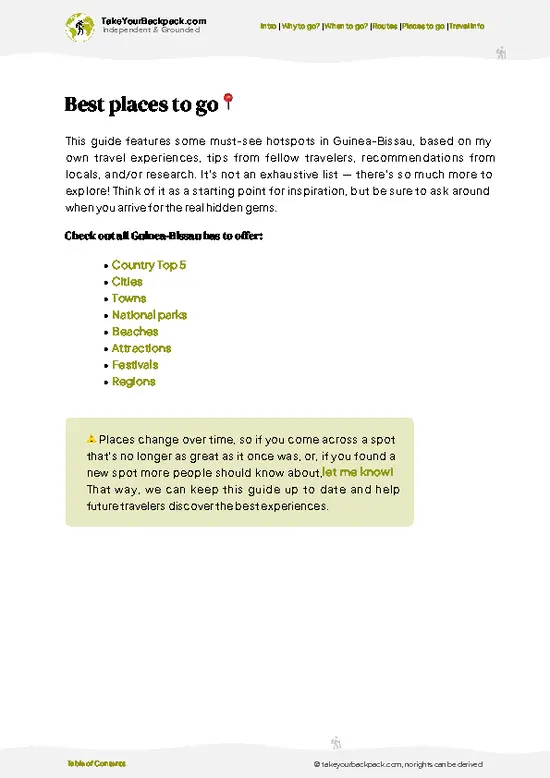
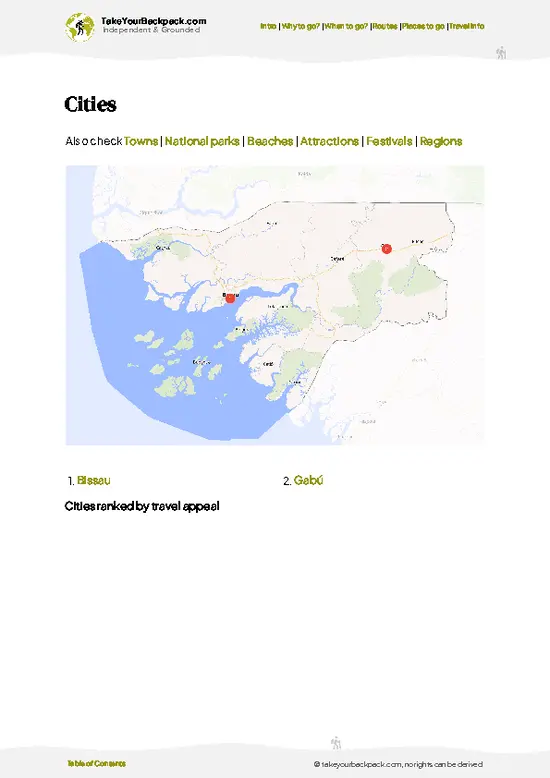
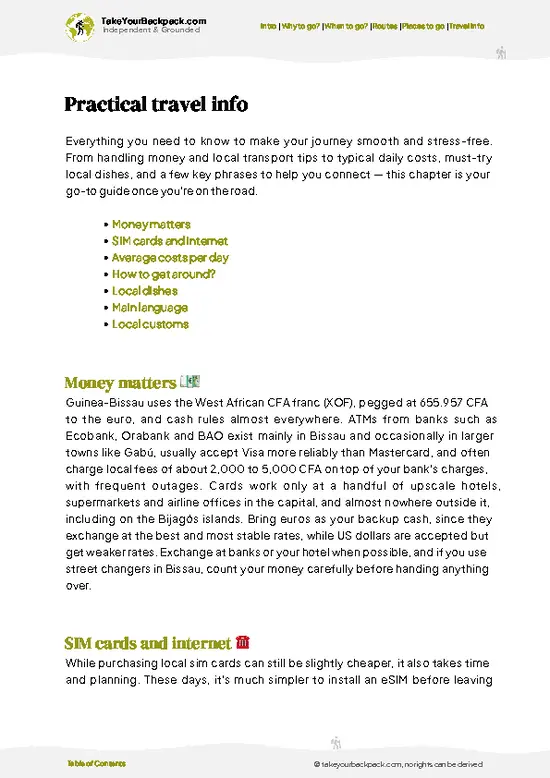
×

Guinea-Bissau🇬🇼 | beachesPraia de RubaneEmpty shoreline, wading birds, tidal flats, barracuda waters | things to do and best time to go

Explore Praia de OrangoExplore Varela Beach

Backpacking in Praia de Rubane
👍 Recommendedbeach ranked #3
By Johan Kruseman 🇳🇱 | Updated October 22, 2026

You will likely have Praia de Rubane almost to yourself, which is the main reason to make the effort. It sits on Rubane island in the Bijagós archipelago of Guinea-Bissau, just north of Bubaque. Getting there takes a boat and some patience, and nothing is waiting on arrival: no beach bars, no loungers, no surf school. The sand is pale and coarse, backed by palms and low bush, and the tide pulls the water far out, leaving wet flats that shine in the afternoon glare and hum with wading birds. Swimming is pleasant at high tide, but at low tide you wade a long way over soft bottom. Snorkeling is poor, and surf is flat. Food and beds are basic and limited, so you bring supplies and plan ahead. In return you get quiet, with only wind in the palms and the odd pirogue engine, and tracks of crabs zigzagging across the damp sand at dawn.

Part of Backpacking in Guinea-Bissau: all 40 places on one map, with routes and the best time to go.
Discover everything you want to know in the 📖 Guinea-Bissau Travel Guide.
Loading the map 🌍
CLICK TO FILTER
cities
towns
national parks
beaches
attractions
festivals
regions
SHOW COUNTRY’S BESTSHOW ALL

✨ Why go?
Ranked #3 beach in Guinea-Bissau
What sets this place apart

Praia de Rubane draws backpackers who want the Bijagós without the small crowd of Bubaque. The first reason is isolation. The island is a short boat hop from the archipelago’s main hub, yet there is no town atmosphere, no hawkers and no nightlife, so a few days here feel like a real pause on an island-hopping route. The second reason is the tidal flats. At low water the exposed mud and sand fill with waders and terns, and the shallows are good for slow beachcombing, with shells, crab holes and the stranded pools where small fish wait for the tide. The third is the Bijagó communities of the archipelago, where local customs and sacred places shape what visitors may do. Ask before wandering inland or photographing people, and you will be met with courtesy. Travelers who like simple living, a … read more 👉
Praia de Rubane draws backpackers who want the Bijagós without the small crowd of Bubaque. The first reason is isolation. The island is a short boat hop from the archipelago’s main hub, yet there is no town atmosphere, no hawkers and no nightlife, so a few days here feel like a real pause on an island-hopping route. The second reason is the tidal flats. At low water the exposed mud and sand fill with waders and terns, and the shallows are good for slow beachcombing, with shells, crab holes and the stranded pools where small fish wait for the tide. The third is the Bijagó communities of the archipelago, where local customs and sacred places shape what visitors may do. Ask before wandering inland or photographing people, and you will be met with courtesy. Travelers who like simple living, a hammock, a book and an unhurried boat ride to the next island will find Praia de Rubane a good connector between Bubaque and the quieter islands further out.

💡 HighlightsThe experiences that define the visit

  1. The long beach at low tide: The sand is firm and wide when the water drops, ideal for a long walk with nobody else in view. Look for ghost crabs, shells and the lines left by receding water.
  2. Birdwatching on the tidal flats: The exposed mud draws waders, gulls and terns in numbers, especially around the turn of the tide. Bring binoculars and sit still near the waterline.
  3. Swimming at high tide: When the water returns, the beach becomes a warm, calm place to swim. The water is cloudy rather than clear, so this is for cooling off, not for snorkeling.
  4. Sport fishing in the surrounding waters: The Bijagós are known for fishing, and the channels around Rubane hold species such as barracuda and tarpon. Local boatmen can take you out, but arrange this ahead.
  5. Pirogue trip to neighboring islands: A dugout
… read more 👉
  1. The long beach at low tide: The sand is firm and wide when the water drops, ideal for a long walk with nobody else in view. Look for ghost crabs, shells and the lines left by receding water.
  2. Birdwatching on the tidal flats: The exposed mud draws waders, gulls and terns in numbers, especially around the turn of the tide. Bring binoculars and sit still near the waterline.
  3. Swimming at high tide: When the water returns, the beach becomes a warm, calm place to swim. The water is cloudy rather than clear, so this is for cooling off, not for snorkeling.
  4. Sport fishing in the surrounding waters: The Bijagós are known for fishing, and the channels around Rubane hold species such as barracuda and tarpon. Local boatmen can take you out, but arrange this ahead.
  5. Pirogue trip to neighboring islands: A dugout or small motorboat links Rubane with Bubaque and other islands. Moving between them lets you see mangrove shores and fishing villages from the water.
Start with the low-tide walk on Praia de Rubane, because the exposed flats are at their best then and the birds and crab trails show up before the sun gets high.
Spotted a mistake or missing something? Contact us.

🌤️ When to go?When to go for the best experience

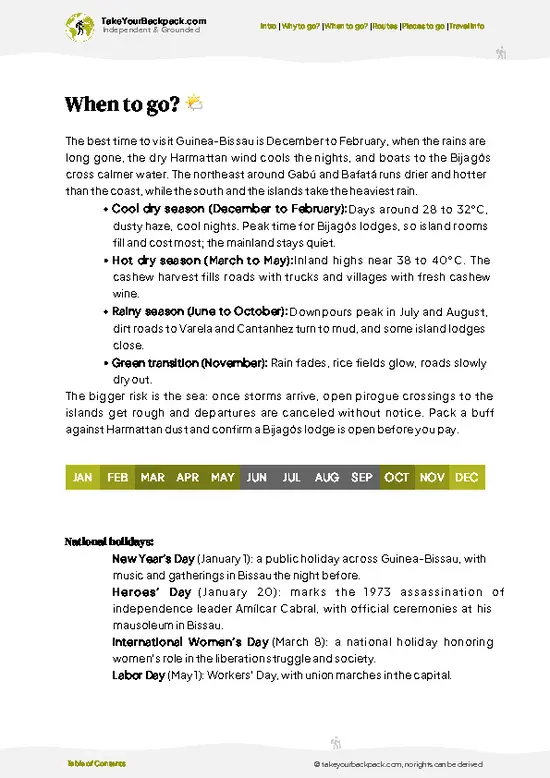
  • Dry Season (November to May): Rain is almost absent, skies stay clear and sea breezes keep the beach comfortable. Days run roughly 25 to 33°C (77 to 91°F), nights 20 to 24°C (68 to 75°F). Daylight lasts about 11 to 12 hours year-round. This is when boats run most reliably and lodge prices peak.
  • December to February: Coolest, driest stretch, with lower humidity and the easiest sea crossings. Bijagós visitors are still few, but beds fill around Christmas and New Year.
  • March to May: Heat and humidity build, with highs near 33°C (91°F). Prices ease slightly and the sand is nearly empty.
  • Rainy Season (June to October): Heavy downpours and squalls, 24 to 31°C (75 to 88°F), thick humidity and mosquitoes. Ferries get canceled in rough weather and some lodges close. Rates drop, but beach days are unpredictable.
… read more 👉
  • Dry Season (November to May): Rain is almost absent, skies stay clear and sea breezes keep the beach comfortable. Days run roughly 25 to 33°C (77 to 91°F), nights 20 to 24°C (68 to 75°F). Daylight lasts about 11 to 12 hours year-round. This is when boats run most reliably and lodge prices peak.
  • December to February: Coolest, driest stretch, with lower humidity and the easiest sea crossings. Bijagós visitors are still few, but beds fill around Christmas and New Year.
  • March to May: Heat and humidity build, with highs near 33°C (91°F). Prices ease slightly and the sand is nearly empty.
  • Rainy Season (June to October): Heavy downpours and squalls, 24 to 31°C (75 to 88°F), thick humidity and mosquitoes. Ferries get canceled in rough weather and some lodges close. Rates drop, but beach days are unpredictable.
Book the Bissau ferry and the onward boat a few days ahead in December and January, since seats are limited.


source: climatestotravel.comJANJanuary: excellent for travelingFEBFebruary: excellent for travelingMARMarch: excellent for travelingAPRApril: excellent for travelingMAYMay: highly recommended for travelingJUNJune: fair for travelingJULJuly: fair for travelingAUGAugust: fair for travelingSEPSeptember: fair for travelingOCTOctober: fair for travelingNOVNovember: highly recommended for travelingDECDecember: excellent for traveling
guinea-bissau-beach-praia-de-rubane
© Google |

✈️ The backpacker research shortcutGuinea-Bissau Travel Guide

What the free pages can't give you: ready-made routes, every place ranked, and it works offline. All in 1 guide.
example page 0 from our offline Travel Guide for Guinea-Bissau
example page 1 from our offline Travel Guide for Guinea-Bissau
example page 2 from our offline Travel Guide for Guinea-Bissau
example page 3 from our offline Travel Guide for Guinea-Bissau
example page 4 from our offline Travel Guide for Guinea-Bissau
example page 5 from our offline Travel Guide for Guinea-Bissau
example page 6 from our offline Travel Guide for Guinea-Bissau
example page 7 from our offline Travel Guide for Guinea-Bissau
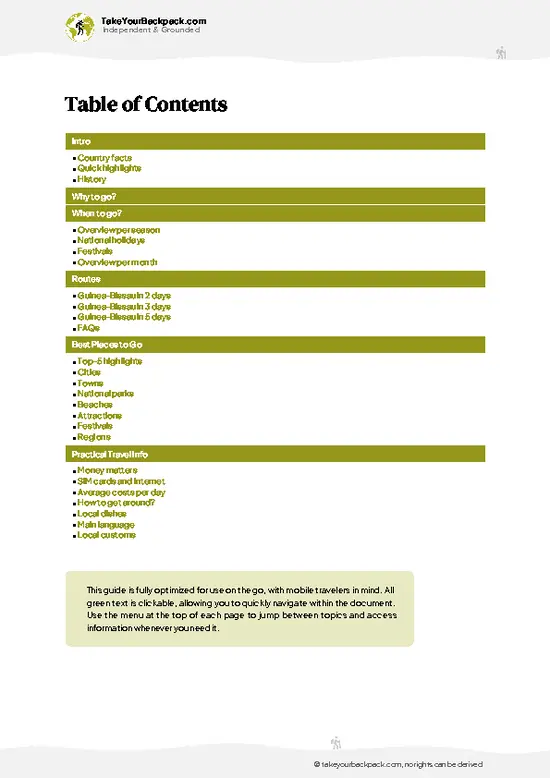
The digital guide (167 pages) contains:-page digital guide:
✅ Ready-made 2, 3 & 5-day routes
✅ All 40 places ranked, so you skip the overrated ones
✅ Works offline, all in 1 guide
✅ Cities, national parks, landmarks, beaches
✅ How to get around
👉 Click to see all 30+ guide features

📅 Plan smarter in minutes, not weeks
✅ Month by month travel advice
✅ Festivals & national holidays
✅ Budget expectations

🗺️ Go to the right places, skip the overrated ones
✅ Honest pros & cons of destinations
✅ Top hikes, parks & viewpoints
✅ Lesser-known places most travelers miss
✅ Clear “worth it vs skip it” guidance

🛏️ Travel smoothly without rookie mistakes
✅ Best areas to stay
✅ Transport systems explained simply
✅ Common scams & safety advice
✅ SIM cards, money & practical tips

🌍 Understand the country, not just visit it
✅ Culture & traditions
✅ 52 Essential phrases & customs
✅ Festivals worth planning around
✅ Traveler-friendly historical context
✅ Insights that make places more meaningful

📱 Built for real travel conditions
✅ Fully downloadable PDF
✅ Works completely offline
✅ Optimized for phone use
✅ Useful in remote areas & buses
✅ All in 1 guide
Stop searching, start planning
Get instant access to your full guide. 30‑day money-back guarantee.


By proceeding you agree to our terms.
Sent to your inbox immediately after payment • 100% Secure Checkout
Best Backpacking Travel Advisor 2025 tourism awardBest Backpacking
Travel Advisor
2025
What others say about Take Your Backpack Guides:
⭐⭐⭐⭐⭐
Fantastic, amazing amount of information!
⭐⭐⭐⭐⭐
My goodness this is amazing, it's what I've been looking for hats off too you!
⭐⭐⭐⭐⭐
I think this is absolutely BRILLIANT
⭐⭐⭐⭐
Very complete and informative. It's still missing places, but I gotta to commend you
⭐⭐⭐⭐⭐
This is truly amazing, thank you, can't wait to explore it with my kids!
⭐⭐⭐⭐⭐
Awesome resource, thank you!
⭐⭐⭐⭐⭐
This is amazing! Can't wait to explore the ones I haven't seen
⭐⭐⭐⭐
I love this! Well done, great idea.
⭐⭐⭐⭐⭐
Thanks for taking the time to make this gem!
⭐⭐⭐⭐⭐
This might be the best website I've ever seen.
⭐⭐⭐⭐⭐
Congratulations, and thank you so much for your work; it's incredibly valuable.
⭐⭐⭐⭐
In all seriousness I think you did a great job pointing out the important spots
⭐⭐⭐⭐⭐
10/10 very good
⭐⭐⭐⭐⭐
As someone who's only just starting to visit regularly this is awesome, thank you.
⭐⭐⭐⭐
Thank you very much! I'm going to visit my dad, it's going to be very useful!
⭐⭐⭐⭐⭐
This is really cool! We'll be travelling for the first time and this definitely come in handy.
⭐⭐⭐⭐⭐
You are now our minister of culture, congratulations 👨‍💼
⭐⭐⭐⭐⭐
Just wanted to tell you that this is a pearl! Going to follow your recommendations.
⭐⭐⭐⭐⭐
This is so cool. I'll definitely be using the resource for my travels soon.
⭐⭐⭐⭐⭐
This is very impressive! Good work.
⭐⭐⭐⭐⭐
This is an amazing and informative site. Very well done!

🛏️ Where to stay?How to pick the right area

Bubaque town is the practical base for backpackers heading to Praia de Rubane, because it has the archipelago’s main port, a few small markets and the only real choice of cheap rooms. Expect simple guesthouses at about €10 to 25 a night, often with fans, shared courtyards and a bar where you will meet the handful of other travelers on the island. It is also where you sort out boats, food and cash, since options on Rubane itself are minimal.

From Bubaque, the best social setup is to stay a couple of nights near the main beaches on its southern coast. Those stretches have beach-side bungalows and … read more 👉
Bubaque town is the practical base for backpackers heading to Praia de Rubane, because it has the archipelago’s main port, a few small markets and the only real choice of cheap rooms. Expect simple guesthouses at about €10 to 25 a night, often with fans, shared courtyards and a bar where you will meet the handful of other travelers on the island. It is also where you sort out boats, food and cash, since options on Rubane itself are minimal.

From Bubaque, the best social setup is to stay a couple of nights near the main beaches on its southern coast. Those stretches have beach-side bungalows and camping-style rooms where travelers cook together and split boat costs for day trips. Sharing a boat to Rubane cuts the transfer price per person considerably.

If you want to sleep close to Praia de Rubane, the island has only a small number of lodges, pricier at roughly €60 to 150 a night with meals, and a quiet, remote atmosphere. Solo travelers wanting company will do better basing in Bubaque and visiting. Arrange accommodation in advance for the dry season, bring cash in euros or CFA francs, and expect no cards or reliable signal.

🛡️ SafetyScams, Hazards, and Annoyances

Praia de Rubane is a calm, lightly visited Atlantic beach in the Bijagós, with no lifeguards, no flags and almost no crowds. Waves are usually small, but the tidal range is large, several meters at springs, so water retreats far across flat sand and returns fast. Check the tide before walking out to sandbars, and swim at mid to high tide when the water is deeper and cleaner. Channels between islands can run with strong tidal currents, so stay close to shore and avoid swimming near boat passages.

Rays are common in the shallows, so shuffle your feet when wading. Sharks live in these waters, though incidents are rare; avoid swimming at dusk or near fishing nets.

The sun is intense with little shade, and midday heat is heavy, so bring a hat, reflective clothing and plenty of water. Mosquitoes … read more 👉
Praia de Rubane is a calm, lightly visited Atlantic beach in the Bijagós, with no lifeguards, no flags and almost no crowds. Waves are usually small, but the tidal range is large, several meters at springs, so water retreats far across flat sand and returns fast. Check the tide before walking out to sandbars, and swim at mid to high tide when the water is deeper and cleaner. Channels between islands can run with strong tidal currents, so stay close to shore and avoid swimming near boat passages.

Rays are common in the shallows, so shuffle your feet when wading. Sharks live in these waters, though incidents are rare; avoid swimming at dusk or near fishing nets.

The sun is intense with little shade, and midday heat is heavy, so bring a hat, reflective clothing and plenty of water. Mosquitoes arrive at dusk, so cover up. Theft is rare, but keep valuables with you on boat transfers. Some Bijagós sites are sacred, so ask locals before wandering inland.

FAQCommon questions from travelers

Reaching Praia de Rubane takes two steps: first get from Bissau to Bubaque, then take a boat to Rubane. The public ferry from Bissau to Bubaque takes roughly 3 to 5 hours and costs about €12 to 20, with only a few sailings a week, while faster private boats take 1.5 to 2 hours for around €25 to 40. From Bubaque, a chartered local boat to Rubane usually takes under an hour and costs about €40 to 90 per boat, so sharing helps.
Praia de Rubane is best for swimming and relaxed beach time, with small waves and warm water around 26 to 29°C (79 to 84°F). Surfing is not a draw, as swell is weak and there is no surf infrastructure. Snorkeling is limited, since visibility is often poor and no rental shops exist, so bring your own gear. Swim near high tide, because the tidal range exposes wide flats at low water.
Praia de Rubane has no entrance fee, and you can walk the sand freely. Costs come from reaching it, mainly the Bissau to Bubaque ferry at about €12 to 20 and a boat transfer of roughly €40 to 90 per boat. Visitors to the Bijagós may be asked for a small community or reserve contribution, usually a few euros, and lodges on the island charge for beds and meals, around €60 to 150 a night.
⚠️ Things can change over time, so always validate details locally before you go.

Other Bissau-Guinean beaches near Praia de Rubane

Explore more nearby:

  • Praia de Bubaque—Working port, fish landing, Praia Bruce nearby, island market| 16 km away
  • Praia de Orango—Hippo country, pirogue creeks, tidal mudflats, lantern evenings| 45 km away
  • Varela Beach—Kilometers of pine-backed sand, heavy surf, border-side village, grilled fish| 136 km away

💡 Not sure where to go next?
Create a personalized itinerary for Guinea-Bissau including Praia de Rubane and the places that fit your trip.

Generate my itinerary

👉 Discover all beaches

Or checkout all Guinea-Bissau has to offer (think cities, towns, villages, national parks, hikes, beaches, festivals)
Country photo of Guinea-Bissau

We 💚 feedbackWhat to keep in mind

Praia de Rubane keeps time by the tide, and most first-timers only look at the clock. Check the tide table before you plan anything, since a swim, a walk and a boat departure all depend on it. I would bring plenty of water, snacks and a good book, then let the water decide the day.

✍️ Help improve this page!
The information on this page is based on in-depth research, insights shared by experienced travelers, and feedback from the local travel community in Guinea-Bissau. While every effort is made to keep the information accurate and current, conditions can change — so if you spot anything incorrect or outdated, please get in touch.


🙋‍♂️ Give feedback

👋 Meet the founderWho’s Behind Take Your Backpack?

Johan, backpacker and founder of TakeYourBackpackHi, I’m Johan (Netherlands 🇳🇱), the creator of TakeYourBackpack. Over the past 30 years, I’ve backpacked through 88 countries across six continents, gaining extensive experience with independent travel, long-term trips, and overland routes.

This site is built on a combination of firsthand travel experience and carefully curated insights from other backpackers. Many guides are based on places I’ve personally visited, while others bring together tips, observations, and practical advice shared by trusted travelers I’ve met along the way.

The goal is to provide realistic, experience-driven guidance — not generic itineraries — so you can explore destinations with better context, clearer expectations, and more confidence.