×

Guyana🇬🇾 | townsMahdiaGold shops, red laterite road, Potaro riverbank, miners' bars | things to do and best time to go

Explore LindenExplore Kaieteur Falls

Backpacking in Mahdia
👌 Worth visitingtown ranked #4
By Johan Kruseman 🇳🇱 | Updated October 19, 2026

Mahdia is best known as a gold and diamond mining town, and you hear it before you see it: the whine of dredge pumps and the rattle of trucks on the red laterite road through the center. It sits in the interior of Guyana, in Potaro-Siparuni, on the road toward the Potaro River and the Kaieteur Falls country. Streets are dusty orange in the dry months and sticky mud in the wet, but you get raw frontier energy, cookshops serving pepperpot and curry, and miners swapping stories over cold Banks beer. Guesthouses are few and basic, and the town has little to see in the way of sights. Getting here takes real effort, and meeting other backpackers is hit and miss, though locals chat readily. It suits adventurous travelers heading deeper inland and those curious about mining life. It won't suit anyone wanting comfort, nightlife or polished attractions.

Discover everything you want to know in the 📖 Guyana Travel Guide.


example page 0 from our offline Travel Guide for Guyana
example page 1 from our offline Travel Guide for Guyana
example page 2 from our offline Travel Guide for Guyana
example page 3 from our offline Travel Guide for Guyana
example page 4 from our offline Travel Guide for Guyana
example page 5 from our offline Travel Guide for Guyana
example page 6 from our offline Travel Guide for Guyana
example page 7 from our offline Travel Guide for Guyana
Loading the map 🌍
CLICK TO FILTER
cities
towns
villages
landmarks
national parks
hikes
beaches
attractions
festivals
regions
SHOW COUNTRY’S BESTSHOW ALL

✨ Why go?
Ranked #4 town in Guyana
What sets this place apart

Mahdia earns a stop because it is a working gold-mining town that sits on the interior road, and few backpackers see this side of Guyana. You come to watch a place that runs on small-scale mining: shops weighing gold, trucks heading off to the pits, and cookshops full of miners at lunch. Most travelers stay one night, two at most, usually breaking a long overland journey toward the deep interior. It is quiet and unpolished, with a handful of simple guesthouses rather than hostels, so social evenings mean talking with locals at a bar or a food stall rather than meeting other travelers. Solo travelers who are comfortable with rough edges and enjoy striking up conversations will get the most from it. A walk along the main road and the river-area edges of town takes an hour or two. Hikers and … read more 👉
Mahdia earns a stop because it is a working gold-mining town that sits on the interior road, and few backpackers see this side of Guyana. You come to watch a place that runs on small-scale mining: shops weighing gold, trucks heading off to the pits, and cookshops full of miners at lunch. Most travelers stay one night, two at most, usually breaking a long overland journey toward the deep interior. It is quiet and unpolished, with a handful of simple guesthouses rather than hostels, so social evenings mean talking with locals at a bar or a food stall rather than meeting other travelers. Solo travelers who are comfortable with rough edges and enjoy striking up conversations will get the most from it. A walk along the main road and the river-area edges of town takes an hour or two. Hikers and comfort seekers should treat it as a short, practical stop.

💡 HighlightsWhat this place is best known for

  1. Mahdia Mining Town Center and Waterfront Streets: The sandy main drag is what Mahdia is known for, a strip of gold shops, dredge-parts suppliers, cookshops and bars where miners come to spend and resupply. Walk it in the morning, when the air is cooler and trucks and quad bikes churn the red dust. It is free and takes 1 to 2 hours.
  2. Gold and Diamond Buying Shops: Small counters along the main road weigh and trade gold from nearby pits, and you can watch scales, mercury-free retorts and cash change hands. Go on a weekday morning. Looking costs nothing, and 20 to 30 minutes is plenty. Ask before taking photos.
  3. Mahdia Market and Cookshops: Stalls sell produce, cassava bread, smoked meat, and plates of pepperpot, curry and fried chicken with rice. Arrive before 9 AM for the best choice. A meal runs
… read more 👉
  1. Mahdia Mining Town Center and Waterfront Streets: The sandy main drag is what Mahdia is known for, a strip of gold shops, dredge-parts suppliers, cookshops and bars where miners come to spend and resupply. Walk it in the morning, when the air is cooler and trucks and quad bikes churn the red dust. It is free and takes 1 to 2 hours.
  2. Gold and Diamond Buying Shops: Small counters along the main road weigh and trade gold from nearby pits, and you can watch scales, mercury-free retorts and cash change hands. Go on a weekday morning. Looking costs nothing, and 20 to 30 minutes is plenty. Ask before taking photos.
  3. Mahdia Market and Cookshops: Stalls sell produce, cassava bread, smoked meat, and plates of pepperpot, curry and fried chicken with rice. Arrive before 9 AM for the best choice. A meal runs about US$3 to 6, and an hour is enough.
  4. Potaro River Bank Viewpoints: Footpaths drop from the edge of town to the tea-colored Potaro, where boats and small dredges work the water. Late afternoon is the best time, as the heat eases and the river turns glassy. It is free and takes about an hour. Wear shoes with grip because the clay gets slick after rain.
  5. Mahdia Evening Bar Scene: After dark the strip fills with music from open-fronted bars, and miners drink Banks beer and local rum on plastic chairs. Go between 7 PM and 10 PM, buy a beer for roughly US$2 to 3, and stay in a group. Plan on 1 to 2 hours.
Mahdia sits within reach of Kaieteur Falls, the 226-meter single-drop waterfall in Kaieteur National Park, and the Potaro River area around Tumatumari, both best arranged as day trips or short excursions with local operators. The easy-to-overlook item here is the gold-buying counters, where a few minutes of quiet watching tells you more about the local economy than any sign.
Spotted a mistake or missing something? Contact us.

Things to do near Mahdia

Ratings based on Tripadvisor reviews. When you book through this link, you support our work at no extra cost to you.

🏘️ NeighborhoodsKey areas and districts to know

Mahdia is a small mining and logging town in central Guyana, and you can cover all of it on foot in an afternoon, with the red dust coating your shoes by the end.
  • Main Road and Market Area: The spine of town, where minibuses idle, generators hum and stalls sell cassava bread, fried chicken, fruit and mining supplies. Dust blows in the dry months and turns to slick red mud after rain. Stand here at dusk and you get the whole town's rhythm, plus a cheap plate of rice and curry from a counter kitchen.
  • Riverside and Landing: The track toward the creek and river side smells of wet clay, diesel and woodsmoke. Boats and trucks load here, and miners wash off the day's work. It is a short walk, and you come away with a real look at how supplies reach the camps.
  • Airstrip Area: Open, flat and quiet except
… read more 👉
Mahdia is a small mining and logging town in central Guyana, and you can cover all of it on foot in an afternoon, with the red dust coating your shoes by the end.
  • Main Road and Market Area: The spine of town, where minibuses idle, generators hum and stalls sell cassava bread, fried chicken, fruit and mining supplies. Dust blows in the dry months and turns to slick red mud after rain. Stand here at dusk and you get the whole town's rhythm, plus a cheap plate of rice and curry from a counter kitchen.
  • Riverside and Landing: The track toward the creek and river side smells of wet clay, diesel and woodsmoke. Boats and trucks load here, and miners wash off the day's work. It is a short walk, and you come away with a real look at how supplies reach the camps.
  • Airstrip Area: Open, flat and quiet except when a small plane lands, with wide red-gravel ground and big sky. Early mornings are cool and bird-filled, and you get a clear view across the surrounding forest edge.
  • Bar and Cookshop Strip: Evenings centre on rum shops with loud soca and dancehall spilling onto the road, and the fried fish is salty and hot. Nightlife is basic and mostly local. You get cold Banks beer and talk with miners and truckers.
  • Outskirts and Mining Settlements: Beyond the last houses, tracks run through scarred sandy pits and secondary forest, with heat shimmering off the ground. Go with a local guide, and you see the gold-mining economy up close.

⌛️ 1 daySeeing the highlights in 24 hours

The day is best done on foot, with a long pause in the early afternoon when the heat and glare flatten the red road.
7:30 AM: Cookshop breakfast Start with fried bake and saltfish or a hot tea at a simple cookshop, where miners fuel up before work. You get a quick feel for the town’s rhythm.
9:00 AM: Main road and gold shops Stroll the main road and watch gold buyers, supply stores and trucks. Walk the length of it slowly, since the whole center is compact.
11:00 AM: Market stalls Wander the stalls for fruit, fish and snacks, and chat with vendors. Buy something small to snack on.
12:30 PM: Lunch and rest Eat curry or pepperpot at a cookshop, then rest in the shade or your guesthouse until the heat eases.
3:30 PM: Riverside edges Walk toward the creeks on the edge of town, away from the standard … read more 👉
The day is best done on foot, with a long pause in the early afternoon when the heat and glare flatten the red road.
7:30 AM: Cookshop breakfast Start with fried bake and saltfish or a hot tea at a simple cookshop, where miners fuel up before work. You get a quick feel for the town’s rhythm.
9:00 AM: Main road and gold shops Stroll the main road and watch gold buyers, supply stores and trucks. Walk the length of it slowly, since the whole center is compact.
11:00 AM: Market stalls Wander the stalls for fruit, fish and snacks, and chat with vendors. Buy something small to snack on.
12:30 PM: Lunch and rest Eat curry or pepperpot at a cookshop, then rest in the shade or your guesthouse until the heat eases.
3:30 PM: Riverside edges Walk toward the creeks on the edge of town, away from the standard route, to see small mining and washing sites against the forest. Keep a respectful distance and ask before taking photos.
5:30 PM: Back through town Return along the road as trucks come in and the light softens, and pick up water for tomorrow.
7:00 PM: Evening at a local bar Finish with a cold beer and music at a small bar. Conversation with locals is the highlight, and you can walk back to your lodging easily.

🌤️ When to go?Best time to visit Mahdia

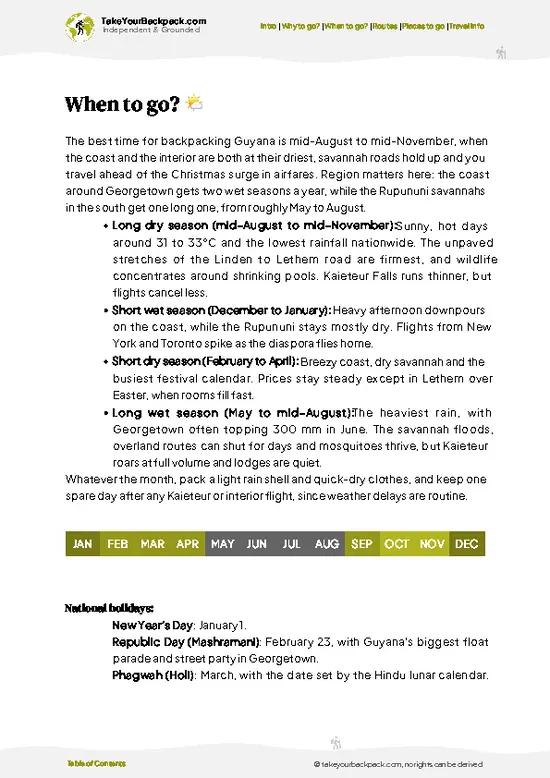
The driest, easiest window for Mahdia is September to November, with a shorter dry spell in February and March.
  • Long Wet Season (May to mid-August): Heavy downpours, highs of 28 to 31°C (82 to 88°F), and red clay roads that can strand trucks for hours. Rooms are easy to find and prices stay flat, but travel times become unpredictable.
  • Main Dry Season (September to November): Roads firm up, with highs near 31 to 33°C (88 to 91°F) and nights around 23°C (73°F). Dust replaces mud. Transport is most reliable, though seats in vehicles toward the interior fill sooner.
  • Short Wet Season (December to January): Showers return in bursts, and the days feel humid. Holiday travel from the coast can push up fares slightly.
  • Short Dry Season (February to March): Mostly sunny with good road conditions, and a fine
… read more 👉
The driest, easiest window for Mahdia is September to November, with a shorter dry spell in February and March.
  • Long Wet Season (May to mid-August): Heavy downpours, highs of 28 to 31°C (82 to 88°F), and red clay roads that can strand trucks for hours. Rooms are easy to find and prices stay flat, but travel times become unpredictable.
  • Main Dry Season (September to November): Roads firm up, with highs near 31 to 33°C (88 to 91°F) and nights around 23°C (73°F). Dust replaces mud. Transport is most reliable, though seats in vehicles toward the interior fill sooner.
  • Short Wet Season (December to January): Showers return in bursts, and the days feel humid. Holiday travel from the coast can push up fares slightly.
  • Short Dry Season (February to March): Mostly sunny with good road conditions, and a fine second choice.
  • Daylight: Days are about 12 hours all year, so plan travel to finish before dark.
Book onward transport in the morning, since afternoon storms are the usual cause of delays.


source: climatestotravel.comJANJanuary: fair for travelingFEBFebruary: fair for travelingMARMarch: fair for travelingAPRApril: fair for travelingMAYMay: fair for travelingJUNJune: fair for travelingJULJuly: fair for travelingAUGAugust: highly recommended for travelingSEPSeptember: excellent for travelingOCTOctober: excellent for travelingNOVNovember: excellent for travelingDECDecember: fair for traveling
when-to-go

✈️ The backpacker research shortcutGuyana Travel Guide

An offline-friendly backpacking guide with optimized travel routes, ranked highlights, transport advice, and the best areas to stay.
example page 0 from our offline Travel Guide for Guyana
example page 1 from our offline Travel Guide for Guyana
example page 2 from our offline Travel Guide for Guyana
example page 3 from our offline Travel Guide for Guyana
example page 4 from our offline Travel Guide for Guyana
example page 5 from our offline Travel Guide for Guyana
example page 6 from our offline Travel Guide for Guyana
example page 7 from our offline Travel Guide for Guyana
The digital guide (161 pages) contains:
✅ 43 highlights, ranked by travel appeal
✅ Optimized 5, 10 & 15-day travel routes
✅ Cities, national parks, landmarks, beaches
✅ How to get around
✅ Offline-friendly for travel without Wi-Fi
👉 Click to see all 30+ guide features

📅 Plan smarter in minutes, not weeks
✅ Month by month travel advice
✅ Festivals & national holidays
✅ Budget expectations

🗺️ Go to the right places, skip the overrated ones
✅ Honest pros & cons of destinations
✅ Top hikes, parks & viewpoints
✅ Lesser-known places most travelers miss
✅ Clear “worth it vs skip it” guidance

🛏️ Travel smoothly without rookie mistakes
✅ Best areas to stay
✅ Transport systems explained simply
✅ Common scams & safety advice
✅ SIM cards, money & practical tips

🌍 Understand the country, not just visit it
✅ Culture & traditions
✅ Local customs
✅ Festivals worth planning around
✅ Traveler-friendly historical context
✅ Insights that make places more meaningful

📱 Built for real travel conditions
✅ Fully downloadable PDF
✅ Works completely offline
✅ Optimized for phone use
✅ Useful in remote areas & buses
✅ Everything in one place
Stop searching, start planning
Get instant access to your full guide. 30‑day money-back guarantee.
+ Add another guide for just

By proceeding you agree to our terms.
Sent to your inbox immediately after payment • 100% Secure Checkout
Best Backpacking Travel Advisor 2025 tourism awardBest Backpacking
Travel Advisor
2025
What others say about Take Your Backpack Guides:
⭐⭐⭐⭐⭐
Fantastic, amazing amount of information!
⭐⭐⭐⭐⭐
My goodness this is amazing, it's what I've been looking for hats off too you!
⭐⭐⭐⭐⭐
I think this is absolutely BRILLIANT
⭐⭐⭐⭐
Very complete and informative. It's still missing places, but I gotta to commend you
⭐⭐⭐⭐⭐
This is truly amazing, thank you, can't wait to explore it with my kids!
⭐⭐⭐⭐⭐
Awesome resource, thank you!
⭐⭐⭐⭐⭐
This is amazing! Can't wait to explore the ones I haven't seen
⭐⭐⭐⭐
I love this! Well done, great idea.
⭐⭐⭐⭐⭐
Thanks for taking the time to make this gem!
⭐⭐⭐⭐⭐
This might be the best website I've ever seen.
⭐⭐⭐⭐⭐
Congratulations, and thank you so much for your work; it's incredibly valuable.
⭐⭐⭐⭐
In all seriousness I think you did a great job pointing out the important spots
⭐⭐⭐⭐⭐
10/10 very good
⭐⭐⭐⭐⭐
As someone who's only just starting to visit regularly this is awesome, thank you.
⭐⭐⭐⭐
Thank you very much! I'm going to visit my dad, it's going to be very useful!
⭐⭐⭐⭐⭐
This is really cool! We'll be travelling for the first time and this definitely come in handy.
⭐⭐⭐⭐⭐
You are now our minister of culture, congratulations 👨‍💼
⭐⭐⭐⭐⭐
Just wanted to tell you that this is a pearl! Going to follow your recommendations.
⭐⭐⭐⭐⭐
This is so cool. I'll definitely be using the resource for my travels soon.
⭐⭐⭐⭐⭐
This is very impressive! Good work.
⭐⭐⭐⭐⭐
This is an amazing and informative site. Very well done!

🛏️ Where to stay?How to pick the right area

Stay along or just off the main road near the market, because that is where the few guesthouses and basic budget rooms cluster in Mahdia.
Dorm beds as such are rare here, so expect simple private rooms with a fan or air conditioning at roughly US$15 to 35 a night. Being near the market puts you steps from food, shops and the minibus pickups, and early departures are easy. The trade-off is noise: generators, music from rum shops and trucks starting at dawn. Bring earplugs.
The second option is the quieter side toward the airstrip, which suits light sleepers and anyone catching a flight. It is a 10 … read more 👉
Stay along or just off the main road near the market, because that is where the few guesthouses and basic budget rooms cluster in Mahdia.
Dorm beds as such are rare here, so expect simple private rooms with a fan or air conditioning at roughly US$15 to 35 a night. Being near the market puts you steps from food, shops and the minibus pickups, and early departures are easy. The trade-off is noise: generators, music from rum shops and trucks starting at dawn. Bring earplugs.
The second option is the quieter side toward the airstrip, which suits light sleepers and anyone catching a flight. It is a 10 to 15 minute walk from the center, with fewer people on the streets after dark, and rooms there are a bit more spacious. Lighting is limited, so carry a headlamp for the walk back at night.
In both areas, book ahead around holidays and when mining crews are rotating in, since rooms are limited. Confirm that water and power are running, as outages happen.

🚌 Getting aroundTransportation options and practical tips

A shared minibus or hired car seat around Mahdia costs roughly US$1 to 3 for short hops, paid in cash in Guyanese dollars to the driver, so carry small notes. Town is tiny and flat, so most days you walk, with the occasional lift to a camp or creek. Roads out are the real challenge, because the red clay track turns slick in rain and slow in any season.
  • Walking: Free, and the main road, market and airstrip are all within 10 to 20 minutes of each other. You trade dust on your boots for conversations at every shop front, and cool early mornings are best.
  • Shared minibuses and trucks: These run mostly to and from Georgetown and to nearby settlements, often leaving early in the morning when full. Expect US$25 to 40 for the long run to the coast, with a rough 8 to 12 hours, and seats that are tight
… read more 👉
A shared minibus or hired car seat around Mahdia costs roughly US$1 to 3 for short hops, paid in cash in Guyanese dollars to the driver, so carry small notes. Town is tiny and flat, so most days you walk, with the occasional lift to a camp or creek. Roads out are the real challenge, because the red clay track turns slick in rain and slow in any season.
  • Walking: Free, and the main road, market and airstrip are all within 10 to 20 minutes of each other. You trade dust on your boots for conversations at every shop front, and cool early mornings are best.
  • Shared minibuses and trucks: These run mostly to and from Georgetown and to nearby settlements, often leaving early in the morning when full. Expect US$25 to 40 for the long run to the coast, with a rough 8 to 12 hours, and seats that are tight and bouncy. You get the forest slipping past the window and a good view of the Essequibo-side road.
  • Hired car or taxi: Informal drivers wait near the market. Short runs cost US$3 to 8, and half-day hires to a creek or mining area run about US$30 to 60. The ride is loud with engine and radio, but you reach places no bus goes.
  • Motorbike taxi: Quick over short distances for US$1 to 4, and the wind is welcome in the heat. Ask for a helmet, and expect a red-dust coating by arrival.
  • Small plane: Charter and scheduled flights from Georgetown use the airstrip, often costing US$100 to 200 one way. The flight takes under an hour, and you see the unbroken green canopy and brown rivers from above.

👛 Costs (as of 19 October 2026)What things cost and how to budget

Budget about US$36 to 82 a day in Mahdia, and the total below uses the high-season room rate.
CategoryBudget RangeLocal Reality
Dorm accommodationUS$15 to 35Dorms are scarce, so a basic private room with fan is the norm. Prices are firmer during busy holiday periods.
MealsUS$10 to 18Cookshop plates of rice, curry, chicken or fish run US$3 to 6, and market snacks are cheaper.
Local transportUS$3 to 8Short rides and shared lifts are cheap, but any out-of-town hire costs more.
Basic activities/entry feesUS$5 to 15Few fees, but a local guide for creeks or pits costs extra.
Miscellaneous expensesUS$3 to 6Water, repellent, phone credit and the occasional beer.
Total Daily BudgetUS$36 to 82About US$60 on a typical day, using the high-season room rate.
Carry plenty of small cash, as card machines and ATMs … read more 👉
Budget about US$36 to 82 a day in Mahdia, and the total below uses the high-season room rate.
CategoryBudget RangeLocal Reality
Dorm accommodationUS$15 to 35Dorms are scarce, so a basic private room with fan is the norm. Prices are firmer during busy holiday periods.
MealsUS$10 to 18Cookshop plates of rice, curry, chicken or fish run US$3 to 6, and market snacks are cheaper.
Local transportUS$3 to 8Short rides and shared lifts are cheap, but any out-of-town hire costs more.
Basic activities/entry feesUS$5 to 15Few fees, but a local guide for creeks or pits costs extra.
Miscellaneous expensesUS$3 to 6Water, repellent, phone credit and the occasional beer.
Total Daily BudgetUS$36 to 82About US$60 on a typical day, using the high-season room rate.
Carry plenty of small cash, as card machines and ATMs are unreliable. Eating at the cookshops instead of guesthouse meals saves several dollars a day.
⚠️ Prices can change and everyone travels differently, so take this as a rough guide. Hope it helps you plan your adventure!

🚌 Day tripsShort trips worth adding

Mahdia works as a base for short, practical trips, though most need a local driver or guide because public transport is scarce.
Mining Areas and Pits:
A half-day with a local guide takes you to working gold and diamond pits within 30 to 60 minutes by truck. Expect US$30 to 60 for transport and guide, and go in the dry months when tracks are firm. First-timers often wander in alone, but camps are private property, so ask permission first.

Potaro River and Tumatumari Area:
River landscapes with rapids and sandbanks lie within a few hours by road, and a hired vehicle costs roughly US$60 to 120 shared. Start before dawn to be back by dark. The mistake is leaving late and meeting the afternoon rain on the clay.

Forest Creek Swim:
Local creeks within an hour's drive offer brown, tea-colored swimming … read more 👉
Mahdia works as a base for short, practical trips, though most need a local driver or guide because public transport is scarce.
Mining Areas and Pits:
A half-day with a local guide takes you to working gold and diamond pits within 30 to 60 minutes by truck. Expect US$30 to 60 for transport and guide, and go in the dry months when tracks are firm. First-timers often wander in alone, but camps are private property, so ask permission first.

Potaro River and Tumatumari Area:
River landscapes with rapids and sandbanks lie within a few hours by road, and a hired vehicle costs roughly US$60 to 120 shared. Start before dawn to be back by dark. The mistake is leaving late and meeting the afternoon rain on the clay.

Forest Creek Swim:
Local creeks within an hour's drive offer brown, tea-colored swimming water and shade, for about US$10 to 30 round trip by hired ride. Go midmorning, and avoid swimming after heavy rain when currents rise.

🛡️ SafetyStaying Safe: What Travelers Should Know

Mahdia is a rough-edged mining town where most trouble comes from opportunistic theft and late-night drinking rather than anything aimed at travelers. Keep your phone and cash out of sight in the market and around the rum shops, and carry only what you need for the day. Unlit streets after dark are the main hazard, along with potholes and passing trucks, so carry a headlamp and walk with company or take a ride.
Solo travelers, women in particular, will get attention in bar areas at night, so it helps to drink little, keep to the main road and say a firm no. Mining camps carry their own risks, so visit only with a local guide. Overcharging on rides happens, so agree the fare before getting in. Mosquitoes and sand flies are an everyday annoyance, and repellent matters more than locks.

FAQCommon questions from travelers

Mahdia is worth a stop if you want a look at Guyana's interior mining economy rather than polished attractions. You get red-dust streets, cookshop meals for US$3 to 6 and access to creeks and mining areas with a local guide. It is not a classic sightseeing destination, so treat it as a gritty, real-life interlude on the way through the interior.
Mahdia needs one to two days. One day covers the market, the airstrip and an evening in the cookshops, while a second lets you arrange a guided trip to a creek or mining area for roughly US$30 to 60. Add a buffer day if heavy rain could delay the road back to Georgetown.
Mahdia is not realistic as a day trip from Georgetown, since the road takes roughly 8 to 12 hours each way in a minibus or truck, and rain can make it longer. A small plane takes under an hour and costs about US$100 to 200 one way, but flights still make for a rushed outing. Plan at least one overnight stay in Mahdia.
⚠️ Things can change over time, so always validate details locally before you go.

Other Guyanese towns near Mahdia

Explore more nearby:

  • Linden—Bauxite pits, Demerara lift bridge, Blue Lake, company bungalows| 124 km away
  • Bartica—Speedboat stelling, Front Street rum shops, river confluence, goldfield gateway| 138 km away
  • Bamichi—Makushi village, forest trails, traditional farming| 203 km away

💡 Not sure where to go next?
Create a personalized itinerary for Guyana including Mahdia and the places that fit your trip.

Generate my itinerary

👉 Discover all towns

Or checkout all Guyana has to offer (think cities, towns, villages, national parks, hikes, beaches, festivals)
Country photo of Guyana

We 💚 feedbackKey takeaways before you go

Mahdia will suit travelers who like rough-edged places and talking with strangers, especially those pushing inland toward Kaieteur country. I would bring cash, a rain jacket and patience, and I would skip it if you want polish or planned activities. Stay one night, ask a miner about the last big strike, and you will learn more than any sign could tell you.

✍️ Help improve this page!
The information on this page is based on in-depth research, insights shared by experienced travelers, and feedback from the local travel community in Guyana. While every effort is made to keep the information accurate and current, conditions can change — so if you spot anything incorrect or outdated, please get in touch.


🙋‍♂️ Give feedback

👋 Meet the founderWho’s Behind Take Your Backpack?

Johan, backpacker and founder of TakeYourBackpackHi, I’m Johan (Netherlands 🇳🇱), the creator of TakeYourBackpack. Over the past 3 decades, I’ve backpacked through 90+ countries across six continents, gaining extensive experience with independent travel, long-term trips, and overland routes.

This site is built on a combination of firsthand travel experience and carefully curated insights from other backpackers. Many guides are based on places I’ve personally visited, while others bring together tips, observations, and practical advice shared by trusted travelers I’ve met along the way.

The goal is to provide realistic, experience-driven guidance — not generic itineraries — so you can explore destinations with better context, clearer expectations, and more confidence.