×

Guyana🇬🇾 | best townsExplore the 4 Best towns in Guyana

Towns in Guyana are small, low-slung and tied to water: wooden houses on stilts, trench-lined streets, and the smell of salt mud, diesel and frying roti. The coast holds nearly all the people, with a Caribbean-style, Indian and African mix, cheap minibuses and loud markets. Heading inland, towns turn into savannah and river outposts where red dust coats everything, red-eyed afternoons are hot, and the nearest ATM may be hours away. Costs climb fast once you leave the coast, because flights, boats and 4x4 transfers carry the price. For independent travel, expect few crowds, patchy signs and plenty of waiting, with warm conversation as compensation.

By Johan Kruseman 🇳🇱 | Updated October 20, 2026
Explore the best villages in Guyana

Why go?What Makes Them Special

Guyana suits town-hopping differently from most countries, because geography sets the rules. Roughly 90 percent of the population lives on a thin Atlantic strip that sits below high-tide level, held back by sea walls and drained by canals. Dutch engineers began that drainage system, then British rule layered on sugar estates, so the coastal towns follow colonial grids with white timber churches, mosques and mandirs sharing the same block. Behind the strip, rainforest and savannah cover most of the country, and towns there are tiny, often reached only by river, bush airstrip or rough laterite road.

That means two very different experiences. The coast is easy, cheap and loud, with shared minibuses, rum shops, cricket on the radio and curry smells drifting from every corner. The interior is … read more 👉
Guyana suits town-hopping differently from most countries, because geography sets the rules. Roughly 90 percent of the population lives on a thin Atlantic strip that sits below high-tide level, held back by sea walls and drained by canals. Dutch engineers began that drainage system, then British rule layered on sugar estates, so the coastal towns follow colonial grids with white timber churches, mosques and mandirs sharing the same block. Behind the strip, rainforest and savannah cover most of the country, and towns there are tiny, often reached only by river, bush airstrip or rough laterite road.

That means two very different experiences. The coast is easy, cheap and loud, with shared minibuses, rum shops, cricket on the radio and curry smells drifting from every corner. The interior is quiet and costly, where distances are long and schedules bend to weather. Travelers should know that English is the official language, which removes a major barrier, but infrastructure is thin: few paved roads beyond the coast, limited cash machines, and slow connectivity. Heat is constant and humidity heavy, so rain can turn tracks to red paste in minutes. Expect fewer sights per town than in neighboring countries, and plan for atmosphere, conversation and river life instead of ticking off landmarks.
Our Approach to Ranking
The list of best towns in Guyana is created based on charm, local culture, atmosphere, hidden gems, and visitor appeal. If you feel a town is missing in this list, please let us know.

When to go?Optimal Periods for Travel

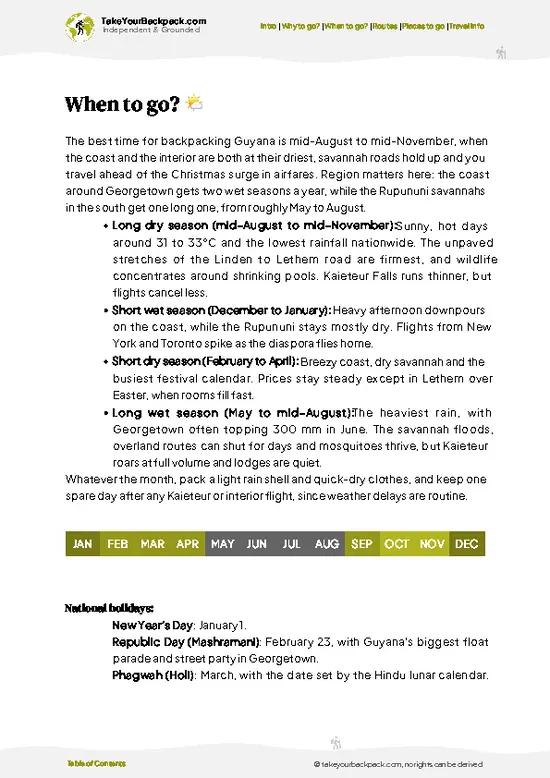
Best months: The best months for towns in Guyana are February to April and September to November, when the country’s two dry seasons keep roads passable and river levels workable. Temperatures hold between 24 and 32°C year-round with humidity above 80 percent, so timing is about rain, not heat.
Wet and dry seasons: Guyana has two wet seasons, roughly May to mid-August and mid-November to January. On the coast, downpours flood streets for an hour or two, mosquitoes surge and the air smells of wet earth and drains. Georgetown and the coastal strip receive around 2,300 mm a year. In the Rupununi savannah to the south, the wet season (May to August) is the key one: red tracks become slick mud, river crossings can be delayed and some interior transfers stop altogether. The dry months there bring … read more 👉
Best months: The best months for towns in Guyana are February to April and September to November, when the country’s two dry seasons keep roads passable and river levels workable. Temperatures hold between 24 and 32°C year-round with humidity above 80 percent, so timing is about rain, not heat.
Wet and dry seasons: Guyana has two wet seasons, roughly May to mid-August and mid-November to January. On the coast, downpours flood streets for an hour or two, mosquitoes surge and the air smells of wet earth and drains. Georgetown and the coastal strip receive around 2,300 mm a year. In the Rupununi savannah to the south, the wet season (May to August) is the key one: red tracks become slick mud, river crossings can be delayed and some interior transfers stop altogether. The dry months there bring dust, golden afternoon light and easy driving.
Peaks and prices: Coastal prices barely move through the year. Interior flights, lodges and 4x4 transfers rise in the dry months, and rooms get tight around the Rupununi Rodeo at Easter and during Mashramani in late February, when Georgetown fills. Late August to early September is a decent shoulder window, with fewer visitors and lower humidity than the wet peaks.

town hoppingHow to Combine towns Into One Trip

How many days: A trip linking several towns in Guyana needs 8 to 14 days, because every move between regions eats half a day or more. Two regions cluster well: the coastal belt around Georgetown and the Berbice and Essequibo areas, and the interior hub reached via Lethem or the Linden highway.
Direction and pacing: Start in Georgetown, work along the coast, then head inland. Coastal stops need 1 to 2 nights each, with minibus rides of 1 to 3 hours along flat roads, plus occasional ferry crossings over wide rivers like the Demerara or Berbice. Interior stops need 2 to 3 nights, and the road from Georgetown toward Lethem takes roughly 12 to 20 hours on a bad day, with red dust or mud as standard. Short flights from Ogle airport cut that to about 1.5 hours but cost far more than buses. Finish … read more 👉
How many days: A trip linking several towns in Guyana needs 8 to 14 days, because every move between regions eats half a day or more. Two regions cluster well: the coastal belt around Georgetown and the Berbice and Essequibo areas, and the interior hub reached via Lethem or the Linden highway.
Direction and pacing: Start in Georgetown, work along the coast, then head inland. Coastal stops need 1 to 2 nights each, with minibus rides of 1 to 3 hours along flat roads, plus occasional ferry crossings over wide rivers like the Demerara or Berbice. Interior stops need 2 to 3 nights, and the road from Georgetown toward Lethem takes roughly 12 to 20 hours on a bad day, with red dust or mud as standard. Short flights from Ogle airport cut that to about 1.5 hours but cost far more than buses. Finish at Georgetown for international flights, since many depart in the small hours.
Planning mistakes: The classic error is cramming too many stops into too few days, then losing a day to a missed ferry or a flooded track. Build in a buffer day before any international flight. Another is booking interior legs in the wet season without slack, so keep those plans flexible. Minibuses leave when full, not on schedule, so arrive early with small bills in hand.

The ListThe Best towns of Guyana

1 Lethem

Brazil border bridge, Easter rodeo, savannah ranchland, Portuguese signs

Cross toward Bonfim over the Takutu, browse the market, and time a visit for Easter when savannah cowboys fill the rodeo grounds.

2 Bartica

Speedboat stelling, Front Street rum shops, river confluence, goldfield gateway

Watch speedboats unload at the river landing, then settle into Front Street cookshops for pepperpot and talk with miners heading inland.

3 Linden

Bauxite pits, Demerara lift bridge, Blue Lake, company bungalows

Walk the bridge over the tea-brown Demerara, swim at Blue Lake, and wander wooden company streets shaped by decades of bauxite mining.

guyana-city-linden
© Google | King_ Jay

4 Mahdia

Gold shops, red laterite road, Potaro riverbank, miners' bars

Walk the dusty main strip past gold buyers and dredge suppliers, then end the day over cold beer in open-fronted bars.

Loading the map 🌍

Expert viewInsights from Locals and Experts

How many towns: I advise three to five towns on a first trip. Distances are long, roads are slow and the best moments come from sitting still: a rum shop at dusk with the sea breeze, or a river landing at dawn with mist on the water. More than five turns the trip into transport. You get conversation, local food and unhurried evenings from fewer stops.
Which kind to prioritize: If you are on a tight budget or short on time, favor coastal towns. They are cheap, easy by minibus and full of roti shops, cricket, Hindu and Muslim festivals, and the sound of calypso and chutney from passing cars. If you want space, birdlife and big skies, add interior towns, accepting higher costs and rougher logistics. Travelers who hate waiting should skip the deep interior, since schedules slide with rain and fuel … read more 👉
How many towns: I advise three to five towns on a first trip. Distances are long, roads are slow and the best moments come from sitting still: a rum shop at dusk with the sea breeze, or a river landing at dawn with mist on the water. More than five turns the trip into transport. You get conversation, local food and unhurried evenings from fewer stops.
Which kind to prioritize: If you are on a tight budget or short on time, favor coastal towns. They are cheap, easy by minibus and full of roti shops, cricket, Hindu and Muslim festivals, and the sound of calypso and chutney from passing cars. If you want space, birdlife and big skies, add interior towns, accepting higher costs and rougher logistics. Travelers who hate waiting should skip the deep interior, since schedules slide with rain and fuel supply.
What it costs: Budget US$35 to 60 a day on the coast: guesthouse rooms run roughly US$20 to 40, a plate of curry or fried rice US$3 to 6, and minibus rides US$1 to 5 per leg. Interior days run US$80 to 150, because lodges, boat hire and 4x4 transfers are priced for visitors. Local guides typically charge US$30 to 80 a day. Domestic flights from Ogle cost about US$100 to 250 one way. Carry Guyanese dollars in small notes, as cards fail outside Georgetown and ATMs are scarce inland.
Safety and culture: Take safety seriously after dark. In coastal towns, use a registered taxi at night rather than walking, avoid displaying phones, and skip quiet stretches near docks and sea walls. Daytime street life is generally easy, and people greet you, ask where you are from and often invite you to eat. Dress modestly around mosques and mandirs, and ask before photographing people. Mosquitoes are constant, so pack repellent, long sleeves at dusk and check yellow fever requirements before arrival. Tap water is not reliably safe to drink, so carry a filter bottle and avoid ice from unknown sources. The reward for these small precautions is easy contact with a warm, talkative, mixed society that rarely sees backpackers.

✈️ The backpacker research shortcutGuyana Travel Guide

An offline-friendly backpacking guide with optimized travel routes, ranked highlights, transport advice, and the best areas to stay.
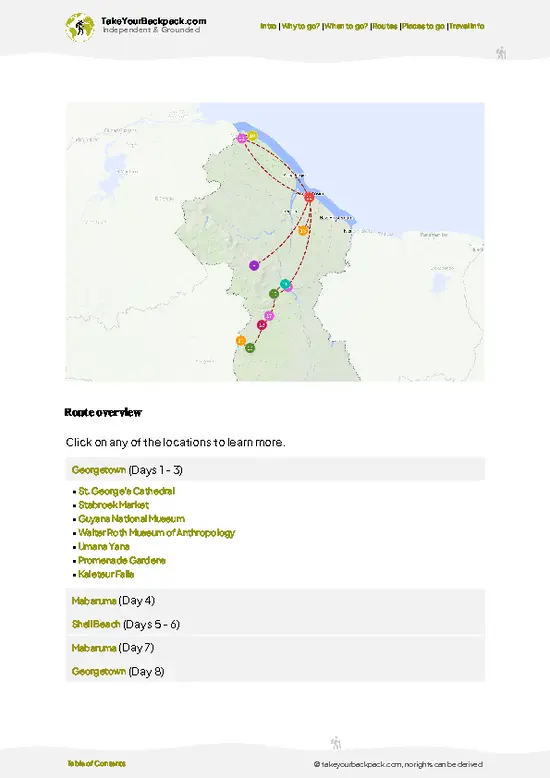
example page 0 from our offline Travel Guide for Guyana
example page 1 from our offline Travel Guide for Guyana
example page 2 from our offline Travel Guide for Guyana
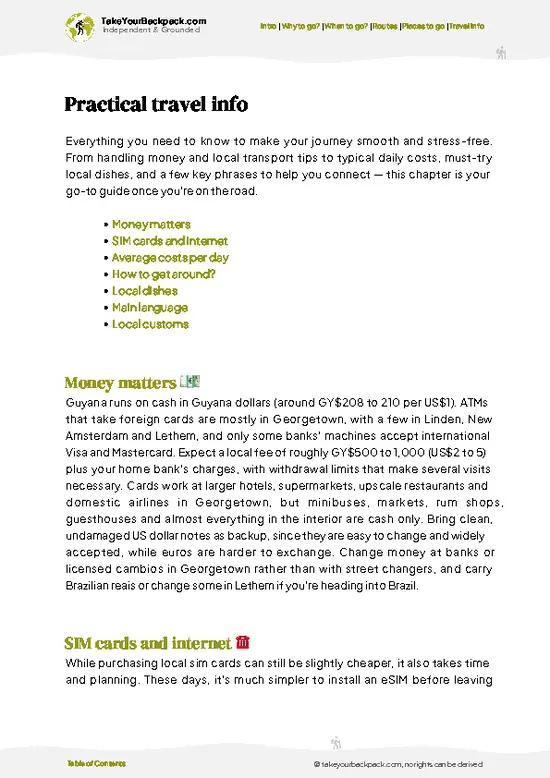
example page 3 from our offline Travel Guide for Guyana
example page 4 from our offline Travel Guide for Guyana
example page 5 from our offline Travel Guide for Guyana
example page 6 from our offline Travel Guide for Guyana
example page 7 from our offline Travel Guide for Guyana
The digital guide (161 pages) contains:
✅ 43 highlights, ranked by travel appeal
✅ Optimized 5, 10 & 15-day travel routes
✅ Cities, national parks, landmarks, beaches
✅ How to get around
✅ Offline-friendly for travel without Wi-Fi
👉 Click to see all 30+ guide features

📅 Plan smarter in minutes, not weeks
✅ Month by month travel advice
✅ Festivals & national holidays
✅ Budget expectations

🗺️ Go to the right places, skip the overrated ones
✅ Honest pros & cons of destinations
✅ Top hikes, parks & viewpoints
✅ Lesser-known places most travelers miss
✅ Clear “worth it vs skip it” guidance

🛏️ Travel smoothly without rookie mistakes
✅ Best areas to stay
✅ Transport systems explained simply
✅ Common scams & safety advice
✅ SIM cards, money & practical tips

🌍 Understand the country, not just visit it
✅ Culture & traditions
✅ Local customs
✅ Festivals worth planning around
✅ Traveler-friendly historical context
✅ Insights that make places more meaningful

📱 Built for real travel conditions
✅ Fully downloadable PDF
✅ Works completely offline
✅ Optimized for phone use
✅ Useful in remote areas & buses
✅ Everything in one place
Stop searching, start planning
Get instant access to your full guide. 30‑day money-back guarantee.
+ Add another guide for just

By proceeding you agree to our terms.
Sent to your inbox immediately after payment • 100% Secure Checkout
Best Backpacking Travel Advisor 2025 tourism awardBest Backpacking
Travel Advisor
2025
What others say about Take Your Backpack Guides:
⭐⭐⭐⭐⭐
Fantastic, amazing amount of information!
⭐⭐⭐⭐⭐
My goodness this is amazing, it's what I've been looking for hats off too you!
⭐⭐⭐⭐⭐
I think this is absolutely BRILLIANT
⭐⭐⭐⭐
Very complete and informative. It's still missing places, but I gotta to commend you
⭐⭐⭐⭐⭐
This is truly amazing, thank you, can't wait to explore it with my kids!
⭐⭐⭐⭐⭐
Awesome resource, thank you!
⭐⭐⭐⭐⭐
This is amazing! Can't wait to explore the ones I haven't seen
⭐⭐⭐⭐
I love this! Well done, great idea.
⭐⭐⭐⭐⭐
Thanks for taking the time to make this gem!
⭐⭐⭐⭐⭐
This might be the best website I've ever seen.
⭐⭐⭐⭐⭐
Congratulations, and thank you so much for your work; it's incredibly valuable.
⭐⭐⭐⭐
In all seriousness I think you did a great job pointing out the important spots
⭐⭐⭐⭐⭐
10/10 very good
⭐⭐⭐⭐⭐
As someone who's only just starting to visit regularly this is awesome, thank you.
⭐⭐⭐⭐
Thank you very much! I'm going to visit my dad, it's going to be very useful!
⭐⭐⭐⭐⭐
This is really cool! We'll be travelling for the first time and this definitely come in handy.
⭐⭐⭐⭐⭐
You are now our minister of culture, congratulations 👨‍💼
⭐⭐⭐⭐⭐
Just wanted to tell you that this is a pearl! Going to follow your recommendations.
⭐⭐⭐⭐⭐
This is so cool. I'll definitely be using the resource for my travels soon.
⭐⭐⭐⭐⭐
This is very impressive! Good work.
⭐⭐⭐⭐⭐
This is an amazing and informative site. Very well done!

🛏️ Where to stay?Best Places to Stay in Guyana

Guyana has only a handful of true backpacker hostels, so most budget travelers stay in simple guesthouses and small family-run hotels in Georgetown, where a private room usually costs US$25 to 50 a night. Kingston and the streets near the seawall put you closest to restaurants, bars and weekend nightlife, while leafy Queenstown is quieter and more residential but still walkable to the center. Bel Air and Lamaha Gardens feel safer and calmer after dark at the cost of a taxi ride everywhere, and the area around Stabroek is cheap and central but best avoided once the market closes.

If you enjoy meeting fellow travelers, consider choosing hostels with high ratings for atmosphere. On the other hand, … read more 👉
Guyana has only a handful of true backpacker hostels, so most budget travelers stay in simple guesthouses and small family-run hotels in Georgetown, where a private room usually costs US$25 to 50 a night. Kingston and the streets near the seawall put you closest to restaurants, bars and weekend nightlife, while leafy Queenstown is quieter and more residential but still walkable to the center. Bel Air and Lamaha Gardens feel safer and calmer after dark at the cost of a taxi ride everywhere, and the area around Stabroek is cheap and central but best avoided once the market closes.

If you enjoy meeting fellow travelers, consider choosing hostels with high ratings for atmosphere. On the other hand, if you prefer having your own space, a hotel might be a better option.

GuyanaExplore Guyana

👋 Meet the founderWho’s Behind Take Your Backpack?

Johan, backpacker and founder of TakeYourBackpackHi, I’m Johan (Netherlands 🇳🇱), the creator of TakeYourBackpack. Over the past 3 decades, I’ve backpacked through 90+ countries across six continents, gaining extensive experience with independent travel, long-term trips, and overland routes.

This site is built on a combination of firsthand travel experience and carefully curated insights from other backpackers. Many guides are based on places I’ve personally visited, while others bring together tips, observations, and practical advice shared by trusted travelers I’ve met along the way.

The goal is to provide realistic, experience-driven guidance — not generic itineraries — so you can explore destinations with better context, clearer expectations, and more confidence.