×

Guyana🇬🇾 | beachesShell BeachNight turtle patrols, broken-shell ridges, scarlet ibis, hammock lodging | things to do and best time to go

Explore Promenade GardensExplore Georgetown

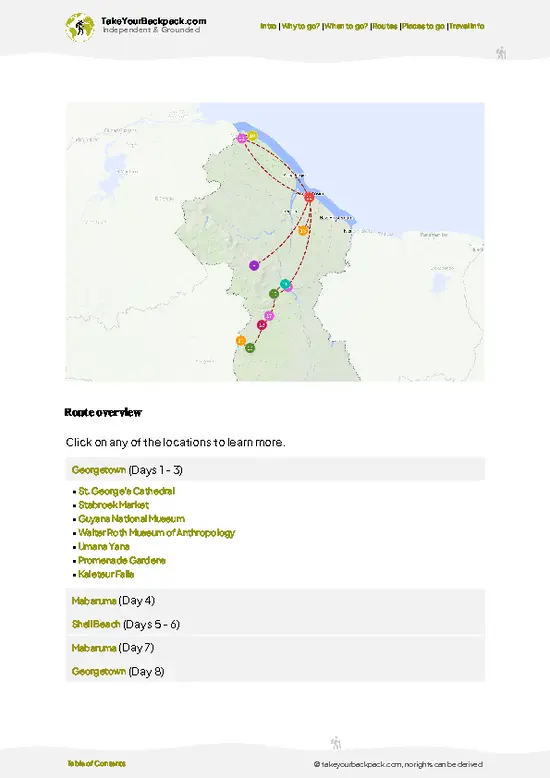
Backpacking in Shell Beach
🏆 Top pickbeach ranked #1
By Johan Kruseman 🇳🇱 | Updated October 19, 2026

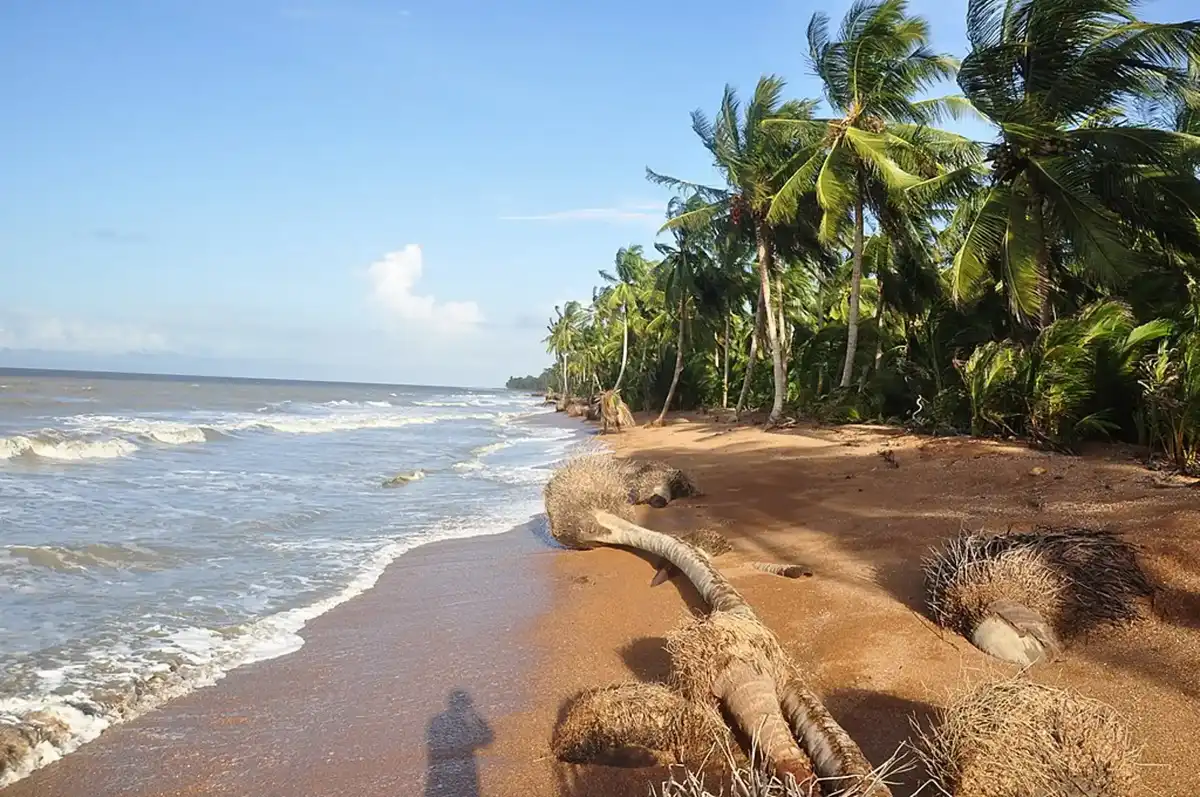
The boat engine cuts out and you step onto sand that crunches, because it is not sand at all but a crust of broken shells, pale and sharp-edged, with the smell of salt mud drifting off the Atlantic. Shell Beach sits along the northwest coast of Guyana, a protected stretch of about 120 kilometers reached from the Pomeroon and Moruca side. Between February and August, four species of sea turtle haul out here to nest at night, and watching a leatherback or green turtle dig in the dark is the reason to come. Swimming is not. The water is brown and silty from Amazon outflow, and mosquitoes and sandflies are part of the evening. There is no surf, no reef and no snorkeling worth the effort. Access is slow, by boat and rough road, and beds are basic, with simple community-run lodging and home-cooked fish. Skip it for a beach holiday. Go for the turtles and the scarlet ibis in the mangroves. Unlike the resort-style sands near Georgetown, this beach is wild, empty and unpolished.

Discover everything you want to know in the 📖 Guyana Travel Guide.


example page 0 from our offline Travel Guide for Guyana
example page 1 from our offline Travel Guide for Guyana
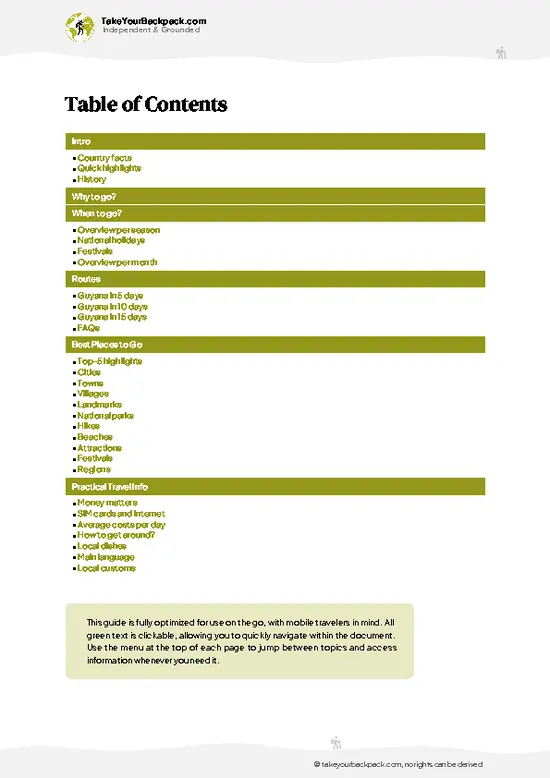
example page 2 from our offline Travel Guide for Guyana
example page 3 from our offline Travel Guide for Guyana
example page 4 from our offline Travel Guide for Guyana
example page 5 from our offline Travel Guide for Guyana
example page 6 from our offline Travel Guide for Guyana
example page 7 from our offline Travel Guide for Guyana
Loading the map 🌍
CLICK TO FILTER
cities
towns
villages
landmarks
national parks
hikes
beaches
attractions
festivals
regions
SHOW COUNTRY’S BESTSHOW ALL

✨ Why go?
Ranked #1 beach in Guyana
What sets this place apart

Backpackers stop at Shell Beach for one reason that outweighs the discomfort: four species of sea turtle nest on this coast, including leatherbacks, the largest of them. Watching a female heave herself up the shell bank under a dark sky, with a ranger guiding you to keep your light off, is the kind of thing you carry around for years. The second draw is the people. Visits run through local Amerindian hosts and conservation groups, so your hammock money lands in the coastal Amerindian communities rather than with a distant operator, and you eat what the household cooks. The third is the sheer lack of anything else. There is no bar strip, no loud music, no sunbed vendors. Shell Beach works as a pause on a trip through the North West, a place where the loudest sound after dark is surf hissing … read more 👉
Backpackers stop at Shell Beach for one reason that outweighs the discomfort: four species of sea turtle nest on this coast, including leatherbacks, the largest of them. Watching a female heave herself up the shell bank under a dark sky, with a ranger guiding you to keep your light off, is the kind of thing you carry around for years. The second draw is the people. Visits run through local Amerindian hosts and conservation groups, so your hammock money lands in the coastal Amerindian communities rather than with a distant operator, and you eat what the household cooks. The third is the sheer lack of anything else. There is no bar strip, no loud music, no sunbed vendors. Shell Beach works as a pause on a trip through the North West, a place where the loudest sound after dark is surf hissing on shell and the occasional splash in the mangroves. Bring repellent, patience and a headlamp with a red setting.

💡 HighlightsKey sights and experiences for travelers

  1. Night turtle watching: This is what Shell Beach is known for. From roughly February to August, leatherback, green, hawksbill and olive ridley turtles come ashore to dig nests, and trained local rangers walk you along the sand in the dark. Lights stay off or red, and you keep your distance. Sightings are likely in peak season but never guaranteed.
  2. Walking the shell banks: The beach is built of ridges of broken shell piled up by the Atlantic, so the walk has a crunch and a glare you will not get on ordinary sand. Go early, when the tide is out and the flats are exposed, and look for tracks left by nesting females.
  3. Shorebird and scarlet ibis watching: The mudflats and mangrove edges fill with plovers, sandpipers, terns and herons, and scarlet ibis flash red over the treeline at dusk. Migrant flocks
… read more 👉
  1. Night turtle watching: This is what Shell Beach is known for. From roughly February to August, leatherback, green, hawksbill and olive ridley turtles come ashore to dig nests, and trained local rangers walk you along the sand in the dark. Lights stay off or red, and you keep your distance. Sightings are likely in peak season but never guaranteed.
  2. Walking the shell banks: The beach is built of ridges of broken shell piled up by the Atlantic, so the walk has a crunch and a glare you will not get on ordinary sand. Go early, when the tide is out and the flats are exposed, and look for tracks left by nesting females.
  3. Shorebird and scarlet ibis watching: The mudflats and mangrove edges fill with plovers, sandpipers, terns and herons, and scarlet ibis flash red over the treeline at dusk. Migrant flocks swell numbers in the northern winter months. Bring binoculars; the birds sit far out on the mud.
  4. Hatchling releases and nest checks: In season, rangers sometimes find nests close to hatching and let visitors watch tiny turtles scramble toward the water. It is unscheduled, so ask your guide on arrival and keep hands off.
  5. Hammock nights at the beach camp: Sleeping in a hammock under a roof with the sea breathing outside is the main activity once the sun goes down. With no streetlights for a long way, the stars are dense, and the evening meal is local fish, rice and cassava-based sides cooked by your hosts.
Give the beach one night at the minimum, since the turtles work after dark, and two nights if you also want the birds and a slow morning walk.
Spotted a mistake or missing something? Contact us.
🌤️ When to go?When to go for the best experience

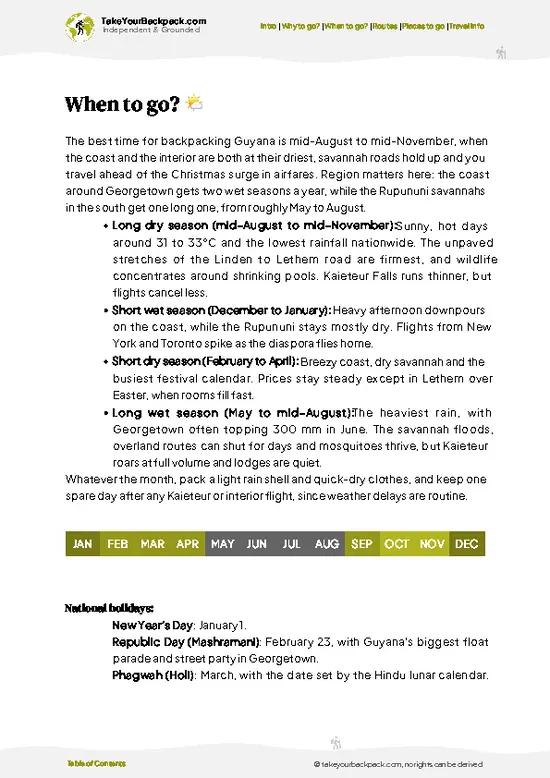
  • Main dry season (September to November): Calmer seas and the least rain make this the easiest window for the boat run along the coast and for camping on the shell ridges. Days reach 30 to 32°C (86 to 90°F), nights sit near 24°C (75°F). Daylight is about 12 hours all year.
  • Sea turtle nesting (February to August): Leatherback, green, hawksbill and olive ridley turtles come ashore to lay eggs, with the peak around April to June. Conservation camps run by local Amerindian communities take volunteers and guests, and this is the reason most people come.
  • Long wet season (May to mid-August): Heavy downpours turn the Mabaruma and Moruca river routes muddy and the sea choppy. Temperatures stay 27 to 31°C (81 to 88°F), and mosquitoes and sandflies multiply.
  • Short wet spell (December to January): Showers
… read more 👉
  • Main dry season (September to November): Calmer seas and the least rain make this the easiest window for the boat run along the coast and for camping on the shell ridges. Days reach 30 to 32°C (86 to 90°F), nights sit near 24°C (75°F). Daylight is about 12 hours all year.
  • Sea turtle nesting (February to August): Leatherback, green, hawksbill and olive ridley turtles come ashore to lay eggs, with the peak around April to June. Conservation camps run by local Amerindian communities take volunteers and guests, and this is the reason most people come.
  • Long wet season (May to mid-August): Heavy downpours turn the Mabaruma and Moruca river routes muddy and the sea choppy. Temperatures stay 27 to 31°C (81 to 88°F), and mosquitoes and sandflies multiply.
  • Short wet spell (December to January): Showers are frequent but briefer, and travel is workable.
  • Crowds and prices: Visitor numbers are tiny in every month. Tour operators price per group, so the cost changes little with the season.
Book your trip at least a few weeks ahead, since the camps only take small groups and transport is arranged by the tour company.


source: climatestotravel.comJANJanuary: good for travelingFEBFebruary: highly recommended for travelingMARMarch: highly recommended for travelingAPRApril: good for travelingMAYMay: good for travelingJUNJune: good for travelingJULJuly: highly recommended for travelingAUGAugust: good for travelingSEPSeptember: good for travelingOCTOctober: highly recommended for travelingNOVNovember: highly recommended for travelingDECDecember: good for traveling

✈️ The backpacker research shortcutGuyana Travel Guide

An offline-friendly backpacking guide with optimized travel routes, ranked highlights, transport advice, and the best areas to stay.
example page 0 from our offline Travel Guide for Guyana
example page 1 from our offline Travel Guide for Guyana
example page 2 from our offline Travel Guide for Guyana
example page 3 from our offline Travel Guide for Guyana
example page 4 from our offline Travel Guide for Guyana
example page 5 from our offline Travel Guide for Guyana
example page 6 from our offline Travel Guide for Guyana
example page 7 from our offline Travel Guide for Guyana
The digital guide (161 pages) contains:
✅ 43 highlights, ranked by travel appeal
✅ Optimized 5, 10 & 15-day travel routes
✅ Cities, national parks, landmarks, beaches
✅ How to get around
✅ Offline-friendly for travel without Wi-Fi
👉 Click to see all 30+ guide features

📅 Plan smarter in minutes, not weeks
✅ Month by month travel advice
✅ Festivals & national holidays
✅ Budget expectations

🗺️ Go to the right places, skip the overrated ones
✅ Honest pros & cons of destinations
✅ Top hikes, parks & viewpoints
✅ Lesser-known places most travelers miss
✅ Clear “worth it vs skip it” guidance

🛏️ Travel smoothly without rookie mistakes
✅ Best areas to stay
✅ Transport systems explained simply
✅ Common scams & safety advice
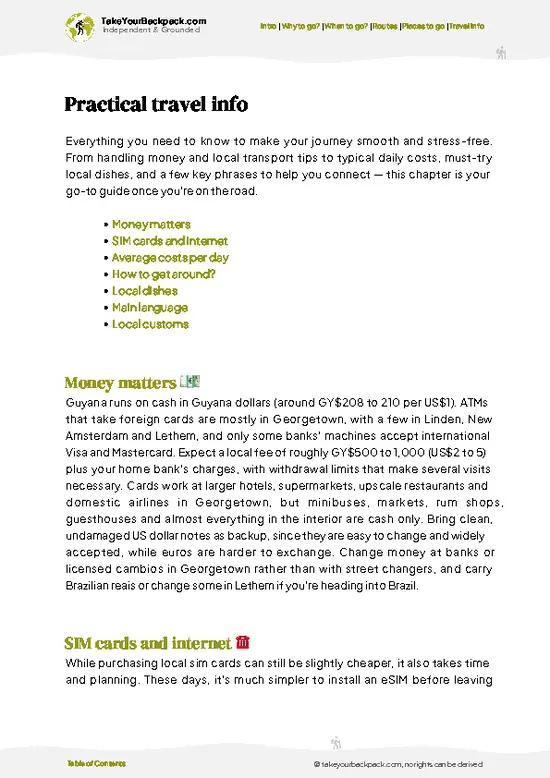
✅ SIM cards, money & practical tips

🌍 Understand the country, not just visit it
✅ Culture & traditions
✅ Local customs
✅ Festivals worth planning around
✅ Traveler-friendly historical context
✅ Insights that make places more meaningful

📱 Built for real travel conditions
✅ Fully downloadable PDF
✅ Works completely offline
✅ Optimized for phone use
✅ Useful in remote areas & buses
✅ Everything in one place
Stop searching, start planning
Get instant access to your full guide. 30‑day money-back guarantee.
+ Add another guide for just

By proceeding you agree to our terms.
Sent to your inbox immediately after payment • 100% Secure Checkout
Best Backpacking Travel Advisor 2025 tourism awardBest Backpacking
Travel Advisor
2025
What others say about Take Your Backpack Guides:
⭐⭐⭐⭐⭐
Fantastic, amazing amount of information!
⭐⭐⭐⭐⭐
My goodness this is amazing, it's what I've been looking for hats off too you!
⭐⭐⭐⭐⭐
I think this is absolutely BRILLIANT
⭐⭐⭐⭐
Very complete and informative. It's still missing places, but I gotta to commend you
⭐⭐⭐⭐⭐
This is truly amazing, thank you, can't wait to explore it with my kids!
⭐⭐⭐⭐⭐
Awesome resource, thank you!
⭐⭐⭐⭐⭐
This is amazing! Can't wait to explore the ones I haven't seen
⭐⭐⭐⭐
I love this! Well done, great idea.
⭐⭐⭐⭐⭐
Thanks for taking the time to make this gem!
⭐⭐⭐⭐⭐
This might be the best website I've ever seen.
⭐⭐⭐⭐⭐
Congratulations, and thank you so much for your work; it's incredibly valuable.
⭐⭐⭐⭐
In all seriousness I think you did a great job pointing out the important spots
⭐⭐⭐⭐⭐
10/10 very good
⭐⭐⭐⭐⭐
As someone who's only just starting to visit regularly this is awesome, thank you.
⭐⭐⭐⭐
Thank you very much! I'm going to visit my dad, it's going to be very useful!
⭐⭐⭐⭐⭐
This is really cool! We'll be travelling for the first time and this definitely come in handy.
⭐⭐⭐⭐⭐
You are now our minister of culture, congratulations 👨‍💼
⭐⭐⭐⭐⭐
Just wanted to tell you that this is a pearl! Going to follow your recommendations.
⭐⭐⭐⭐⭐
This is so cool. I'll definitely be using the resource for my travels soon.
⭐⭐⭐⭐⭐
This is very impressive! Good work.
⭐⭐⭐⭐⭐
This is an amazing and informative site. Very well done!

🛏️ Where to stay?Choosing the right base

Your realistic options are the basic eco-lodges and camps on the shell ridges themselves, plus a night in Mabaruma or Moruca before or after the beach. Staying at the beach means simple wooden or thatched shelters, hammocks with mosquito nets, shared outdoor washing facilities and cooked meals served communally. Expect US$40 to 90 per person per night on a package, which usually covers meals and local guiding. There is no mains electricity at most camps, so solar lighting and an early bedtime are the norm.
The social side is strong here. Everyone sits at the same table, groups are small, and the … read more 👉
Your realistic options are the basic eco-lodges and camps on the shell ridges themselves, plus a night in Mabaruma or Moruca before or after the beach. Staying at the beach means simple wooden or thatched shelters, hammocks with mosquito nets, shared outdoor washing facilities and cooked meals served communally. Expect US$40 to 90 per person per night on a package, which usually covers meals and local guiding. There is no mains electricity at most camps, so solar lighting and an early bedtime are the norm.
The social side is strong here. Everyone sits at the same table, groups are small, and the volunteers and rangers who patrol at night are glad to talk about the turtles. Solo travelers fit in easily because most visitors arrive on the same boat and share the same schedule.
Mabaruma, in the North West region, is the better base for the night before your boat departs. Guesthouses there run US$20 to 45 a night, with small restaurants and shops for stocking up on snacks, water and repellent. Moruca is closer to the Amerindian communities that manage the area and has only very basic lodging.
Spontaneous drop-ins are not practical. Arrange the camp stay and the boat through a Georgetown operator or the community conservation group, and bring your own cash in small bills.

🛡️ SafetyTraveler Safety Guide

Shell Beach is remote and quiet, and the main risks come from the sea and the sun rather than from people. The water here is brown and silty because of the Amazon outflow, and the shoreline is a mix of mud flats and shell ridges, so swimming is not the point. Tides shift the waterline a long way, and wading over soft mud can leave you sinking to the knee. Stay with your guide and swim only where they say it is fine. Stingrays sit in the shallows, so shuffle your feet.
Sun exposure is strong from mid-morning, and there is little shade on the ridges, so bring a hat and a long-sleeved shirt. Sandflies and mosquitoes are worst at dusk, and repellent is essential. Night turtle walks use red light or none, so keep your torch off and stay behind the ranger.
Theft is rare in the camps, but keep valuables … read more 👉
Shell Beach is remote and quiet, and the main risks come from the sea and the sun rather than from people. The water here is brown and silty because of the Amazon outflow, and the shoreline is a mix of mud flats and shell ridges, so swimming is not the point. Tides shift the waterline a long way, and wading over soft mud can leave you sinking to the knee. Stay with your guide and swim only where they say it is fine. Stingrays sit in the shallows, so shuffle your feet.
Sun exposure is strong from mid-morning, and there is little shade on the ridges, so bring a hat and a long-sleeved shirt. Sandflies and mosquitoes are worst at dusk, and repellent is essential. Night turtle walks use red light or none, so keep your torch off and stay behind the ranger.
Theft is rare in the camps, but keep valuables in a dry bag. Boat transfers can be rough in the wet season, so wear a life jacket.

FAQCommon questions from travelers

Most visitors go with a tour operator from Georgetown, which usually means a flight to Mabaruma (about 45 to 60 minutes) and then a boat ride of several hours along the coast to the camps. The overland alternative is a long journey by road and ferry toward Moruca and then by boat, taking a full day or more. Packages typically cost US$300 to 700 per person for two to four days, including transport, food and guides.
Swimming is poor because the water is muddy, the tides are strong and the shoreline is soft mud and shell, so most people only wade. Surfing is not possible given the low waves, and snorkeling is pointless with almost no visibility. The draw is turtle watching on the nesting beaches, with the season from February to August and the peak around April to June.
There is no formal gate fee for the beach itself, but you cannot realistically visit without paying for a guided stay with an operator or community camp. Camp stays run about US$40 to 90 per person per night, usually including meals and guiding. Some groups ask for a small conservation or community contribution of around US$5 to 15, so carry small bills.
⚠️ Things can change over time, so always validate details locally before you go.

Ideas for continuing your journey

Shell Beach isn’t the only highlight in Guyana. Explore all what Guyana has to offer.
Country photo of Guyana

We 💚 feedbackWhat to keep in mind

Most people arrive at Shell Beach expecting a swim and a lounger, then sulk when the water is brown. Skip that plan. Time your trip for nesting season, pack a long-sleeved shirt and strong repellent for the evenings, and treat the dark, mosquito-filled walk behind a ranger as the whole point. Take a red headlamp, not a bright torch.

✍️ Help improve this page!
The information on this page is based on in-depth research, insights shared by experienced travelers, and feedback from the local travel community in Guyana. While every effort is made to keep the information accurate and current, conditions can change — so if you spot anything incorrect or outdated, please get in touch.


🙋‍♂️ Give feedback

👋 Meet the founderWho’s Behind Take Your Backpack?

Johan, backpacker and founder of TakeYourBackpackHi, I’m Johan (Netherlands 🇳🇱), the creator of TakeYourBackpack. Over the past 3 decades, I’ve backpacked through 90+ countries across six continents, gaining extensive experience with independent travel, long-term trips, and overland routes.

This site is built on a combination of firsthand travel experience and carefully curated insights from other backpackers. Many guides are based on places I’ve personally visited, while others bring together tips, observations, and practical advice shared by trusted travelers I’ve met along the way.

The goal is to provide realistic, experience-driven guidance — not generic itineraries — so you can explore destinations with better context, clearer expectations, and more confidence.