×

Guyana🇬🇾 | best beachesExplore the Best beaches in Guyana

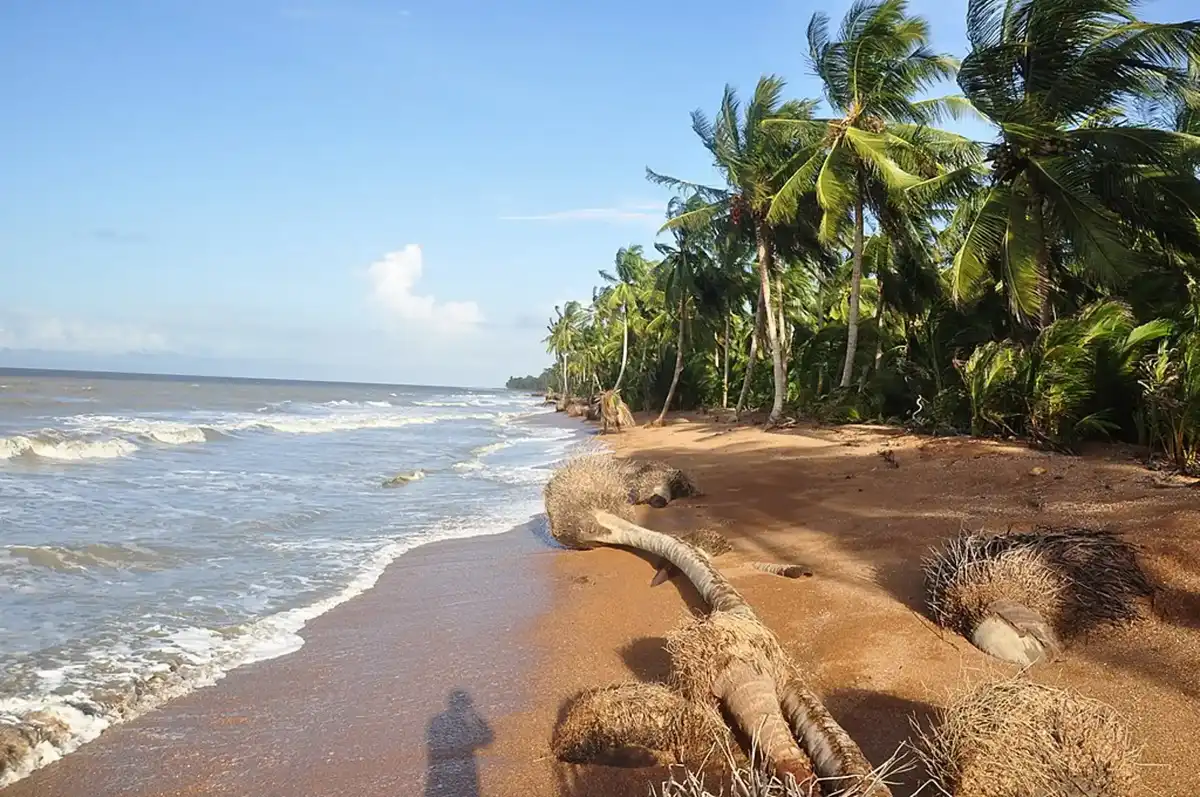
Beaches in Guyana are not the postcard kind. The Atlantic coast runs brown and silty, fringed with mangroves and backed by a sea wall, and the water smells of salt, mud and rotting leaves at low tide. The real sand sits elsewhere. In the northwest, remote shell-and-sand ridges take hours of boat travel and a community guide. Inland, white river sandbars and sandy lake shores appear around Bartica, the Essequibo and the Rupununi, with warm tea-colored water and almost no one on them. For backpackers and independent travelers, expect basic lodging, small costs and big effort, not resort comfort.

By Johan Kruseman 🇳🇱 | Updated October 20, 2026
Explore the best attractions in Guyana

Why go?What Makes Them Special

Guyana’s coastline is shaped by the Amazon. Mud from Brazil’s rivers drifts northwest on the Guiana Current, so the sea is chocolate-brown and the shore a soft mudflat rather than clean sand. Most of the populated coast sits below sea level behind a sea wall, and mangroves do the rest of the defending. That is why the country has no Caribbean-style resort strip, despite its Caribbean cultural ties.

What it offers instead is wild, empty shoreline and a river network that exposes pale sand when the water drops. Nesting sea turtles, scarlet ibis and huge flocks of shorebirds matter more here than sunbeds. Light is hot and flat at midday, and evenings carry the buzz of insects and the smell of wet forest.

Before choosing Guyana for beaches, know that infrastructure is thin. There are few lifeguards, … read more 👉
Guyana’s coastline is shaped by the Amazon. Mud from Brazil’s rivers drifts northwest on the Guiana Current, so the sea is chocolate-brown and the shore a soft mudflat rather than clean sand. Most of the populated coast sits below sea level behind a sea wall, and mangroves do the rest of the defending. That is why the country has no Caribbean-style resort strip, despite its Caribbean cultural ties.

What it offers instead is wild, empty shoreline and a river network that exposes pale sand when the water drops. Nesting sea turtles, scarlet ibis and huge flocks of shorebirds matter more here than sunbeds. Light is hot and flat at midday, and evenings carry the buzz of insects and the smell of wet forest.

Before choosing Guyana for beaches, know that infrastructure is thin. There are few lifeguards, almost no beach bars, and the best stretches need boats or small planes. Prices reflect that distance, not luxury. Sandflies and mosquitoes are part of the deal, and swimming is better in rivers than in the sea. Travelers who want turquoise water will be disappointed. Those who want sand with wildlife and no crowds will find it.
How the List Was Created
The list of best beaches in Guyana is created based on beauty, vibe, water quality, activities, and surrounding scenery. If you feel a beach is missing in this list, please let us know.

When to go?Optimal Periods for Travel

Best months and the weather behind them: The best months for Guyana’s beaches are February to April and mid-August to mid-November, because these are the two dry seasons, when skies are clear, river sandbars surface and boat trips run reliably. Temperatures hold at 26 to 32°C all year, with humid air that clings by midday and a sea breeze that helps on the coast.Wet seasons and shoulder periods: The long wet season runs from roughly May to mid-August, with Georgetown getting several hundred millimeters a month at the peak and annual rainfall around 2,300 mm. A shorter wet spell arrives from mid-November to January. Rain comes in hard, warm bursts, turning dirt tracks to red mud and raising rivers so sandbars vanish. The shoulder months of January and late April are usually workable, with showers … read more 👉
Best months and the weather behind them: The best months for Guyana’s beaches are February to April and mid-August to mid-November, because these are the two dry seasons, when skies are clear, river sandbars surface and boat trips run reliably. Temperatures hold at 26 to 32°C all year, with humid air that clings by midday and a sea breeze that helps on the coast.Wet seasons and shoulder periods: The long wet season runs from roughly May to mid-August, with Georgetown getting several hundred millimeters a month at the peak and annual rainfall around 2,300 mm. A shorter wet spell arrives from mid-November to January. Rain comes in hard, warm bursts, turning dirt tracks to red mud and raising rivers so sandbars vanish. The shoulder months of January and late April are usually workable, with showers breaking the heat rather than ruining days.Regional and seasonal differences: The Rupununi savanna in the south follows its own rhythm. Its wet season runs about May to August, and its dry months from September to March bring dust, cracked ground and the best access to river sand. On the northwest coast, turtle nesting peaks from March to August, so the wetter months suit wildlife even when swimming is poor. Guyana has no true tourist peak. Prices for boats and lodges stay fairly steady, though availability tightens around Christmas and Easter, when locals travel.

beach hoppingHow to Combine beaches Into One Trip

How long a multi-beach trip needs: A trip linking several beaches in Guyana needs 7 to 10 days, since every transfer involves a boat, a bumpy road or a small plane. Regions cluster by access: the Georgetown and Bartica corridor on one side, the remote northwest coast on the other, and the Rupununi interior far to the south.Direction and time per stop: Start in Georgetown and head west or northwest first. Minibuses reach Parika in about an hour, and speedboats cross to Bartica in roughly an hour (the ferry takes 2 to 3 hours). River sand around Bartica deserves 1 to 2 days. The northwest is reached by small plane to Mabaruma (about an hour) or by long boat transfers, and it needs 2 to 4 days because the distance only makes sense with time on the ground. The Rupununi is a flight or a long, rough … read more 👉
How long a multi-beach trip needs: A trip linking several beaches in Guyana needs 7 to 10 days, since every transfer involves a boat, a bumpy road or a small plane. Regions cluster by access: the Georgetown and Bartica corridor on one side, the remote northwest coast on the other, and the Rupununi interior far to the south.Direction and time per stop: Start in Georgetown and head west or northwest first. Minibuses reach Parika in about an hour, and speedboats cross to Bartica in roughly an hour (the ferry takes 2 to 3 hours). River sand around Bartica deserves 1 to 2 days. The northwest is reached by small plane to Mabaruma (about an hour) or by long boat transfers, and it needs 2 to 4 days because the distance only makes sense with time on the ground. The Rupununi is a flight or a long, rough drive from the coast, so treat it as a separate trip unless you have more than ten days.Planning mistakes to avoid: The most common error is packing too many stops into a short stay. A late boat or a flooded track can erase a day. Allow a buffer day before any international flight. Another is booking dates in the wet season for river sandbars, which may sit underwater. Check water levels with operators before paying. Small planes also have luggage limits, so pack light, in dry bags, and keep cash in Guyanese dollars.

The ListThe Best beaches of Guyana

1 Shell Beach

Night turtle patrols, broken-shell ridges, scarlet ibis, hammock lodging

Follow rangers along the crunching shell banks after dark to watch leatherback and green turtles nest, then sleep in a hammock above the tide.

Loading the map 🌍

Expert viewInsights from Locals and Experts

How many beaches to visit: Two or three is the right number for most backpackers. Guyana’s beaches take real effort to reach, and each stop eats most of a day in transit, so a third beach starts to cost you wildlife and village time. Pick one river sandbar or lake shore for easy swimming and one remote coastal stretch for the sense of emptiness, with the sound of surf on shell ridges and the call of shorebirds at dusk.Choosing by travel style: Budget travelers and swimmers should favor river and lake sand. The water is warm, tea-brown and calm, and a boat from Bartica is cheap. Wildlife lovers should prioritize the nesting coast between March and August, when turtles haul ashore after dark. Those who want a social atmosphere should add a Georgetown seawall evening, where families gather at … read more 👉
How many beaches to visit: Two or three is the right number for most backpackers. Guyana’s beaches take real effort to reach, and each stop eats most of a day in transit, so a third beach starts to cost you wildlife and village time. Pick one river sandbar or lake shore for easy swimming and one remote coastal stretch for the sense of emptiness, with the sound of surf on shell ridges and the call of shorebirds at dusk.Choosing by travel style: Budget travelers and swimmers should favor river and lake sand. The water is warm, tea-brown and calm, and a boat from Bartica is cheap. Wildlife lovers should prioritize the nesting coast between March and August, when turtles haul ashore after dark. Those who want a social atmosphere should add a Georgetown seawall evening, where families gather at sunset with snacks and music. Do not expect to swim there. The reward is the breeze, the color of the sky over the brown Atlantic and a cold drink in your hand.What it costs: Plan on US$40 to 70 a day (about GY$8,500 to 14,500) for guesthouses, local meals and shared transport. Parika minibuses cost little, and the speedboat to Bartica runs roughly US$20 to 25. Community fees at protected sites are small, often GY$1,000 to 3,000 (US$5 to 15). Guides and boat hire for river sand run about US$40 to 80 a day split among a group. Remote coastal trips cost much more, usually US$120 to 250 a day including lodging, meals, boat and guide, because fuel and distance drive the price. Carry cash, as cards rarely work outside Georgetown.Safety and etiquette: The Atlantic coast has strong currents, shifting mud and no lifeguards, so stay out of the sea. In rivers, swim where locals do, shake out shoes, and avoid dusk near banks, where black caiman and stingrays live. Sandflies leave itchy welts, so bring repellent and long, light clothing. Malaria exists in parts of the interior, and a yellow fever certificate is often requested on entry. Skip walking the Georgetown seawall alone after dark.

Many beach areas sit within Indigenous communities. Ask the village captain or your guide before camping, fishing or photographing people. Dress modestly away from the sand. On turtle nights, follow your guide, keep lights off, avoid flash and stay well back. Seeing a leatherback in the dark, breathing hard as she covers her nest, is worth every uncomfortable hour of the journey.

✈️ The backpacker research shortcutGuyana Travel Guide

An offline-friendly backpacking guide with optimized travel routes, ranked highlights, transport advice, and the best areas to stay.
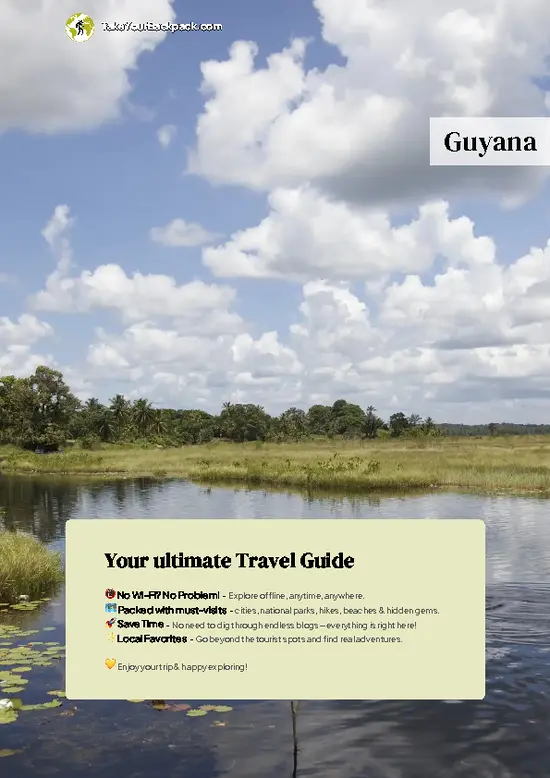
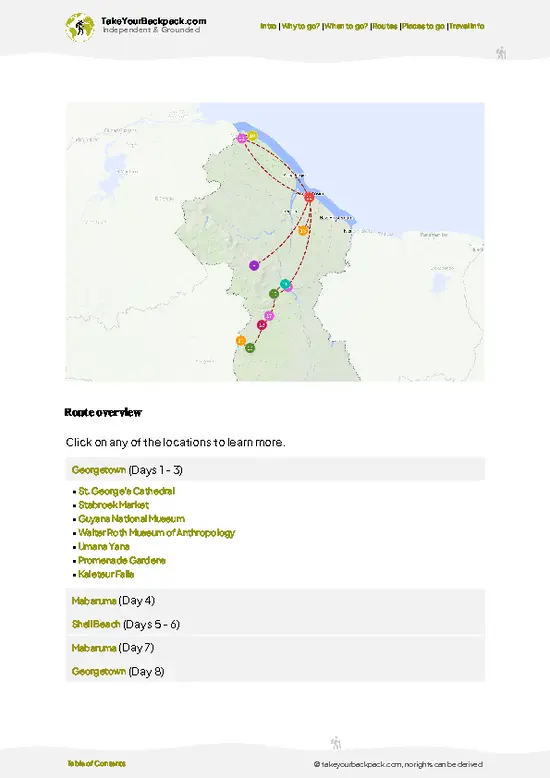
example page 0 from our offline Travel Guide for Guyana
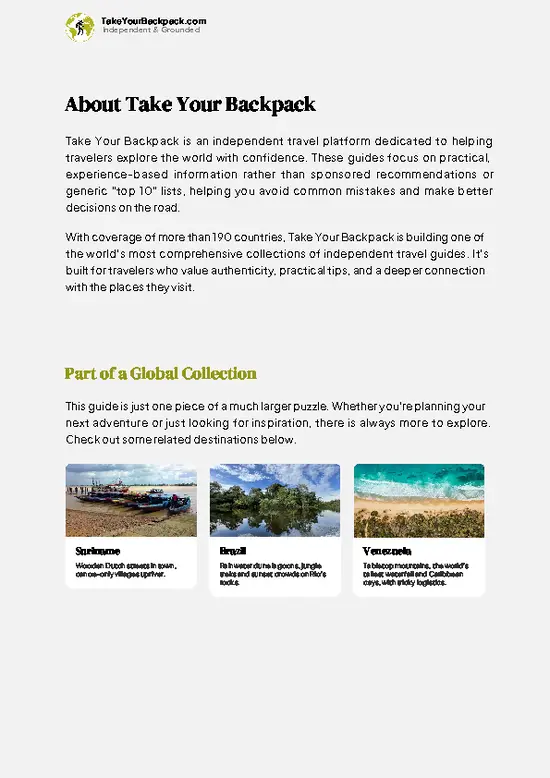
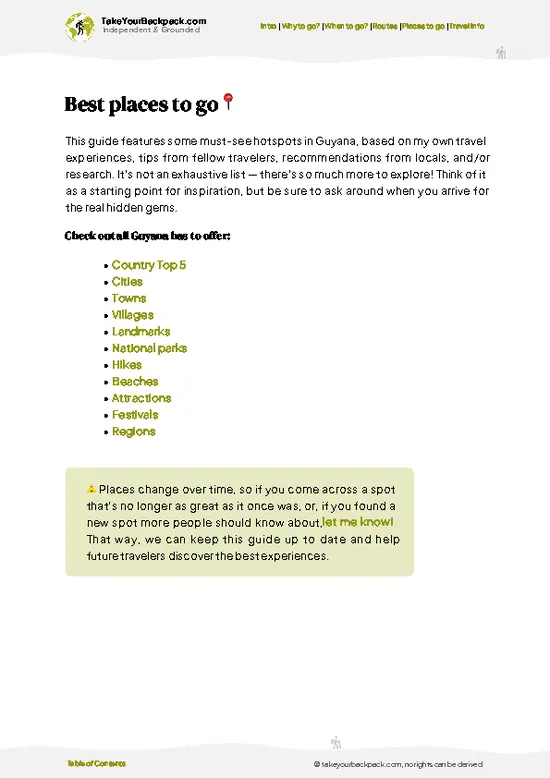
example page 1 from our offline Travel Guide for Guyana
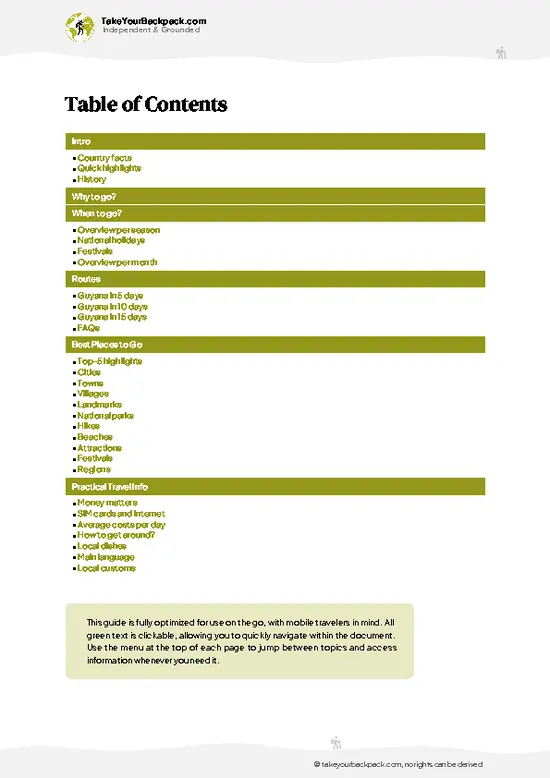
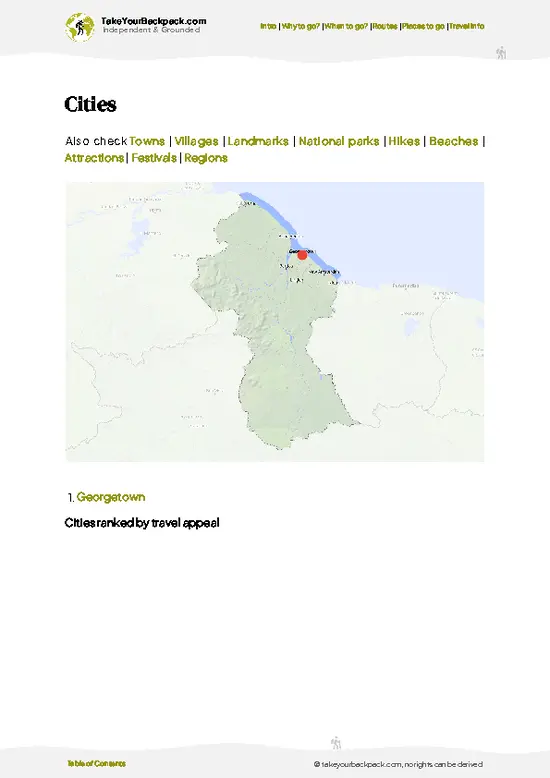
example page 2 from our offline Travel Guide for Guyana
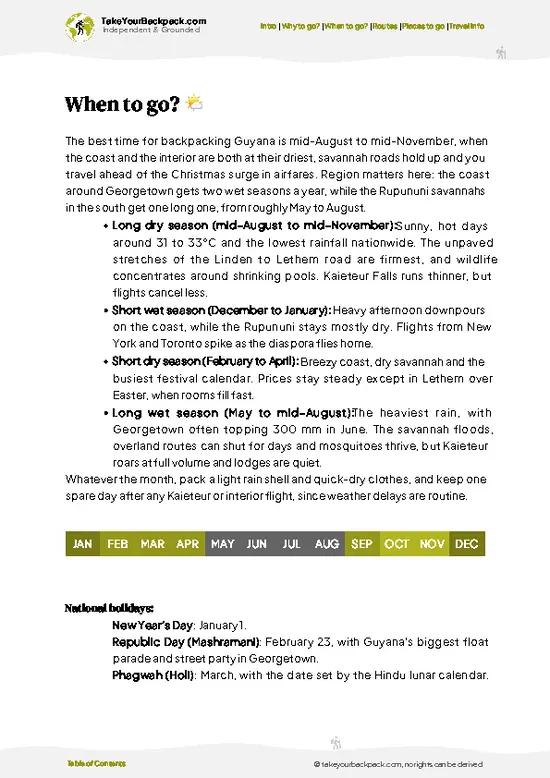
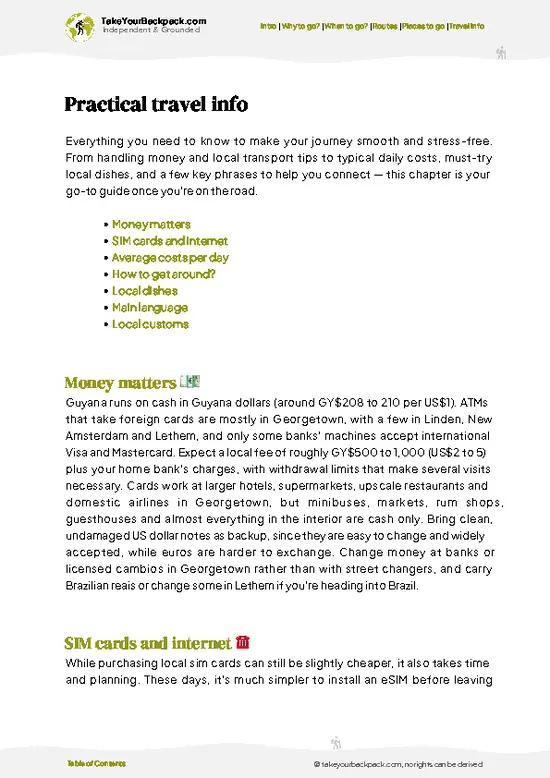
example page 3 from our offline Travel Guide for Guyana
example page 4 from our offline Travel Guide for Guyana
example page 5 from our offline Travel Guide for Guyana
example page 6 from our offline Travel Guide for Guyana
example page 7 from our offline Travel Guide for Guyana
The digital guide (161 pages) contains:
✅ 43 highlights, ranked by travel appeal
✅ Optimized 5, 10 & 15-day travel routes
✅ Cities, national parks, landmarks, beaches
✅ How to get around
✅ Offline-friendly for travel without Wi-Fi
👉 Click to see all 30+ guide features

📅 Plan smarter in minutes, not weeks
✅ Month by month travel advice
✅ Festivals & national holidays
✅ Budget expectations

🗺️ Go to the right places, skip the overrated ones
✅ Honest pros & cons of destinations
✅ Top hikes, parks & viewpoints
✅ Lesser-known places most travelers miss
✅ Clear “worth it vs skip it” guidance

🛏️ Travel smoothly without rookie mistakes
✅ Best areas to stay
✅ Transport systems explained simply
✅ Common scams & safety advice
✅ SIM cards, money & practical tips

🌍 Understand the country, not just visit it
✅ Culture & traditions
✅ Local customs
✅ Festivals worth planning around
✅ Traveler-friendly historical context
✅ Insights that make places more meaningful

📱 Built for real travel conditions
✅ Fully downloadable PDF
✅ Works completely offline
✅ Optimized for phone use
✅ Useful in remote areas & buses
✅ Everything in one place
Stop searching, start planning
Get instant access to your full guide. 30‑day money-back guarantee.
+ Add another guide for just

By proceeding you agree to our terms.
Sent to your inbox immediately after payment • 100% Secure Checkout
Best Backpacking Travel Advisor 2025 tourism awardBest Backpacking
Travel Advisor
2025
What others say about Take Your Backpack Guides:
⭐⭐⭐⭐⭐
Fantastic, amazing amount of information!
⭐⭐⭐⭐⭐
My goodness this is amazing, it's what I've been looking for hats off too you!
⭐⭐⭐⭐⭐
I think this is absolutely BRILLIANT
⭐⭐⭐⭐
Very complete and informative. It's still missing places, but I gotta to commend you
⭐⭐⭐⭐⭐
This is truly amazing, thank you, can't wait to explore it with my kids!
⭐⭐⭐⭐⭐
Awesome resource, thank you!
⭐⭐⭐⭐⭐
This is amazing! Can't wait to explore the ones I haven't seen
⭐⭐⭐⭐
I love this! Well done, great idea.
⭐⭐⭐⭐⭐
Thanks for taking the time to make this gem!
⭐⭐⭐⭐⭐
This might be the best website I've ever seen.
⭐⭐⭐⭐⭐
Congratulations, and thank you so much for your work; it's incredibly valuable.
⭐⭐⭐⭐
In all seriousness I think you did a great job pointing out the important spots
⭐⭐⭐⭐⭐
10/10 very good
⭐⭐⭐⭐⭐
As someone who's only just starting to visit regularly this is awesome, thank you.
⭐⭐⭐⭐
Thank you very much! I'm going to visit my dad, it's going to be very useful!
⭐⭐⭐⭐⭐
This is really cool! We'll be travelling for the first time and this definitely come in handy.
⭐⭐⭐⭐⭐
You are now our minister of culture, congratulations 👨‍💼
⭐⭐⭐⭐⭐
Just wanted to tell you that this is a pearl! Going to follow your recommendations.
⭐⭐⭐⭐⭐
This is so cool. I'll definitely be using the resource for my travels soon.
⭐⭐⭐⭐⭐
This is very impressive! Good work.
⭐⭐⭐⭐⭐
This is an amazing and informative site. Very well done!

🛏️ Where to stay?Where to Base Yourself

Guyana has only a handful of true backpacker hostels, so most budget travelers stay in simple guesthouses and small family-run hotels in Georgetown, where a private room usually costs US$25 to 50 a night. Kingston and the streets near the seawall put you closest to restaurants, bars and weekend nightlife, while leafy Queenstown is quieter and more residential but still walkable to the center. Bel Air and Lamaha Gardens feel safer and calmer after dark at the cost of a taxi ride everywhere, and the area around Stabroek is cheap and central but best avoided once the market closes.

If you enjoy meeting fellow travelers, consider choosing hostels with high ratings for atmosphere. On the other hand, … read more 👉
Guyana has only a handful of true backpacker hostels, so most budget travelers stay in simple guesthouses and small family-run hotels in Georgetown, where a private room usually costs US$25 to 50 a night. Kingston and the streets near the seawall put you closest to restaurants, bars and weekend nightlife, while leafy Queenstown is quieter and more residential but still walkable to the center. Bel Air and Lamaha Gardens feel safer and calmer after dark at the cost of a taxi ride everywhere, and the area around Stabroek is cheap and central but best avoided once the market closes.

If you enjoy meeting fellow travelers, consider choosing hostels with high ratings for atmosphere. On the other hand, if you prefer having your own space, a hotel might be a better option.

GuyanaExpand Your Journey

👋 Meet the founderWho’s Behind Take Your Backpack?

Johan, backpacker and founder of TakeYourBackpackHi, I’m Johan (Netherlands 🇳🇱), the creator of TakeYourBackpack. Over the past 3 decades, I’ve backpacked through 90+ countries across six continents, gaining extensive experience with independent travel, long-term trips, and overland routes.

This site is built on a combination of firsthand travel experience and carefully curated insights from other backpackers. Many guides are based on places I’ve personally visited, while others bring together tips, observations, and practical advice shared by trusted travelers I’ve met along the way.

The goal is to provide realistic, experience-driven guidance — not generic itineraries — so you can explore destinations with better context, clearer expectations, and more confidence.