v2.webp)
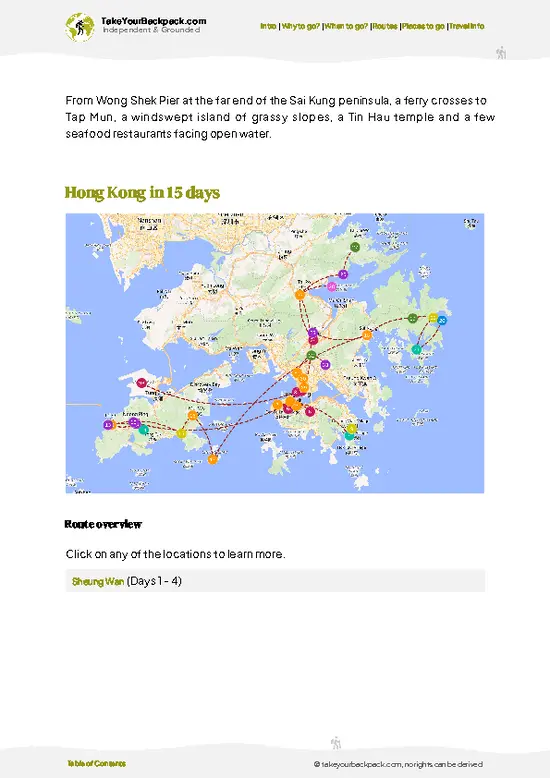
- Pak Tai Temple — One of the island’s oldest temples, central to local religious life and the Bun Festival. It’s not a museum: you’ll see incense, village rituals and ornate wood carvings that tell Cheung Chau’s seafaring history up close.
- Cheung Po Tsai Cave — The legendary pirate cave of Cheung Po Tsai. It’s a real little cavern on the island’s west coast you can walk into, and the pirate stories and views from the short approach make it feel uniquely Cheung Chau.
- Tung Wan Beach (Main Beach) — Sandy, clean, and lively: local swimmers, windsurfers and seafood stalls cluster here. It’s the island’s social hub for sun, sea and cheap eats — a different vibe compared with Hong Kong’s mainland beaches.
- Cheung Chau Market & Praya Street — Narrow lanes of fresh seafood stalls, tiny dai pai dong-style
- Pak Tai Temple — One of the island’s oldest temples, central to local religious life and the Bun Festival. It’s not a museum: you’ll see incense, village rituals and ornate wood carvings that tell Cheung Chau’s seafaring history up close.
- Cheung Po Tsai Cave — The legendary pirate cave of Cheung Po Tsai. It’s a real little cavern on the island’s west coast you can walk into, and the pirate stories and views from the short approach make it feel uniquely Cheung Chau.
- Tung Wan Beach (Main Beach) — Sandy, clean, and lively: local swimmers, windsurfers and seafood stalls cluster here. It’s the island’s social hub for sun, sea and cheap eats — a different vibe compared with Hong Kong’s mainland beaches.
- Cheung Chau Market & Praya Street — Narrow lanes of fresh seafood stalls, tiny dai pai dong-style stalls and bakeries. This is where locals shop and snack; try the island’s fish balls, fresh squid or a bowl of simple noodles and you’ll see why Cheung Chau food culture stands out.
- Bun Festival site and temporary Bun Towers — The Bun Festival is an old, very local celebration and when it’s on the temporary bun towers and parades turn streets and temple squares into something you won’t find anywhere else in Hong Kong. Even off-season, the island’s festival tradition is visible in the temples and murals.
- Island coastal walk / family trail — A compact loop of headlands, rocky coves and quiet lanes that can be done in a few hours. The combination of fishing boats, little beaches and sudden panoramic views makes the walk feel much more intimate and local than bigger hikes elsewhere.
- Kwun Yam Wan (Kwun Yam Bay) — A quieter bay with a more peaceful, local-swim vibe than the main beach. Great early morning for calm water and to watch fishermen tending nets — a low-key, authentic seaside moment most day-trippers miss.
- West-coast rock pools and tide-pooling (Hidden gem) — At low tide the western rocky shores open up with little pools and natural sculptures. Locals and families explore them for marine life; it’s an inexpensive, hands-on nature fix away from the busier sands.
- Harbourfront viewpoints around Pak She Praya (Hidden gem) — Small concrete jetties and low seawalls where fishermen mend nets and locals gather for sunset. No commercial viewpoint, just honest harbor life and great light for photos — especially quiet on weekday evenings.
- Back-alley snacks and old-shop lanes (Hidden gem) — Wander the alleys off the main street and you’ll find tiny bakeries, old tea shops and noodle joints that haven’t changed much in decades. They’re the real everyday Cheung Chau — simple, cheap and full of local character.
Spotted a mistake or missing something? Contact us.

 Best Backpacking
.jpg) Hi, I’m Johan (Netherlands 🇳🇱), the creator of TakeYourBackpack. Over the past 3 decades, I’ve backpacked through 90+ countries across six continents, gaining extensive experience with independent travel, long-term trips, and overland routes.
Hi, I’m Johan (Netherlands 🇳🇱), the creator of TakeYourBackpack. Over the past 3 decades, I’ve backpacked through 90+ countries across six continents, gaining extensive experience with independent travel, long-term trips, and overland routes.