×

Indonesia🇮🇩 | national parksKarimunjawa National ParkIsland-hopping, blacktip reef sharks, white sand cays, shallow snorkeling | things to do and best time to go

Explore Alas Purwo National ParkExplore Baluran National Park

Backpacking in Karimunjawa
👍 Recommendednational park ranked #11
By Johan Kruseman 🇳🇱 | Updated October 15, 2026

Most travelers don't realize Karimunjawa National Park is far less crowded than Komodo or Raja Ampat, yet delivers comparable marine drama and island hiking. Located 90 kilometers off Java's north coast, this 27-island archipelago sits in a sweet spot: accessible enough for independent backpackers, remote enough to feel genuinely off the radar. The park swings between lush jungle trails, coral reefs teeming with reef sharks and turtles, and white-sand beaches where you'll see more monkeys than tourists. I remember anchoring off Geleang Island at dawn, the water so clear I could count fish from the boat before diving. The catch is that logistics require patience: irregular ferries, limited accommodation, and no ATMs mean you plan ahead or improvise. Compared to Bromo or Lombok, Karimunjawa demands more self-reliance but rewards it with solitude.

Discover everything you want to know in the 📖 Indonesia Travel Guide.


example page 0 from our offline Travel Guide for Indonesia
example page 1 from our offline Travel Guide for Indonesia
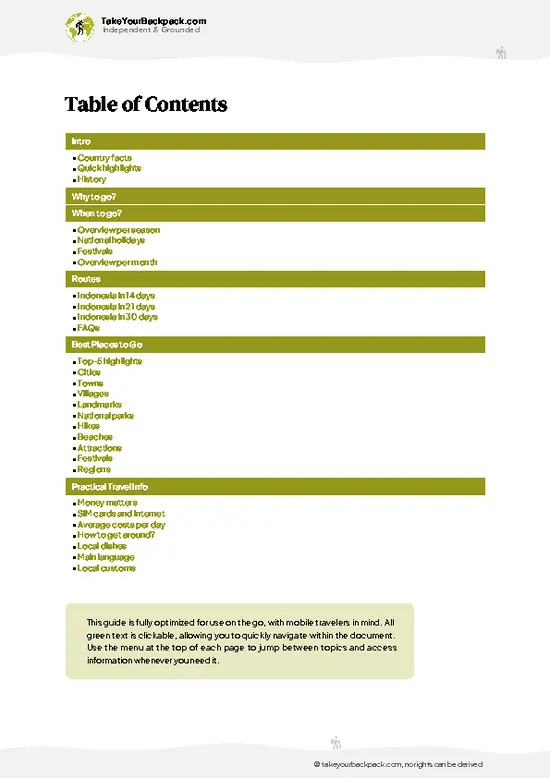
example page 2 from our offline Travel Guide for Indonesia
example page 3 from our offline Travel Guide for Indonesia
example page 4 from our offline Travel Guide for Indonesia
example page 5 from our offline Travel Guide for Indonesia
example page 6 from our offline Travel Guide for Indonesia
example page 7 from our offline Travel Guide for Indonesia
Loading the map 🌍
CLICK TO FILTER
cities
towns
villages
landmarks
national parks
hikes
beaches
attractions
festivals
regions
SHOW COUNTRY’S BESTSHOW ALL

✨ Why go?
Ranked #11 national park in Indonesia
Why Karimunjawa should be on your travel list

Karimunjawa suits backpackers who crave independent island exploration without the infrastructure headaches of more famous parks. You can camp or stay in basic guesthouses for under USD 15 a night, then spend days hiking jungle trails or snorkeling reefs on your own schedule. The park is self-guided friendly: trails are marked, boats are available for hire, and English-speaking locals help navigate. Unlike Komodo, which funnels you through tour operators, Karimunjawa lets you move between islands at your own pace, mixing reef dives with forest hikes. The wildlife is genuine (reef sharks, flying foxes, sea turtles) without the tourist machinery. Budget travelers find the low cost and minimal crowds irresistible, while experienced hikers appreciate the terrain variety and the chance to explore a marine park that still feels like discovery.

💡 HighlightsThe experiences that define the visit

  1. Karimunjawa Island's Jungle Trails: The main island offers the most developed network of forest paths, winding through secondary jungle where you'll spot long-tailed macaques, flying foxes, and endemic bird species. Trails range from 30 minutes to 3 hours and connect coastal viewpoints with inland freshwater springs.
  2. Geleang Island Reef: A short boat ride from the main island, this reef is one of the park's healthiest coral gardens, home to reef sharks, groupers, and dense schools of jacks. Snorkeling is excellent in 3 to 8 meters of water.
  3. Menjangan Kecil (Small Deer Island): A tiny island with pristine white sand and shallow reefs perfect for beginners. The name refers to the small deer that once inhabited it; now it's a quiet spot for swimming and reef exploration.
  4. Cemara Island's Lighthouse:
… read more 👉
  1. Karimunjawa Island's Jungle Trails: The main island offers the most developed network of forest paths, winding through secondary jungle where you'll spot long-tailed macaques, flying foxes, and endemic bird species. Trails range from 30 minutes to 3 hours and connect coastal viewpoints with inland freshwater springs.
  2. Geleang Island Reef: A short boat ride from the main island, this reef is one of the park's healthiest coral gardens, home to reef sharks, groupers, and dense schools of jacks. Snorkeling is excellent in 3 to 8 meters of water.
  3. Menjangan Kecil (Small Deer Island): A tiny island with pristine white sand and shallow reefs perfect for beginners. The name refers to the small deer that once inhabited it; now it's a quiet spot for swimming and reef exploration.
  4. Cemara Island's Lighthouse: A steep climb rewards you with 360-degree views of the archipelago and Java's distant coastline. The trail takes 45 minutes and passes through coastal scrub and coconut groves.
  5. Nyamuk Island's Mangrove Forest: A unique ecosystem where you can kayak or wade through mangrove channels, spotting mudskippers, crabs, and wading birds. It's a different landscape from the coral and jungle elsewhere in the park.
  6. Parang Island's Coral Wall: A deeper dive site (12 to 25 meters) with dramatic coral formations and pelagic fish. Best for experienced snorkelers or divers with a guide.
  7. Burung Island (Bird Island): A nesting site for seabirds and a good spot for birdwatching, especially during breeding season. The island is small but offers views of the open ocean and passing marine life.
I'd start with Geleang Island's reef: it's close, accessible, and gives you an immediate sense of the park's marine richness without requiring a full day's travel.
Spotted a mistake or missing something? Contact us.

🌤️ When to go?Choosing the right time of year

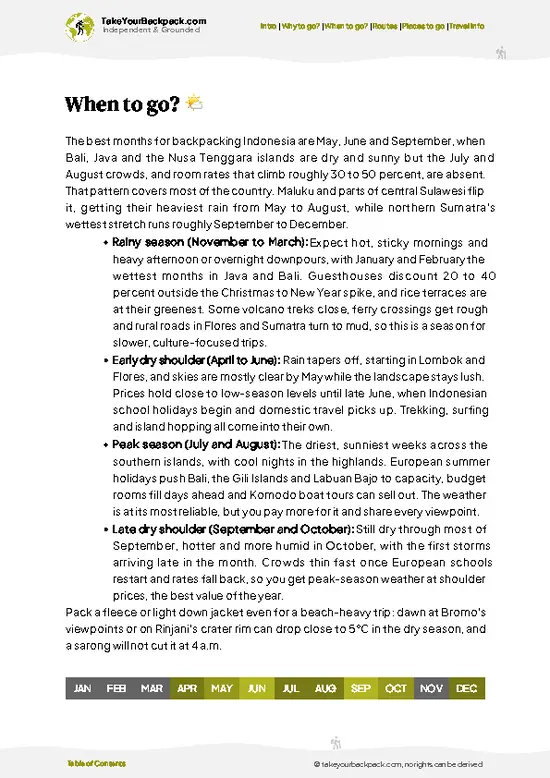
  • Dry Season (May to September): Best window for backpacking. Seas are calm, visibility underwater exceeds 20 meters, and trails are passable. Temperatures hover around 28 to 32°C (82 to 90°F). Daylight runs roughly 12 hours. Expect moderate crowds, especially July and August.
  • Shoulder Months (April, October): Still viable. Weather is transitional but generally stable. Fewer tourists than peak season. Prices remain steady.
  • Rainy Season (November to March): Ferries run sporadically or stop entirely. Trails become muddy and slippery. Visibility underwater drops to 5 to 10 meters. Accommodation prices fall, but logistics become unpredictable.
Plan your visit between May and September for reliable weather and sea access; book ferries in advance during July and August.

source: climatestotravel.comJANJanuary: below average for travelingFEBFebruary: below average for travelingMARMarch: fair for travelingAPRApril: highly recommended for travelingMAYMay: excellent for travelingJUNJune: excellent for travelingJULJuly: excellent for travelingAUGAugust: excellent for travelingSEPSeptember: highly recommended for travelingOCTOctober: highly recommended for travelingNOVNovember: fair for travelingDECDecember: below average for traveling
when-to-go

✈️ The backpacker research shortcutIndonesia Travel Guide

An offline-friendly backpacking guide with optimized travel routes, ranked highlights, transport advice, and the best areas to stay.
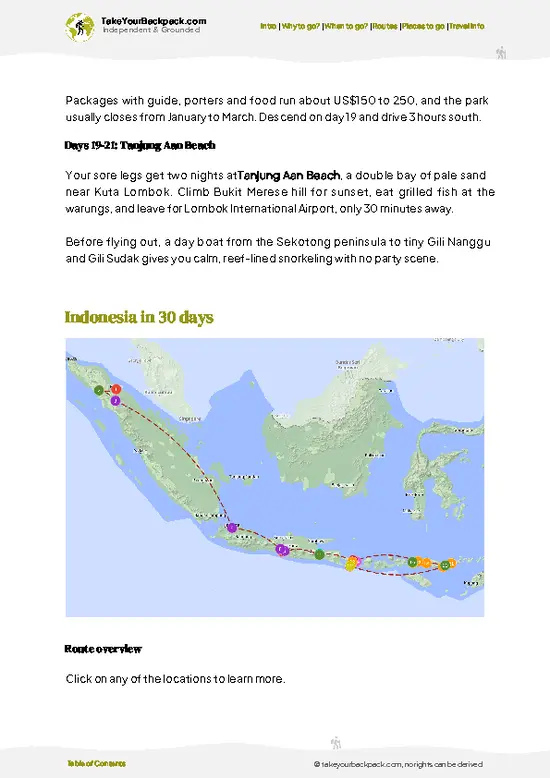
example page 0 from our offline Travel Guide for Indonesia
example page 1 from our offline Travel Guide for Indonesia
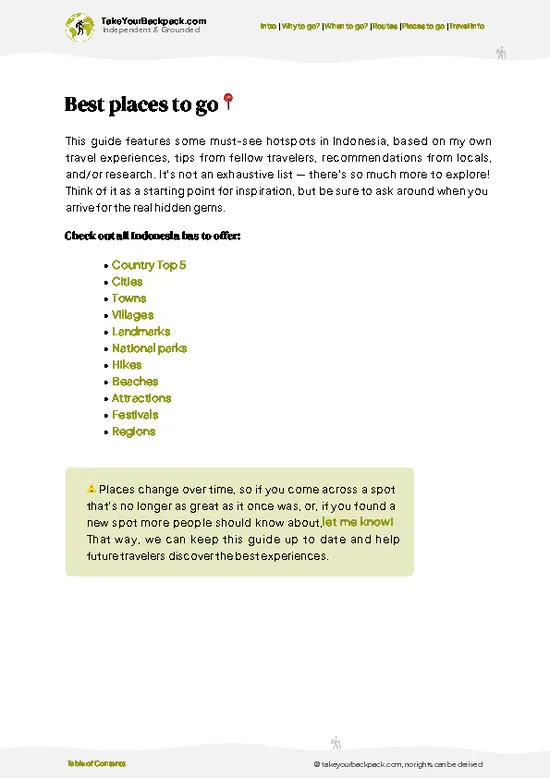
example page 2 from our offline Travel Guide for Indonesia
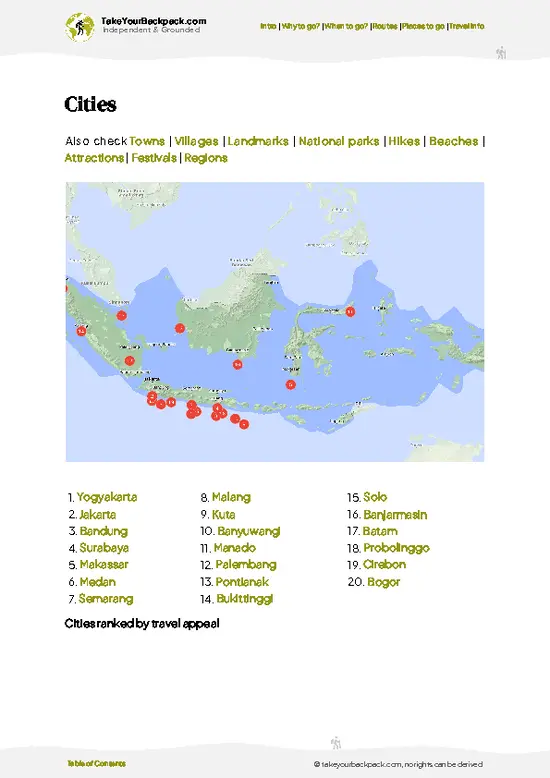
example page 3 from our offline Travel Guide for Indonesia
example page 4 from our offline Travel Guide for Indonesia
example page 5 from our offline Travel Guide for Indonesia
example page 6 from our offline Travel Guide for Indonesia
example page 7 from our offline Travel Guide for Indonesia
The digital guide (460 pages) contains:
✅ 153 highlights, ranked by travel appeal
✅ Optimized 14, 21 & 30-day travel routes
✅ Cities, national parks, landmarks, beaches
✅ How to get around
✅ Offline-friendly for travel without Wi-Fi
👉 Click to see all 30+ guide features

📅 Plan smarter in minutes, not weeks
✅ Month by month travel advice
✅ Festivals & national holidays
✅ Budget expectations

🗺️ Go to the right places, skip the overrated ones
✅ Honest pros & cons of destinations
✅ Top hikes, parks & viewpoints
✅ Lesser-known places most travelers miss
✅ Clear “worth it vs skip it” guidance

🛏️ Travel smoothly without rookie mistakes
✅ Best areas to stay
✅ Transport systems explained simply
✅ Common scams & safety advice
✅ SIM cards, money & practical tips

🌍 Understand the country, not just visit it
✅ Culture & traditions
✅ 52 Essential phrases & customs
✅ Festivals worth planning around
✅ Traveler-friendly historical context
✅ Insights that make places more meaningful

📱 Built for real travel conditions
✅ Fully downloadable PDF
✅ Works completely offline
✅ Optimized for phone use
✅ Useful in remote areas & buses
✅ Everything in one place
Stop searching, start planning
Get instant access to your full guide. 30‑day money-back guarantee.
+ Add another guide for just

By proceeding you agree to our terms.
Sent to your inbox immediately after payment • 100% Secure Checkout
Best Backpacking Travel Advisor 2025 tourism awardBest Backpacking
Travel Advisor
2025
What others say about Take Your Backpack Guides:
⭐⭐⭐⭐⭐
Fantastic, amazing amount of information!
⭐⭐⭐⭐⭐
My goodness this is amazing, it's what I've been looking for hats off too you!
⭐⭐⭐⭐⭐
I think this is absolutely BRILLIANT
⭐⭐⭐⭐
Very complete and informative. It's still missing places, but I gotta to commend you
⭐⭐⭐⭐⭐
This is truly amazing, thank you, can't wait to explore it with my kids!
⭐⭐⭐⭐⭐
Awesome resource, thank you!
⭐⭐⭐⭐⭐
This is amazing! Can't wait to explore the ones I haven't seen
⭐⭐⭐⭐
I love this! Well done, great idea.
⭐⭐⭐⭐⭐
Thanks for taking the time to make this gem!
⭐⭐⭐⭐⭐
This might be the best website I've ever seen.
⭐⭐⭐⭐⭐
Congratulations, and thank you so much for your work; it's incredibly valuable.
⭐⭐⭐⭐
In all seriousness I think you did a great job pointing out the important spots
⭐⭐⭐⭐⭐
10/10 very good
⭐⭐⭐⭐⭐
As someone who's only just starting to visit regularly this is awesome, thank you.
⭐⭐⭐⭐
Thank you very much! I'm going to visit my dad, it's going to be very useful!
⭐⭐⭐⭐⭐
This is really cool! We'll be travelling for the first time and this definitely come in handy.
⭐⭐⭐⭐⭐
You are now our minister of culture, congratulations 👨‍💼
⭐⭐⭐⭐⭐
Just wanted to tell you that this is a pearl! Going to follow your recommendations.
⭐⭐⭐⭐⭐
This is so cool. I'll definitely be using the resource for my travels soon.
⭐⭐⭐⭐⭐
This is very impressive! Good work.
⭐⭐⭐⭐⭐
This is an amazing and informative site. Very well done!

🛏️ Where to stay?Where staying makes the most sense

Accommodation inside Karimunjawa National Park is limited to basic guesthouses and homestays on the main island, ranging from USD 10 to 25 per night for simple rooms with shared bathrooms. Several operators offer beachfront bungalows for USD 30 to 50. Camping is possible but requires coordination with park staff. The main settlement, Karimunjawa Village, has the most options and serves as the hub for boat rentals and supplies. Nearby Semarang, on Java's coast, offers more conventional backpacker hostels (USD 8 to 15) and is the ferry departure point; many travelers spend a night there before heading … read more 👉
Accommodation inside Karimunjawa National Park is limited to basic guesthouses and homestays on the main island, ranging from USD 10 to 25 per night for simple rooms with shared bathrooms. Several operators offer beachfront bungalows for USD 30 to 50. Camping is possible but requires coordination with park staff. The main settlement, Karimunjawa Village, has the most options and serves as the hub for boat rentals and supplies. Nearby Semarang, on Java's coast, offers more conventional backpacker hostels (USD 8 to 15) and is the ferry departure point; many travelers spend a night there before heading to the islands. If you're island-hopping, bring a tent or negotiate homestay rates on smaller islands like Geleang or Menjangan Kecil, though facilities are minimal. Book ahead during peak season (July to August) or accept that you may sleep on boats or improvise with local families.

👛 Costs (as of 15 October 2026)Travel costs and budget guide for Karimunjawa

Daily costs at Karimunjawa National Park run USD 35 to 65 for budget backpackers, depending on accommodation choices and how many islands you visit. Most expenses cluster around transport, camping or guesthouse stays, and park fees. Here's what to expect:
CategoryBudget RangeLocal Reality
Entrance FeeUSD 5 to 10Paid at the park office on Karimunjawa Island; covers access to the marine park for one day
Camping or GuesthouseUSD 8 to 25 per nightBasic beach camping available; guesthouses on the main island range from simple to mid-range; book ahead during peak season
Boat Transport Between IslandsUSD 3 to 8 per tripShared boats run daily; prices vary by distance and operator; negotiate if traveling in a group
Food and SuppliesUSD 12 to 20 dailyWarung meals cost USD 2 to 4; fresh produce and imported
… read more 👉
Daily costs at Karimunjawa National Park run USD 35 to 65 for budget backpackers, depending on accommodation choices and how many islands you visit. Most expenses cluster around transport, camping or guesthouse stays, and park fees. Here's what to expect:
CategoryBudget RangeLocal Reality
Entrance FeeUSD 5 to 10Paid at the park office on Karimunjawa Island; covers access to the marine park for one day
Camping or GuesthouseUSD 8 to 25 per nightBasic beach camping available; guesthouses on the main island range from simple to mid-range; book ahead during peak season
Boat Transport Between IslandsUSD 3 to 8 per tripShared boats run daily; prices vary by distance and operator; negotiate if traveling in a group
Food and SuppliesUSD 12 to 20 dailyWarung meals cost USD 2 to 4; fresh produce and imported goods are pricier than mainland Java; bring non-perishables from Semarang
Snorkeling or Diving Gear RentalUSD 5 to 15Basic snorkel sets available; quality varies; bring your own if you're particular
The biggest hidden cost is the ferry from Semarang to Karimunjawa (USD 15 to 30 return), which many travelers underestimate. Book accommodation before arrival to avoid inflated walk-in rates. Bring cash; ATMs on the main island are limited and unreliable.
⚠️ Prices can change and everyone travels differently, so take this as a rough guide. Hope it helps you plan your adventure!

🥾 TrailsWhere to hike in Karimunjawa: trails for every level

Hiking in Karimunjawa ranges from easy coastal walks to moderate jungle treks. Most trails are on the main island and nearby islets, with terrain that mixes sandy paths, exposed rock, and dense vegetation. You'll encounter roots, steep sections, and occasional scrambling, but nothing technical. Wildlife is present but not aggressive: macaques are curious rather than threatening, and snakes are rare on main trails. The park's real appeal is combining hiking with water-based exploration, so many days blend a morning trek with afternoon snorkeling.

Main Island Loop Trail:
  • Length: 8 to 10 kilometers
  • Duration:
… read more 👉
Hiking in Karimunjawa ranges from easy coastal walks to moderate jungle treks. Most trails are on the main island and nearby islets, with terrain that mixes sandy paths, exposed rock, and dense vegetation. You'll encounter roots, steep sections, and occasional scrambling, but nothing technical. Wildlife is present but not aggressive: macaques are curious rather than threatening, and snakes are rare on main trails. The park's real appeal is combining hiking with water-based exploration, so many days blend a morning trek with afternoon snorkeling.

Main Island Loop Trail:
  • Length: 8 to 10 kilometers
  • Duration: 4 to 5 hours
  • Difficulty: Moderate
  • Features: Coastal viewpoints, jungle canopy, freshwater spring, panoramic views of surrounding islands
  • Terrain: Sandy paths, exposed rock, tree roots, some steep sections

Cemara Island Lighthouse Trail:
  • Length: 1.5 kilometers
  • Duration: 45 minutes to 1 hour
  • Difficulty: Moderate to challenging
  • Features: Steep climb, 360-degree views, coconut groves
  • Terrain: Loose rock, steep gradient, minimal shade

The park is accessible by ferry from Semarang (Java's north coast), a 5 to 6 hour journey that runs 2 to 3 times weekly. Ferries are often delayed or canceled during rough seas, so build buffer time into your schedule. Once on the main island, you hire boats to reach other islands; expect USD 40 to 80 per day for a private boat. Trails are marked but basic, and a local guide (USD 20 to 30 daily) is helpful for wildlife spotting and navigation. The park sees fewer than 10,000 visitors annually, so crowds are minimal except during Indonesian school holidays (July, August, December). Entrance fees are approximately USD 5 to 10 per person, collected at the park office on the main island.
⚠️ Hiking info can sometimes be outdated or inaccurate. Before you hit the trail, check the latest conditions with locals. If you do spot anything that's off, I'd love to hear from you, so I can update it for fellow travelers.

🛡️ SafetyScams, Hazards, and Annoyances

Karimunjawa is generally straightforward for experienced hikers and manageable for first-timers with basic preparation. Trails are well-worn and marked, though navigation can be unclear in dense sections; a local guide eliminates confusion. Heat and humidity are the main physical challenge: start early, carry 2 to 3 liters of water per person, and pace yourself. Reef sharks are present but avoid swimmers; they're not aggressive and typically flee from humans. Sea urchins and stonefish inhabit shallow reefs, so wear reef shoes and watch your footing. Ferry travel is the biggest risk: boats are often overcrowded and lack modern safety equipment. Check weather forecasts before booking and avoid traveling during the rainy season when seas are rough. Dehydration and minor cuts are common; bring … read more 👉
Karimunjawa is generally straightforward for experienced hikers and manageable for first-timers with basic preparation. Trails are well-worn and marked, though navigation can be unclear in dense sections; a local guide eliminates confusion. Heat and humidity are the main physical challenge: start early, carry 2 to 3 liters of water per person, and pace yourself. Reef sharks are present but avoid swimmers; they're not aggressive and typically flee from humans. Sea urchins and stonefish inhabit shallow reefs, so wear reef shoes and watch your footing. Ferry travel is the biggest risk: boats are often overcrowded and lack modern safety equipment. Check weather forecasts before booking and avoid traveling during the rainy season when seas are rough. Dehydration and minor cuts are common; bring a basic first aid kit. The park has no medical facilities, so serious injuries require evacuation to Semarang. Most issues are preventable through pacing, hydration, and respecting local advice on weather and tides.

FAQCommon questions from travelers

Three to four days is ideal: one day to settle and snorkel near the main island, one to two days hiking and island-hopping, and a buffer day for weather delays or boat cancellations. Most backpackers spend two nights camping and one night in a guesthouse. The ferry from Semarang takes 4 to 5 hours each way, so factor that into your timeline.
Yes, but it requires planning. Ferries run from Semarang (on Java) to Karimunjawa Island three times weekly; the journey takes 4 to 5 hours. Once on the islands, shared boats connect the main island to smaller islands for day hikes and snorkeling. No car rental is available or necessary; everything moves by foot or boat.
Yes. The entrance fee is USD 5 to 10 per person per day, paid at the park office on Karimunjawa Island. No advance permit is required for backpackers doing day hikes or camping. If you plan to dive or visit protected zones, inform the park office; some areas have additional restrictions during nesting season (May to August).
⚠️ Things can change over time, so always validate details locally before you go.

Other Indonesian national parks near Karimunjawa

Explore more nearby:


💡 Not sure where to go next?
Create a personalized itinerary for Indonesia including Karimunjawa and the places that fit your trip.

Generate my itinerary

👉 Discover all national parks

Or checkout all Indonesia has to offer (think cities, towns, villages, national parks, hikes, beaches, festivals)
Country photo of Indonesia

We 💚 feedbackIs it worth it?

Karimunjawa delivers genuine tropical island hiking and snorkeling without the crowds of Bali or Lombok, and the trails feel genuinely remote. The catch is that logistics take patience: ferries run on island time, and supplies are limited once you're out there.

✈️ When did I visit Indonesia?
As part of my 1.5 year travel around the world trip, I visited Indonesia twice (and it was worth it): first in September 2015 and a bit later again in January and February 2016.

✍️ Help improve this page!
The information on this page is based on my own backpacking experience in Indonesia, supplemented with up-to-date research and feedback from other travelers. Travel details can change, so if you notice anything outdated or incomplete, feel free to let me know.


🙋‍♂️ Give feedback

👋 Meet the founderWho’s Behind Take Your Backpack?

Johan, backpacker and founder of TakeYourBackpackHi, I’m Johan (Netherlands 🇳🇱), the creator of TakeYourBackpack. Over the past 3 decades, I’ve backpacked through 90+ countries across six continents, gaining extensive experience with independent travel, long-term trips, and overland routes.

This site is built on a combination of firsthand travel experience and carefully curated insights from other backpackers. Many guides are based on places I’ve personally visited, while others bring together tips, observations, and practical advice shared by trusted travelers I’ve met along the way.

The goal is to provide realistic, experience-driven guidance — not generic itineraries — so you can explore destinations with better context, clearer expectations, and more confidence.