×

Indonesia🇮🇩 | landmarksPrambananShiva spire, Hindu reliefs, Ramayana ballet, Yogyakarta plain | things to do and best time to go

Explore Lake TobaExplore Sikidang Crater

Backpacking in Prambanan
UNESCO World Heritage site
🏆 Top pickunique site ranked #2
By Johan Kruseman 🇳🇱 | Updated October 15, 2026

Walk the base of the main Shiva temple slowly and you’ll spot reliefs of a kalpataru, the wish-granting tree, with paired birds and deer-like creatures flanking it. Most visitors power straight up the stairs and miss it. Prambanan sits on the border of Yogyakarta and Central Java, about 17 kilometers east of Yogyakarta city. So get moving. The popular image is a sunrise-gold spire with no one around. The reality is tour groups by 9 a.m., heat that bounces off the stone, and a foreigner ticket far pricier than local entry. Still, the 47-meter Shiva temple, the Ramayana carvings and the ruined shrines across the grounds repay every rupiah. I once pressed my palm to the andesite at 4 p.m. and felt the day’s heat still stored in it, gritty and almost alive. Arrive early, wander the outer ruins, and shoot the spires from the lawns.

Discover everything you want to know in the 📖 Indonesia Travel Guide.


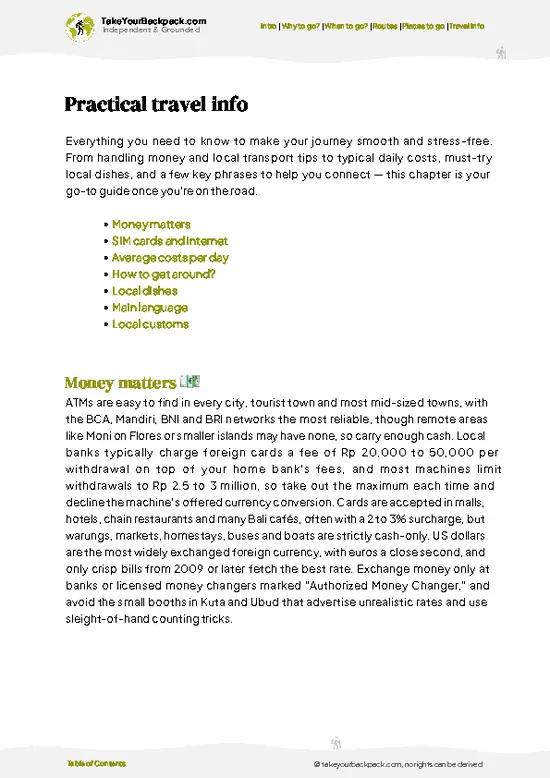
example page 0 from our offline Travel Guide for Indonesia
example page 1 from our offline Travel Guide for Indonesia
example page 2 from our offline Travel Guide for Indonesia
example page 3 from our offline Travel Guide for Indonesia
example page 4 from our offline Travel Guide for Indonesia
example page 5 from our offline Travel Guide for Indonesia
example page 6 from our offline Travel Guide for Indonesia
example page 7 from our offline Travel Guide for Indonesia
Loading the map 🌍
CLICK TO FILTER
cities
towns
villages
landmarks
national parks
hikes
beaches
attractions
festivals
regions
SHOW COUNTRY’S BESTSHOW ALL

✨ Why go?
Ranked #2 unique site in Indonesia
What makes it a must-see unique site

Backpackers make time for Prambanan because it is the largest Hindu temple complex in Indonesia, and it sits in a country better known for Buddhist Borobudur. That contrast alone makes the effort worthwhile. Getting there is easy and cheap: a commuter train or Trans Jogja bus from Yogyakarta covers the distance in 25 to 45 minutes for a few thousand rupiah, and you can be back for lunch. The ticket is the main expense, but it buys a full half day, since the grounds hold hundreds of ruined shrines, a museum and quiet lawns. The site is also a natural link in a wider route. Pair it with Borobudur about 40 kilometers northwest, the Kraton and Malioboro in town, or the nearby Buddhist temples of Sewu and Plaosan. Add Mount Merapi tours or Dieng on the way north, and you have a compact Central … read more 👉
Backpackers make time for Prambanan because it is the largest Hindu temple complex in Indonesia, and it sits in a country better known for Buddhist Borobudur. That contrast alone makes the effort worthwhile. Getting there is easy and cheap: a commuter train or Trans Jogja bus from Yogyakarta covers the distance in 25 to 45 minutes for a few thousand rupiah, and you can be back for lunch. The ticket is the main expense, but it buys a full half day, since the grounds hold hundreds of ruined shrines, a museum and quiet lawns. The site is also a natural link in a wider route. Pair it with Borobudur about 40 kilometers northwest, the Kraton and Malioboro in town, or the nearby Buddhist temples of Sewu and Plaosan. Add Mount Merapi tours or Dieng on the way north, and you have a compact Central Java loop. Few world-class monuments are this close to a backpacker hub with such low hassle.

💡 HighlightsPlaces and moments you shouldn't skip

  1. Candi Shiva: The central temple rises 47 meters on a stepped base and is the tallest in the complex. Its four chambers hold a four-armed Shiva statue and shrines to Durga, Ganesha and Agastya. The Durga statue in the north room is the origin of the Rara Jonggrang legend.
  2. Ramayana Reliefs: Carved panels on the inner balustrades of the Shiva and Brahma temples tell the epic in sequence. Walk clockwise and the story unfolds as you go. The Vishnu temple carries scenes of Krishna’s life.
  3. Candi Brahma and Candi Vishnu: Flanking Shiva, these slimmer temples complete the Trimurti of creator, preserver and destroyer. Each houses one statue, and they make a calmer stop than the main tower.
  4. Vahana Temples: Three small shrines face the main three and were built for the divine mounts. The one opposite Shiva
… read more 👉
  1. Candi Shiva: The central temple rises 47 meters on a stepped base and is the tallest in the complex. Its four chambers hold a four-armed Shiva statue and shrines to Durga, Ganesha and Agastya. The Durga statue in the north room is the origin of the Rara Jonggrang legend.
  2. Ramayana Reliefs: Carved panels on the inner balustrades of the Shiva and Brahma temples tell the epic in sequence. Walk clockwise and the story unfolds as you go. The Vishnu temple carries scenes of Krishna’s life.
  3. Candi Brahma and Candi Vishnu: Flanking Shiva, these slimmer temples complete the Trimurti of creator, preserver and destroyer. Each houses one statue, and they make a calmer stop than the main tower.
  4. Vahana Temples: Three small shrines face the main three and were built for the divine mounts. The one opposite Shiva is dedicated to the bull Nandi. They are easy to skip and worth a look.
  5. Candi Sewu: This Buddhist complex sits about 800 meters north, with a large central temple ringed by hundreds of small shrines. It’s older than Prambanan, and you’ll often share it with only a few visitors.
  6. Ratu Boko Sunset: About 3 kilometers south, this hilltop palace site gives wide views of Prambanan’s spires with Merapi behind. Go for the last hour of light.
  7. Ramayana Ballet: On scheduled evenings, dancers perform the epic with a gamelan orchestra, and the lit temples form the backdrop.
I would start with Candi Shiva and its reliefs at opening time. The carved stone is sharpest in low light, the stairs are empty, and you understand the layout before the crowds arrive.
Spotted a mistake or missing something? Contact us.

Things to do around Prambanan

Ratings based on Tripadvisor reviews. When you book through this link, you support our work at no extra cost to you.

🌤️ When to go?Choosing the right time of year

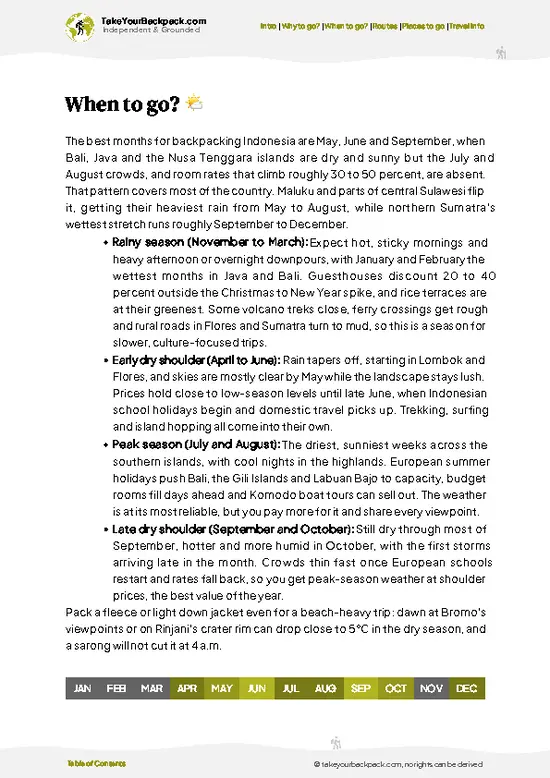
The best time for Prambanan is the dry season from May to September, when skies are clearest and rain rarely interrupts a visit.
  • Dry Season (May to September): Days run 22 to 32°C (72 to 90°F), with cool mornings and low rainfall. Sunrise is around 5:30 a.m. and sunset around 5:30 p.m. Crowds and hotel prices peak in July and August.
  • Wet Season (November to March): Expect 23 to 31°C (73 to 88°F), high humidity and afternoon downpours. The grounds are greener and quieter, and rooms are cheaper. Plan to arrive when gates open.
  • Shoulder Months (April and October): Mostly dry with fewer people, and good value on rooms.
  • Holidays: Indonesian school breaks, Lebaran and Christmas fill the grounds with domestic visitors and push up local prices.
  • Ramayana Ballet Season: The open-air stage shows run mainly
… read more 👉
The best time for Prambanan is the dry season from May to September, when skies are clearest and rain rarely interrupts a visit.
  • Dry Season (May to September): Days run 22 to 32°C (72 to 90°F), with cool mornings and low rainfall. Sunrise is around 5:30 a.m. and sunset around 5:30 p.m. Crowds and hotel prices peak in July and August.
  • Wet Season (November to March): Expect 23 to 31°C (73 to 88°F), high humidity and afternoon downpours. The grounds are greener and quieter, and rooms are cheaper. Plan to arrive when gates open.
  • Shoulder Months (April and October): Mostly dry with fewer people, and good value on rooms.
  • Holidays: Indonesian school breaks, Lebaran and Christmas fill the grounds with domestic visitors and push up local prices.
  • Ramayana Ballet Season: The open-air stage shows run mainly in the dry months on selected evenings, while indoor performances are used in the rain.
Arrive at opening, around 6:30 to 7 a.m., for cooler air, soft light and almost no tour buses.


source: climatestotravel.comJANJanuary: fair for travelingFEBFebruary: fair for travelingMARMarch: fair for travelingAPRApril: fair for travelingMAYMay: highly recommended for travelingJUNJune: excellent for travelingJULJuly: excellent for travelingAUGAugust: excellent for travelingSEPSeptember: highly recommended for travelingOCTOctober: fair for travelingNOVNovember: fair for travelingDECDecember: fair for traveling
when-to-go

✈️ The backpacker research shortcutIndonesia Travel Guide

An offline-friendly backpacking guide with optimized travel routes, ranked highlights, transport advice, and the best areas to stay.
example page 0 from our offline Travel Guide for Indonesia
example page 1 from our offline Travel Guide for Indonesia
example page 2 from our offline Travel Guide for Indonesia
example page 3 from our offline Travel Guide for Indonesia
example page 4 from our offline Travel Guide for Indonesia
example page 5 from our offline Travel Guide for Indonesia
example page 6 from our offline Travel Guide for Indonesia
example page 7 from our offline Travel Guide for Indonesia
The digital guide (469 pages) contains:
✅ 153 highlights, ranked by travel appeal
✅ Optimized 14, 21 & 30-day travel routes
✅ Cities, national parks, landmarks, beaches
✅ How to get around
✅ Offline-friendly for travel without Wi-Fi
👉 Click to see all 30+ guide features

📅 Plan smarter in minutes, not weeks
✅ Month by month travel advice
✅ Festivals & national holidays
✅ Budget expectations

🗺️ Go to the right places, skip the overrated ones
✅ Honest pros & cons of destinations
✅ Top hikes, parks & viewpoints
✅ Lesser-known places most travelers miss
✅ Clear “worth it vs skip it” guidance

🛏️ Travel smoothly without rookie mistakes
✅ Best areas to stay
✅ Transport systems explained simply
✅ Common scams & safety advice
✅ SIM cards, money & practical tips

🌍 Understand the country, not just visit it
✅ Culture & traditions
✅ 52 Essential phrases & customs
✅ Festivals worth planning around
✅ Traveler-friendly historical context
✅ Insights that make places more meaningful

📱 Built for real travel conditions
✅ Fully downloadable PDF
✅ Works completely offline
✅ Optimized for phone use
✅ Useful in remote areas & buses
✅ Everything in one place
Stop searching, start planning
Get instant access to your full guide. 30‑day money-back guarantee.
+ Add another guide for just

By proceeding you agree to our terms.
Sent to your inbox immediately after payment • 100% Secure Checkout
Best Backpacking Travel Advisor 2025 tourism awardBest Backpacking
Travel Advisor
2025
What others say about Take Your Backpack Guides:
⭐⭐⭐⭐⭐
Fantastic, amazing amount of information!
⭐⭐⭐⭐⭐
My goodness this is amazing, it's what I've been looking for hats off too you!
⭐⭐⭐⭐⭐
I think this is absolutely BRILLIANT
⭐⭐⭐⭐
Very complete and informative. It's still missing places, but I gotta to commend you
⭐⭐⭐⭐⭐
This is truly amazing, thank you, can't wait to explore it with my kids!
⭐⭐⭐⭐⭐
Awesome resource, thank you!
⭐⭐⭐⭐⭐
This is amazing! Can't wait to explore the ones I haven't seen
⭐⭐⭐⭐
I love this! Well done, great idea.
⭐⭐⭐⭐⭐
Thanks for taking the time to make this gem!
⭐⭐⭐⭐⭐
This might be the best website I've ever seen.
⭐⭐⭐⭐⭐
Congratulations, and thank you so much for your work; it's incredibly valuable.
⭐⭐⭐⭐
In all seriousness I think you did a great job pointing out the important spots
⭐⭐⭐⭐⭐
10/10 very good
⭐⭐⭐⭐⭐
As someone who's only just starting to visit regularly this is awesome, thank you.
⭐⭐⭐⭐
Thank you very much! I'm going to visit my dad, it's going to be very useful!
⭐⭐⭐⭐⭐
This is really cool! We'll be travelling for the first time and this definitely come in handy.
⭐⭐⭐⭐⭐
You are now our minister of culture, congratulations 👨‍💼
⭐⭐⭐⭐⭐
Just wanted to tell you that this is a pearl! Going to follow your recommendations.
⭐⭐⭐⭐⭐
This is so cool. I'll definitely be using the resource for my travels soon.
⭐⭐⭐⭐⭐
This is very impressive! Good work.
⭐⭐⭐⭐⭐
This is an amazing and informative site. Very well done!

🛏️ Where to stay?Best areas to stay in Indonesia

Stay in Yogyakarta’s Prawirotaman and Sosrowijayan areas, since there are no real backpacker hubs next to Prambanan itself. Both are roughly 17 to 20 kilometers from the temples, with plenty of social hostels, guesthouses and cheap warungs.
Sosrowijayan, near Tugu train station and Malioboro, is the classic backpacker lane. Alleys of dorms and homestays, easy train access and tour desks make it the best choice for solo travelers who want to meet people fast. It is noisy and a bit cramped, but you can reach Prambanan by commuter train from Tugu or Yogyakarta station in about 25 minutes.
Prawirotaman … read more 👉
Stay in Yogyakarta’s Prawirotaman and Sosrowijayan areas, since there are no real backpacker hubs next to Prambanan itself. Both are roughly 17 to 20 kilometers from the temples, with plenty of social hostels, guesthouses and cheap warungs.
Sosrowijayan, near Tugu train station and Malioboro, is the classic backpacker lane. Alleys of dorms and homestays, easy train access and tour desks make it the best choice for solo travelers who want to meet people fast. It is noisy and a bit cramped, but you can reach Prambanan by commuter train from Tugu or Yogyakarta station in about 25 minutes.
Prawirotaman is calmer, with cafes, restaurants, laundry services and a more relaxed mix of long-stay travelers. It is a good base if you want quiet evenings, and rooms often cost a little more. Grab or a Trans Jogja bus gets you to the temple in 40 to 60 minutes.
If you want sunrise at the gates, look at guesthouses in the Prambanan village area or near Maguwoharjo. They are quieter, less social and have fewer eating options, but they save you the early commute. Book ahead in July, August and school holidays.

👛 Costs (as of 15 October 2026)Travel costs and budget guide for Prambanan

A visit to Prambanan costs roughly USD 30 to 55 per day, with the entry ticket making up the largest share.
CategoryBudget RangeLocal Reality
Entry Ticket (foreign adult)USD 22 to 28Foreigners pay far more than locals. Combined tickets with Ratu Boko or Borobudur are sometimes available and cheaper than buying separately.
Transport from YogyakartaUSD 0.50 to 5Trans Jogja bus and KRL commuter train cost under USD 1. A Grab or Gojek car costs USD 3 to 5 each way.
Food and DrinkUSD 3 to 10Warungs near the exit serve nasi campur and noodles for USD 1.50 to 4. Cafes inside cost more.
Ramayana BalletUSD 20 to 45Prices depend on seating class and whether the show is outdoors or indoors.
Guide or Audio GuideUSD 10 to 25Official guides at the gate quote set rates. A guide is helpful for the reliefs but optional.
… read more 👉
A visit to Prambanan costs roughly USD 30 to 55 per day, with the entry ticket making up the largest share.
CategoryBudget RangeLocal Reality
Entry Ticket (foreign adult)USD 22 to 28Foreigners pay far more than locals. Combined tickets with Ratu Boko or Borobudur are sometimes available and cheaper than buying separately.
Transport from YogyakartaUSD 0.50 to 5Trans Jogja bus and KRL commuter train cost under USD 1. A Grab or Gojek car costs USD 3 to 5 each way.
Food and DrinkUSD 3 to 10Warungs near the exit serve nasi campur and noodles for USD 1.50 to 4. Cafes inside cost more.
Ramayana BalletUSD 20 to 45Prices depend on seating class and whether the show is outdoors or indoors.
Guide or Audio GuideUSD 10 to 25Official guides at the gate quote set rates. A guide is helpful for the reliefs but optional.
Lodging in YogyakartaUSD 6 to 25Dorms are USD 6 to 12 and private rooms start around USD 15 to 25.
Carry small notes and water. Card payment works at the ticket office but not in every warung.


source: indonesia.travel
⚠️ Prices can change and everyone travels differently, so take this as a rough guide. Hope it helps you plan your adventure!

FAQTraveler FAQ

Prambanan is a 9th-century Hindu temple complex dedicated to Shiva, Vishnu and Brahma, and a UNESCO World Heritage Site since 1991. Its central Shiva temple stands 47 meters tall and is covered in Ramayana reliefs. The site lies about 17 kilometers east of Yogyakarta on the Central Java border, and the foreigner ticket costs roughly USD 22 to 28.
Plan 2 to 3 hours for the main temples and their reliefs, or 4 to 5 hours if you add the museum and walk the outer ruins. A half day also leaves time for nearby Candi Sewu, about 800 meters north. If you want the Ramayana Ballet in the evening or the sunset at Ratu Boko, set aside a full day.
From Yogyakarta, take the KRL commuter train to Prambanan station (about 25 minutes, under USD 1), then walk or ride a short distance to the gate. The Trans Jogja bus line 1A takes 40 to 60 minutes for under USD 0.50. A Grab or Gojek takes 30 to 45 minutes and costs USD 3 to 5.
⚠️ Things can change over time, so always validate details locally before you go.

Other Indonesian landmarks near Prambanan

Explore more nearby:

  • Borobudur—Nine stacked platforms, 504 Buddha statues, sunrise from Setumbu Hill, Central Java| 36 km away
  • Sikidang Crater—Sulfur vents, Dieng Plateau, boiling mud, highland chill| 88 km away
  • Kawah Putih—Milky-green crater lake, Ciwidey highlands, boardwalk access, cool mist| 347 km away

💡 Not sure where to go next?
Create a personalized itinerary for Indonesia including Prambanan and the places that fit your trip.

Generate my itinerary

👉 Discover all landmarks

Or checkout all Indonesia has to offer (think cities, towns, villages, national parks, hikes, beaches, festivals)
Country photo of Indonesia

We 💚 feedbackParting advice and final tips

Prambanan is worth the price for the carved Ramayana panels alone. Run your eyes along them and the story becomes tangible, far from the selfie crowd. The honest drawback is the midday heat and the foreigner ticket, which costs many times the local price. Go at opening, bring water and a hat, and give yourself enough time for the outer ruins.

✈️ When did I visit Indonesia?
As part of my 1.5 year travel around the world trip, I visited Indonesia twice (and it was worth it): first in September 2015 and a bit later again in January and February 2016.

✍️ Help improve this page!
The information on this page is based on my own backpacking experience in Indonesia, supplemented with up-to-date research and feedback from other travelers. Travel details can change, so if you notice anything outdated or incomplete, feel free to let me know.


🙋‍♂️ Give feedback

👋 Meet the founderWho’s Behind Take Your Backpack?

Johan, backpacker and founder of TakeYourBackpackHi, I’m Johan (Netherlands 🇳🇱), the creator of TakeYourBackpack. Over the past 3 decades, I’ve backpacked through 90+ countries across six continents, gaining extensive experience with independent travel, long-term trips, and overland routes.

This site is built on a combination of firsthand travel experience and carefully curated insights from other backpackers. Many guides are based on places I’ve personally visited, while others bring together tips, observations, and practical advice shared by trusted travelers I’ve met along the way.

The goal is to provide realistic, experience-driven guidance — not generic itineraries — so you can explore destinations with better context, clearer expectations, and more confidence.