v2.webp)
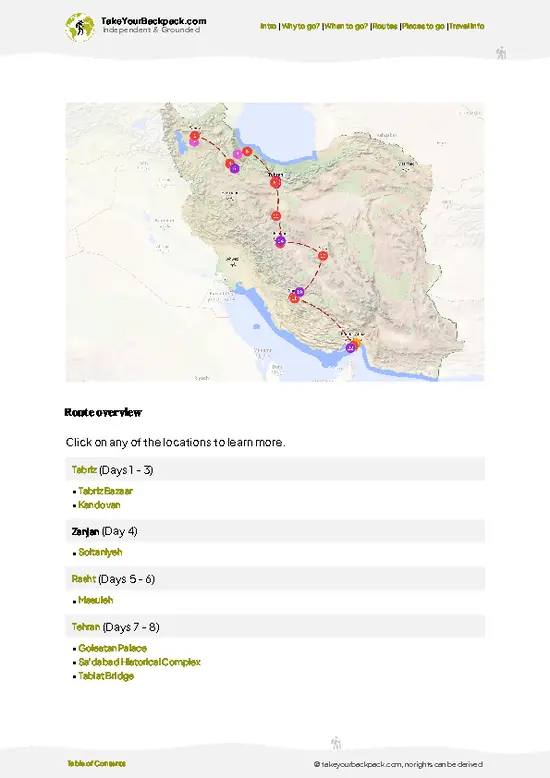
The Rooftop Panorama
Forget the postcard-perfect Instagram angle from the plaza. The real payoff is climbing inside and up to the viewing platform. Tehran sprawls beneath you—smog, traffic, and all—framed by the Alborz mountains. It’s not a sanitized, curated view; it’s the city’s raw pulse. You’ll see the contrast between the modern skyline and the old neighborhoods, and if you catch it at sunset, the city glows with a kind of stubborn optimism that no filter can fake.
The Underside Arches
Most people snap a quick shot and move on, but the real magic is under the tower. The geometric patterns—think Escher meets Persian tilework—are dizzying up close. Stand beneath the arch and look up: the way the light slices through the latticework is a masterclass in architectural drama. It’s a spot that … read more 👉
Forget the postcard-perfect Instagram angle from the plaza. The real payoff is climbing inside and up to the viewing platform. Tehran sprawls beneath you—smog, traffic, and all—framed by the Alborz mountains. It’s not a sanitized, curated view; it’s the city’s raw pulse. You’ll see the contrast between the modern skyline and the old neighborhoods, and if you catch it at sunset, the city glows with a kind of stubborn optimism that no filter can fake.
The Underside Arches
Most people snap a quick shot and move on, but the real magic is under the tower. The geometric patterns—think Escher meets Persian tilework—are dizzying up close. Stand beneath the arch and look up: the way the light slices through the latticework is a masterclass in architectural drama. It’s a spot that … read more 👉
The Rooftop Panorama
Forget the postcard-perfect Instagram angle from the plaza. The real payoff is climbing inside and up to the viewing platform. Tehran sprawls beneath you—smog, traffic, and all—framed by the Alborz mountains. It’s not a sanitized, curated view; it’s the city’s raw pulse. You’ll see the contrast between the modern skyline and the old neighborhoods, and if you catch it at sunset, the city glows with a kind of stubborn optimism that no filter can fake.
The Underside Arches
Most people snap a quick shot and move on, but the real magic is under the tower. The geometric patterns—think Escher meets Persian tilework—are dizzying up close. Stand beneath the arch and look up: the way the light slices through the latticework is a masterclass in architectural drama. It’s a spot that makes you feel both tiny and part of something enormous, and you’ll hear your own voice echo in a way that’s oddly grounding.
The Museum Inside
Azadi Tower isn’t just a hollow monument. The basement museum is a crash course in Iranian history, but not the dry, textbook kind. You’ll find artifacts, old coins, and a timeline that puts the tower in context—built in 1971, it’s a mashup of ancient Persian motifs and 1970s ambition. The exhibits are compact but punchy, and you’ll leave with a sense of how fiercely Iran guards its identity, even as it reinvents itself.
The Nighttime Light Show
By day, the tower is all white marble and sharp lines. At night, it transforms. LED lights ripple across the surface, sometimes in national colors, sometimes in wild, abstract patterns. It’s not subtle, but it’s pure spectacle—Tehran’s answer to the Eiffel Tower’s sparkle, minus the tourist mobs. Locals hang out on the grass, couples stroll, and the vibe is more block party than tourist trap.
The People-Watching
Azadi Tower is Tehran’s unofficial living room. You’ll see everything from skateboarders and street musicians to families picnicking and students debating politics. It’s a crash course in modern Iranian life, unscripted and unfiltered. If you want to understand the city’s energy, skip the selfie and just sit on the steps for an hour. The stories walk right past you.
Forget the postcard-perfect Instagram angle from the plaza. The real payoff is climbing inside and up to the viewing platform. Tehran sprawls beneath you—smog, traffic, and all—framed by the Alborz mountains. It’s not a sanitized, curated view; it’s the city’s raw pulse. You’ll see the contrast between the modern skyline and the old neighborhoods, and if you catch it at sunset, the city glows with a kind of stubborn optimism that no filter can fake.
The Underside Arches
Most people snap a quick shot and move on, but the real magic is under the tower. The geometric patterns—think Escher meets Persian tilework—are dizzying up close. Stand beneath the arch and look up: the way the light slices through the latticework is a masterclass in architectural drama. It’s a spot that makes you feel both tiny and part of something enormous, and you’ll hear your own voice echo in a way that’s oddly grounding.
The Museum Inside
Azadi Tower isn’t just a hollow monument. The basement museum is a crash course in Iranian history, but not the dry, textbook kind. You’ll find artifacts, old coins, and a timeline that puts the tower in context—built in 1971, it’s a mashup of ancient Persian motifs and 1970s ambition. The exhibits are compact but punchy, and you’ll leave with a sense of how fiercely Iran guards its identity, even as it reinvents itself.
The Nighttime Light Show
By day, the tower is all white marble and sharp lines. At night, it transforms. LED lights ripple across the surface, sometimes in national colors, sometimes in wild, abstract patterns. It’s not subtle, but it’s pure spectacle—Tehran’s answer to the Eiffel Tower’s sparkle, minus the tourist mobs. Locals hang out on the grass, couples stroll, and the vibe is more block party than tourist trap.
The People-Watching
Azadi Tower is Tehran’s unofficial living room. You’ll see everything from skateboarders and street musicians to families picnicking and students debating politics. It’s a crash course in modern Iranian life, unscripted and unfiltered. If you want to understand the city’s energy, skip the selfie and just sit on the steps for an hour. The stories walk right past you.
Spotted a mistake or missing something? Contact us.

 Best Backpacking
.jpg) Hi, I’m Johan (Netherlands 🇳🇱), the creator of TakeYourBackpack. Over the past 3 decades, I’ve backpacked through 90+ countries across six continents, gaining extensive experience with independent travel, long-term trips, and overland routes.
Hi, I’m Johan (Netherlands 🇳🇱), the creator of TakeYourBackpack. Over the past 3 decades, I’ve backpacked through 90+ countries across six continents, gaining extensive experience with independent travel, long-term trips, and overland routes.