×

Iraq🇮🇶 | landmarksUrziggurat, ancient Sumer, royal tombs, desert plateau | things to do and best time to go

Explore Mesopotamian MarshesExplore Babylon

Backpacking in Ur
🌟 Highlightunique site ranked #3
By Johan Kruseman 🇳🇱 | Updated June 10, 2026

Most people online talk about Ur like it’s some lost city in the desert, but the surprising truth for backpackers is that you’ll probably have this world-class archaeological site almost entirely to yourself. Ur sits in southern Iraq, near Nasiriyah in Dhi Qar Governorate, in a flat, sun-blasted landscape that feels more worksite than theme park. The ziggurat has serious wow-factor in person: huge, geometric, and eerily intact, with a weight that hits harder than most “famous” ruins you’ve queued hours for elsewhere. There’s almost no crowd, no café culture, and very little shade, so the vibe is raw, quiet, and a bit military-adjacent due to nearby bases and checkpoints. Costs on-site are low, but getting here safely and legally isn’t. Photo potential is excellent if you like stark lines, big skies, and ruins over romance, but don’t come expecting polished infrastructure or backpacker buzz.

Discover everything you want to know in the 📖 Iraq Travel Guide.
Safety warning

The current risk level for Iraq is high. Check the advice before going.


Get your Iraq guide
107 ranked highlights, routes & tips, works offline (375 pages)
Loading the map 🌍
CLICK TO FILTER
cities
towns
landmarks
national parks
hikes
beaches
attractions
festivals
regions
SHOW COUNTRY’S BESTSHOW ALL

✨ Why go?
Ranked #3 unique site in Iraq
What sets this place apart

The Ziggurat of Ur isn’t just a relic; it’s a time capsule that transports you back to the cradle of civilization. Sure, it’s not the Instagram darling you might expect, often overshadowed by flashier sites. But that’s where the real magic lies.

You’ll dodge the crowds, and the cost? Minimal. A few bucks gets you in, and you’ll likely have the place to yourself. This isn’t a tourist trap; it’s a chance to stand where ancient Sumerians once thrived.

The uniqueness of Ur is palpable. The ziggurat, with its towering structure and intricate brickwork, is a testament to human ingenuity. It’s not just about the site; it’s about the stories woven into the land.

Plus, it fits perfectly into a broader route through southern Iraq. Pair it with a visit to Nasiriyah or the nearby Euphrates Riverread more 👉
The Ziggurat of Ur isn’t just a relic; it’s a time capsule that transports you back to the cradle of civilization. Sure, it’s not the Instagram darling you might expect, often overshadowed by flashier sites. But that’s where the real magic lies.

You’ll dodge the crowds, and the cost? Minimal. A few bucks gets you in, and you’ll likely have the place to yourself. This isn’t a tourist trap; it’s a chance to stand where ancient Sumerians once thrived.

The uniqueness of Ur is palpable. The ziggurat, with its towering structure and intricate brickwork, is a testament to human ingenuity. It’s not just about the site; it’s about the stories woven into the land.

Plus, it fits perfectly into a broader route through southern Iraq. Pair it with a visit to Nasiriyah or the nearby Euphrates River for a rich tapestry of experiences. Backpackers know: it’s not just about the destination, but the journey that makes it worthwhile.
Get the complete Travel Guide for Iraq
Everything organized for offline planning — routes, highlights, costs & tips

See what’s inside 👉

Get the Travel Guide -

💡 HighlightsThe experiences that define the visit

  • Ziggurat of Ur — The giant stepped temple platform built for the moon god Nanna (around 2100 BCE). Its restored burnt-brick façade sitting on a mudbrick core is the single most iconic thing here; climb the ramps, watch the light change at sunrise or sunset and you’ll feel why rulers poured resources into these skyward stages.
  • Royal Cemetery and Tombs — A cluster of spectacular burials where chariots, jewelry and ritual goods were buried with the elite. The archaeology here (many finds now in museums) gives a raw, human glimpse of Sumerian death rites and social hierarchy — dramatic and sobering in equal measure.
  • Street plans and mudbrick city remains — You can still pick out house foundations, lanes and city blocks in the tell. It’s a hands-on lesson in one of the world’s earliest cities:
read more 👉
  • Ziggurat of Ur — The giant stepped temple platform built for the moon god Nanna (around 2100 BCE). Its restored burnt-brick façade sitting on a mudbrick core is the single most iconic thing here; climb the ramps, watch the light change at sunrise or sunset and you’ll feel why rulers poured resources into these skyward stages.
  • Royal Cemetery and Tombs — A cluster of spectacular burials where chariots, jewelry and ritual goods were buried with the elite. The archaeology here (many finds now in museums) gives a raw, human glimpse of Sumerian death rites and social hierarchy — dramatic and sobering in equal measure.
  • Street plans and mudbrick city remains — You can still pick out house foundations, lanes and city blocks in the tell. It’s a hands-on lesson in one of the world’s earliest cities: urban planning, neighborhoods, and how people lived day-to-day nearly five millennia ago.
  • Traces of craft and long-distance trade — Look for evidence of workshops and imported materials (lapis, copper) that show Ur wasn’t isolated. The scale and variety of goods here tell the story of early global trade networks and specialized artisanship.
  • Panoramic view over the plain and former Euphrates course — From the tell you get a clear sense of the landscape that fed Sumerian civilization: river channels, irrigated fields and marsh edges. It’s quietly beautiful and helps explain why people settled here in the first place.
  • Restoration and archaeological trenches — Ongoing conservation work and exposed digs let you watch archaeology in action: preserved bricks, trench profiles and modern interventions that reveal both ancient technique and modern stewardship challenges.
  • Local life at the foot of the tell — Small villages, shepherds and date palms surround the site. Interacting respectfully with locals (and sipping tea if offered) is one of the best ways to connect past and present — just remember to be low-key and polite.
Spotted a mistake or missing something? Contact us.
🌤️ When to go?When to go for the best experience


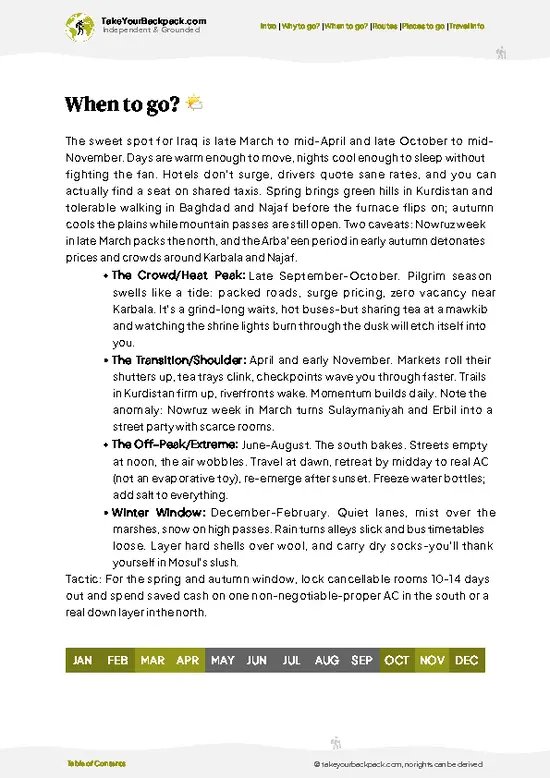
  • Weather: Summers in Ur scorch with highs often hitting 40°C (104°F) or more, turning exploration into a sweaty slog. Winters are mild and dry, with temperatures ranging from 10°C to 20°C (50°F to 68°F), making it the only sensible window for a visit.

  • Temperature: Spring and autumn offer a sweet spot—daytime temps hover around 20-25°C (68-77°F), perfect for wandering ruins without frying or freezing. Nights can dip to 10°C (50°F), so pack layers.

  • Daylight Hours: Expect roughly 10 to 12 hours of daylight year-round. Longer days in summer mean more time to explore, but the heat kills the vibe. Winter’s shorter days limit your window but keep things comfortable.

  • Crowds: Forget Instagram’s empty ruins fantasy. Peak season (late autumn to early spring) draws local tourists and history buffs,
read more 👉

  • Weather: Summers in Ur scorch with highs often hitting 40°C (104°F) or more, turning exploration into a sweaty slog. Winters are mild and dry, with temperatures ranging from 10°C to 20°C (50°F to 68°F), making it the only sensible window for a visit.

  • Temperature: Spring and autumn offer a sweet spot—daytime temps hover around 20-25°C (68-77°F), perfect for wandering ruins without frying or freezing. Nights can dip to 10°C (50°F), so pack layers.

  • Daylight Hours: Expect roughly 10 to 12 hours of daylight year-round. Longer days in summer mean more time to explore, but the heat kills the vibe. Winter’s shorter days limit your window but keep things comfortable.

  • Crowds: Forget Instagram’s empty ruins fantasy. Peak season (late autumn to early spring) draws local tourists and history buffs, but crowds are manageable—nothing like the crush at more famous sites.

  • Seasonal Activities: No flashy festivals here, but winter months sometimes bring local cultural events and markets nearby, adding authentic flavor to your trip.

  • Price Fluctuations: Off-season (summer) sees lower accommodation and transport costs, but the brutal heat makes it a false economy. Shoulder seasons balance decent prices with tolerable weather.


Pro-tip: Aim for late October to early April—cooler temps, fewer crowds, and a chance to catch local life beyond the ruins.


source: climatestotravel.comJANJanuary: excellent for travelingFEBFebruary: excellent for travelingMARMarch: excellent for travelingAPRApril: highly recommended for travelingMAYMay: fair for travelingJUNJune: below average for travelingJULJuly: below average for travelingAUGAugust: below average for travelingSEPSeptember: fair for travelingOCTOctober: highly recommended for travelingNOVNovember: excellent for travelingDECDecember: excellent for traveling
when-to-go

✈️ The backpacker research shortcutIraq Travel Guide

An offline-friendly backpacking guide with optimized travel routes, ranked highlights, transport advice, and the best areas to stay.
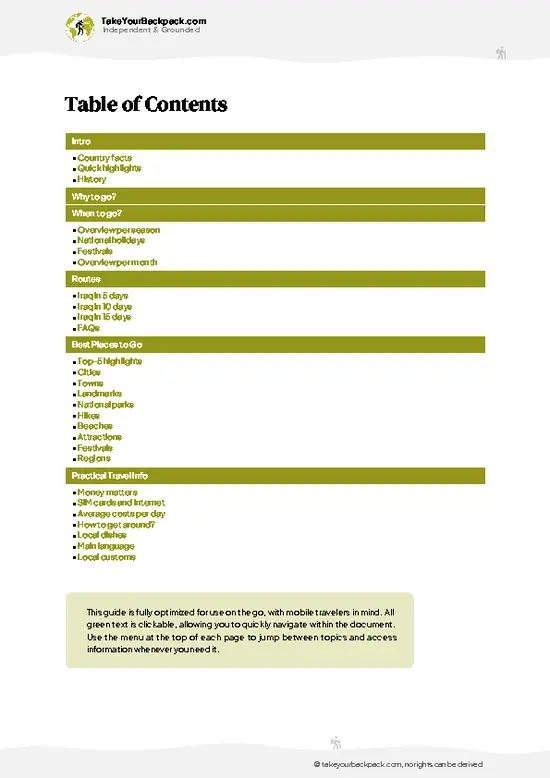
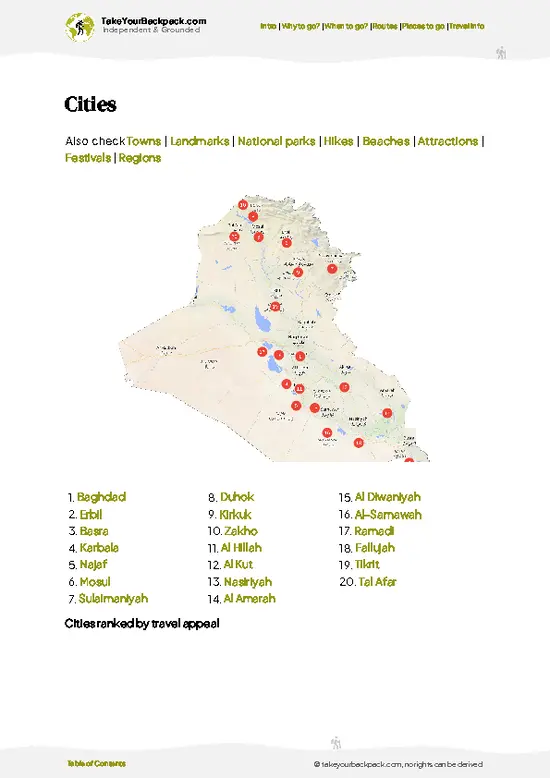
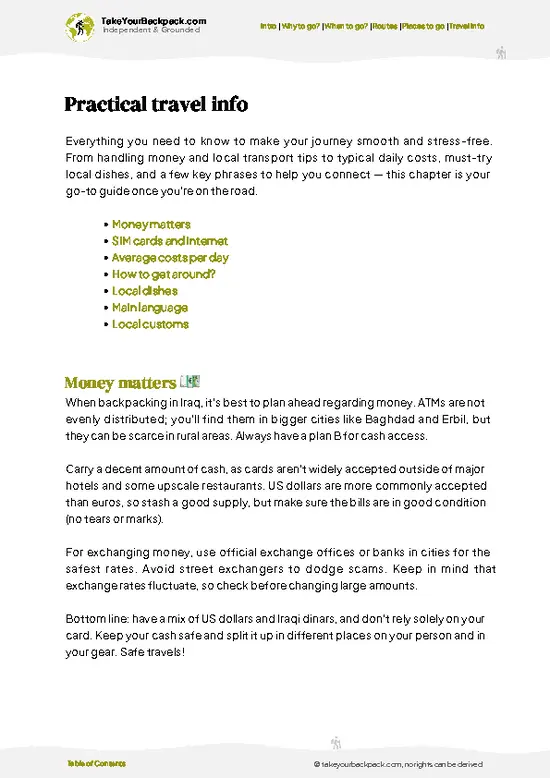
example page 0 from our offline Travel Guide for Iraqexample page 1 from our offline Travel Guide for Iraqexample page 2 from our offline Travel Guide for Iraqexample page 3 from our offline Travel Guide for Iraqexample page 4 from our offline Travel Guide for Iraqexample page 5 from our offline Travel Guide for Iraqexample page 6 from our offline Travel Guide for Iraqexample page 7 from our offline Travel Guide for Iraq
The digital guide (375 pages) contains:
107 highlights, ranked by travel appeal
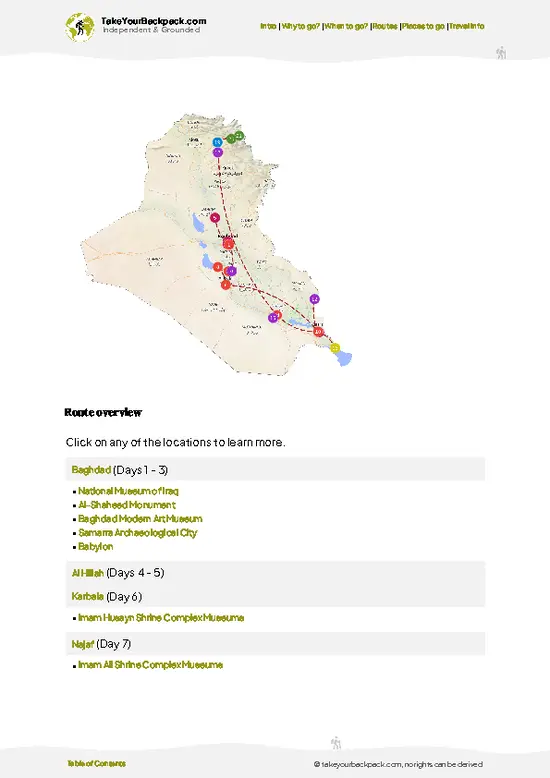
Optimized 5, 10 & 15-day travel routes
Cities, national parks, beaches, historical sites, ...
How to get around
Offline-friendly for travel without Wi-Fi
👉 Click to see all 30+ guide features

📅 Plan smarter in minutes, not weeks
Month by month travel advice
Festivals & national holidays
Budget expectations

🗺️ Go to the right places, skip the overrated ones
Honest pros & cons of destinations
Top hikes, parks & viewpoints
Lesser-known places most travelers miss
Clear “worth it vs skip it” guidance

🛏️ Travel smoothly without rookie mistakes
Best areas to stay
Transport systems explained simply
Common scams & safety advice
SIM cards, money & practical tips

🌍 Understand the country, not just visit it
Culture & traditions
52 Essential phrases & customs
Festivals worth planning around
Traveler-friendly historical context
Insights that make places more meaningful

📱 Built for real travel conditions
Fully downloadable PDF
Works completely offline
Optimized for phone use
Useful in remote areas & buses
Everything in one place
Save weeks of stressful planning
Get instant access to the full guide directly. 30-day money-back guarantee.


Sent to your inbox immediately after payment • 100% Secure Checkout
Best Backpacking Travel Advisor 2025 tourism awardBest Backpacking
Travel Advisor
2025
What others say about Take Your Backpack Guides:
⭐⭐⭐⭐⭐
Fantastic, amazing amount of information!
⭐⭐⭐⭐⭐
My goodness this is amazing, it's what I've been looking for hats off too you!
⭐⭐⭐⭐⭐
I think this is absolutely BRILLIANT
⭐⭐⭐⭐
Very complete and informative. It's still missing places, but I gotta to commend you
⭐⭐⭐⭐⭐
This is truly amazing, thank you, can't wait to explore it with my kids!
⭐⭐⭐⭐⭐
Awesome resource, thank you!
⭐⭐⭐⭐⭐
This is amazing! Can't wait to explore the ones I haven't seen
⭐⭐⭐⭐
I love this! Well done, great idea.
⭐⭐⭐⭐⭐
Thanks for taking the time to make this gem!
⭐⭐⭐⭐⭐
This might be the best website I've ever seen.
⭐⭐⭐⭐⭐
Congratulations, and thank you so much for your work; it's incredibly valuable.
⭐⭐⭐⭐
In all seriousness I think you did a great job pointing out the important spots
⭐⭐⭐⭐⭐
10/10 very good
⭐⭐⭐⭐⭐
As someone who's only just starting to visit regularly this is awesome, thank you.
⭐⭐⭐⭐
Thank you very much! I'm going to visit my dad, it's going to be very useful!
⭐⭐⭐⭐⭐
This is really cool! We'll be travelling for the first time and this definitely come in handy.
⭐⭐⭐⭐⭐
You are now our minister of culture, congratulations 👨‍💼
⭐⭐⭐⭐⭐
Just wanted to tell you that this is a pearl! Going to follow your recommendations.
⭐⭐⭐⭐⭐
This is so cool. I'll definitely be using the resource for my travels soon.
⭐⭐⭐⭐⭐
This is very impressive! Good work.
⭐⭐⭐⭐⭐
This is an amazing and informative site. Very well done!

🛏️ Where to stay?Best areas to stay in Iraq

Staying near the ancient site of ’Ur’ in Iraq can feel like stepping into a time machine, but let’s cut through the hype. The area isn’t overflowing with options, and the ones that exist can be a mixed bag.

First off, look to the city of Nasiriyah. It’s your best bet for budget travelers. The vibe here is laid-back, and you’ll find a few guesthouses that cater to backpackers. They’re not fancy, but they’re safe and offer a chance to meet fellow travelers. You’ll want to brush up on your Arabic or at least have a translation app handy; English isn’t widely spoken.

Another option is to stay in … read more 👉
Staying near the ancient site of ’Ur’ in Iraq can feel like stepping into a time machine, but let’s cut through the hype. The area isn’t overflowing with options, and the ones that exist can be a mixed bag.

First off, look to the city of Nasiriyah. It’s your best bet for budget travelers. The vibe here is laid-back, and you’ll find a few guesthouses that cater to backpackers. They’re not fancy, but they’re safe and offer a chance to meet fellow travelers. You’ll want to brush up on your Arabic or at least have a translation app handy; English isn’t widely spoken.

Another option is to stay in the outskirts of ’Ur’ itself. There are some local accommodations that might not pop up on your usual booking sites. These spots give you a more authentic experience, and you can soak in the local culture. Just be prepared for basic amenities and a bit of a language barrier.

Crowds? Expect them at the site, especially during weekends. But if you go early in the morning or later in the afternoon, you’ll have a moment to breathe and truly appreciate the history. The real magic lies in the stories you’ll hear from locals and the quiet moments you carve out for yourself.

👛 Costs (as of 21 June 2026)What things cost and how to budget

Visiting Ur, Iraq, is a journey into the heart of ancient civilization, but it comes with its own set of costs and considerations. Here’s the real deal on what you can expect to spend.
  • Entry Fees: Expect to pay around $5 to $10 for entry to the archaeological site. This fee supports preservation efforts, but it’s a small price for stepping into history.
  • Transportation: Getting to Ur can be tricky. If you’re traveling from Nasiriyah, a taxi might cost you between $20 and $30. Public transport is cheaper but less reliable, so budget for potential delays.
  • Accommodation: Options are limited. A basic hotel in Nasiriyah will run you about $30 to $50 per night. For a more comfortable stay, expect to pay $70 or more. Booking in advance is wise, especially during peak travel times.
  • Food: Local eateries
read more 👉
Visiting Ur, Iraq, is a journey into the heart of ancient civilization, but it comes with its own set of costs and considerations. Here’s the real deal on what you can expect to spend.
  • Entry Fees: Expect to pay around $5 to $10 for entry to the archaeological site. This fee supports preservation efforts, but it’s a small price for stepping into history.
  • Transportation: Getting to Ur can be tricky. If you’re traveling from Nasiriyah, a taxi might cost you between $20 and $30. Public transport is cheaper but less reliable, so budget for potential delays.
  • Accommodation: Options are limited. A basic hotel in Nasiriyah will run you about $30 to $50 per night. For a more comfortable stay, expect to pay $70 or more. Booking in advance is wise, especially during peak travel times.
  • Food: Local eateries are affordable. A meal can cost anywhere from $3 to $10. If you’re craving something more upscale, budget around $15 to $25 for a nice dinner.
  • Guided Tours: Hiring a local guide can enhance your experience. Expect to pay around $50 to $100 for a half-day tour. This investment can provide insights you won’t get from guidebooks.

Be prepared for the realities of travel in Iraq. Crowds can vary, and while you might not have the place to yourself, the experience is rich with history and culture.
⚠️ Prices can change and everyone travels differently, so take this as a rough guide. Hope it helps you plan your adventure!

Other Iraqi landmarks near Ur

Explore more nearby:

  • Mesopotamian Marshes—reed islands, water buffalo, Ma'dan villages, winding waterways| 165 km away
  • Babylon—Ishtar Gate, lion reliefs, palace ruins, Euphrates proximity| 223 km away
  • Khadimiyah—golden domes, Shia pilgrimage, bustling bazaar, shrine complex| 316 km away

👉 Discover all landmarks

Or checkout all Iraq has to offer (think cities, towns, villages, national parks, hikes, beaches, festivals)
Country photo of Iraq

We 💚 feedbackFinal thoughts on visiting Ur

Ur is a raw slice of history, but don’t expect a polished tourist experience. The vibe is quiet, almost eerie, with ancient ruins whispering stories of a civilization long gone. The best surprise? The locals are genuinely warm and eager to share their culture. Just be prepared for the heat and the occasional crowd of curious visitors. It’s not about the Instagram shots; it’s about standing where humanity began. Embrace the grit, and you’ll find the real magic.

✍️ Help improve this page!
The information on this page is based on in-depth research, insights shared by experienced travelers, and feedback from the local travel community in Iraq. While every effort is made to keep the information accurate and current, conditions can change — so if you spot anything incorrect or outdated, please get in touch.


🙋‍♂️ Give feedback

👋 Meet the founderWho’s Behind Take Your Backpack?

Johan, backpacker and founder of TakeYourBackpackHi, I’m Johan (Netherlands 🇳🇱), the creator of TakeYourBackpack. Over the past decade, I’ve backpacked through 80+ countries across six continents, gaining extensive experience with independent travel, long-term trips, and overland routes.

This site is built on a combination of firsthand travel experience and carefully curated insights from other backpackers. Many guides are based on places I’ve personally visited, while others bring together tips, observations, and practical advice shared by trusted travelers I’ve met along the way.

The goal is to provide realistic, experience-driven guidance — not generic itineraries — so you can explore destinations with better context, clearer expectations, and more confidence.

Get full Iraq guide •
Instant download • 107 highlights • Full Offline guide