×

Iraq🇮🇶 | landmarksBabylonIshtar Gate, lion reliefs, palace ruins, Euphrates proximity | things to do and best time to go

Explore UrExplore National Museum of Iraq

Backpacking in Babylon
🏆 Top pickunique site ranked #2
By Johan Kruseman 🇳🇱 | Updated June 15, 2026

Most people don’t realize it, but Babylon is not some remote desert ruin; it’s a partly reconstructed archaeological zone a short hop from Hillah in central Iraq, about 85 km south of Baghdad, with Saddam-era rebuilds sitting right on top of the ancient city. That’s the first shock. As a backpacker, you’re not walking into a frozen-in-time wonder; you’re walking into a layered, sometimes clumsy mash-up of original bricks, modern restorations, and raw history that still hits hard if you let it. The pros: low ticket cost, almost no international crowds, huge historical weight, and the surreal feeling of standing where names like Nebuchadnezzar and the Hanging Gardens come from. The cons: patchy preservation, limited public transport, occasional overzealous “guides,” and less Instagram drama than the internet promises. The vibe is quiet, slightly eerie, and more emotionally heavy than visually mind-blowing.

Discover everything you want to know in the 📖 Iraq Travel Guide.
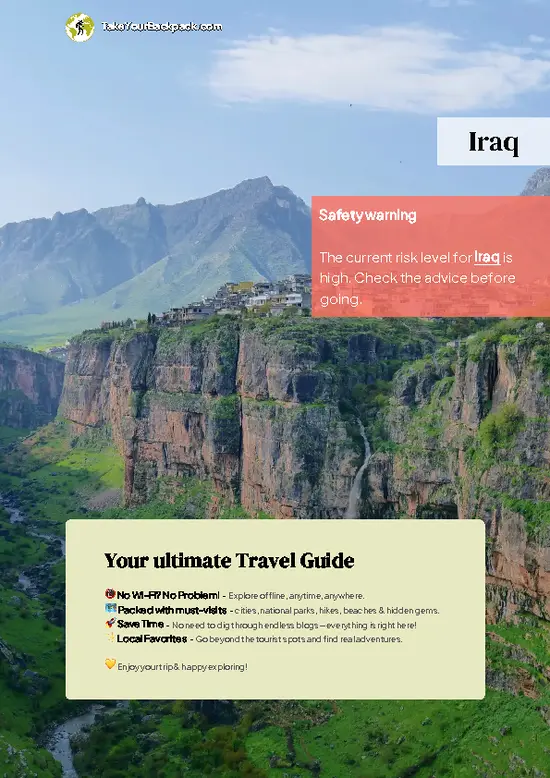
Safety warning

The current risk level for Iraq is high. Check the advice before going.


Get your Iraq guide
107 ranked highlights, routes & tips, works offline (375 pages)
Loading the map 🌍
CLICK TO FILTER
cities
towns
landmarks
national parks
hikes
beaches
attractions
festivals
regions
SHOW COUNTRY’S BESTSHOW ALL

✨ Why go?
Ranked #2 unique site in Iraq
The unique appeal for travelers

Babylon in Iraq isn’t just a dusty relic; it’s a living testament to human ambition and history. Sure, you’ll encounter crowds—especially if you hit peak tourist season—but don’t let that deter you. The cost is minimal, often just a few dollars for entry, making it a steal compared to other world wonders.

What makes Babylon truly unique is its layered history. You’re walking through the same streets where Nebuchadnezzar II once ruled. The Ishtar Gate, with its vibrant blue tiles, isn’t just a photo op; it’s a portal into a civilization that shaped the world.

Accessibility is surprisingly decent. While Iraq has its challenges, many backpackers find their way to Babylon as part of a broader route through the Mesopotamian cradle. Pair it with a visit to nearby Baghdad or Karbala for a rich … read more 👉
Babylon in Iraq isn’t just a dusty relic; it’s a living testament to human ambition and history. Sure, you’ll encounter crowds—especially if you hit peak tourist season—but don’t let that deter you. The cost is minimal, often just a few dollars for entry, making it a steal compared to other world wonders.

What makes Babylon truly unique is its layered history. You’re walking through the same streets where Nebuchadnezzar II once ruled. The Ishtar Gate, with its vibrant blue tiles, isn’t just a photo op; it’s a portal into a civilization that shaped the world.

Accessibility is surprisingly decent. While Iraq has its challenges, many backpackers find their way to Babylon as part of a broader route through the Mesopotamian cradle. Pair it with a visit to nearby Baghdad or Karbala for a rich tapestry of experiences.

This isn’t just a stop; it’s a journey into the past that adds depth to your travels. The real magic lies in the stories you’ll hear and the connections you’ll make, far beyond the Instagram filters.
Want to include Babylon in your Iraq route?
Create a personalized Iraq itinerary that includes Babylon and the places that fit your trip — based on your travel style, budget, and available time. Get your route in seconds.

Generate my trip

💡 HighlightsDon't-miss highlights and experiences

  • Ishtar Gate & Processional Way — The ceremonial entrance to Neo-Babylon, famous for its deep-blue glazed bricks decorated with lions and dragons; what you see now are foundations and traces on site (many original tiles are in museums), but the scale and the idea of a ritual route still hits you — it’s the image people picture when they think “ancient Babylon.”
  • Lion of Babylon — A weathered basalt statue that’s become the city’s emblem; small but powerful, it embodies ancient royal iconography and makes the past feel oddly alive when you stand beside it.
  • Nebuchadnezzar’s Palaces (Southern Palace complex) — Massive mudbrick platforms and ruined halls that hint at imperial pomp: ceremonial rooms, storerooms and courtyards compressed into huge, earthen volumes that speak to the administrative
read more 👉
  • Ishtar Gate & Processional Way — The ceremonial entrance to Neo-Babylon, famous for its deep-blue glazed bricks decorated with lions and dragons; what you see now are foundations and traces on site (many original tiles are in museums), but the scale and the idea of a ritual route still hits you — it’s the image people picture when they think “ancient Babylon.”
  • Lion of Babylon — A weathered basalt statue that’s become the city’s emblem; small but powerful, it embodies ancient royal iconography and makes the past feel oddly alive when you stand beside it.
  • Nebuchadnezzar’s Palaces (Southern Palace complex) — Massive mudbrick platforms and ruined halls that hint at imperial pomp: ceremonial rooms, storerooms and courtyards compressed into huge, earthen volumes that speak to the administrative and architectural might of the empire.
  • Esagila and the Temple Precinct — The religious heart dedicated to Marduk, with temple foundations and ziggurat bases; it’s where royal power met theology, and where New Year rituals once reshaped kingship — a must for anyone interested in ancient ritual spaces.
  • Hanging Gardens (legendary location) — One of the ancient Seven Wonders traditionally tied to Babylon; archaeological proof is still debated, but the story—terraced greenery, water engineering and royal display—adds a mythical layer that makes Babylon more than just bricks.
  • Old Euphrates channel and city layout — The river once ran through the city, creating canals, defensive moats and a unique urban plan; seeing the river’s course and the street grids helps you picture how life, trade and engineering worked in an ancient capital.
  • Tell Babil (archaeological layers) — The huge mounds of debris and occupation layers you can walk around are like an onion of history: Babylon accumulated multiple periods (Old Babylonian, Neo-Babylonian, Achaemenid and later) and the stratigraphy tells that long, complex story.
Spotted a mistake or missing something? Contact us.
🌤️ When to go?Weather, crowds, and seasonal trade-offs


  • Weather: Summers in Babylon scorch with highs often hitting 40°C (104°F), turning exploration into a sweat-drenched slog. Winters are mild and dry, hovering around 15°C (59°F), making it the only realistic window for comfortable trekking.

  • Temperature: Spring and autumn offer a sweet spot—daytime temps between 20-30°C (68-86°F). Nights can dip sharply, so pack layers. Avoid the brutal summer heat unless you’re a desert-dwelling masochist.

  • Daylight Hours: Expect roughly 10-12 hours of daylight year-round. Longer days in summer mean more time to explore but also more sun exposure. Winter’s shorter days limit your window but keep the heat in check.

  • Crowds: Babylon isn’t exactly a tourist magnet, but local holidays and weekends bring modest crowds. Visiting midweek in off-peak seasons
read more 👉

  • Weather: Summers in Babylon scorch with highs often hitting 40°C (104°F), turning exploration into a sweat-drenched slog. Winters are mild and dry, hovering around 15°C (59°F), making it the only realistic window for comfortable trekking.

  • Temperature: Spring and autumn offer a sweet spot—daytime temps between 20-30°C (68-86°F). Nights can dip sharply, so pack layers. Avoid the brutal summer heat unless you’re a desert-dwelling masochist.

  • Daylight Hours: Expect roughly 10-12 hours of daylight year-round. Longer days in summer mean more time to explore but also more sun exposure. Winter’s shorter days limit your window but keep the heat in check.

  • Crowds: Babylon isn’t exactly a tourist magnet, but local holidays and weekends bring modest crowds. Visiting midweek in off-peak seasons means you’ll have the ruins mostly to yourself, which is a rare luxury here.

  • Seasonal Activities: There’s no flashy festival calendar, but spring sees locals celebrating Nowruz nearby, adding cultural flavor if timed right. Otherwise, the site’s quiet—perfect for those who want to soak in history without distractions.

  • Price Fluctuations: Prices for guides and accommodations spike slightly during cooler months when more travelers arrive. Summer sees a dip, but you pay in sweat and discomfort. Budget accordingly—comfort comes at a premium here.


Pro-tip: Aim for late autumn or early spring to dodge the heat and crowds, snag better prices, and experience Babylon’s raw, unfiltered atmosphere without the Instagram gloss.


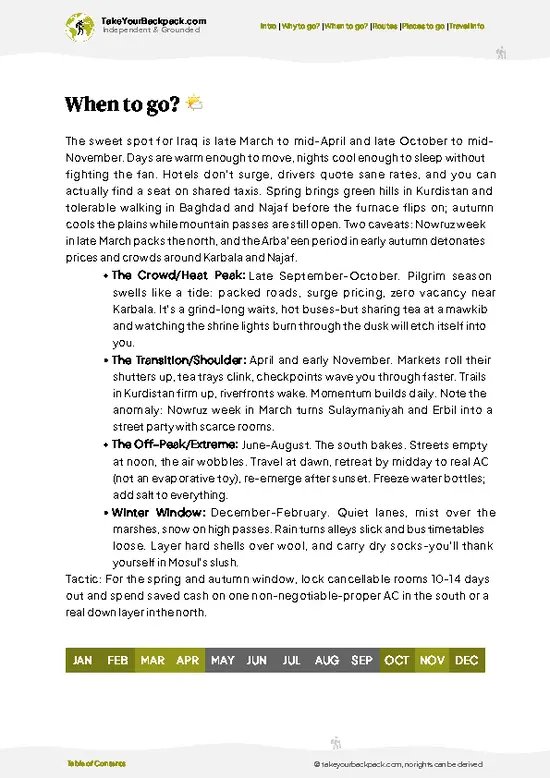
source: climatestotravel.comJANJanuary: highly recommended for travelingFEBFebruary: highly recommended for travelingMARMarch: excellent for travelingAPRApril: excellent for travelingMAYMay: good for travelingJUNJune: fair for travelingJULJuly: below average for travelingAUGAugust: below average for travelingSEPSeptember: good for travelingOCTOctober: excellent for travelingNOVNovember: excellent for travelingDECDecember: highly recommended for traveling
iraq-unique-site-babylon
© Google |

✈️ The backpacker research shortcutIraq Travel Guide

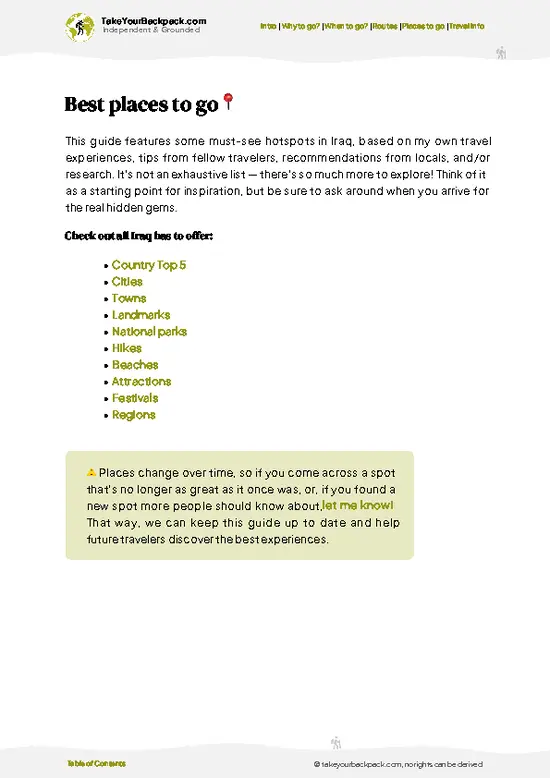
An offline-friendly backpacking guide with optimized travel routes, ranked highlights, transport advice, and the best areas to stay.
example page 0 from our offline Travel Guide for Iraq
example page 1 from our offline Travel Guide for Iraq
example page 2 from our offline Travel Guide for Iraq
example page 3 from our offline Travel Guide for Iraq
example page 4 from our offline Travel Guide for Iraq
example page 5 from our offline Travel Guide for Iraq
example page 6 from our offline Travel Guide for Iraq
example page 7 from our offline Travel Guide for Iraq
The digital guide (375 pages) contains:
107 highlights, ranked by travel appeal
Optimized 5, 10 & 15-day travel routes
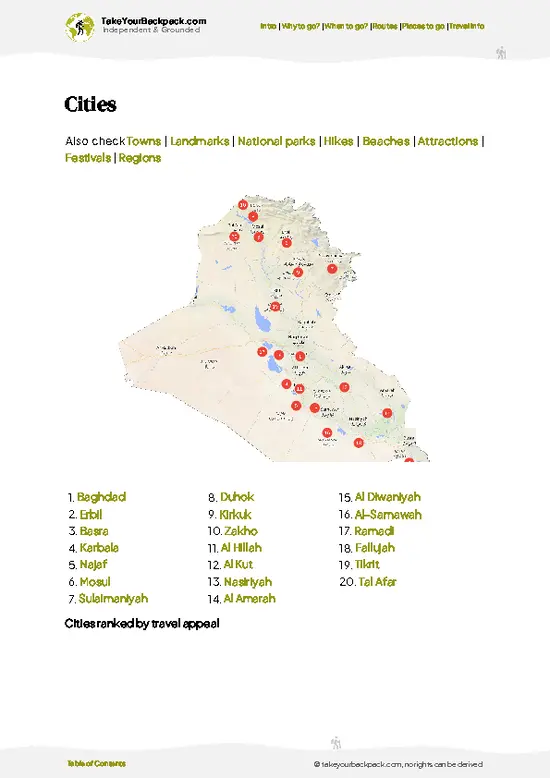
Cities, national parks, landmarks, beaches
How to get around
Offline-friendly for travel without Wi-Fi
👉 Click to see all 30+ guide features

📅 Plan smarter in minutes, not weeks
Month by month travel advice
Festivals & national holidays
Budget expectations

🗺️ Go to the right places, skip the overrated ones
Honest pros & cons of destinations
Top hikes, parks & viewpoints
Lesser-known places most travelers miss
Clear “worth it vs skip it” guidance

🛏️ Travel smoothly without rookie mistakes
Best areas to stay
Transport systems explained simply
Common scams & safety advice
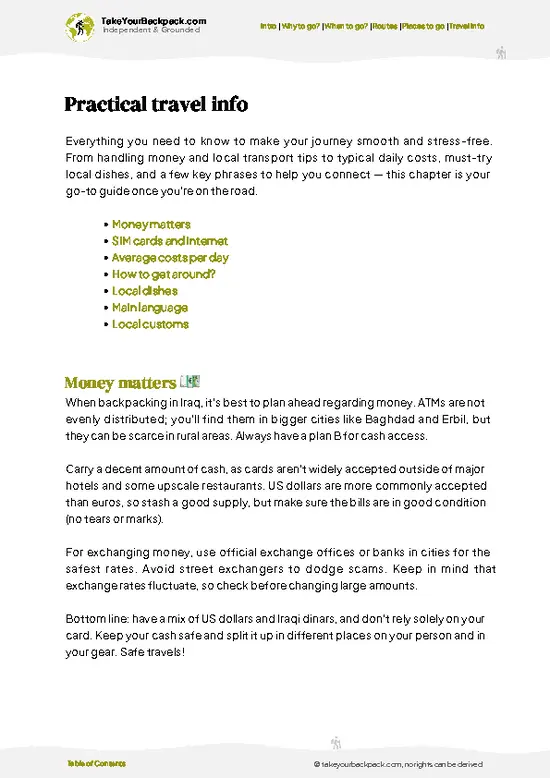
SIM cards, money & practical tips

🌍 Understand the country, not just visit it
Culture & traditions
52 Essential phrases & customs
Festivals worth planning around
Traveler-friendly historical context
Insights that make places more meaningful

📱 Built for real travel conditions
Fully downloadable PDF
Works completely offline
Optimized for phone use
Useful in remote areas & buses
Everything in one place
Save weeks of stressful planning
Get instant access to your full guide. 30‑day money-back guarantee.


By proceeding you agree to our terms.
Sent to your inbox immediately after payment • 100% Secure Checkout
Best Backpacking Travel Advisor 2025 tourism awardBest Backpacking
Travel Advisor
2025
What others say about Take Your Backpack Guides:
⭐⭐⭐⭐⭐
Fantastic, amazing amount of information!
⭐⭐⭐⭐⭐
My goodness this is amazing, it's what I've been looking for hats off too you!
⭐⭐⭐⭐⭐
I think this is absolutely BRILLIANT
⭐⭐⭐⭐
Very complete and informative. It's still missing places, but I gotta to commend you
⭐⭐⭐⭐⭐
This is truly amazing, thank you, can't wait to explore it with my kids!
⭐⭐⭐⭐⭐
Awesome resource, thank you!
⭐⭐⭐⭐⭐
This is amazing! Can't wait to explore the ones I haven't seen
⭐⭐⭐⭐
I love this! Well done, great idea.
⭐⭐⭐⭐⭐
Thanks for taking the time to make this gem!
⭐⭐⭐⭐⭐
This might be the best website I've ever seen.
⭐⭐⭐⭐⭐
Congratulations, and thank you so much for your work; it's incredibly valuable.
⭐⭐⭐⭐
In all seriousness I think you did a great job pointing out the important spots
⭐⭐⭐⭐⭐
10/10 very good
⭐⭐⭐⭐⭐
As someone who's only just starting to visit regularly this is awesome, thank you.
⭐⭐⭐⭐
Thank you very much! I'm going to visit my dad, it's going to be very useful!
⭐⭐⭐⭐⭐
This is really cool! We'll be travelling for the first time and this definitely come in handy.
⭐⭐⭐⭐⭐
You are now our minister of culture, congratulations 👨‍💼
⭐⭐⭐⭐⭐
Just wanted to tell you that this is a pearl! Going to follow your recommendations.
⭐⭐⭐⭐⭐
This is so cool. I'll definitely be using the resource for my travels soon.
⭐⭐⭐⭐⭐
This is very impressive! Good work.
⭐⭐⭐⭐⭐
This is an amazing and informative site. Very well done!

🛏️ Where to stay?How to pick the right area

Staying near Babylon, Iraq, isn’t just about the ruins; it’s about the experience. First off, you’ll want to look at the town of Hillah. It’s the closest urban area, and while it’s not a tourist hotspot, that’s part of its charm. You’ll find a mix of local eateries and markets, where you can dive into authentic Iraqi cuisine without the tourist markup.

Next, consider the vibe in the surrounding villages. They’re quieter and give you a real sense of the local culture. You might not find fancy accommodations, but you’ll meet locals who are eager to share stories and traditions. This is where you’ll … read more 👉
Staying near Babylon, Iraq, isn’t just about the ruins; it’s about the experience. First off, you’ll want to look at the town of Hillah. It’s the closest urban area, and while it’s not a tourist hotspot, that’s part of its charm. You’ll find a mix of local eateries and markets, where you can dive into authentic Iraqi cuisine without the tourist markup.

Next, consider the vibe in the surrounding villages. They’re quieter and give you a real sense of the local culture. You might not find fancy accommodations, but you’ll meet locals who are eager to share stories and traditions. This is where you’ll feel the heartbeat of Iraq, away from the crowds.

Safety is a concern, but staying in these areas often means you’re among families and community members who look out for one another. Just be smart: stick to well-traveled paths and engage with locals who can guide you.

Lastly, don’t overlook the chance to camp near the ruins. It’s a unique way to connect with the history of Babylon under the stars. Just make sure to check in with local guides for safety and logistics. This is where the real magic happens, far from the glossy Instagram posts.

👛 Costs (as of 16 June 2026)Typical daily expenses

Visiting Babylon, Iraq, is a journey steeped in history, but it comes with its own set of costs and realities. Here’s what you need to know to budget effectively.
  • Entry Fees: Expect to pay around $5 to $10 for entry. This fee grants you access to the archaeological site, but it’s worth noting that the experience can vary based on ongoing restoration work and local regulations.
  • Transportation: Getting to Babylon can be tricky. If you’re traveling from Baghdad, a taxi or private car hire will set you back about $50 to $100. Public transport is cheaper but less reliable. Factor in the cost of local transport once you arrive, which can be around $10 to $20 for taxis or shared rides.
  • Guided Tours: Hiring a local guide can enhance your experience significantly. Expect to pay between $30 and $70 for
read more 👉
Visiting Babylon, Iraq, is a journey steeped in history, but it comes with its own set of costs and realities. Here’s what you need to know to budget effectively.
  • Entry Fees: Expect to pay around $5 to $10 for entry. This fee grants you access to the archaeological site, but it’s worth noting that the experience can vary based on ongoing restoration work and local regulations.
  • Transportation: Getting to Babylon can be tricky. If you’re traveling from Baghdad, a taxi or private car hire will set you back about $50 to $100. Public transport is cheaper but less reliable. Factor in the cost of local transport once you arrive, which can be around $10 to $20 for taxis or shared rides.
  • Guided Tours: Hiring a local guide can enhance your experience significantly. Expect to pay between $30 and $70 for a half-day tour. This investment can provide insights that you won’t get from guidebooks or signage alone.
  • Accommodation: Options near Babylon are limited. Budget hotels start around $30 per night, while mid-range accommodations can go up to $80. If you want to stay in Baghdad, prices can range from $50 to $150, depending on the area and amenities.
  • Food and Drink: Meals can be quite affordable. Street food or local eateries might cost you $5 to $10 per meal. If you opt for a sit-down restaurant, budget around $15 to $30 for a decent meal. Always check if drinks are included, as that can add to your total.
  • Miscellaneous Costs: Don’t forget about souvenirs or additional experiences. Budget an extra $20 to $50 for local crafts or snacks. Also, consider any tips for guides or service staff, which can add another $5 to $10.

Understanding these costs will help you navigate your visit to Babylon without any surprises. The history is rich, but so are the realities of traveling in this unique region.
⚠️ Prices can change and everyone travels differently, so take this as a rough guide. Hope it helps you plan your adventure!

Other Iraqi landmarks near Babylon

Explore more nearby:

  • Khadimiyah—golden domes, Shia pilgrimage, bustling bazaar, shrine complex| 103 km away
  • Samarra—spiral minaret, Abbasid mosque, river plain, brickwork patterns| 198 km away
  • Ur—ziggurat, ancient Sumer, royal tombs, desert plateau| 223 km away

💡 Not sure where to go next?
Create a personalized itinerary for Iraq including Babylon and the places that fit your trip.

Generate my itinerary

👉 Discover all landmarks

Or checkout all Iraq has to offer (think cities, towns, villages, national parks, hikes, beaches, festivals)
Country photo of Iraq

We 💚 feedbackFinal thoughts on visiting Babylon

Babylon isn’t just a dusty relic; it’s a pulse of history. Expect crowds, especially if you hit peak tourist season. But here’s the kicker: the real magic lies in the quiet moments. Find a spot away from the tour groups and soak in the ancient bricks, the whispers of the past. The best surprise? The locals. They’re eager to share stories that textbooks miss. Just a heads-up: be respectful. This isn’t just a photo op; it’s a sacred place. Embrace it, and you’ll leave with more than just memories.

✍️ Help improve this page!
The information on this page is based on in-depth research, insights shared by experienced travelers, and feedback from the local travel community in Iraq. While every effort is made to keep the information accurate and current, conditions can change — so if you spot anything incorrect or outdated, please get in touch.


🙋‍♂️ Give feedback

👋 Meet the founderWho’s Behind Take Your Backpack?

Johan, backpacker and founder of TakeYourBackpackHi, I’m Johan (Netherlands 🇳🇱), the creator of TakeYourBackpack. Over the past decade, I’ve backpacked through 80+ countries across six continents, gaining extensive experience with independent travel, long-term trips, and overland routes.

This site is built on a combination of firsthand travel experience and carefully curated insights from other backpackers. Many guides are based on places I’ve personally visited, while others bring together tips, observations, and practical advice shared by trusted travelers I’ve met along the way.

The goal is to provide realistic, experience-driven guidance — not generic itineraries — so you can explore destinations with better context, clearer expectations, and more confidence.

Get full Iraq guide •
Instant download • 107 highlights • Full Offline guide