×

Iraq🇮🇶 | best landmarksEssential 10 landmarks to Explore in Iraq

Landmarks in Iraq are ancient sites first and tourist attractions second. The country holds Mesopotamian ruins, Shia pilgrimage shrines, Ottoman-era streets and Kurdish citadels, and each region delivers a different trip. The Kurdistan Region in the north is the easiest for independent travel: visa on arrival, reliable taxis, cheap guesthouses, few crowds. The south (Ur, Babylon, the Marshes) means more paperwork, more checkpoints and often a guide. Karbala and Najaf draw millions of pilgrims, so expect crowds and strict dress codes. Baghdad is fascinating but slow to explore. Backpackers on a tight budget should start in the north. Skip anything that needs a long detour for a ruin with little left standing.

By Johan Kruseman 🇳🇱 | Updated October 19, 2026
Explore the best national parks in Iraq

Why go?Understanding Their Importance

Iraq holds some of the oldest urban remains on earth, because Mesopotamia between the Tigris and Euphrates is where writing, the first cities and early law codes appeared. That depth is real, and no neighboring country matches it in one place. The same history also explains the layers: Sumerian, Assyrian, Babylonian, Abbasid and Ottoman sites sit within a few hours of each other, and living religious sites still operate on top of old foundations.

Before choosing Iraq for landmarks, understand the limits. Infrastructure for visitors is thin. Signage is sparse, many ruins are partly reconstructed or poorly labeled, and museum displays can be uneven. Decades of conflict damaged or looted sites, so some of the biggest names look rougher than photographs suggest. Reconstruction at certain ancient … read more 👉
Iraq holds some of the oldest urban remains on earth, because Mesopotamia between the Tigris and Euphrates is where writing, the first cities and early law codes appeared. That depth is real, and no neighboring country matches it in one place. The same history also explains the layers: Sumerian, Assyrian, Babylonian, Abbasid and Ottoman sites sit within a few hours of each other, and living religious sites still operate on top of old foundations.

Before choosing Iraq for landmarks, understand the limits. Infrastructure for visitors is thin. Signage is sparse, many ruins are partly reconstructed or poorly labeled, and museum displays can be uneven. Decades of conflict damaged or looted sites, so some of the biggest names look rougher than photographs suggest. Reconstruction at certain ancient sites is also controversial, which matters if you care about authenticity.

Security varies by province, and checkpoints are routine in the center and south. Distances are long and the desert climate shapes everything, since most sites are exposed with almost no shade. Tourism is small, so you will often have a site nearly to yourself, but you will also rely on local drivers and fixers more than elsewhere. Go for the history and the people, not for polish.
How the List Was Created
The list of best unique sites in Iraq is created based on history or culture, wow factor, atmosphere, quirks, and memorability. If you feel a unique site is missing in this list, please let us know.

When to go?Best Time to Visit Iraq for landmarks

Best months: The best months are October to November and March to April, when daytime highs sit around 20 to 32°C instead of the 45 to 50°C common in the south in summer. Those temperatures make exposed ruins and long walking days workable, and the light is better for photographs.
Shoulder and low seasons: December to February is cool and usable in the south and center, with highs of 12 to 20°C and occasional rain. Most of Iraq's rainfall, roughly 100 to 200 mm in the south and center, falls in this window. In the Kurdistan Region, winters are colder, with snow in the mountains and highs near 5 to 10°C, and muddy tracks can close rural sites. Spring there is green and the best time for hilltop citadels and mountain scenery.
Avoid summer: June to August is not worth the time for landmarks in … read more 👉
Best months: The best months are October to November and March to April, when daytime highs sit around 20 to 32°C instead of the 45 to 50°C common in the south in summer. Those temperatures make exposed ruins and long walking days workable, and the light is better for photographs.
Shoulder and low seasons: December to February is cool and usable in the south and center, with highs of 12 to 20°C and occasional rain. Most of Iraq's rainfall, roughly 100 to 200 mm in the south and center, falls in this window. In the Kurdistan Region, winters are colder, with snow in the mountains and highs near 5 to 10°C, and muddy tracks can close rural sites. Spring there is green and the best time for hilltop citadels and mountain scenery.
Avoid summer: June to August is not worth the time for landmarks in Baghdad and the south. Midday heat above 45°C makes outdoor sites miserable and dangerous, and dust storms are common. If you must go, the north is the only sensible option, with highs around 35 to 40°C.
Religious peaks: Muharram and especially Arbaeen send millions to Karbala and Najaf. Roads close, hotels fill and prices can double or triple. Plan around those dates unless pilgrimage is the point.

unique site hoppingSuggested Travel Strategies

How long you need: A trip combining several landmarks in Iraq needs 10 to 16 days, because distances are long and checkpoints slow every leg.
Grouping the regions: Three clusters work. The Kurdistan Region (Erbil, Sulaymaniyah, Duhok) fits 4 to 6 days, with 3 to 5 hours between cities by shared taxi. The center (Baghdad and nearby sites) needs 3 to 4 days. The south (Najaf, Karbala, Nasiriyah and the Marshes) needs 3 to 5 days, with Baghdad to Karbala or Najaf taking 1.5 to 3 hours and Baghdad to Nasiriyah 4 to 5 hours. A sensible direction is north to south: fly into Erbil, work through Kurdistan, then fly or drive to Baghdad and continue south, finishing in Basra or flying out of Najaf. Allow about 1 day per site in the south and half a day to a full day for most northern stops.
Common planning … read more 👉
How long you need: A trip combining several landmarks in Iraq needs 10 to 16 days, because distances are long and checkpoints slow every leg.
Grouping the regions: Three clusters work. The Kurdistan Region (Erbil, Sulaymaniyah, Duhok) fits 4 to 6 days, with 3 to 5 hours between cities by shared taxi. The center (Baghdad and nearby sites) needs 3 to 4 days. The south (Najaf, Karbala, Nasiriyah and the Marshes) needs 3 to 5 days, with Baghdad to Karbala or Najaf taking 1.5 to 3 hours and Baghdad to Nasiriyah 4 to 5 hours. A sensible direction is north to south: fly into Erbil, work through Kurdistan, then fly or drive to Baghdad and continue south, finishing in Basra or flying out of Najaf. Allow about 1 day per site in the south and half a day to a full day for most northern stops.
Common planning mistakes: The biggest is cramming two distant sites into one day. Roads are slow, checkpoints add 15 to 60 minutes, and daylight is short in winter. Book a driver for each region instead of rushing between them. Another error is skipping buffer time: add a spare day before any flight out. Many travelers also underestimate paperwork for the south, so arrange permits and a guide before leaving the north. Do not overstuff Baghdad; two days is enough.

The ListTop landmarks of Iraq

1 Babylon

Ishtar Gate, lion reliefs, palace ruins, Euphrates proximity

Walk among reconstructed walls and scattered relics, imagining the ceremonies and power struggles that once defined this legendary capital.

iraq-unique-site-babylon
© Google |

2 Erbil Citadel

hilltop mound, layered settlements, Kurdish heritage, panoramic views

Climb the ancient mound to explore narrow lanes and mudbrick houses, absorbing centuries of continuous habitation above the modern city.

3 Hatra

stone temples, circular fortifications, Greco-Parthian carvings, desert isolation

Wander through monumental ruins where columns and statues rise from the sand, revealing a crossroads of ancient empires and faiths.

4 Ur

ziggurat, ancient Sumer, royal tombs, desert plateau

Stand beneath the stepped brick ziggurat and trace the outlines of one of humanity’s earliest cities, surrounded by silent desert.

5 Shanidar Cave

prehistoric cave, limestone cliffs, archaeological site

Walk a path that traces ancient footsteps, passing dramatic rock formations and ending at a cave known for its Neanderthal discoveries.

6 Samarra

spiral minaret, Abbasid mosque, river plain, brickwork patterns

Ascend the iconic minaret’s spiral ramp for sweeping views, then explore the vast mosque complex and geometric brick designs below.

7 Mesopotamian Marshes

reed islands, water buffalo, Ma'dan villages, winding waterways

Glide by canoe through a labyrinth of wetlands, encountering floating homes, grazing buffalo, and the daily life of Iraq’s Marsh Arabs.

8 Kadhimiya

golden domes, Shia pilgrimage, bustling bazaar, shrine complex

Join pilgrims in a vibrant quarter, moving from crowded markets to the ornate shrine at the heart of Iraq’s religious life.

9 Ashur

Assyrian palace, riverbank cliffs, carved reliefs, archaeological layers

Survey the remains of an Assyrian stronghold perched above the Tigris, where carved stones and earthworks hint at lost grandeur.

10 Delal Bridge

stone bridge, river crossing, local legend

Cross a centuries-old bridge spanning a clear river, with stories and traditions still alive in the surrounding community.

Loading the map 🌍

Expert viewPro Tips for Exploring the Best

How many landmarks: Plan on 6 to 9 landmarks across a two-week trip. More than that and you spend the whole time at checkpoints and in cars. Iraq punishes ambition: distances are long, heat or cold cuts your hours, and each site often needs a driver or permit. One major stop a day is realistic, two only inside the same city.
Prioritizing by travel style: For history lovers, put the Mesopotamian ruins first and accept that they are sparse and exposed. For first-time visitors who want ease, choose the Kurdistan Region, where citadels, old bazaars and mountain villages can be done independently. For cultural depth, the Shia shrine cities are the most atmospheric, but they are active places of worship, not photo stops. Skip minor sites with little left to see and no explanation; a 3-hour detour … read more 👉
How many landmarks: Plan on 6 to 9 landmarks across a two-week trip. More than that and you spend the whole time at checkpoints and in cars. Iraq punishes ambition: distances are long, heat or cold cuts your hours, and each site often needs a driver or permit. One major stop a day is realistic, two only inside the same city.
Prioritizing by travel style: For history lovers, put the Mesopotamian ruins first and accept that they are sparse and exposed. For first-time visitors who want ease, choose the Kurdistan Region, where citadels, old bazaars and mountain villages can be done independently. For cultural depth, the Shia shrine cities are the most atmospheric, but they are active places of worship, not photo stops. Skip minor sites with little left to see and no explanation; a 3-hour detour for a mound of bricks is not worth the time.
What it costs: Budget US$45 to 90 a day including a modest hotel (US$25 to 50), meals (US$8 to 15) and local transport. Entry fees are low, usually 5,000 to 25,000 Iraqi dinars (about US$4 to 19), and many shrines are free. A private driver for a day costs US$60 to 120, and a licensed guide US$30 to 80. In the south, a guide and driver together are often unavoidable, so the per-visit cost rises to US$80 to 150. Share costs with other travelers to cut this sharply. Carry cash in dinars and US dollars, since cards are rarely accepted outside big hotels, and ATMs can fail.
Delays and hidden costs: Checkpoints are the main time drain. Carry your passport, visa and any permit copies at all times, and expect 15 to 60 minutes of delay on some roads. Photographing military or police posts can lead to detention, so keep the camera down near them. Unlicensed guides sometimes quote in dollars and inflate the price; agree the total in writing before you start. Fees for photography permits at some sites are charged separately, so ask at the gate.
Safety and etiquette: Check current advisories and local conditions before each region, since security shifts by province. Dress conservatively: long trousers and covered shoulders for everyone, and a headscarf and abaya (often lent at the entrance) for women at shrines. Non-Muslims may be limited in parts of some shrines, so follow staff instructions. Avoid visiting during major religious processions unless you have a local host. Do not climb on ancient walls or take fragments; the penalties are real and the damage is permanent. Carry water, sun protection and a power bank for long, shadeless days.

✈️ The backpacker research shortcutIraq Travel Guide

An offline-friendly backpacking guide with optimized travel routes, ranked highlights, transport advice, and the best areas to stay.
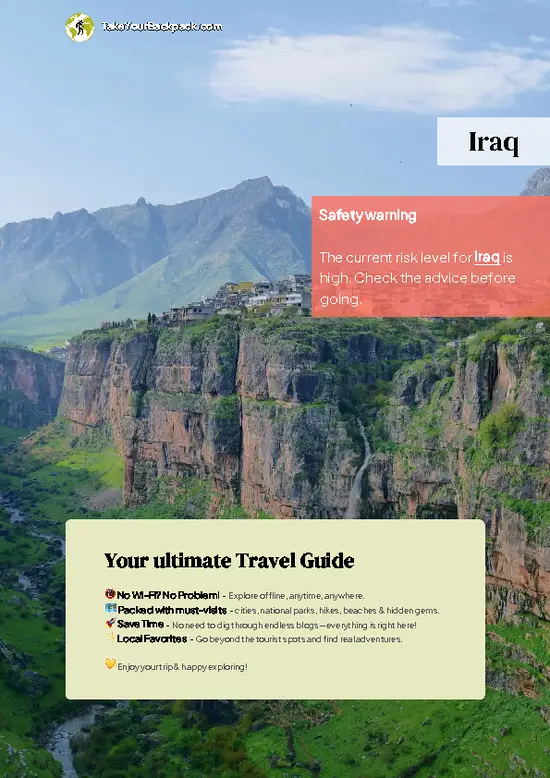
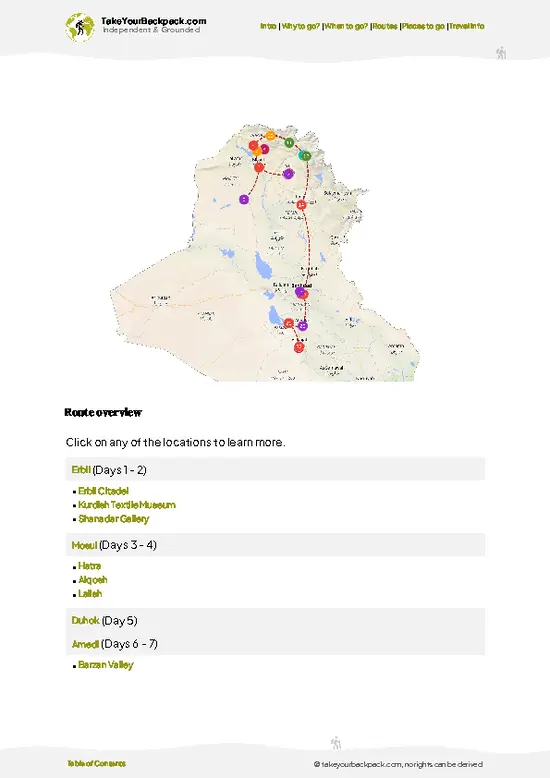
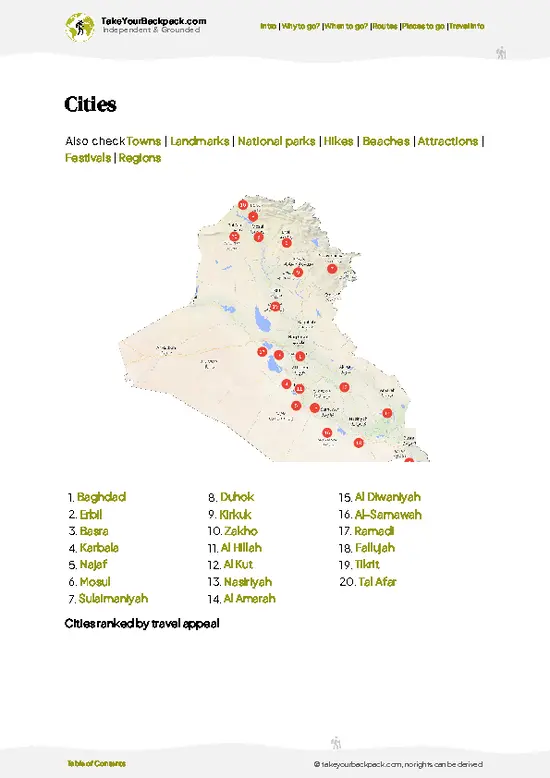
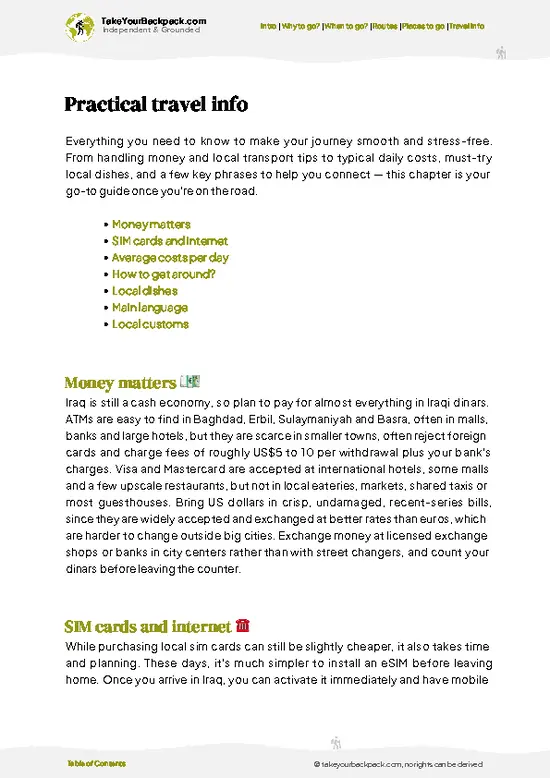
example page 0 from our offline Travel Guide for Iraq
example page 1 from our offline Travel Guide for Iraq
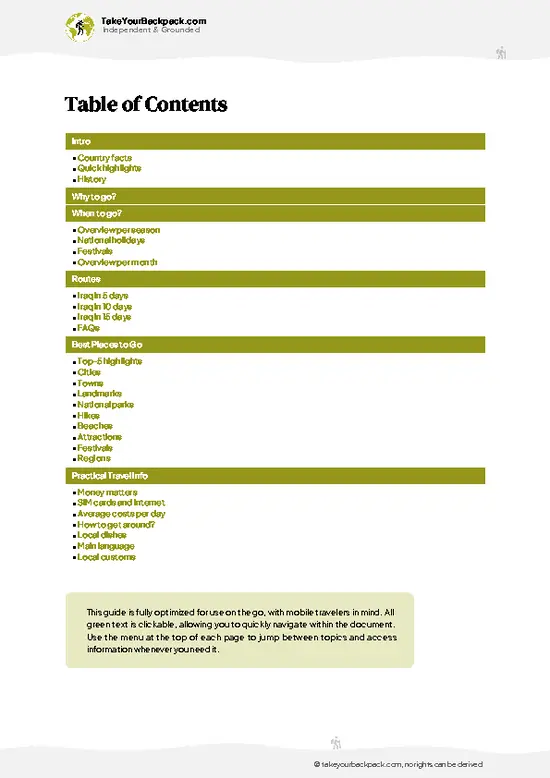
example page 2 from our offline Travel Guide for Iraq
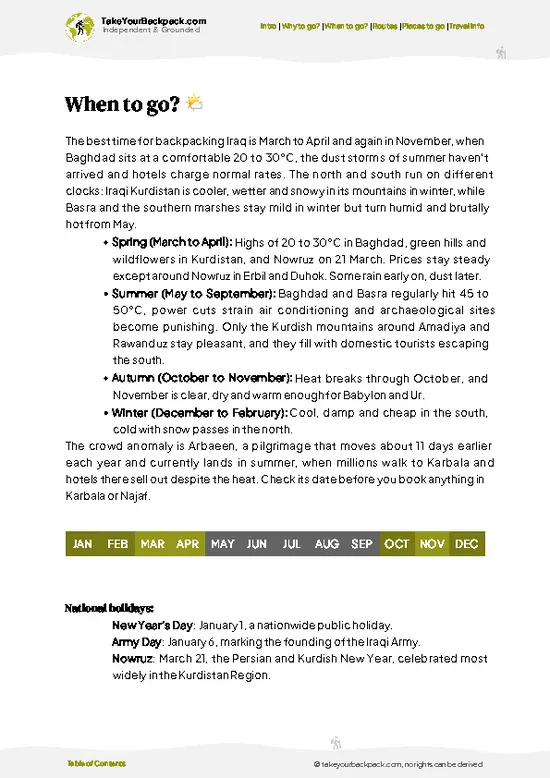
example page 3 from our offline Travel Guide for Iraq
example page 4 from our offline Travel Guide for Iraq
example page 5 from our offline Travel Guide for Iraq
example page 6 from our offline Travel Guide for Iraq
example page 7 from our offline Travel Guide for Iraq
The digital guide (327 pages) contains:
✅ 95 highlights, ranked by travel appeal
✅ Optimized 5, 10 & 15-day travel routes
✅ Cities, national parks, landmarks, beaches
✅ How to get around
✅ Offline-friendly for travel without Wi-Fi
👉 Click to see all 30+ guide features

📅 Plan smarter in minutes, not weeks
✅ Month by month travel advice
✅ Festivals & national holidays
✅ Budget expectations

🗺️ Go to the right places, skip the overrated ones
✅ Honest pros & cons of destinations
✅ Top hikes, parks & viewpoints
✅ Lesser-known places most travelers miss
✅ Clear “worth it vs skip it” guidance

🛏️ Travel smoothly without rookie mistakes
✅ Best areas to stay
✅ Transport systems explained simply
✅ Common scams & safety advice
✅ SIM cards, money & practical tips

🌍 Understand the country, not just visit it
✅ Culture & traditions
✅ 52 Essential phrases & customs
✅ Festivals worth planning around
✅ Traveler-friendly historical context
✅ Insights that make places more meaningful

📱 Built for real travel conditions
✅ Fully downloadable PDF
✅ Works completely offline
✅ Optimized for phone use
✅ Useful in remote areas & buses
✅ Everything in one place
Stop searching, start planning
Get instant access to your full guide. 30‑day money-back guarantee.
+ Add another guide for just

By proceeding you agree to our terms.
Sent to your inbox immediately after payment • 100% Secure Checkout
Best Backpacking Travel Advisor 2025 tourism awardBest Backpacking
Travel Advisor
2025
What others say about Take Your Backpack Guides:
⭐⭐⭐⭐⭐
Fantastic, amazing amount of information!
⭐⭐⭐⭐⭐
My goodness this is amazing, it's what I've been looking for hats off too you!
⭐⭐⭐⭐⭐
I think this is absolutely BRILLIANT
⭐⭐⭐⭐
Very complete and informative. It's still missing places, but I gotta to commend you
⭐⭐⭐⭐⭐
This is truly amazing, thank you, can't wait to explore it with my kids!
⭐⭐⭐⭐⭐
Awesome resource, thank you!
⭐⭐⭐⭐⭐
This is amazing! Can't wait to explore the ones I haven't seen
⭐⭐⭐⭐
I love this! Well done, great idea.
⭐⭐⭐⭐⭐
Thanks for taking the time to make this gem!
⭐⭐⭐⭐⭐
This might be the best website I've ever seen.
⭐⭐⭐⭐⭐
Congratulations, and thank you so much for your work; it's incredibly valuable.
⭐⭐⭐⭐
In all seriousness I think you did a great job pointing out the important spots
⭐⭐⭐⭐⭐
10/10 very good
⭐⭐⭐⭐⭐
As someone who's only just starting to visit regularly this is awesome, thank you.
⭐⭐⭐⭐
Thank you very much! I'm going to visit my dad, it's going to be very useful!
⭐⭐⭐⭐⭐
This is really cool! We'll be travelling for the first time and this definitely come in handy.
⭐⭐⭐⭐⭐
You are now our minister of culture, congratulations 👨‍💼
⭐⭐⭐⭐⭐
Just wanted to tell you that this is a pearl! Going to follow your recommendations.
⭐⭐⭐⭐⭐
This is so cool. I'll definitely be using the resource for my travels soon.
⭐⭐⭐⭐⭐
This is very impressive! Good work.
⭐⭐⭐⭐⭐
This is an amazing and informative site. Very well done!

🛏️ Where to stay?Where to Stay: Iraq Edition

Backpacker hostels in Iraq are still rare, but cheap guesthouses and simple hotels at roughly US$15 to 35 a night exist in every major city, and a few small hostels have opened in Baghdad and the Kurdish cities. In Baghdad, Karrada has the widest choice, with riverside cafés and late-opening restaurants, while the older streets around Bab al-Sharqi and Saadoun Street are cheaper and closer to Tahrir Square and Mutanabbi Street, though louder and grittier after dark. In Erbil, budget rooms cluster around the Citadel and the bazaar for easy sightseeing on foot, the Christian district of Ankawa costs more but has bars and a calmer night, and in Sulaymaniyah the streets near the bazaar mix low prices … read more 👉
Backpacker hostels in Iraq are still rare, but cheap guesthouses and simple hotels at roughly US$15 to 35 a night exist in every major city, and a few small hostels have opened in Baghdad and the Kurdish cities. In Baghdad, Karrada has the widest choice, with riverside cafés and late-opening restaurants, while the older streets around Bab al-Sharqi and Saadoun Street are cheaper and closer to Tahrir Square and Mutanabbi Street, though louder and grittier after dark. In Erbil, budget rooms cluster around the Citadel and the bazaar for easy sightseeing on foot, the Christian district of Ankawa costs more but has bars and a calmer night, and in Sulaymaniyah the streets near the bazaar mix low prices with a lively evening crowd.

If you enjoy meeting fellow travelers, consider choosing hostels with high ratings for atmosphere. On the other hand, if you prefer having your own space, a hotel might be a better option.

IraqExplore Beyond This Category

👋 Meet the founderWho’s Behind Take Your Backpack?

Johan, backpacker and founder of TakeYourBackpackHi, I’m Johan (Netherlands 🇳🇱), the creator of TakeYourBackpack. Over the past 3 decades, I’ve backpacked through 90+ countries across six continents, gaining extensive experience with independent travel, long-term trips, and overland routes.

This site is built on a combination of firsthand travel experience and carefully curated insights from other backpackers. Many guides are based on places I’ve personally visited, while others bring together tips, observations, and practical advice shared by trusted travelers I’ve met along the way.

The goal is to provide realistic, experience-driven guidance — not generic itineraries — so you can explore destinations with better context, clearer expectations, and more confidence.