×

Jamaica🇯🇲 | regionsRio Grande ValleyBamboo rafts, Maroon history, Reach Falls, river pools | things to do and best time to go

Explore Port RoyalExplore Bob Marley Museum

Backpacking in Rio Grande Valley
👀 For curious travelersregion ranked #9
By Johan Kruseman 🇳🇱 | Updated October 23, 2026

Rafting the Rio Grande on a bamboo raft is the one thing nearly every visitor does, and whether to book it as a package with a hotel pickup or arrive on your own tips it either way: the raft price is fixed, so packages only add markup. Rio Grande Valley sits in the northeast of Jamaica, in Portland Parish, inland from Port Antonio, below the Blue and John Crow Mountains. The valley is lush, wet and quiet, with waterfalls and river pools, but the hiking is patchy and public transport is slow. Skip the souvenir stalls. I once turned up at midday with no cash and had to beg a ride back to the town; the lesson was that raft captains and rural shops run on cash. Bring small bills and start by 9 a.m.

Discover everything you want to know in the 📖 Jamaica Travel Guide.


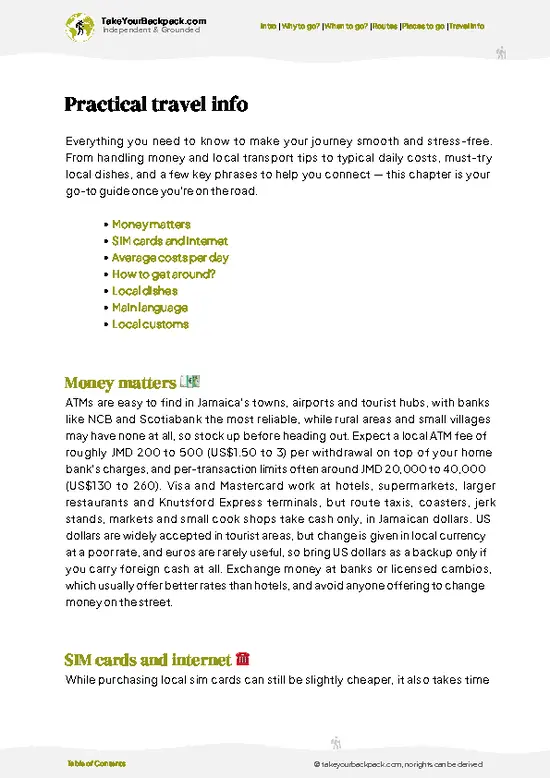
example page 0 from our offline Travel Guide for Jamaica
example page 1 from our offline Travel Guide for Jamaica
example page 2 from our offline Travel Guide for Jamaica
example page 3 from our offline Travel Guide for Jamaica
example page 4 from our offline Travel Guide for Jamaica
example page 5 from our offline Travel Guide for Jamaica
example page 6 from our offline Travel Guide for Jamaica
example page 7 from our offline Travel Guide for Jamaica
Loading the map 🌍
CLICK TO FILTER
cities
towns
villages
landmarks
national parks
hikes
beaches
attractions
festivals
regions
SHOW COUNTRY’S BESTSHOW ALL

✨ Why go?
Ranked #9 region in Jamaica
What sets this place apart

Rio Grande Valley suits backpackers who like making their own plans, because the best of it costs little and needs no tour company. You can walk to the raft station at Berridale, haggle directly with a captain, and spend a long afternoon drifting under bamboo and banana leaves at a pace you set. The second draw is the Maroon connection. The village of Moore Town is a Windward Maroon community, and its museum and Nanny’s legacy give the valley real history that organized day tours often rush through. Stay local and you can talk with residents over a plate of pepper shrimp or fried fish at a roadside stand. The third reason is the Reach Falls area nearby, a short hop that rounds out the visit. Expect rain, wear sandals that grip, and keep days flexible.

💡 HighlightsThe experiences that define the visit

  1. Bamboo rafting on the Rio Grande: the signature experience, a long, slow float of about two hours on a 10 meter bamboo raft poled by a captain who knows every bend, with shaded banks and dipping spots.
  2. Berridale raft station: the starting point where captains line up and the upstream hills show themselves; a good place to compare offers face to face.
  3. Moore Town Maroon Museum: a small museum in a Windward Maroon settlement with artifacts and stories of resistance and independence.
  4. Nanny Falls: a modest waterfall tied to the legend of Nanny of the Maroons, reached on foot with a local guide.
  5. Reach Falls: a series of clear limestone pools and cascades just beyond the valley, good for swimming and shallow caves; a small entry fee applies.
  6. Blue and John Crow Mountains foothills: forested slopes above
… read more 👉
  1. Bamboo rafting on the Rio Grande: the signature experience, a long, slow float of about two hours on a 10 meter bamboo raft poled by a captain who knows every bend, with shaded banks and dipping spots.
  2. Berridale raft station: the starting point where captains line up and the upstream hills show themselves; a good place to compare offers face to face.
  3. Moore Town Maroon Museum: a small museum in a Windward Maroon settlement with artifacts and stories of resistance and independence.
  4. Nanny Falls: a modest waterfall tied to the legend of Nanny of the Maroons, reached on foot with a local guide.
  5. Reach Falls: a series of clear limestone pools and cascades just beyond the valley, good for swimming and shallow caves; a small entry fee applies.
  6. Blue and John Crow Mountains foothills: forested slopes above the valley with birdsong, ferns and views down to the river.
  7. Roadside river stops: informal swimming holes along the road where locals bathe and kids jump from rocks.
Rafting in the morning and Moore Town in the afternoon fit neatly into one day, with Rio Grande Valley’s river and its Maroon heritage side by side.
Spotted a mistake or missing something? Contact us.

Things to do near Rio Grande Valley

Ratings based on Tripadvisor reviews. When you book through this link, you support our work at no extra cost to you.

⌛️ 5 daysWhat you can realistically do in a week

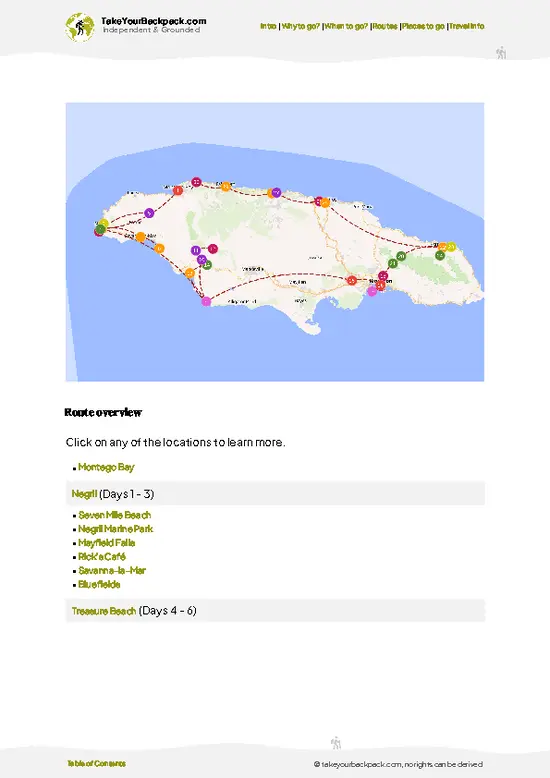
Day 1: Port Antonio: Market morning first: the produce stalls near the town’s main square are busiest early, and a bag of Portland jerk and fresh fruit sets you up for the valley. Base yourself here because Port Antonio is where the shared taxis and minibuses fan out, and the valley road is served by few vehicles, so you plan around them rather than the other way around.
Day 2: Berridale: Take a morning minibus south toward Berridale, the usual launch point for bamboo rafts on the Rio Grande. Book the long, slow float downstream and settle in for a couple of hours of green walls, kingfishers and the occasional vendor on a passing raft. Transport thins out in the afternoon, so finishing by lunch matters.
Day 3: Millbank and Moore Town: Push up the valley toward Millbank, where the road climbs … read more 👉
Day 1: Port Antonio: Market morning first: the produce stalls near the town’s main square are busiest early, and a bag of Portland jerk and fresh fruit sets you up for the valley. Base yourself here because Port Antonio is where the shared taxis and minibuses fan out, and the valley road is served by few vehicles, so you plan around them rather than the other way around.
Day 2: Berridale: Take a morning minibus south toward Berridale, the usual launch point for bamboo rafts on the Rio Grande. Book the long, slow float downstream and settle in for a couple of hours of green walls, kingfishers and the occasional vendor on a passing raft. Transport thins out in the afternoon, so finishing by lunch matters.
Day 3: Millbank and Moore Town: Push up the valley toward Millbank, where the road climbs into Blue and John Crow Mountains foothills. Moore Town, the Maroon heartland, is reachable only by patient hops, so arrange a local guide and a driver for the day. The Maroon story of resistance against the British is told here by people who live it, and the Nanny of the Maroons memorial is a short walk from the center.
Day 4: Detour to Nanny Falls: This is the detour: a guided hike from Moore Town to Nanny Falls adds a river swim and forest trail without moving your bed. Wear shoes that can get wet and start early so you are back before the usual rains.
Day 5: Back to Port Antonio: Ride out with the morning traffic, then spend the afternoon at a quiet cove near town to let the legs recover.
If I had to pick one day that justifies the trip, it is Day 3. Hearing Maroon history in the very hills where it happened beats any raft ride, however lovely.

🌤️ When to go?Weather, crowds, and seasonal trade-offs

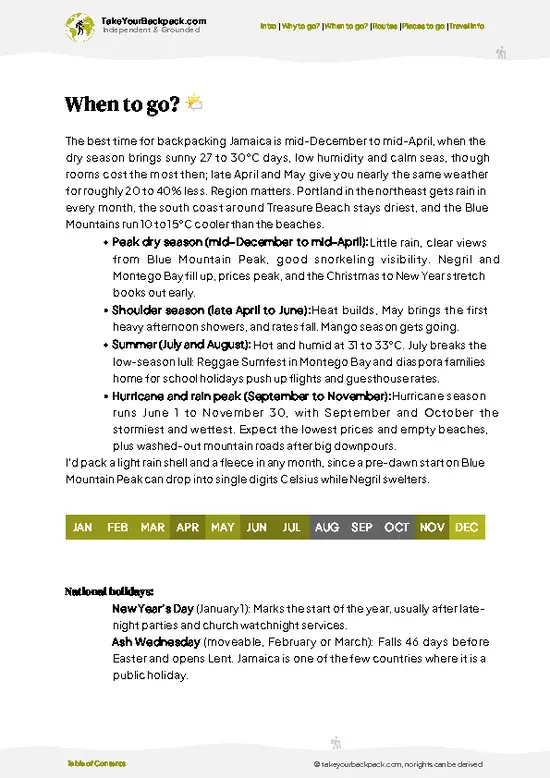
  • Dry Season (December to April): Mornings run 20 to 24°C (68 to 75°F), afternoons 28 to 31°C (82 to 88°F), and rafting on the Rio Grande is at its smoothest. Daylight lasts roughly 11 to 12 hours. This is the busiest stretch around Port Antonio, and rooms cost more.
  • Shoulder Months (May to June): Heat climbs to 31 to 33°C (88 to 91°F) with short afternoon showers. Crowds thin and guesthouses offer discounts.
  • Wet Season (September to November): This is the rainiest stretch in the Blue Mountain foothills, and trails above Moore Town turn to mud. Rain can raise the river quickly and cancel rafts. Hurricane risk peaks here. Rates are lowest.
  • Summer (July to August): Hot and humid at 30 to 33°C (86 to 91°F), with local holiday crowds around Emancipation and Independence days.
Book a morning raft in … read more 👉
  • Dry Season (December to April): Mornings run 20 to 24°C (68 to 75°F), afternoons 28 to 31°C (82 to 88°F), and rafting on the Rio Grande is at its smoothest. Daylight lasts roughly 11 to 12 hours. This is the busiest stretch around Port Antonio, and rooms cost more.
  • Shoulder Months (May to June): Heat climbs to 31 to 33°C (88 to 91°F) with short afternoon showers. Crowds thin and guesthouses offer discounts.
  • Wet Season (September to November): This is the rainiest stretch in the Blue Mountain foothills, and trails above Moore Town turn to mud. Rain can raise the river quickly and cancel rafts. Hurricane risk peaks here. Rates are lowest.
  • Summer (July to August): Hot and humid at 30 to 33°C (86 to 91°F), with local holiday crowds around Emancipation and Independence days.
Book a morning raft in February or March for clear water and fewer rain delays.


source: climatestotravel.comJANJanuary: excellent for travelingFEBFebruary: excellent for travelingMARMarch: excellent for travelingAPRApril: highly recommended for travelingMAYMay: highly recommended for travelingJUNJune: fair for travelingJULJuly: fair for travelingAUGAugust: fair for travelingSEPSeptember: fair for travelingOCTOctober: fair for travelingNOVNovember: highly recommended for travelingDECDecember: excellent for traveling
jamaica-region-rio-grande-valley
© Google |

✈️ The backpacker research shortcutJamaica Travel Guide

An offline-friendly backpacking guide with optimized travel routes, ranked highlights, transport advice, and the best areas to stay.
example page 0 from our offline Travel Guide for Jamaica
example page 1 from our offline Travel Guide for Jamaica
example page 2 from our offline Travel Guide for Jamaica
example page 3 from our offline Travel Guide for Jamaica
example page 4 from our offline Travel Guide for Jamaica
example page 5 from our offline Travel Guide for Jamaica
example page 6 from our offline Travel Guide for Jamaica
example page 7 from our offline Travel Guide for Jamaica
The digital guide (238 pages) contains:
✅ 71 highlights, ranked by travel appeal
✅ Optimized 5, 10 & 15-day travel routes
✅ Cities, national parks, landmarks, beaches
✅ How to get around
✅ Offline-friendly for travel without Wi-Fi
👉 Click to see all 30+ guide features

📅 Plan smarter in minutes, not weeks
✅ Month by month travel advice
✅ Festivals & national holidays
✅ Budget expectations

🗺️ Go to the right places, skip the overrated ones
✅ Honest pros & cons of destinations
✅ Top hikes, parks & viewpoints
✅ Lesser-known places most travelers miss
✅ Clear “worth it vs skip it” guidance

🛏️ Travel smoothly without rookie mistakes
✅ Best areas to stay
✅ Transport systems explained simply
✅ Common scams & safety advice
✅ SIM cards, money & practical tips

🌍 Understand the country, not just visit it
✅ Culture & traditions
✅ 52 Essential phrases & customs
✅ Festivals worth planning around
✅ Traveler-friendly historical context
✅ Insights that make places more meaningful

📱 Built for real travel conditions
✅ Fully downloadable PDF
✅ Works completely offline
✅ Optimized for phone use
✅ Useful in remote areas & buses
✅ Everything in one place
Stop searching, start planning
Get instant access to your full guide. 30‑day money-back guarantee.
+ Add another guide for just

By proceeding you agree to our terms.
Sent to your inbox immediately after payment • 100% Secure Checkout
Best Backpacking Travel Advisor 2025 tourism awardBest Backpacking
Travel Advisor
2025
What others say about Take Your Backpack Guides:
⭐⭐⭐⭐⭐
Fantastic, amazing amount of information!
⭐⭐⭐⭐⭐
My goodness this is amazing, it's what I've been looking for hats off too you!
⭐⭐⭐⭐⭐
I think this is absolutely BRILLIANT
⭐⭐⭐⭐
Very complete and informative. It's still missing places, but I gotta to commend you
⭐⭐⭐⭐⭐
This is truly amazing, thank you, can't wait to explore it with my kids!
⭐⭐⭐⭐⭐
Awesome resource, thank you!
⭐⭐⭐⭐⭐
This is amazing! Can't wait to explore the ones I haven't seen
⭐⭐⭐⭐
I love this! Well done, great idea.
⭐⭐⭐⭐⭐
Thanks for taking the time to make this gem!
⭐⭐⭐⭐⭐
This might be the best website I've ever seen.
⭐⭐⭐⭐⭐
Congratulations, and thank you so much for your work; it's incredibly valuable.
⭐⭐⭐⭐
In all seriousness I think you did a great job pointing out the important spots
⭐⭐⭐⭐⭐
10/10 very good
⭐⭐⭐⭐⭐
As someone who's only just starting to visit regularly this is awesome, thank you.
⭐⭐⭐⭐
Thank you very much! I'm going to visit my dad, it's going to be very useful!
⭐⭐⭐⭐⭐
This is really cool! We'll be travelling for the first time and this definitely come in handy.
⭐⭐⭐⭐⭐
You are now our minister of culture, congratulations 👨‍💼
⭐⭐⭐⭐⭐
Just wanted to tell you that this is a pearl! Going to follow your recommendations.
⭐⭐⭐⭐⭐
This is so cool. I'll definitely be using the resource for my travels soon.
⭐⭐⭐⭐⭐
This is very impressive! Good work.
⭐⭐⭐⭐⭐
This is an amazing and informative site. Very well done!

🛏️ Where to stay?Where staying makes the most sense

No lodging sits inside the valley itself, so most backpackers sleep in Port Antonio, the nearest town on the coast, and travel inland for hikes and rafting. Expect guesthouses and small hostels there at roughly US$30 to 70 for a private room and US$15 to 25 for a dorm bed, with a handful of budget spots near Drapers and Fairy Hill along the coast road. Port Antonio works best if you want restaurants, a market, and shared taxis heading to Rio Grande Valley. For something quieter, look at Fellowship or Berridale, where family-run lodges and homestays sit closer to the river and farm country, often … read more 👉
No lodging sits inside the valley itself, so most backpackers sleep in Port Antonio, the nearest town on the coast, and travel inland for hikes and rafting. Expect guesthouses and small hostels there at roughly US$30 to 70 for a private room and US$15 to 25 for a dorm bed, with a handful of budget spots near Drapers and Fairy Hill along the coast road. Port Antonio works best if you want restaurants, a market, and shared taxis heading to Rio Grande Valley. For something quieter, look at Fellowship or Berridale, where family-run lodges and homestays sit closer to the river and farm country, often with home-cooked meals included. Moore Town, up the valley, has a few community stays and is the base for Maroon culture visits and Blue Mountain trekking. Book ahead in December to April, since small places fill quickly. Hosts can usually arrange raft captains and guides.

🚌 Getting aroundHow to get from A to B

A shared route taxi along the Rio Grande Valley road from Port Antonio costs roughly US$1 to 2 per hop, paid in Jamaican dollars in cash to the driver when you get out or when he asks. Rio Grande Valley is a thin strip of road, river and bamboo rafts running south of Port Antonio toward Berrydale and Moore Town, and most backpackers combine route taxis with one raft ride. The roads are narrow and winding, and service is steady in the morning but thins out by late afternoon.
Rio Grande Valley rewards you for choosing the right option and punishes you for overplanning, so skip anything that needs a tight schedule.
  • Route taxi: Shared cars run from Port Antonio to Fellowship and further up the valley for about US$1 to 3, and they fill up before leaving, so expect a 10 to 20 minute wait. You get
… read more 👉
A shared route taxi along the Rio Grande Valley road from Port Antonio costs roughly US$1 to 2 per hop, paid in Jamaican dollars in cash to the driver when you get out or when he asks. Rio Grande Valley is a thin strip of road, river and bamboo rafts running south of Port Antonio toward Berrydale and Moore Town, and most backpackers combine route taxis with one raft ride. The roads are narrow and winding, and service is steady in the morning but thins out by late afternoon.
Rio Grande Valley rewards you for choosing the right option and punishes you for overplanning, so skip anything that needs a tight schedule.
  • Route taxi: Shared cars run from Port Antonio to Fellowship and further up the valley for about US$1 to 3, and they fill up before leaving, so expect a 10 to 20 minute wait. You get a seat among locals, a view of the bamboo-lined river and a driver who will point out the best roadside stall.
  • Bamboo raft: The classic 8 to 9 kilometer (5 to 6 mile) drift from Berrydale down to Rafters Rest takes 2 to 3 hours and costs around US$60 to 80 per raft, which carries two people, so split it. It is the one pricey item worth paying for, because you float silently past cliffs, kingfishers and riverside vendors with cold Red Stripe.
  • Private charter taxi: A licensed driver from Port Antonio to the raft start costs roughly US$25 to 40 each way. Skip it if you are alone, but with three or four people it is faster and puts you at the water by 8 a.m. before the heat builds.
  • Walking: Between villages the road is quiet enough to stroll for 30 to 60 minutes, free, with mango trees, farm plots and children heading to school. Do not walk it after dark, as there are no streetlights.
Arrange your raft pickup at the end point when you book, since route taxis back to Port Antonio get scarce after mid-afternoon.

👛 Costs (as of 23 October 2026)Money, prices, and spending tips

Rio Grande Valley costs about US$113 to 260 a day for a backpacker, with the raft trip being the largest single expense. The table sums a high-season day with a raft, a guesthouse room and local food.
CategoryBudget RangeLocal Reality
Bamboo raftingUS$65 to 100 per raftA raft carries two people, so splitting it halves your share. Tip the captain separately.
Accommodation (high season)US$15 to 70Dorm beds or basic guesthouse rooms in Port Antonio and nearby villages.
Local transportUS$3 to 15Shared route taxis between Port Antonio and the valley are cheap. Private taxis cost more.
Food and suppliesUS$10 to 25Jerk stands and cookshops serve filling plates. Restaurants cost more.
Guides for hikesUS$20 to 50Optional for Moore Town and upland trails, negotiated per day.
Total Daily BudgetUS$113 to 260Sharing a raft and a room lowers your daily cost.
⚠️ Prices can change and everyone travels differently, so take this as a rough guide. Hope it helps you plan your adventure!

🍲 FoodEating & Drinking in Rio Grande Valley

Start with jerk, smoky and peppery, sold from roadside drums that you smell long before you see them. Chicken or pork comes chopped with a cleaver onto foil, with a piece of hard dough bread and a sharp scotch bonnet kick. Along the river, vendors sell pepper shrimp in paper bags, and fresh river fish is fried or steamed with okra and bammy, a flat cassava cake that soaks up the sauce. Ask for festival and roast breadfruit when it is in season.
For drinks, look for coconut water chopped open in front of you, sorrel around Christmas, and cold Red Stripe at raft landings. Rum shops are the social hubs, where domino slaps and dancehall carry across the porch.
Eat at cookshops and roadside stalls in Port Antonio and the valley villages, where a plate runs about US$4 to 8. Greet people before ordering, … read more 👉
Start with jerk, smoky and peppery, sold from roadside drums that you smell long before you see them. Chicken or pork comes chopped with a cleaver onto foil, with a piece of hard dough bread and a sharp scotch bonnet kick. Along the river, vendors sell pepper shrimp in paper bags, and fresh river fish is fried or steamed with okra and bammy, a flat cassava cake that soaks up the sauce. Ask for festival and roast breadfruit when it is in season.
For drinks, look for coconut water chopped open in front of you, sorrel around Christmas, and cold Red Stripe at raft landings. Rum shops are the social hubs, where domino slaps and dancehall carry across the porch.
Eat at cookshops and roadside stalls in Port Antonio and the valley villages, where a plate runs about US$4 to 8. Greet people before ordering, since a plain “good afternoon” matters. Cash only, and service is relaxed, so expect a wait.

🛡️ SafetyTraveler Safety Guide

The valley is generally straightforward, with the main hazards being rain, river conditions and slippery ground. Afternoon downpours arrive fast in the foothills, and trails around Moore Town become muddy, so wear shoes with real grip and start early. After heavy rain, rivers rise and rafting or crossings may be halted, so follow your captain’s call. Use a local guide for upland routes, since junctions are poorly marked and mobile signal is patchy. Carry at least 2 liters of water, insect repellent and a rain layer. There are no dangerous large animals, though mosquitoes and biting midges are common near the water. Keep valuables out of sight in Port Antonio, and agree on prices for guides and rafts before setting off.

FAQTraveler FAQ

Two days is a comfortable fit for Rio Grande Valley: one for a bamboo raft ride of roughly 2 to 3 hours, another for a walk or Maroon visit in Moore Town. Add a third day if you want to hike higher toward the Blue and John Crow Mountains foothills. Most people stay in Port Antonio.
Yes, though it takes planning. Shared route taxis run from Port Antonio to Berridale and Fellowship, and rafting operators often provide pickup at the start point for a small fee. Rio Grande Valley is about 15 to 25 minutes by road from Port Antonio, and a private taxi costs roughly US$20 to 40 each way.
There is no national park gate fee, but you pay for activities. A bamboo raft for two typically costs US$65 to 100, and local guides for hikes charge about US$20 to 50 a day. Rio Grande Valley does not require a permit for ordinary visits, though Moore Town community visits may ask for a small donation.
⚠️ Things can change over time, so always validate details locally before you go.

Other destinations worth considering

Rio Grande Valley isn’t the only highlight in Jamaica. Explore all what Jamaica has to offer.
Country photo of Jamaica

We 💚 feedbackSumming up the experience

Rio Grande Valley rewards people who look beyond the raft. Most first-timers overlook Moore Town, where Maroon history is still lived rather than staged. I would raft early, then give the afternoon to the museum and a local guide. Bring cash, because there are few machines out here.

✈️ When did I visit Jamaica?
As part of my 1.5 year travel around the world trip, I visited Jamaica in May 2016.

✍️ Help improve this page!
The information on this page is based on my own backpacking experience in Jamaica, supplemented with up-to-date research and feedback from other travelers. Travel details can change, so if you notice anything outdated or incomplete, feel free to let me know.


🙋‍♂️ Give feedback

👋 Meet the founderWho’s Behind Take Your Backpack?

Johan, backpacker and founder of TakeYourBackpackHi, I’m Johan (Netherlands 🇳🇱), the creator of TakeYourBackpack. Over the past 3 decades, I’ve backpacked through 90+ countries across six continents, gaining extensive experience with independent travel, long-term trips, and overland routes.

This site is built on a combination of firsthand travel experience and carefully curated insights from other backpackers. Many guides are based on places I’ve personally visited, while others bring together tips, observations, and practical advice shared by trusted travelers I’ve met along the way.

The goal is to provide realistic, experience-driven guidance — not generic itineraries — so you can explore destinations with better context, clearer expectations, and more confidence.