×

Jamaica🇯🇲 | best regionsWhere to Find the 2 Best regions in Jamaica

Jamaica packs wildly different trips into an island about 235 km (146 miles) long. The north coast runs on resorts and cruise ports, with higher prices and constant hustle. The south coast is slower, cheaper and rougher, with fewer tourists and more fishing villages. The Blue Mountains and the east trade beaches for cool air, coffee farms and hiking. Kingston is the cultural engine of music and food, but it is no beach town. For independent travel, public transport is cheap yet slow, so distances matter more than the map suggests. Skip the all-inclusive strips unless comfort is the goal. Back the quieter coasts and hills for character.

By Johan Kruseman 🇳🇱 | Updated October 23, 2026
Explore the best cities in Jamaica

Why go?Why Travelers Love These Spots

Jamaica suits a regions-based trip because the geography splits sharply. A central mountain spine (the Blue Mountains peak at 2,256 meters) throws rain onto the northeast and leaves the south drier, so coastlines differ in weather, vegetation and feel. History adds another layer. Plantation economies, Maroon communities in the interior and the rise of reggae in Kingston left distinct local cultures, accents and food traditions, not one uniform island identity.

Infrastructure is the main limit. Roads are narrow, winding and often congested, and a 100 km journey can take three hours or more. Public transport runs on shared minibuses and route taxis, which are cheap but crowded, without reliable timetables. Tourism is concentrated in resort corridors, so independent budget options are thinner … read more 👉
Jamaica suits a regions-based trip because the geography splits sharply. A central mountain spine (the Blue Mountains peak at 2,256 meters) throws rain onto the northeast and leaves the south drier, so coastlines differ in weather, vegetation and feel. History adds another layer. Plantation economies, Maroon communities in the interior and the rise of reggae in Kingston left distinct local cultures, accents and food traditions, not one uniform island identity.

Infrastructure is the main limit. Roads are narrow, winding and often congested, and a 100 km journey can take three hours or more. Public transport runs on shared minibuses and route taxis, which are cheap but crowded, without reliable timetables. Tourism is concentrated in resort corridors, so independent budget options are thinner than in much of Central America or Southeast Asia, and prices run higher than visitors expect. A day of moving costs real time.

Travelers should also know that hassle from touts is common in tourist areas, and that saying a firm, polite no works better than avoidance. Choose Jamaica for its depth in a few places, not for ticking off the whole island. Anyone wanting cheap, frictionless hopping between many stops will be frustrated.
Why These Made the Cut
The list of best regions in Jamaica is created based on landscapes, local culture, attractions, vibes, and overall appeal. If you feel a region is missing in this list, please let us know.

When to go?Optimal Periods for Travel

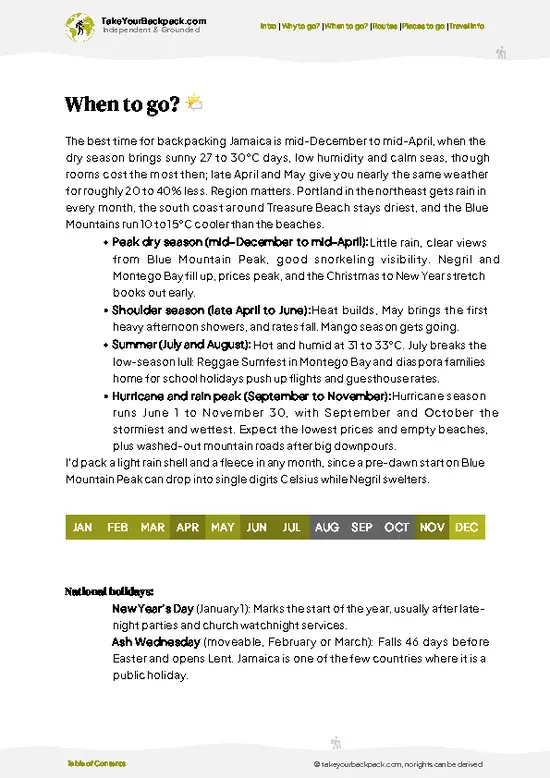
Best months and weather: The best months are December to April, when it is dry, sunny and roughly 27 to 31°C (81 to 88°F) on the coast, with low humidity and the least rain. Mid-December to mid-April is also peak season, and accommodation prices can run 30 to 60 percent above summer rates, especially on the north coast and around Christmas and New Year.
Shoulder seasons: May to June and November are the smart compromise. Prices drop, crowds thin and you still get plenty of sun, though showers arrive in short afternoon bursts. May and October are the two rainiest months in many areas, and the northeast, around Portland, is wetter than anywhere else all year, with rainfall that can exceed 3,000 mm annually. The south is noticeably drier.
Seasons to avoid: July to August is hot (often 32°C or more) … read more 👉
Best months and weather: The best months are December to April, when it is dry, sunny and roughly 27 to 31°C (81 to 88°F) on the coast, with low humidity and the least rain. Mid-December to mid-April is also peak season, and accommodation prices can run 30 to 60 percent above summer rates, especially on the north coast and around Christmas and New Year.
Shoulder seasons: May to June and November are the smart compromise. Prices drop, crowds thin and you still get plenty of sun, though showers arrive in short afternoon bursts. May and October are the two rainiest months in many areas, and the northeast, around Portland, is wetter than anywhere else all year, with rainfall that can exceed 3,000 mm annually. The south is noticeably drier.
Seasons to avoid: July to August is hot (often 32°C or more) and good for budgets, but it is not worth it for hiking. Hurricane season runs June to November and peaks from August to October. Storms are not constant, but flooded roads and landslides in the Blue Mountains can wreck transport plans, so skip September and October unless flexibility is total. For mountain hiking, the cooler, clearer dry months are best, as summits can sit at 10 to 15°C at dawn.

region hoppingPlanning Your Route Efficiently

How many days to allow: A trip combining several regions needs 10 to 14 days. Anything under a week means two bases at most. Allow 3 to 4 nights per stop, since arriving, finding transport and settling in eats half a day each time.
Direction and grouping: Fly into Montego Bay or Kingston and finish at the other, so you never backtrack. The west and north coast group naturally, and so do Kingston and the eastern mountains. The south coast links the two sides through the island interior. Traveling west to east gives a gentle start and ends in the cooler hills and the capital, which suits a trip with a music and food focus.
Travel times and transport: Expect Montego Bay to Negril at 1.5 to 2 hours, Montego Bay to Kingston at 3.5 to 5 hours, and Kingston to Port Antonio at 2.5 to 3.5 hours. Knutsford … read more 👉
How many days to allow: A trip combining several regions needs 10 to 14 days. Anything under a week means two bases at most. Allow 3 to 4 nights per stop, since arriving, finding transport and settling in eats half a day each time.
Direction and grouping: Fly into Montego Bay or Kingston and finish at the other, so you never backtrack. The west and north coast group naturally, and so do Kingston and the eastern mountains. The south coast links the two sides through the island interior. Traveling west to east gives a gentle start and ends in the cooler hills and the capital, which suits a trip with a music and food focus.
Travel times and transport: Expect Montego Bay to Negril at 1.5 to 2 hours, Montego Bay to Kingston at 3.5 to 5 hours, and Kingston to Port Antonio at 2.5 to 3.5 hours. Knutsford Express coaches run between main hubs with fixed fares and are the best value for long legs. Route taxis and minibuses fill the gaps but add waiting time.
Planning mistakes: The biggest error is cramming five or six stops into a week, which turns the trip into road time. Another is trusting map distances, as a 60 km mountain road can take two hours. Do not arrange an early flight after a long coastal drive, and leave a buffer day before departure. Cut stops rather than rush them.

The ListThe Best regions of Jamaica

1 Cockpit Country

Maroon villages, limestone cockpits, bat caves, guided trails, endemic birds

Hire a local guide in Accompong, Windsor or Quick Step to reach Maroon sites, a dusk bat flight and birding trails across roadless limestone hills.

2 Rio Grande Valley

Bamboo rafts, Maroon history, Reach Falls, river pools

Float two unhurried hours on a poled bamboo raft, then cool off in limestone pools and learn Maroon history at Moore Town.

jamaica-region-rio-grande-valley
© Google |
Loading the map 🌍

Expert viewPro Tips for Exploring the Best

How many regions to visit: Plan on two or three regions for a trip of up to two weeks. Jamaica’s roads are slow and public transport is unscheduled, so each additional base costs most of a day and US$15 to 40 in transfers. Four or more regions turns the trip into a series of departures. For a week, choose two.
Which kind suits your style: Choose a cultural and food region if music, street food and nightlife matter more than beaches. Pick a mountain or rural region for hiking, coffee farms and quiet, and a coastal region for swimming and cliff jumping. A resort-style coast is the poor choice for a budget traveler. Prices are high, and much of the offer is walled off from local life. Backpackers get more for their money in the smaller, community-run coastal and hill areas.
What it costs: A realistic … read more 👉
How many regions to visit: Plan on two or three regions for a trip of up to two weeks. Jamaica’s roads are slow and public transport is unscheduled, so each additional base costs most of a day and US$15 to 40 in transfers. Four or more regions turns the trip into a series of departures. For a week, choose two.
Which kind suits your style: Choose a cultural and food region if music, street food and nightlife matter more than beaches. Pick a mountain or rural region for hiking, coffee farms and quiet, and a coastal region for swimming and cliff jumping. A resort-style coast is the poor choice for a budget traveler. Prices are high, and much of the offer is walled off from local life. Backpackers get more for their money in the smaller, community-run coastal and hill areas.
What it costs: A realistic budget is US$50 to 90 a day for hostels or guesthouses, local food and shared transport. Dorm beds run about US$20 to 35, private rooms US$45 to 90. Jerk stands and cookshops cost US$4 to 10 a meal, while tourist restaurants charge double. Entry fees for waterfalls, caves and parks typically run US$10 to 25, and licensed mountain guides cost roughly US$40 to 80 for a day hike. Private taxis between towns run US$60 to 150, so shared options save a lot. Budget around US$400 to 700 for a week of moving carefully.
Costs and mistakes that catch people out: Agree every taxi fare before getting in, because unmetered rides quoted in US dollars can double the local rate. Carry Jamaican dollars in small notes, since many roadside stalls and minibuses do not take cards or change large bills. Do not pay for a guide on arrival at a site until the price and duration are fixed. Skip the cruise-port excursions, which sell the same rivers and falls at two to three times the standard fee.
Safety and culture: Most visits pass without trouble, but petty theft and persistent touts occur in busy areas. Avoid walking at night in cities, use licensed taxis after dark and keep phones out of sight. Do not buy cannabis from strangers on the street, as it is only partly decriminalized, with limited legal amounts. Greet people before asking anything, as a hello matters here. Ask before photographing people. Dress modestly away from the beach, and bring rain gear for hill trips, as trails turn slick quickly.

✈️ The backpacker research shortcutJamaica Travel Guide

An offline-friendly backpacking guide with optimized travel routes, ranked highlights, transport advice, and the best areas to stay.
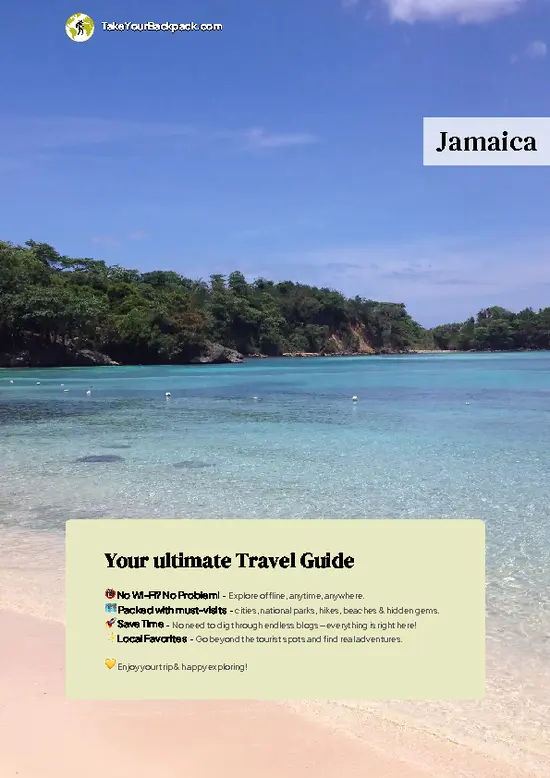
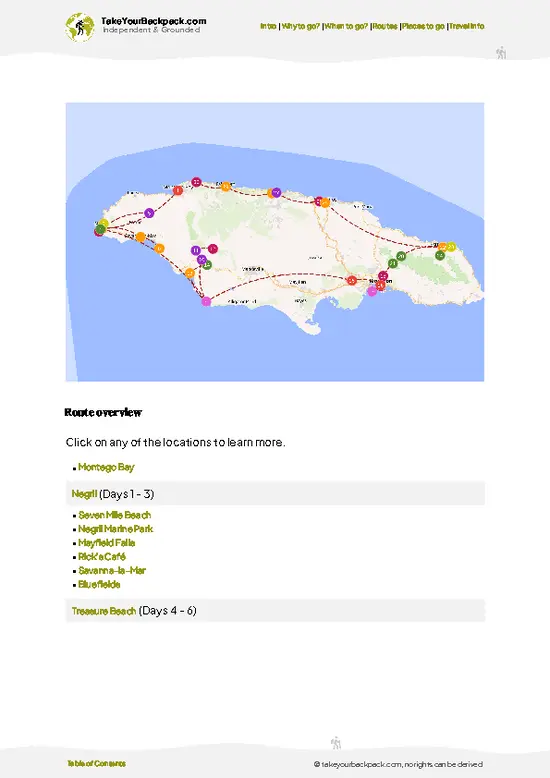
example page 0 from our offline Travel Guide for Jamaica
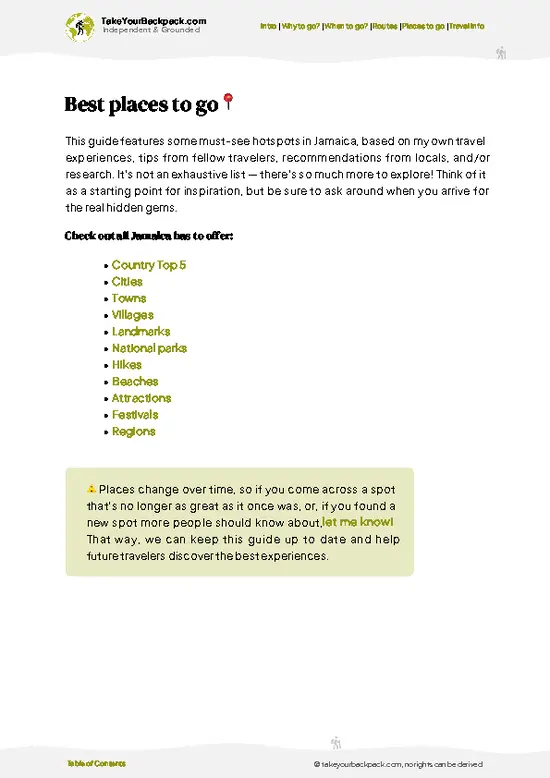
example page 1 from our offline Travel Guide for Jamaica
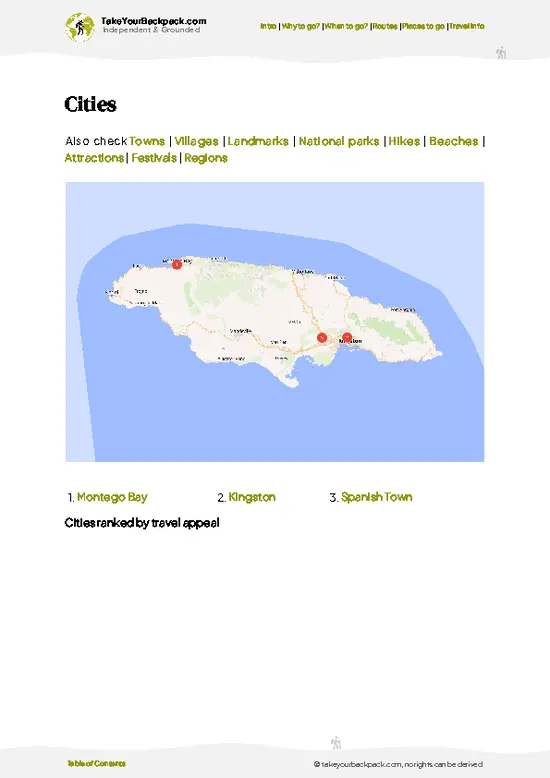
example page 2 from our offline Travel Guide for Jamaica
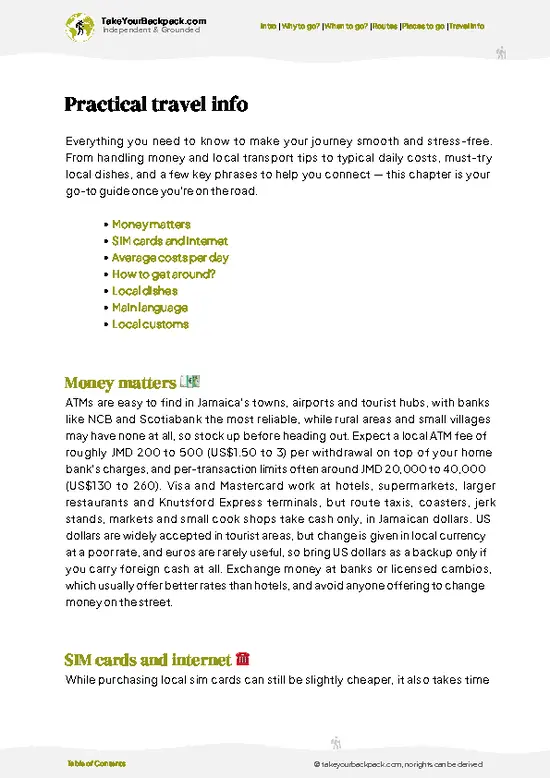
example page 3 from our offline Travel Guide for Jamaica
example page 4 from our offline Travel Guide for Jamaica
example page 5 from our offline Travel Guide for Jamaica
example page 6 from our offline Travel Guide for Jamaica
example page 7 from our offline Travel Guide for Jamaica
The digital guide (238 pages) contains:
✅ 71 highlights, ranked by travel appeal
✅ Optimized 5, 10 & 15-day travel routes
✅ Cities, national parks, landmarks, beaches
✅ How to get around
✅ Offline-friendly for travel without Wi-Fi
👉 Click to see all 30+ guide features

📅 Plan smarter in minutes, not weeks
✅ Month by month travel advice
✅ Festivals & national holidays
✅ Budget expectations

🗺️ Go to the right places, skip the overrated ones
✅ Honest pros & cons of destinations
✅ Top hikes, parks & viewpoints
✅ Lesser-known places most travelers miss
✅ Clear “worth it vs skip it” guidance

🛏️ Travel smoothly without rookie mistakes
✅ Best areas to stay
✅ Transport systems explained simply
✅ Common scams & safety advice
✅ SIM cards, money & practical tips

🌍 Understand the country, not just visit it
✅ Culture & traditions
✅ 52 Essential phrases & customs
✅ Festivals worth planning around
✅ Traveler-friendly historical context
✅ Insights that make places more meaningful

📱 Built for real travel conditions
✅ Fully downloadable PDF
✅ Works completely offline
✅ Optimized for phone use
✅ Useful in remote areas & buses
✅ Everything in one place
Stop searching, start planning
Get instant access to your full guide. 30‑day money-back guarantee.
+ Add another guide for just

By proceeding you agree to our terms.
Sent to your inbox immediately after payment • 100% Secure Checkout
Best Backpacking Travel Advisor 2025 tourism awardBest Backpacking
Travel Advisor
2025
What others say about Take Your Backpack Guides:
⭐⭐⭐⭐⭐
Fantastic, amazing amount of information!
⭐⭐⭐⭐⭐
My goodness this is amazing, it's what I've been looking for hats off too you!
⭐⭐⭐⭐⭐
I think this is absolutely BRILLIANT
⭐⭐⭐⭐
Very complete and informative. It's still missing places, but I gotta to commend you
⭐⭐⭐⭐⭐
This is truly amazing, thank you, can't wait to explore it with my kids!
⭐⭐⭐⭐⭐
Awesome resource, thank you!
⭐⭐⭐⭐⭐
This is amazing! Can't wait to explore the ones I haven't seen
⭐⭐⭐⭐
I love this! Well done, great idea.
⭐⭐⭐⭐⭐
Thanks for taking the time to make this gem!
⭐⭐⭐⭐⭐
This might be the best website I've ever seen.
⭐⭐⭐⭐⭐
Congratulations, and thank you so much for your work; it's incredibly valuable.
⭐⭐⭐⭐
In all seriousness I think you did a great job pointing out the important spots
⭐⭐⭐⭐⭐
10/10 very good
⭐⭐⭐⭐⭐
As someone who's only just starting to visit regularly this is awesome, thank you.
⭐⭐⭐⭐
Thank you very much! I'm going to visit my dad, it's going to be very useful!
⭐⭐⭐⭐⭐
This is really cool! We'll be travelling for the first time and this definitely come in handy.
⭐⭐⭐⭐⭐
You are now our minister of culture, congratulations 👨‍💼
⭐⭐⭐⭐⭐
Just wanted to tell you that this is a pearl! Going to follow your recommendations.
⭐⭐⭐⭐⭐
This is so cool. I'll definitely be using the resource for my travels soon.
⭐⭐⭐⭐⭐
This is very impressive! Good work.
⭐⭐⭐⭐⭐
This is an amazing and informative site. Very well done!

🛏️ Where to stay?Top Areas to Stay

Jamaica has a small but solid spread of hostels, guesthouses and cheap cottages, with dorm beds typically around US$20 to 35 a night and simple private rooms from roughly US$40 to 70. Negril has the widest choice: the West End cliffs are quieter, cheaper and better for swimming off rocks, while Seven Mile Beach puts you near the sand and beach bars but costs more and brings constant hustlers. In Kingston, New Kingston keeps you close to restaurants, nightlife and transport and feels safer than downtown after dark, whereas laid-back Treasure Beach and Port Antonio trade nightlife for calm, friendly guesthouse stays near the coast and the rivers.

If you enjoy meeting fellow travelers, consider … read more 👉
Jamaica has a small but solid spread of hostels, guesthouses and cheap cottages, with dorm beds typically around US$20 to 35 a night and simple private rooms from roughly US$40 to 70. Negril has the widest choice: the West End cliffs are quieter, cheaper and better for swimming off rocks, while Seven Mile Beach puts you near the sand and beach bars but costs more and brings constant hustlers. In Kingston, New Kingston keeps you close to restaurants, nightlife and transport and feels safer than downtown after dark, whereas laid-back Treasure Beach and Port Antonio trade nightlife for calm, friendly guesthouse stays near the coast and the rivers.

If you enjoy meeting fellow travelers, consider choosing hostels with high ratings for atmosphere. On the other hand, if you prefer having your own space, a hotel might be a better option.

JamaicaDiscover the Country

👋 Meet the founderWho’s Behind Take Your Backpack?

Johan, backpacker and founder of TakeYourBackpackHi, I’m Johan (Netherlands 🇳🇱), the creator of TakeYourBackpack. Over the past 3 decades, I’ve backpacked through 90+ countries across six continents, gaining extensive experience with independent travel, long-term trips, and overland routes.

This site is built on a combination of firsthand travel experience and carefully curated insights from other backpackers. Many guides are based on places I’ve personally visited, while others bring together tips, observations, and practical advice shared by trusted travelers I’ve met along the way.

The goal is to provide realistic, experience-driven guidance — not generic itineraries — so you can explore destinations with better context, clearer expectations, and more confidence.