
×

Kenya🇰🇪 | landmarksGedi RuinsSwahili stonework, forested enclosures, coral architecture | things to do and best time to go

Explore KapenguriaExplore Kakamega Forest

Backpacking in Gedi Ruins
🏆 Top pickunique site ranked #1
By Johan Kruseman 🇳🇱 | Updated June 9, 2026

A monkey chatters overhead, scattering dry baobab leaves across the sun-bleached coral walls. Your boots crunch on centuries-old shell fragments. The air smells faintly of salt and moss, and for a split second, you’re the only human in a lost city. Gedi Ruins sits tucked in the coastal forest just south of Malindi, Kenya—far from Nairobi’s chaos, and even further from the safari circuit’s spotlight. Here’s the truth: you won’t find crowds jostling for selfies, and you won’t need to elbow past tour buses. The entry fee is pocket change by global standards, and the payoff is a real sense of discovery—if you can handle the heat and the occasional tout at the gate. Gedi isn’t a postcard-perfect monument; it’s a puzzle of crumbling mosques, silent tombs, and banyan roots swallowing ancient doorways. The magic isn’t in the photos you’ll take, but in the eerie, echoing quiet—a rare chance to feel like you’ve stumbled onto history’s secret level.

Discover everything you want to know in the 📖 Kenya Travel Guide.


Get your Kenya guide
114 ranked highlights, routes & tips, works offline (429 pages)
Loading the map 🌍
CLICK TO FILTER
cities
towns
landmarks
national parks
hikes
beaches
attractions
festivals
regions
SHOW COUNTRY’S BESTSHOW ALL

✨ Why go?
Ranked #1 unique site in Kenya
Why visitors keep coming back

The Gedi Ruins in Kenya are a must-see for backpackers who crave authenticity over Instagram filters. Sure, you’ll encounter crowds, especially during peak season, but don’t let that deter you. The history here is palpable; these 12th-century Swahili ruins whisper tales of a once-thriving civilization.

What sets Gedi apart is its uniqueness. Unlike other tourist traps, you’re not just looking at stones; you’re walking through a living museum surrounded by lush jungle. The cost is minimal—entry fees are pocket change, and you can easily spend hours wandering the grounds without breaking the bank.

Gedi fits seamlessly into a broader route along the Kenyan coast. Pair it with a visit to nearby Watamu or Malindi for a perfect blend of culture and beach time. The ruins are not just a stop; … read more 👉
The Gedi Ruins in Kenya are a must-see for backpackers who crave authenticity over Instagram filters. Sure, you’ll encounter crowds, especially during peak season, but don’t let that deter you. The history here is palpable; these 12th-century Swahili ruins whisper tales of a once-thriving civilization.

What sets Gedi apart is its uniqueness. Unlike other tourist traps, you’re not just looking at stones; you’re walking through a living museum surrounded by lush jungle. The cost is minimal—entry fees are pocket change, and you can easily spend hours wandering the grounds without breaking the bank.

Gedi fits seamlessly into a broader route along the Kenyan coast. Pair it with a visit to nearby Watamu or Malindi for a perfect blend of culture and beach time. The ruins are not just a stop; they’re a gateway to understanding the region’s rich heritage. Embrace the experience, and you’ll leave with stories that go far beyond the selfies.
Want to include Gedi Ruins in your Kenya route?
Create a personalized Kenya itinerary that includes Gedi Ruins and the places that fit your trip — based on your travel style, budget, and available time. Get your route in seconds.

Generate my trip

💡 HighlightsPlaces and moments you shouldn't skip

  • Great Mosque — One of the oldest standing mosques on the Kenyan coast, built from coral stone with a clearly marked mihrab; it’s simple but powerful, showing the early spread of Islam and the town’s role as a religious center.
  • Pillar Tombs — Tall, cylindrical tombs topped with stone pillars and occasional carved decoration; they’re visually striking and uniquely Swahili, marking status and giving the site a distinct skyline.
  • The Palace and Stone Houses — Multi-room domestic complexes with courtyards and stone foundations that hint at wealthy merchant life; climbing around the ruined rooms makes it easy to imagine daily life here centuries ago.
  • City Wall and Street Layout — A surrounding stone wall and an organized street plan reveal deliberate urban planning and defense, rare for a site
read more 👉
  • Great Mosque — One of the oldest standing mosques on the Kenyan coast, built from coral stone with a clearly marked mihrab; it’s simple but powerful, showing the early spread of Islam and the town’s role as a religious center.
  • Pillar Tombs — Tall, cylindrical tombs topped with stone pillars and occasional carved decoration; they’re visually striking and uniquely Swahili, marking status and giving the site a distinct skyline.
  • The Palace and Stone Houses — Multi-room domestic complexes with courtyards and stone foundations that hint at wealthy merchant life; climbing around the ruined rooms makes it easy to imagine daily life here centuries ago.
  • City Wall and Street Layout — A surrounding stone wall and an organized street plan reveal deliberate urban planning and defense, rare for a site this old on the East African coast.
  • Traces of Indian Ocean Trade — Excavations have turned up Chinese porcelain, glass beads and other imported goods; they’re quiet evidence that Gedi was plugged into long-distance maritime trade networks.
  • Arabuko-Sokoke Forest Edge and Wildlife — The ruins sit at the forest’s edge, so you get the archaeology plus monkeys, birds and cool shade on the walks — a nice mix of history and nature that most ruin sites don’t offer.
  • Atmosphere and Ruinscape — Weathered coral walls, narrow lanes and scattered foundations create a haunting, peaceful vibe; it’s a whole-place experience rather than a single monument, great for slow wandering and photos.
Spotted a mistake or missing something? Contact us.

Things to do near Gedi Ruins

Ratings based on Tripadvisor reviews. When you book through this link, you support our work at no extra cost to you.

🌤️ When to go?Choosing the right time of year


  • Weather: The dry seasons from June to October and January to February are your best bets. Expect clear skies and minimal rain, which means easier trails and less mud to slog through. The wet seasons (March to May and November to December) can turn the ruins into a slippery mess and limit your exploration.

  • Temperature: Daytime highs hover around 25-30°C (77-86°F) during dry months, perfect for hiking without overheating. Nights can dip to 15°C (59°F), so pack a light jacket. Wet seasons bring cooler temps but also humidity that can sap your energy.

  • Daylight Hours: Kenya’s near-equatorial location means roughly 12 hours of daylight year-round. Sunrise around 6:30 AM and sunset near 6:30 PM give you plenty of time to explore without rushing.

  • Crowds: Peak tourist season coincides with
read more 👉

  • Weather: The dry seasons from June to October and January to February are your best bets. Expect clear skies and minimal rain, which means easier trails and less mud to slog through. The wet seasons (March to May and November to December) can turn the ruins into a slippery mess and limit your exploration.

  • Temperature: Daytime highs hover around 25-30°C (77-86°F) during dry months, perfect for hiking without overheating. Nights can dip to 15°C (59°F), so pack a light jacket. Wet seasons bring cooler temps but also humidity that can sap your energy.

  • Daylight Hours: Kenya’s near-equatorial location means roughly 12 hours of daylight year-round. Sunrise around 6:30 AM and sunset near 6:30 PM give you plenty of time to explore without rushing.

  • Crowds: Peak tourist season coincides with the dry months, so expect more visitors and slightly higher prices. The ruins aren’t a massive tourist magnet, but weekends and holidays see a noticeable bump.

  • Seasonal Activities: Dry season offers better chances to spot wildlife around the ruins and nearby forest. Birdwatching peaks during migration periods (September-November), adding a bonus layer to your visit.

  • Price Fluctuations: Entrance fees and local guides’ rates tend to rise during peak dry months. Off-season might save you a few bucks but at the cost of muddy trails and unpredictable weather.


Pro-tip: Aim for the shoulder months of June or February—fewer crowds, decent weather, and a more authentic vibe without the tourist rush.


source: climatestotravel.comJANJanuary: excellent for travelingFEBFebruary: excellent for travelingMARMarch: fair for travelingAPRApril: below average for travelingMAYMay: fair for travelingJUNJune: highly recommended for travelingJULJuly: excellent for travelingAUGAugust: excellent for travelingSEPSeptember: highly recommended for travelingOCTOctober: highly recommended for travelingNOVNovember: fair for travelingDECDecember: fair for traveling
kenya-unique-site-gedi-ruins v1
© Google |

✈️ The backpacker research shortcutKenya Travel Guide

An offline-friendly backpacking guide with optimized travel routes, ranked highlights, transport advice, and the best areas to stay.
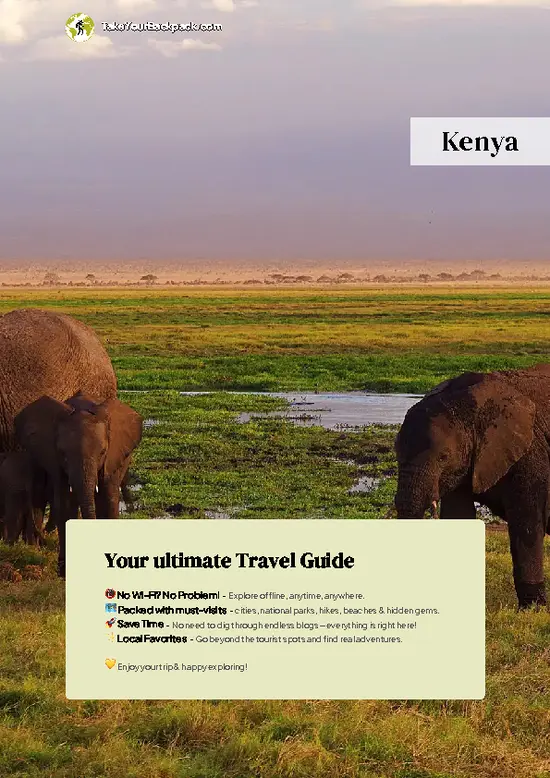
example page 0 from our offline Travel Guide for Kenya
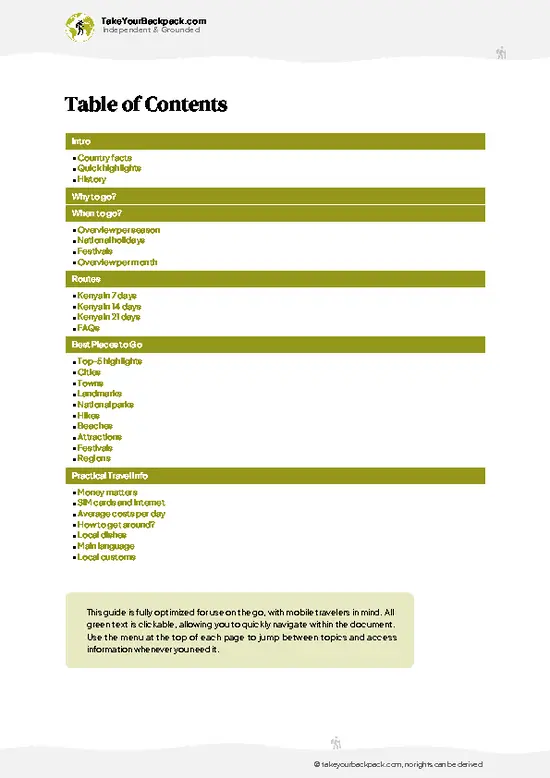
example page 1 from our offline Travel Guide for Kenya
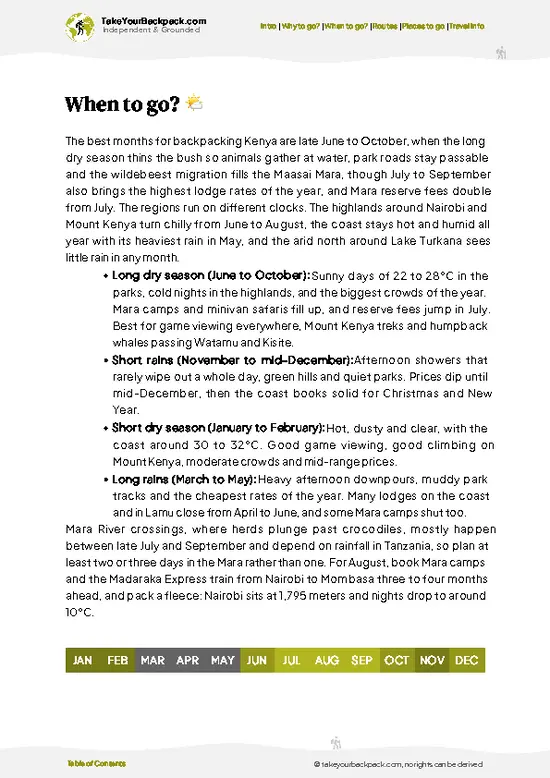
example page 2 from our offline Travel Guide for Kenya
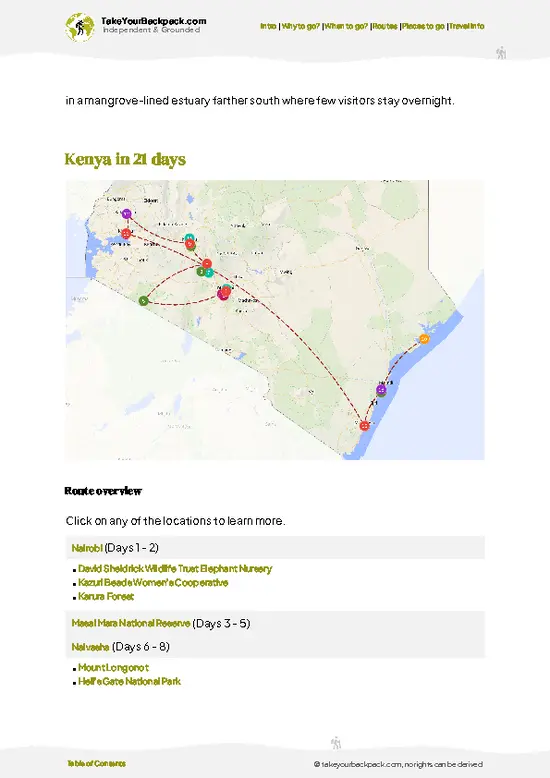
example page 3 from our offline Travel Guide for Kenya
example page 4 from our offline Travel Guide for Kenya
example page 5 from our offline Travel Guide for Kenya
example page 6 from our offline Travel Guide for Kenya
example page 7 from our offline Travel Guide for Kenya
The digital guide (429 pages) contains:
114 highlights, ranked by travel appeal
Optimized 7, 14 & 21-day travel routes
Cities, national parks, landmarks, beaches
How to get around
Offline-friendly for travel without Wi-Fi
👉 Click to see all 30+ guide features

📅 Plan smarter in minutes, not weeks
Month by month travel advice
Festivals & national holidays
Budget expectations

🗺️ Go to the right places, skip the overrated ones
Honest pros & cons of destinations
Top hikes, parks & viewpoints
Lesser-known places most travelers miss
Clear “worth it vs skip it” guidance

🛏️ Travel smoothly without rookie mistakes
Best areas to stay
Transport systems explained simply
Common scams & safety advice
SIM cards, money & practical tips

🌍 Understand the country, not just visit it
Culture & traditions
52 Essential phrases & customs
Festivals worth planning around
Traveler-friendly historical context
Insights that make places more meaningful

📱 Built for real travel conditions
Fully downloadable PDF
Works completely offline
Optimized for phone use
Useful in remote areas & buses
Everything in one place
Save weeks of stressful planning
Get instant access to your full guide. 30‑day money-back guarantee.


By proceeding you agree to our terms.
Sent to your inbox immediately after payment • 100% Secure Checkout
Best Backpacking Travel Advisor 2025 tourism awardBest Backpacking
Travel Advisor
2025
What others say about Take Your Backpack Guides:
⭐⭐⭐⭐⭐
Fantastic, amazing amount of information!
⭐⭐⭐⭐⭐
My goodness this is amazing, it's what I've been looking for hats off too you!
⭐⭐⭐⭐⭐
I think this is absolutely BRILLIANT
⭐⭐⭐⭐
Very complete and informative. It's still missing places, but I gotta to commend you
⭐⭐⭐⭐⭐
This is truly amazing, thank you, can't wait to explore it with my kids!
⭐⭐⭐⭐⭐
Awesome resource, thank you!
⭐⭐⭐⭐⭐
This is amazing! Can't wait to explore the ones I haven't seen
⭐⭐⭐⭐
I love this! Well done, great idea.
⭐⭐⭐⭐⭐
Thanks for taking the time to make this gem!
⭐⭐⭐⭐⭐
This might be the best website I've ever seen.
⭐⭐⭐⭐⭐
Congratulations, and thank you so much for your work; it's incredibly valuable.
⭐⭐⭐⭐
In all seriousness I think you did a great job pointing out the important spots
⭐⭐⭐⭐⭐
10/10 very good
⭐⭐⭐⭐⭐
As someone who's only just starting to visit regularly this is awesome, thank you.
⭐⭐⭐⭐
Thank you very much! I'm going to visit my dad, it's going to be very useful!
⭐⭐⭐⭐⭐
This is really cool! We'll be travelling for the first time and this definitely come in handy.
⭐⭐⭐⭐⭐
You are now our minister of culture, congratulations 👨‍💼
⭐⭐⭐⭐⭐
Just wanted to tell you that this is a pearl! Going to follow your recommendations.
⭐⭐⭐⭐⭐
This is so cool. I'll definitely be using the resource for my travels soon.
⭐⭐⭐⭐⭐
This is very impressive! Good work.
⭐⭐⭐⭐⭐
This is an amazing and informative site. Very well done!

🛏️ Where to stay?Best areas and accommodation options

Staying near Gedi Ruins in Kenya? You’re in for a treat, but let’s cut through the fluff. The area around Watamu is your best bet. It’s a laid-back coastal town that attracts a mix of backpackers and locals. You’ll find a range of budget-friendly accommodations, from hostels to guesthouses. The vibe is social, making it easy to connect with fellow travelers.

Now, let’s talk about the reality. Crowds can be a hassle, especially during peak season. But if you time your visits to the ruins early in the morning or late in the afternoon, you’ll dodge the throngs and soak in the history without the … read more 👉
Staying near Gedi Ruins in Kenya? You’re in for a treat, but let’s cut through the fluff. The area around Watamu is your best bet. It’s a laid-back coastal town that attracts a mix of backpackers and locals. You’ll find a range of budget-friendly accommodations, from hostels to guesthouses. The vibe is social, making it easy to connect with fellow travelers.

Now, let’s talk about the reality. Crowds can be a hassle, especially during peak season. But if you time your visits to the ruins early in the morning or late in the afternoon, you’ll dodge the throngs and soak in the history without the noise.

Another option is Malindi, just a short ride away. It’s a bit busier, but you’ll find a lively atmosphere with plenty of markets and eateries. Plus, the beach is stunning, offering a perfect spot to unwind after a day of exploration.

Safety is generally good, but stick to well-lit areas at night. Embrace the local culture, chat with the residents, and you’ll uncover the real magic of this coastal paradise.

👛 Costs (as of 9 October 2025)How expensive it really is

Visiting the Gedi Ruins in Kenya is a journey into history, but it comes with its own set of costs. Here’s the breakdown:
  • Entrance Fee: Expect to pay around $10 to $15 USD for a ticket. This fee grants you access to the ruins and the surrounding forest, where you can explore the remnants of this ancient Swahili town.
  • Guided Tours: If you want a deeper understanding of the site, consider a guided tour. Prices range from $20 to $50 USD, depending on the guide’s expertise and the length of the tour. A knowledgeable guide can bring the history to life, making the experience much richer.
  • Transportation: Getting to Gedi can vary. If you’re coming from Malindi or Watamu, expect to spend about $30 to $50 USD on a taxi. Public transport is cheaper, around $5 to $10 USD, but it’s less convenient and may
read more 👉
Visiting the Gedi Ruins in Kenya is a journey into history, but it comes with its own set of costs. Here’s the breakdown:
  • Entrance Fee: Expect to pay around $10 to $15 USD for a ticket. This fee grants you access to the ruins and the surrounding forest, where you can explore the remnants of this ancient Swahili town.
  • Guided Tours: If you want a deeper understanding of the site, consider a guided tour. Prices range from $20 to $50 USD, depending on the guide’s expertise and the length of the tour. A knowledgeable guide can bring the history to life, making the experience much richer.
  • Transportation: Getting to Gedi can vary. If you’re coming from Malindi or Watamu, expect to spend about $30 to $50 USD on a taxi. Public transport is cheaper, around $5 to $10 USD, but it’s less convenient and may take longer.
  • Food and Drink: There are limited options nearby, but if you’re planning to eat, budget around $5 to $15 USD for a meal. Local eateries offer authentic dishes at reasonable prices, but be prepared for basic settings.
  • Souvenirs: If you’re looking to take a piece of Gedi home, set aside $5 to $20 USD for local crafts. The quality varies, but supporting local artisans is always a good move.

In total, a day at Gedi can cost anywhere from $50 to $100 USD, depending on your choices. It’s not just about the ruins; it’s about the experience and the stories that come with them.
⚠️ Prices can change and everyone travels differently, so take this as a rough guide. Hope it helps you plan your adventure!

Other Kenyan landmarks near Gedi Ruins

Explore more nearby:

  • Serengeti Migration—Wildebeest herds, river crossings, predator encounters| 595 km away
  • Kakamega Forest—Equatorial rainforest, rare primates, ancient canopy| 708 km away
  • Mount Elgon—Extinct volcano, lava caves, highland moorlands| 756 km away

💡 Not sure where to go next?
Create a personalized itinerary for Kenya including Gedi Ruins and the places that fit your trip.

Generate my itinerary

👉 Discover all landmarks

Or checkout all Kenya has to offer (think cities, towns, villages, national parks, hikes, beaches, festivals)
Country photo of Kenya

We 💚 feedbackParting advice and final tips

Gedi Ruins is a wild mix of history and nature. You’ll dodge the crowds if you go early, and trust me, that’s when the magic happens. The towering trees and crumbling walls whisper stories of a lost civilization. The best surprise? Spotting the monkeys swinging through the ruins—it’s like they’re part of the tour. Just a heads-up: the heat can be brutal, so pack water and a hat. This place isn’t just a stop; it’s an experience that sticks with you.

✍️ Help improve this page!
The information on this page is based on in-depth research, insights shared by experienced travelers, and feedback from the local travel community in Kenya. While every effort is made to keep the information accurate and current, conditions can change — so if you spot anything incorrect or outdated, please get in touch.


🙋‍♂️ Give feedback

👋 Meet the founderWho’s Behind Take Your Backpack?

Johan, backpacker and founder of TakeYourBackpackHi, I’m Johan (Netherlands 🇳🇱), the creator of TakeYourBackpack. Over the past decade, I’ve backpacked through 80+ countries across six continents, gaining extensive experience with independent travel, long-term trips, and overland routes.

This site is built on a combination of firsthand travel experience and carefully curated insights from other backpackers. Many guides are based on places I’ve personally visited, while others bring together tips, observations, and practical advice shared by trusted travelers I’ve met along the way.

The goal is to provide realistic, experience-driven guidance — not generic itineraries — so you can explore destinations with better context, clearer expectations, and more confidence.

Get full Kenya guide •
Instant download • 114 highlights • Full Offline guide