
×

Kenya🇰🇪 | landmarksKakamega ForestEquatorial rainforest, rare primates, ancient canopy | things to do and best time to go

Explore Gedi RuinsExplore Mount Elgon

Backpacking in Kakamega Forest
👍 Recommendedunique site ranked #2
By Johan Kruseman 🇳🇱 | Updated June 4, 2026

Forget the Instagram myth: Kakamega Forest isn’t a manicured, empty rainforest with toucans posing on every branch—it’s a living, breathing patch of ancient equatorial jungle, and yes, you’ll probably get muddy. Tucked in Kenya’s far west, closer to Uganda than Nairobi, Kakamega is the last real chunk of the Congo Basin rainforest left in Kenya. Here’s the truth: you won’t find crowds of selfie-stick tourists, but you also won’t find luxury. The wow-factor is real, but it’s subtle—think blue monkeys crashing through the canopy, the electric buzz of cicadas, and the kind of green that makes your eyes recalibrate. It’s cheap to enter, but getting here takes effort—bumpy matatus, unpredictable weather, and a total lack of Wi-Fi. Don’t expect postcard-perfect photos unless you love mist, mud, and the occasional curious villager in your frame. But if you want to feel the pulse of a forest older than most countries, Kakamega is the real deal.

Discover everything you want to know in the 📖 Kenya Travel Guide.


Get your Kenya guide
114 ranked highlights, routes & tips, works offline (429 pages)
Loading the map 🌍
CLICK TO FILTER
cities
towns
landmarks
national parks
hikes
beaches
attractions
festivals
regions
SHOW COUNTRY’S BESTSHOW ALL

✨ Why go?
Ranked #2 unique site in Kenya
Reasons people choose to visit here

Kakamega Forest is a breath of fresh air in a country often overshadowed by its more famous parks. Yes, it can get crowded, especially on weekends, but the real magic lies in its biodiversity. This isn’t just another Instagram backdrop; it’s a living, breathing ecosystem. You’ll find over 300 species of birds and countless butterflies flitting through the trees.

The cost? Minimal. Entry fees are pocket change, and you can easily navigate the trails without breaking the bank. Plus, it fits perfectly into a broader route—combine it with a visit to the nearby Rift Valley or Lake Victoria.

What sets Kakamega apart is its authenticity. You won’t find overpriced souvenirs or tour guides pushing you through a scripted experience. Instead, you’ll connect with local communities, perhaps even join … read more 👉
Kakamega Forest is a breath of fresh air in a country often overshadowed by its more famous parks. Yes, it can get crowded, especially on weekends, but the real magic lies in its biodiversity. This isn’t just another Instagram backdrop; it’s a living, breathing ecosystem. You’ll find over 300 species of birds and countless butterflies flitting through the trees.

The cost? Minimal. Entry fees are pocket change, and you can easily navigate the trails without breaking the bank. Plus, it fits perfectly into a broader route—combine it with a visit to the nearby Rift Valley or Lake Victoria.

What sets Kakamega apart is its authenticity. You won’t find overpriced souvenirs or tour guides pushing you through a scripted experience. Instead, you’ll connect with local communities, perhaps even join a traditional dance or sample local cuisine.

So, if you’re looking for a spot that offers real adventure without the fluff, Kakamega Forest is your ticket. It’s not just a stop; it’s a chance to immerse yourself in something genuinely unique.
Want to include Kakamega Forest in your Kenya route?
Create a personalized Kenya itinerary that includes Kakamega Forest and the places that fit your trip — based on your travel style, budget, and available time. Get your route in seconds.

Generate my trip

💡 HighlightsKey sights and experiences for travelers

  • The last patch of Guineo-Congolian rainforest in Kenya: Kakamega isn’t just “a nice forest” — it’s the country’s only tropical rainforest remnant, with dense, old-growth canopy and a very different feel from Kenya’s savanna. That ancient, sticky-green vibe is the main reason the place matters biologically and visually.
  • World-class birdwatching: The forest hosts hundreds of bird species, many of them forest specialists you won’t see on the plains — think loud turacos, forest warblers and sunbirds. Dawn walks can be magic for both easy sightings and the soundtrack of the place.
  • Primates and other wildlife: Expect troops of blue monkeys and striking black-and-white colobus, plus small mammals and a riot of insects. Encounters are common on the trails, and watching monkeys work the canopy
read more 👉
  • The last patch of Guineo-Congolian rainforest in Kenya: Kakamega isn’t just “a nice forest” — it’s the country’s only tropical rainforest remnant, with dense, old-growth canopy and a very different feel from Kenya’s savanna. That ancient, sticky-green vibe is the main reason the place matters biologically and visually.
  • World-class birdwatching: The forest hosts hundreds of bird species, many of them forest specialists you won’t see on the plains — think loud turacos, forest warblers and sunbirds. Dawn walks can be magic for both easy sightings and the soundtrack of the place.
  • Primates and other wildlife: Expect troops of blue monkeys and striking black-and-white colobus, plus small mammals and a riot of insects. Encounters are common on the trails, and watching monkeys work the canopy is oddly addictive.
  • Butterflies, moths and insect life: Kakamega is a hotspot for colorful forest butterflies and other invertebrates — if you like patterns and close-up nature, bring a good macro camera or just enjoy the shower of wings on a sunny clearing.
  • Rivers, springs and small waterfalls: Streams like the Isiukhu thread through the forest, creating cool pools, mossy rocks and pleasant picnic spots. The water features break up the canopy monotony and are perfect for a sweaty-hike cooldown.
  • Well-marked trails, viewpoints and canopy experiences: There are several established trails and local lookout points (and raised platforms in places) that give good canopy perspective without having to climb trees — great for photography and short, manageable hikes.
  • Local culture and conservation stories: The forest is tightly linked to nearby Luhya communities and grassroots conservation work. Guided walks with local guides double as cultural exchanges — you’ll hear stories about medicinal plants, forest taboos and the fight to keep this remnant standing.
Spotted a mistake or missing something? Contact us.

🌤️ When to go?Choosing the right time of year


  • Weather: The forest is at its greenest and most alive during the long rains from March to May, but expect muddy trails and persistent drizzle. The dry season from June to September offers easier hiking conditions but less bird activity.

  • Temperature: Daytime temps hover between 20-25°C (68-77°F) year-round, making it comfortable for trekking. Nights can dip to 13°C (55°F), so pack a warm layer.

  • Daylight Hours: Roughly 12 hours of daylight year-round, with sunrise around 6:30 AM and sunset near 6:30 PM. Plan early starts to maximize wildlife spotting.

  • Crowds: Weekends and Kenyan holidays bring local visitors, especially in the dry season. For near solitude, aim for weekdays in the shoulder months of October-November or January-February.

  • Seasonal Activities: Birdwatching peaks during
read more 👉

  • Weather: The forest is at its greenest and most alive during the long rains from March to May, but expect muddy trails and persistent drizzle. The dry season from June to September offers easier hiking conditions but less bird activity.

  • Temperature: Daytime temps hover between 20-25°C (68-77°F) year-round, making it comfortable for trekking. Nights can dip to 13°C (55°F), so pack a warm layer.

  • Daylight Hours: Roughly 12 hours of daylight year-round, with sunrise around 6:30 AM and sunset near 6:30 PM. Plan early starts to maximize wildlife spotting.

  • Crowds: Weekends and Kenyan holidays bring local visitors, especially in the dry season. For near solitude, aim for weekdays in the shoulder months of October-November or January-February.

  • Seasonal Activities: Birdwatching peaks during the dry season when migratory species arrive. The wet season is prime for spotting butterflies and lush flora but expect fewer guided tours.

  • Price Fluctuations: Entrance fees and accommodation rates stay steady, but local guides may charge more during peak tourist months (July-August). Booking ahead can lock in better rates.


Pro-tip: Visit just after the long rains end in late May or early June—trails dry out, crowds thin, and the forest is still dripping with fresh life.


source: climatestotravel.comJANJanuary: highly recommended for travelingFEBFebruary: highly recommended for travelingMARMarch: good for travelingAPRApril: fair for travelingMAYMay: good for travelingJUNJune: highly recommended for travelingJULJuly: good for travelingAUGAugust: good for travelingSEPSeptember: highly recommended for travelingOCTOctober: highly recommended for travelingNOVNovember: highly recommended for travelingDECDecember: highly recommended for traveling
when-to-go

✈️ The backpacker research shortcutKenya Travel Guide

An offline-friendly backpacking guide with optimized travel routes, ranked highlights, transport advice, and the best areas to stay.
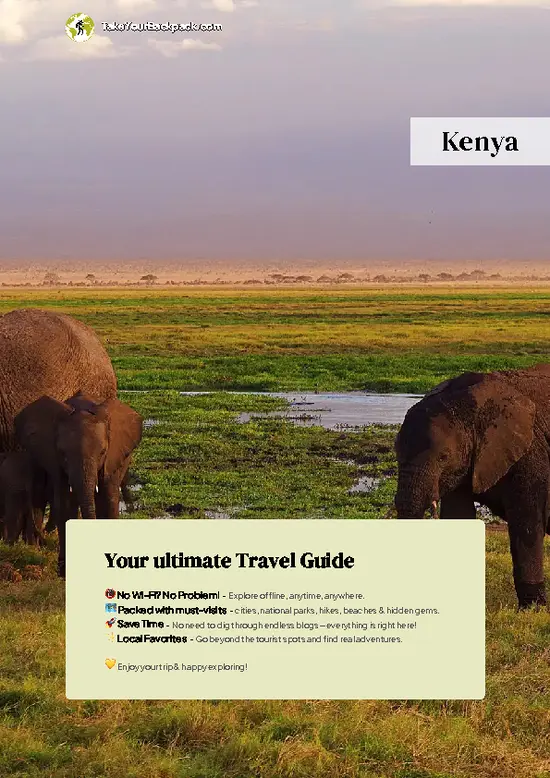
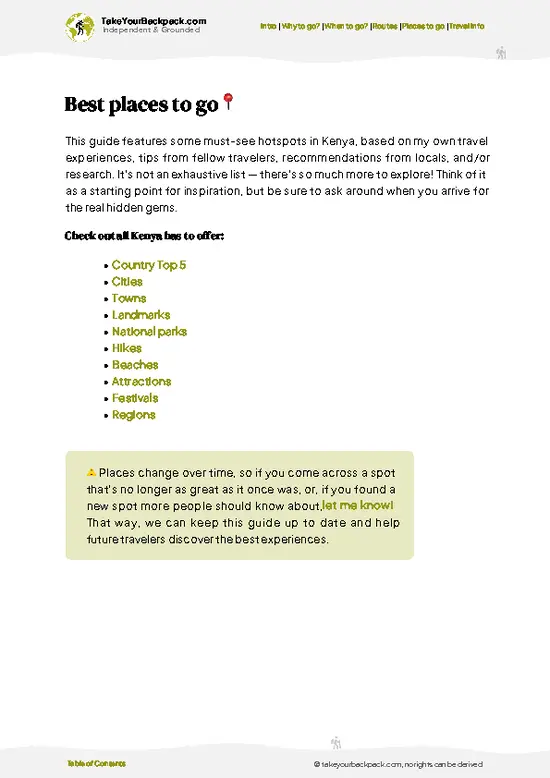
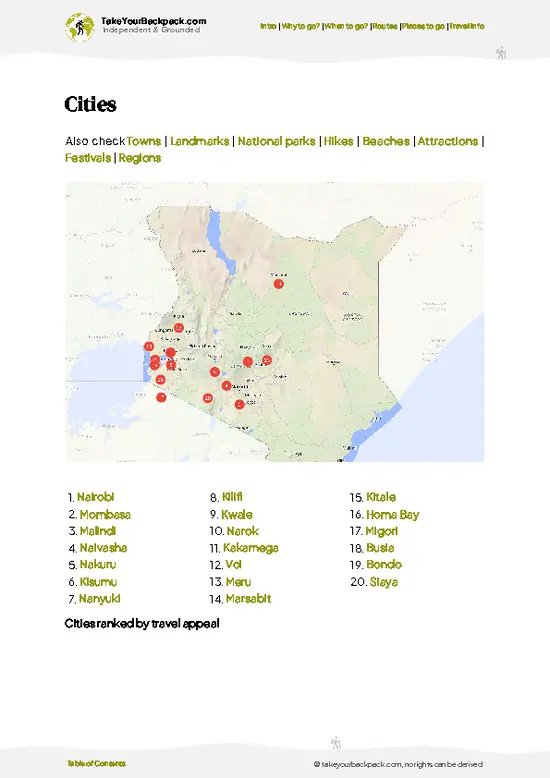
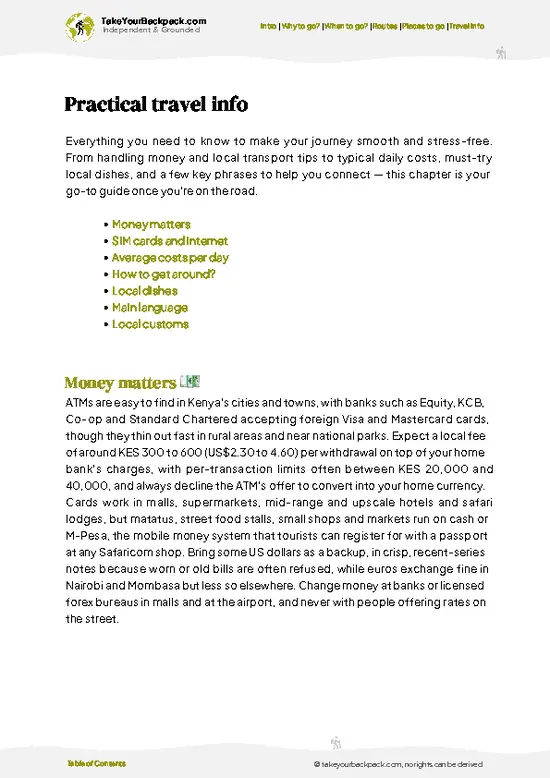
example page 0 from our offline Travel Guide for Kenya
example page 1 from our offline Travel Guide for Kenya
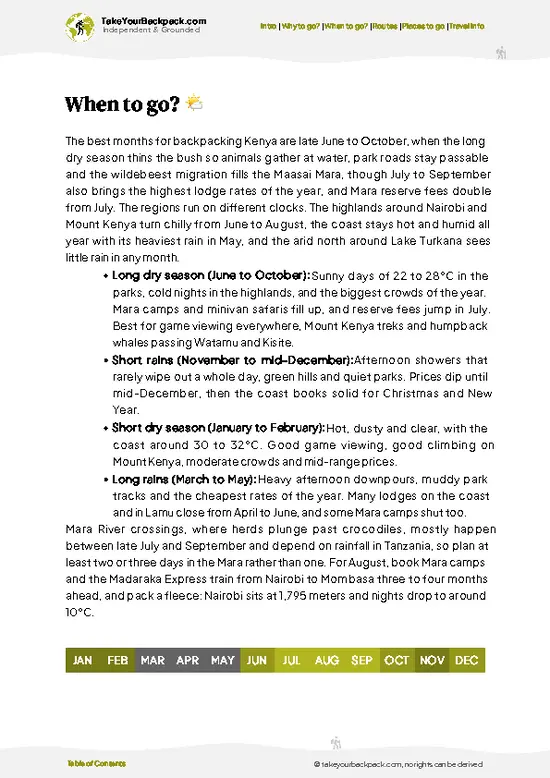
example page 2 from our offline Travel Guide for Kenya
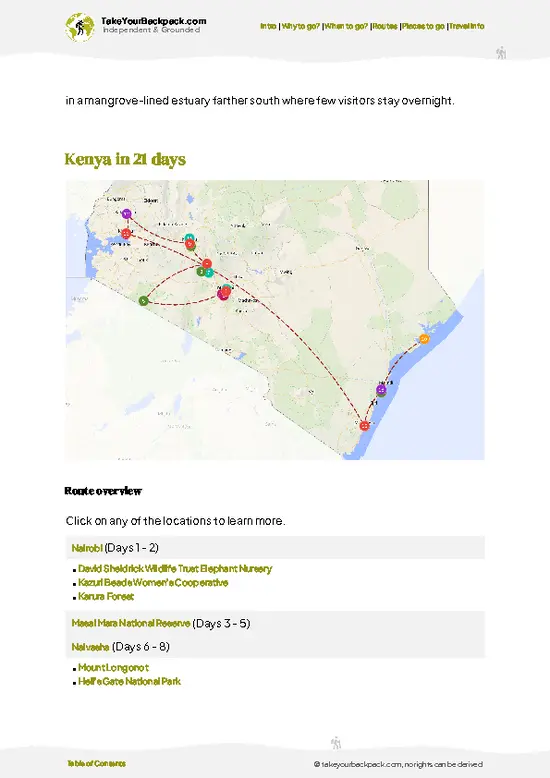
example page 3 from our offline Travel Guide for Kenya
example page 4 from our offline Travel Guide for Kenya
example page 5 from our offline Travel Guide for Kenya
example page 6 from our offline Travel Guide for Kenya
example page 7 from our offline Travel Guide for Kenya
The digital guide (429 pages) contains:
114 highlights, ranked by travel appeal
Optimized 7, 14 & 21-day travel routes
Cities, national parks, landmarks, beaches
How to get around
Offline-friendly for travel without Wi-Fi
👉 Click to see all 30+ guide features

📅 Plan smarter in minutes, not weeks
Month by month travel advice
Festivals & national holidays
Budget expectations

🗺️ Go to the right places, skip the overrated ones
Honest pros & cons of destinations
Top hikes, parks & viewpoints
Lesser-known places most travelers miss
Clear “worth it vs skip it” guidance

🛏️ Travel smoothly without rookie mistakes
Best areas to stay
Transport systems explained simply
Common scams & safety advice
SIM cards, money & practical tips

🌍 Understand the country, not just visit it
Culture & traditions
52 Essential phrases & customs
Festivals worth planning around
Traveler-friendly historical context
Insights that make places more meaningful

📱 Built for real travel conditions
Fully downloadable PDF
Works completely offline
Optimized for phone use
Useful in remote areas & buses
Everything in one place
Save weeks of stressful planning
Get instant access to your full guide. 30‑day money-back guarantee.


By proceeding you agree to our terms.
Sent to your inbox immediately after payment • 100% Secure Checkout
Best Backpacking Travel Advisor 2025 tourism awardBest Backpacking
Travel Advisor
2025
What others say about Take Your Backpack Guides:
⭐⭐⭐⭐⭐
Fantastic, amazing amount of information!
⭐⭐⭐⭐⭐
My goodness this is amazing, it's what I've been looking for hats off too you!
⭐⭐⭐⭐⭐
I think this is absolutely BRILLIANT
⭐⭐⭐⭐
Very complete and informative. It's still missing places, but I gotta to commend you
⭐⭐⭐⭐⭐
This is truly amazing, thank you, can't wait to explore it with my kids!
⭐⭐⭐⭐⭐
Awesome resource, thank you!
⭐⭐⭐⭐⭐
This is amazing! Can't wait to explore the ones I haven't seen
⭐⭐⭐⭐
I love this! Well done, great idea.
⭐⭐⭐⭐⭐
Thanks for taking the time to make this gem!
⭐⭐⭐⭐⭐
This might be the best website I've ever seen.
⭐⭐⭐⭐⭐
Congratulations, and thank you so much for your work; it's incredibly valuable.
⭐⭐⭐⭐
In all seriousness I think you did a great job pointing out the important spots
⭐⭐⭐⭐⭐
10/10 very good
⭐⭐⭐⭐⭐
As someone who's only just starting to visit regularly this is awesome, thank you.
⭐⭐⭐⭐
Thank you very much! I'm going to visit my dad, it's going to be very useful!
⭐⭐⭐⭐⭐
This is really cool! We'll be travelling for the first time and this definitely come in handy.
⭐⭐⭐⭐⭐
You are now our minister of culture, congratulations 👨‍💼
⭐⭐⭐⭐⭐
Just wanted to tell you that this is a pearl! Going to follow your recommendations.
⭐⭐⭐⭐⭐
This is so cool. I'll definitely be using the resource for my travels soon.
⭐⭐⭐⭐⭐
This is very impressive! Good work.
⭐⭐⭐⭐⭐
This is an amazing and informative site. Very well done!

🛏️ Where to stay?Choosing the right base

Kakamega Forest is a treasure, but let’s cut through the Instagram fluff. It’s not just about the lush greenery and unique wildlife; it’s about finding your tribe and a place to rest your head after a day of adventure.

Start in the town of Kakamega itself. It’s buzzing with life and offers a range of budget-friendly accommodations. You’ll find fellow backpackers, local eateries, and vibrant markets. The energy here is infectious, and you can easily connect with others who share your passion for exploration.

Another option is to stay near the forest’s entrance. There are basic lodges and campsites … read more 👉
Kakamega Forest is a treasure, but let’s cut through the Instagram fluff. It’s not just about the lush greenery and unique wildlife; it’s about finding your tribe and a place to rest your head after a day of adventure.

Start in the town of Kakamega itself. It’s buzzing with life and offers a range of budget-friendly accommodations. You’ll find fellow backpackers, local eateries, and vibrant markets. The energy here is infectious, and you can easily connect with others who share your passion for exploration.

Another option is to stay near the forest’s entrance. There are basic lodges and campsites that cater to backpackers. This is where you can wake up to the sounds of nature and be just a stone’s throw from the trails. It’s a bit quieter, but you’ll still meet like-minded adventurers.

Safety is generally good, but keep your wits about you, especially at night. Stick to well-lit areas and travel in groups when possible. The real magic of Kakamega isn’t just in the forest; it’s in the connections you make and the stories you share. Embrace the experience, and you’ll leave with more than just photos.

👛 Costs (as of 4 October 2025)How expensive it really is

Visiting Kakamega Forest isn’t just about the lush greenery; it’s about understanding the costs that come with it. Here’s the real deal on what you can expect to spend.
  • Entry Fees: Expect to pay around $5 to $10 USD for entry. This fee helps maintain the trails and supports conservation efforts. It’s a small price for the chance to wander through one of the last remaining rainforests in Kenya.
  • Guided Tours: If you want to dive deeper into the forest’s biodiversity, guided tours range from $20 to $50 USD. A knowledgeable guide can enhance your experience, pointing out unique flora and fauna you might miss on your own.
  • Transportation: Getting to Kakamega can vary. A matatu (shared taxi) from Nairobi might cost you around $10 to $15 USD. If you prefer a private taxi, budget around $100 USD for a
read more 👉
Visiting Kakamega Forest isn’t just about the lush greenery; it’s about understanding the costs that come with it. Here’s the real deal on what you can expect to spend.
  • Entry Fees: Expect to pay around $5 to $10 USD for entry. This fee helps maintain the trails and supports conservation efforts. It’s a small price for the chance to wander through one of the last remaining rainforests in Kenya.
  • Guided Tours: If you want to dive deeper into the forest’s biodiversity, guided tours range from $20 to $50 USD. A knowledgeable guide can enhance your experience, pointing out unique flora and fauna you might miss on your own.
  • Transportation: Getting to Kakamega can vary. A matatu (shared taxi) from Nairobi might cost you around $10 to $15 USD. If you prefer a private taxi, budget around $100 USD for a round trip. The journey is part of the adventure, so soak it in.
  • Accommodation: Options range from budget hostels at about $10 to $30 USD per night to mid-range lodges costing $50 to $100 USD. Staying close to the forest can enhance your experience, allowing for early morning hikes.
  • Food: Meals can be quite affordable. Street food or local eateries will set you back about $3 to $10 USD per meal. If you opt for a sit-down restaurant, expect to pay around $10 to $20 USD for a decent meal.

Kakamega Forest is worth every penny. The experience goes beyond the price tag; it’s about connecting with nature in a way that’s raw and real.
⚠️ Prices can change and everyone travels differently, so take this as a rough guide. Hope it helps you plan your adventure!

Other Kenyan landmarks near Kakamega Forest

Explore more nearby:

  • Mount Elgon—Extinct volcano, lava caves, highland moorlands| 81 km away
  • Serengeti Migration—Wildebeest herds, river crossings, predator encounters| 197 km away
  • Gedi Ruins—Swahili stonework, forested enclosures, coral architecture| 708 km away

💡 Not sure where to go next?
Create a personalized itinerary for Kenya including Kakamega Forest and the places that fit your trip.

Generate my itinerary

👉 Discover all landmarks

Or checkout all Kenya has to offer (think cities, towns, villages, national parks, hikes, beaches, festivals)
Country photo of Kenya

We 💚 feedbackWhat to keep in mind

Kakamega Forest isn’t just another pretty spot; it’s a living, breathing ecosystem that feels untouched. Expect crowds, especially on weekends, but don’t let that deter you. The real magic lies in the symphony of bird calls and the thrill of spotting a rare butterfly. Bring a guide; they’ll unlock stories hidden in the trees. Just be ready for the humidity—it’s no joke. Embrace the sweat, and you’ll find a connection to nature that’s hard to shake off.

✍️ Help improve this page!
The information on this page is based on in-depth research, insights shared by experienced travelers, and feedback from the local travel community in Kenya. While every effort is made to keep the information accurate and current, conditions can change — so if you spot anything incorrect or outdated, please get in touch.


🙋‍♂️ Give feedback

👋 Meet the founderWho’s Behind Take Your Backpack?

Johan, backpacker and founder of TakeYourBackpackHi, I’m Johan (Netherlands 🇳🇱), the creator of TakeYourBackpack. Over the past decade, I’ve backpacked through 80+ countries across six continents, gaining extensive experience with independent travel, long-term trips, and overland routes.

This site is built on a combination of firsthand travel experience and carefully curated insights from other backpackers. Many guides are based on places I’ve personally visited, while others bring together tips, observations, and practical advice shared by trusted travelers I’ve met along the way.

The goal is to provide realistic, experience-driven guidance — not generic itineraries — so you can explore destinations with better context, clearer expectations, and more confidence.

Get full Kenya guide •
Instant download • 114 highlights • Full Offline guide