
×

Kiribati🇰🇮 | landmarksBairiki CemeteryCoral-slab graves, open sandy ground, Bairiki islet, no facilities | things to do and best time to go

Explore BetioExplore Kuria’s ancient stone structures

Backpacking in Bairiki Cemetery
🏆 Top pickunique site ranked #3
By Johan Kruseman 🇳🇱 | Updated October 15, 2026

Bairiki Cemetery is a low, open burial ground where coral-white graves sit in sandy ground under a wide sky, with the hum of passing motorbikes never far off. It lies on Bairiki islet in South Tarawa, the urban heart of Kiribati, close to the government offices. Expect glare off the sand, heat that settles by mid-morning, salt wind from the lagoon and the soft rustle of palms. There is no ticket booth, no crowd and no cost, but also no signboards, shade or facilities, and nothing here is staged for visitors. The wow-factor is quiet: how plainly and closely the living and the dead share the same narrow strip of land. Photo potential is real, though it needs restraint. It suits travelers who like ordinary places and slow observation. Anyone after monuments, guided tours or a big headline sight will find it thin.

Discover everything you want to know in the 📖 Kiribati Travel Guide.


example page 0 from our offline Travel Guide for Kiribati
example page 1 from our offline Travel Guide for Kiribati
example page 2 from our offline Travel Guide for Kiribati
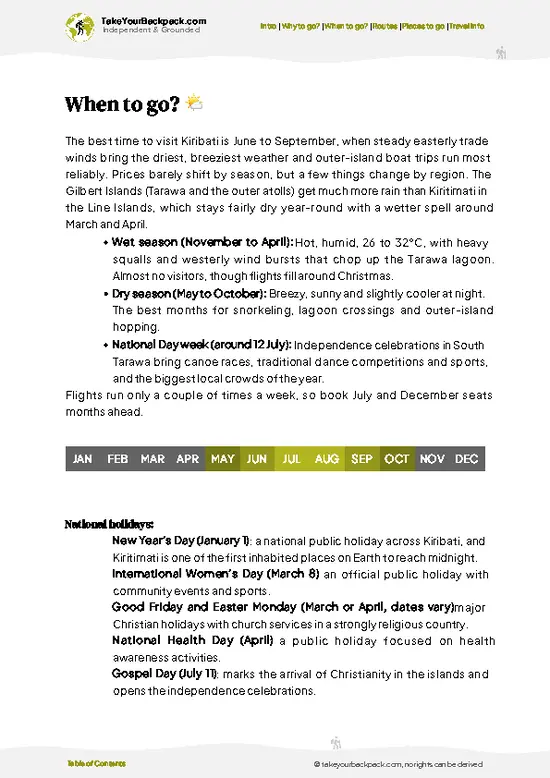
example page 3 from our offline Travel Guide for Kiribati
example page 4 from our offline Travel Guide for Kiribati
example page 5 from our offline Travel Guide for Kiribati
example page 6 from our offline Travel Guide for Kiribati
example page 7 from our offline Travel Guide for Kiribati
Loading the map 🌍
CLICK TO FILTER
towns
villages
landmarks
national parks
beaches
attractions
festivals
regions
SHOW COUNTRY’S BESTSHOW ALL

✨ Why go?
Ranked #3 unique site in Kiribati
The unique appeal for travelers

Bairiki Cemetery earns a stop because it shows how everyday life on a narrow atoll actually works. On Bairiki islet, land is scarce, and burial grounds, homes, offices and roads press against one another. A short stroll tells you more about island life than a brochure, and it costs nothing.
It also fits easily into a day on South Tarawa. Bairiki sits between the lagoon road traffic and the causeway toward Betio, so you can pass through on the way to the war-history sites at the western end of the atoll. Add the stadium nearby and you have a relaxed half day on foot and by minibus, without a rigid schedule.
The effort is minimal, but the reward depends on your attitude. Go for the plain, human look of the place: weathered markers, flowers left on graves, and families who know exactly whose plot … read more 👉
Bairiki Cemetery earns a stop because it shows how everyday life on a narrow atoll actually works. On Bairiki islet, land is scarce, and burial grounds, homes, offices and roads press against one another. A short stroll tells you more about island life than a brochure, and it costs nothing.
It also fits easily into a day on South Tarawa. Bairiki sits between the lagoon road traffic and the causeway toward Betio, so you can pass through on the way to the war-history sites at the western end of the atoll. Add the stadium nearby and you have a relaxed half day on foot and by minibus, without a rigid schedule.
The effort is minimal, but the reward depends on your attitude. Go for the plain, human look of the place: weathered markers, flowers left on graves, and families who know exactly whose plot is whose. Treat it with the same respect you would give any local graveyard and you will leave with a clearer sense of the I-Kiribati relationship with family land.

💡 HighlightsThe experiences that define the visit

  1. Bairiki Cemetery: the main reason to come. Rows of sand-covered graves, many marked with simple concrete or coral slabs and often with flowers, sit in the open under strong light. It is a calm, unadorned look at how the community remembers its dead.
  2. Bairiki lagoon shoreline: the lagoon side of the islet gives you flat, shallow water, a steady breeze and views across to neighboring islets. Fishermen and children use it daily, so it is a good place to watch local routines.
  3. Bairiki National Stadium: the islet’s main sports ground hosts football and athletics events, and in the late afternoon locals gather to train or just walk. It is a quick way to feel the social life of the district.
  4. Bairiki to Betio causeway: the road link between the two islets is the atoll’s everyday artery. Walking or riding
… read more 👉
  1. Bairiki Cemetery: the main reason to come. Rows of sand-covered graves, many marked with simple concrete or coral slabs and often with flowers, sit in the open under strong light. It is a calm, unadorned look at how the community remembers its dead.
  2. Bairiki lagoon shoreline: the lagoon side of the islet gives you flat, shallow water, a steady breeze and views across to neighboring islets. Fishermen and children use it daily, so it is a good place to watch local routines.
  3. Bairiki National Stadium: the islet’s main sports ground hosts football and athletics events, and in the late afternoon locals gather to train or just walk. It is a quick way to feel the social life of the district.
  4. Bairiki to Betio causeway: the road link between the two islets is the atoll’s everyday artery. Walking or riding across gives open water on both sides, plus a good sense of how narrow the land really is.
  5. Government district streets: offices, a post office and small shops line the main road, and you can see civil servants, vendors and schoolchildren crossing paths. It is plain, but it explains why Bairiki matters to the country.
The cemetery and the lagoon shoreline combine well in one morning, with the shore walk making a gentle, shaded-by-breeze follow-up once the heat builds.
Spotted a mistake or missing something? Contact us.

🌤️ When to go?Best time to visit Bairiki Cemetery

Early morning on a dry-season day is the best moment to visit Bairiki Cemetery, before the equatorial sun climbs and the shade thins out. Tarawa sits almost on the equator, so temperatures barely move across the year.
  • Dry Season (roughly May to October): Highs of 30 to 32°C (86 to 90°F), lows around 25°C (77°F), steadier trade winds and less mud between the graves. Daylight runs about 12 hours all year, with sunrise between about 6:10 and 6:40 am and sunset between about 6:15 and 6:45 pm.
  • Wetter Season (roughly November to April): Same temperatures, but heavier squalls, higher humidity and puddled paths. Showers tend to pass within an hour.
  • Crowds and Prices: Visitors are rare in any month, so there is no peak pricing. Flights into Tarawa and rooms are the only costs that shift, mostly around
… read more 👉
Early morning on a dry-season day is the best moment to visit Bairiki Cemetery, before the equatorial sun climbs and the shade thins out. Tarawa sits almost on the equator, so temperatures barely move across the year.
  • Dry Season (roughly May to October): Highs of 30 to 32°C (86 to 90°F), lows around 25°C (77°F), steadier trade winds and less mud between the graves. Daylight runs about 12 hours all year, with sunrise between about 6:10 and 6:40 am and sunset between about 6:15 and 6:45 pm.
  • Wetter Season (roughly November to April): Same temperatures, but heavier squalls, higher humidity and puddled paths. Showers tend to pass within an hour.
  • Crowds and Prices: Visitors are rare in any month, so there is no peak pricing. Flights into Tarawa and rooms are the only costs that shift, mostly around Christmas and Independence Day (July 12), when family travel fills seats.
  • Local Occasions: All Saints and Christmas periods see families tidying and decorating graves, which is a time for quiet respect, not photos.
Visit before 9 am or after 4 pm for cooler air and softer light.


source: climatestotravel.comJANJanuary: fair for travelingFEBFebruary: fair for travelingMARMarch: fair for travelingAPRApril: fair for travelingMAYMay: highly recommended for travelingJUNJune: excellent for travelingJULJuly: excellent for travelingAUGAugust: excellent for travelingSEPSeptember: excellent for travelingOCTOctober: highly recommended for travelingNOVNovember: fair for travelingDECDecember: fair for traveling
when-to-go

✈️ The backpacker research shortcutKiribati Travel Guide

An offline-friendly backpacking guide with optimized travel routes, ranked highlights, transport advice, and the best areas to stay.
example page 0 from our offline Travel Guide for Kiribati
example page 1 from our offline Travel Guide for Kiribati
example page 2 from our offline Travel Guide for Kiribati
example page 3 from our offline Travel Guide for Kiribati
example page 4 from our offline Travel Guide for Kiribati
example page 5 from our offline Travel Guide for Kiribati
example page 6 from our offline Travel Guide for Kiribati
example page 7 from our offline Travel Guide for Kiribati
The digital guide (120 pages) contains:
✅ 25 highlights, ranked by travel appeal
✅ Optimized 2, 3 & 5-day travel routes
✅ Cities, national parks, landmarks, beaches
✅ How to get around
✅ Offline-friendly for travel without Wi-Fi
👉 Click to see all 30+ guide features

📅 Plan smarter in minutes, not weeks
✅ Month by month travel advice
✅ Festivals & national holidays
✅ Budget expectations

🗺️ Go to the right places, skip the overrated ones
✅ Honest pros & cons of destinations
✅ Top hikes, parks & viewpoints
✅ Lesser-known places most travelers miss
✅ Clear “worth it vs skip it” guidance

🛏️ Travel smoothly without rookie mistakes
✅ Best areas to stay
✅ Transport systems explained simply
✅ Common scams & safety advice
✅ SIM cards, money & practical tips

🌍 Understand the country, not just visit it
✅ Culture & traditions
✅ 52 Essential phrases & customs
✅ Festivals worth planning around
✅ Traveler-friendly historical context
✅ Insights that make places more meaningful

📱 Built for real travel conditions
✅ Fully downloadable PDF
✅ Works completely offline
✅ Optimized for phone use
✅ Useful in remote areas & buses
✅ Everything in one place
Stop searching, start planning
Get instant access to your full guide. 30‑day money-back guarantee.
+ Add another guide for just

By proceeding you agree to our terms.
Sent to your inbox immediately after payment • 100% Secure Checkout
Best Backpacking Travel Advisor 2025 tourism awardBest Backpacking
Travel Advisor
2025
What others say about Take Your Backpack Guides:
⭐⭐⭐⭐⭐
Fantastic, amazing amount of information!
⭐⭐⭐⭐⭐
My goodness this is amazing, it's what I've been looking for hats off too you!
⭐⭐⭐⭐⭐
I think this is absolutely BRILLIANT
⭐⭐⭐⭐
Very complete and informative. It's still missing places, but I gotta to commend you
⭐⭐⭐⭐⭐
This is truly amazing, thank you, can't wait to explore it with my kids!
⭐⭐⭐⭐⭐
Awesome resource, thank you!
⭐⭐⭐⭐⭐
This is amazing! Can't wait to explore the ones I haven't seen
⭐⭐⭐⭐
I love this! Well done, great idea.
⭐⭐⭐⭐⭐
Thanks for taking the time to make this gem!
⭐⭐⭐⭐⭐
This might be the best website I've ever seen.
⭐⭐⭐⭐⭐
Congratulations, and thank you so much for your work; it's incredibly valuable.
⭐⭐⭐⭐
In all seriousness I think you did a great job pointing out the important spots
⭐⭐⭐⭐⭐
10/10 very good
⭐⭐⭐⭐⭐
As someone who's only just starting to visit regularly this is awesome, thank you.
⭐⭐⭐⭐
Thank you very much! I'm going to visit my dad, it's going to be very useful!
⭐⭐⭐⭐⭐
This is really cool! We'll be travelling for the first time and this definitely come in handy.
⭐⭐⭐⭐⭐
You are now our minister of culture, congratulations 👨‍💼
⭐⭐⭐⭐⭐
Just wanted to tell you that this is a pearl! Going to follow your recommendations.
⭐⭐⭐⭐⭐
This is so cool. I'll definitely be using the resource for my travels soon.
⭐⭐⭐⭐⭐
This is very impressive! Good work.
⭐⭐⭐⭐⭐
This is an amazing and informative site. Very well done!

🛏️ Where to stay?Best areas to stay in Kiribati

Stay in Bairiki or Betio, the two South Tarawa areas within a short ride of the cemetery. Bairiki is the government center on the lagoon side, with the cemetery, shops and the post office within walking or short minibus distance. It is quiet after dark, and you can see most of what you need on foot in daylight.
Betio, at the western tip, has more guesthouses, the port, the WWII relics and the liveliest street life. Minibuses run the single main road constantly, so you can reach Bairiki in around 15 to 25 minutes. It feels busier and rougher at the edges, so keep valuables out of sight and avoid … read more 👉
Stay in Bairiki or Betio, the two South Tarawa areas within a short ride of the cemetery. Bairiki is the government center on the lagoon side, with the cemetery, shops and the post office within walking or short minibus distance. It is quiet after dark, and you can see most of what you need on foot in daylight.
Betio, at the western tip, has more guesthouses, the port, the WWII relics and the liveliest street life. Minibuses run the single main road constantly, so you can reach Bairiki in around 15 to 25 minutes. It feels busier and rougher at the edges, so keep valuables out of sight and avoid walking alone late at night.
Bikenibeu, further east, is the third option. It has the big supermarkets, a calmer residential feel and easy access to the airport side of the island.
Kiribati has no real backpacker scene, so do not expect hostel dorms or travelers to chat with. Small guesthouses and family-run lodgings are the norm, and the social side comes from hosts and neighbors. Book ahead by message or phone, because rooms are limited. Choose a place with a fan or air conditioning and reliable water.

👛 Costs (as of 15 October 2026)What things cost and how to budget

Expect to spend about US$70 to 120 per day around Bairiki Cemetery, with entry costing nothing and accommodation making up most of the total. Tarawa is an expensive, import-dependent destination, so prices run well above those in the neighboring Pacific islands. Costs below are in US dollars, though you will pay in Australian dollars, which Kiribati uses.
CategoryBudget RangeLocal Reality
Cemetery EntryUSD 0Open public site with no ticket. Ask permission before photographing graves.
Accommodation (high season)USD 45 to 80Basic guesthouse room, often with a fan or air conditioning. Few options, so book ahead.
FoodUSD 15 to 25Fish, rice and breadfruit at local eateries cost far less than imported-food meals at hotels.
Local TransportUSD 1 to 5Shared minibuses along the main road charge a small flat
… read more 👉
Expect to spend about US$70 to 120 per day around Bairiki Cemetery, with entry costing nothing and accommodation making up most of the total. Tarawa is an expensive, import-dependent destination, so prices run well above those in the neighboring Pacific islands. Costs below are in US dollars, though you will pay in Australian dollars, which Kiribati uses.
CategoryBudget RangeLocal Reality
Cemetery EntryUSD 0Open public site with no ticket. Ask permission before photographing graves.
Accommodation (high season)USD 45 to 80Basic guesthouse room, often with a fan or air conditioning. Few options, so book ahead.
FoodUSD 15 to 25Fish, rice and breadfruit at local eateries cost far less than imported-food meals at hotels.
Local TransportUSD 1 to 5Shared minibuses along the main road charge a small flat fare. Taxis cost more and are fixed by negotiation.
Water and ExtrasUSD 3 to 6Bottled water is a daily need and imports raise prices.
Flexible SpendingUSD 4 to 6Small offerings, museum donations or a guide for the wider area.
Total Daily BudgetUSD 70 to 120Per person, per day, in high season.
⚠️ Prices can change and everyone travels differently, so take this as a rough guide. Hope it helps you plan your adventure!

FAQTraveler FAQ

Bairiki Cemetery is a public burial ground in Bairiki, the government district of South Tarawa, where I-Kiribati families lay their dead in marked graves close to their homes. It sits beside the lagoon road and is a short walk from the government offices. Entry is free, and visits are best kept quiet and respectful.
Plan 30 to 45 minutes for a walk through the cemetery itself. Pair it with a half day around Bairiki, including the government buildings, and you can fit the rest into a day on South Tarawa. Go early, before about 9 am, to avoid the heat.
Fly into Bonriki International Airport on Tarawa, the only international airport, then take a minibus or taxi west along the main road to Bairiki. The ride takes roughly 45 minutes to an hour and a minibus costs a small flat fare, usually under US$1 to 2. International flights arrive via Nadi (Fiji), Nauru or Honiara, and Bairiki is also around 15 to 25 minutes by minibus from Betio.
⚠️ Things can change over time, so always validate details locally before you go.

Other destinations worth considering

Bairiki Cemetery isn’t the only highlight in Kiribati. Explore all what Kiribati has to offer.
Country photo of Kiribati

We 💚 feedbackWhat to keep in mind

Travelers often wander in with a camera raised like it is a sightseeing stop. Slow down instead. Walk the edge of the graves rather than across them, dress modestly, and ask a family nearby before photographing anything. Go in the early morning, when the light is softer and the heat is manageable, and bring water because there is no shade.

✍️ Help improve this page!
The information on this page is based on in-depth research, insights shared by experienced travelers, and feedback from the local travel community in Kiribati. While every effort is made to keep the information accurate and current, conditions can change — so if you spot anything incorrect or outdated, please get in touch.


🙋‍♂️ Give feedback

👋 Meet the founderWho’s Behind Take Your Backpack?

Johan, backpacker and founder of TakeYourBackpackHi, I’m Johan (Netherlands 🇳🇱), the creator of TakeYourBackpack. Over the past 3 decades, I’ve backpacked through 90+ countries across six continents, gaining extensive experience with independent travel, long-term trips, and overland routes.

This site is built on a combination of firsthand travel experience and carefully curated insights from other backpackers. Many guides are based on places I’ve personally visited, while others bring together tips, observations, and practical advice shared by trusted travelers I’ve met along the way.

The goal is to provide realistic, experience-driven guidance — not generic itineraries — so you can explore destinations with better context, clearer expectations, and more confidence.