×

Kyrgyzstan🇰🇬 | best villagesDiscover the 5 Best villages Across Kyrgyzstan

Villages in Kyrgyzstan come in three flavors, and picking the right one shapes your whole trip. Around Issyk-Kul, lakeside settlements mean paved roads, marshrutka rides from Bishkek and easy homestay hopping, with the most visitors in July and August. The Tian Shan interior around Kochkor, Naryn and Song-Kol swaps tarmac for gravel, yurt camps and shepherds on horseback. The south, from Osh into the Fergana and Alay valleys, brings walnut forests, Uzbek-influenced bazaars and hardly any crowds. Independent travelers can cover all three on shared transport and community-run homestays, usually for US$20 to 35 a day. Pack layers, pick your region, and go.

By Johan Kruseman 🇳🇱 | Updated November 18, 2026
Explore the best landmarks in Kyrgyzstan

Why go?Why Travelers Love These Spots

Kyrgyzstan is built for village travel because nomadic life never really left. Herding families still move livestock to high jailoo pastures every summer, and that rhythm shapes how settlements work: hospitality is a habit, guests get tea, bread, jam and cream before they get a question. Soviet-era collectivization planted permanent villages in the valleys, so you find concrete bus stops and Russian-language signs beside felt carpets and yurts.

Geography does the rest. About 90 percent of the country sits above 1,500 meters, so villages hug valley floors, lake shores and river terraces, and the mountains stay in view from nearly every doorstep. The Community Based Tourism (CBT) network and similar homestay schemes run in many regions, which means you can book a bed, dinner and a horse through … read more 👉
Kyrgyzstan is built for village travel because nomadic life never really left. Herding families still move livestock to high jailoo pastures every summer, and that rhythm shapes how settlements work: hospitality is a habit, guests get tea, bread, jam and cream before they get a question. Soviet-era collectivization planted permanent villages in the valleys, so you find concrete bus stops and Russian-language signs beside felt carpets and yurts.

Geography does the rest. About 90 percent of the country sits above 1,500 meters, so villages hug valley floors, lake shores and river terraces, and the mountains stay in view from nearly every doorstep. The Community Based Tourism (CBT) network and similar homestay schemes run in many regions, which means you can book a bed, dinner and a horse through one local contact instead of improvising.

Know the limits before you commit. Roads outside the main corridors are rough, public transport is shared minibuses and taxis that leave when full, and English is thin beyond tourist hubs, so a few Russian or Kyrgyz phrases earn real goodwill. Winter shuts high villages and passes. Expect basic toilets, shared washing facilities and cash-only payments in most places. Accept that, and you get a country where a village stay feels like being invited in rather than being sold a tour.
Why These Made the Cut
The list of best villages in Kyrgyzstan is created based on authenticity, scenic beauty, community spirit, traditions, and overall character. If you feel a village is missing in this list, please let us know.

When to go?Optimal Periods for Travel

Best months: June to September is the best window for villages in Kyrgyzstan, because high passes are open, jailoo pastures are occupied and daytime temperatures in the valleys sit around 20 to 30°C. July and August are the warmest and busiest, especially around Issyk-Kul, where homestay prices climb by roughly 20 to 40 percent and beds fill on weekends.
Shoulder seasons: May and late September to early October are quieter and cheaper. Valley villages are green in May and golden in autumn, but nights at 2,000 meters or more drop toward 0°C, and snow can still close high roads in May or return in October. Southern areas around Osh and Jalal-Abad warm up earlier, often hitting 20°C by April, which makes them the smart pick for early spring, and walnut forests turn colors in October.
Winter: November … read more 👉
Best months: June to September is the best window for villages in Kyrgyzstan, because high passes are open, jailoo pastures are occupied and daytime temperatures in the valleys sit around 20 to 30°C. July and August are the warmest and busiest, especially around Issyk-Kul, where homestay prices climb by roughly 20 to 40 percent and beds fill on weekends.
Shoulder seasons: May and late September to early October are quieter and cheaper. Valley villages are green in May and golden in autumn, but nights at 2,000 meters or more drop toward 0°C, and snow can still close high roads in May or return in October. Southern areas around Osh and Jalal-Abad warm up earlier, often hitting 20°C by April, which makes them the smart pick for early spring, and walnut forests turn colors in October.
Winter: November to March brings -10°C to -25°C in Naryn and the high interior, with heavy snow and many yurt camps and guesthouses closed. Lower villages stay reachable, and Issyk-Kul rarely freezes thanks to its salinity, but trails and passes are for ski tourers and the well equipped. Rain is light overall, with spring (April to June) the wettest stretch, so muddy tracks are likelier then than in high summer.

village hoppingTips for Visiting Multiple Destinations

How long to allow: A trip linking several villages in Kyrgyzstan needs 10 to 14 days, and 7 days works if you stay to one region. Travel days eat more time than expected, so build the plan around two or three regions instead of all of them.
Which regions pair well: Bishkek is the hub for everything. The cleanest loop runs Issyk-Kul to the Tian Shan interior and then south: Bishkek to Karakol by marshrutka takes 6 to 7 hours, Karakol to Kochkor around 5 to 6 hours, Kochkor to Naryn about 3 hours. From Naryn, shared taxis head toward Osh in roughly 8 to 10 hours via Kazarman or Jalal-Abad. Finish in the south with Osh as the base and fly or drive back to Bishkek (a 1-hour flight or 10 to 12 hours by road). Going north to south means you end in warmer, quieter country with a flight option, which … read more 👉
How long to allow: A trip linking several villages in Kyrgyzstan needs 10 to 14 days, and 7 days works if you stay to one region. Travel days eat more time than expected, so build the plan around two or three regions instead of all of them.
Which regions pair well: Bishkek is the hub for everything. The cleanest loop runs Issyk-Kul to the Tian Shan interior and then south: Bishkek to Karakol by marshrutka takes 6 to 7 hours, Karakol to Kochkor around 5 to 6 hours, Kochkor to Naryn about 3 hours. From Naryn, shared taxis head toward Osh in roughly 8 to 10 hours via Kazarman or Jalal-Abad. Finish in the south with Osh as the base and fly or drive back to Bishkek (a 1-hour flight or 10 to 12 hours by road). Going north to south means you end in warmer, quieter country with a flight option, which saves a long final bus.
Time per stop: Give each village 2 to 3 nights. One night feels like a transit stop, and walks, horse rides and meals with the family fill a second day easily.
Common mistakes: Travelers cram in too many stops and spend half their trip in minibuses. Others forget that shared transport leaves only when full, mostly in the morning, so afternoon arrivals strand them. Leave a buffer day before any flight, start early, and book onward taxis through your host.

The ListMust-Visit villages in Kyrgyzstan

1 Jyrgalan

Former coal town, ski touring, Karakol day hikes, homestays

Base yourself in a quiet ex-mining settlement, then ski-tour or hike into side valleys where few other travelers go.

kyrgyzstan-city-jyrgalan
© Google |

2 Chong-Kemin

Kemin Valley, Chon-Kemin National Park, horse treks, yurt stays, apricot and honey stalls

Ride horses through a wide alpine valley with pine slopes, sleep in family guesthouses or yurts, and reach trailheads within an hour.

3 Tamga

Issyk-Kul south shore, red sandstone cliffs, Skazka Canyon, beach guesthouses

Walk from a lakeside guesthouse to the red canyons nearby, then swim in cold Issyk-Kul water as the afternoon light fades.

4 Kyzyl-Oi

Homestay dinners, Gulcha valley, shepherd pastures, kymyz stops

Walk the village lanes to a family table, then follow the Gulcha River upvalley and climb toward the pastures where shepherds work.

5 Kyzyl-Tuu

Eagle hunters, Issyk-Kul south shore, yurt camps, felt crafts

Watch trained golden eagles at work with local hunters and stay in a village on the quieter southern shore of the lake.

Loading the map 🌍

Expert viewPro Tips for Exploring the Best

How many villages to visit: Aim for four to six villages in total, and stay two or three nights in each. That is enough to settle into a family routine, take a day walk or ride, and still hit the road with energy. Pack in more and you spend your trip bouncing in marshrutkas on unpaved roads, seeing little beyond a windshield.
Choosing the kind of village: Lakeside villages around Issyk-Kul suit first-timers and anyone short on time: paved roads, cafes, hot showers and frequent transport. The mountain villages of the interior suit hikers and horse riders, with yurt stays, shepherd life and trailheads at your door, but you need to accept long transfers and pit toilets. Southern villages around Osh and Fergana suit culture seekers, who get walnut groves, bazaars and Uzbek and Kyrgyz food traditions … read more 👉
How many villages to visit: Aim for four to six villages in total, and stay two or three nights in each. That is enough to settle into a family routine, take a day walk or ride, and still hit the road with energy. Pack in more and you spend your trip bouncing in marshrutkas on unpaved roads, seeing little beyond a windshield.
Choosing the kind of village: Lakeside villages around Issyk-Kul suit first-timers and anyone short on time: paved roads, cafes, hot showers and frequent transport. The mountain villages of the interior suit hikers and horse riders, with yurt stays, shepherd life and trailheads at your door, but you need to accept long transfers and pit toilets. Southern villages around Osh and Fergana suit culture seekers, who get walnut groves, bazaars and Uzbek and Kyrgyz food traditions with almost no other foreigners. Pick one kind to anchor the trip and add one contrasting stop.
What it costs: Budget US$20 to 35 a day if you eat and sleep in homestays and use shared transport. A homestay bed with dinner and breakfast runs about US$15 to 25 a night, a yurt-camp bed US$15 to 30 with meals. Horse rental with a guide costs roughly US$20 to 40 a day, and a 4x4 taxi for a day trip US$50 to 100. Marshrutka and shared taxi fares are typically US$3 to 12 for most legs. Some areas charge small national park or permit fees of US$2 to 10, and border-zone permits apply in places such as the Inylchek and Sary-Jaz valleys. Carry cash in som, because ATMs vanish outside district towns.
Safety and etiquette: Villages are generally safe and warm toward visitors. Take off your shoes at the door, accept tea and bread even if you decline more, and use your right hand to take food. Dress modestly in the south and in rural areas, where shorts and tank tops draw stares. Ask before photographing people, and be careful with alcohol: it is common at celebrations but heavy drinking embarrasses hosts. Mountain weather turns quickly, so carry a warm layer even in August. Dogs guarding flocks can be aggressive, so keep a distance and stay on the road if one charges. Register with your homestay and tell them where you are heading before any ride or hike, because mobile coverage drops out fast above the valleys.

✈️ The backpacker research shortcutKyrgyzstan Travel Guide

What the free pages can't give you: ready-made routes, every place ranked, and it works offline. All in 1 guide.
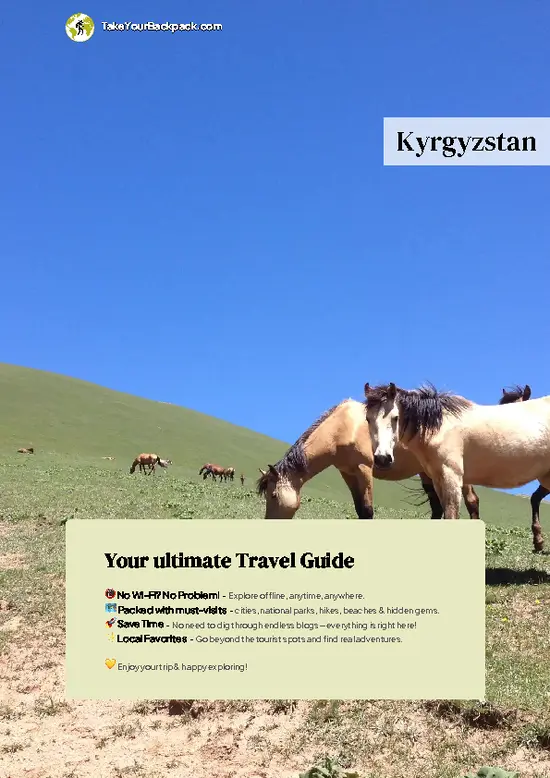
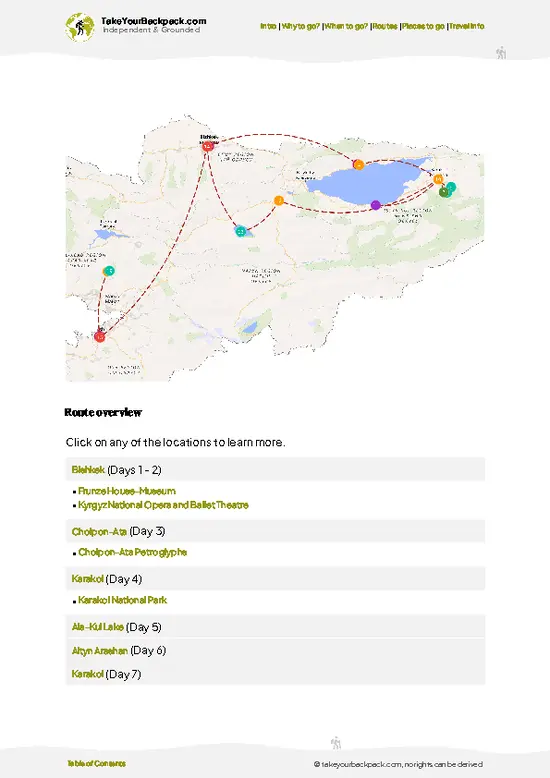
example page 0 from our offline Travel Guide for Kyrgyzstan
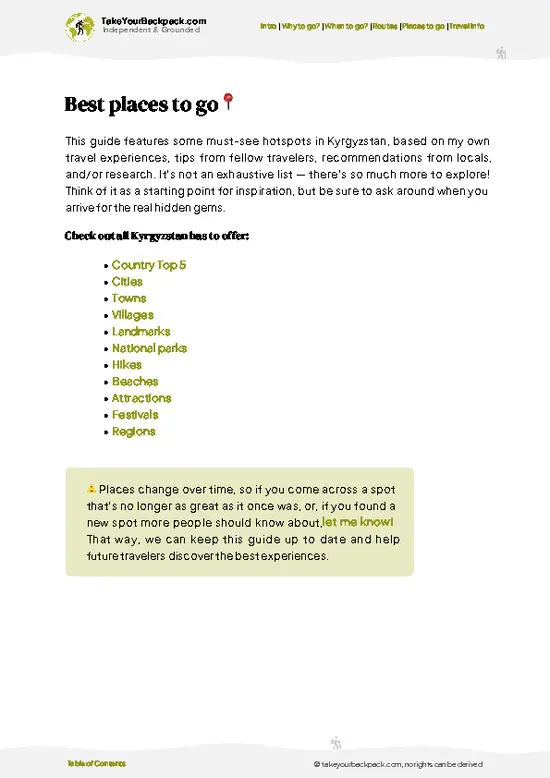
example page 1 from our offline Travel Guide for Kyrgyzstan
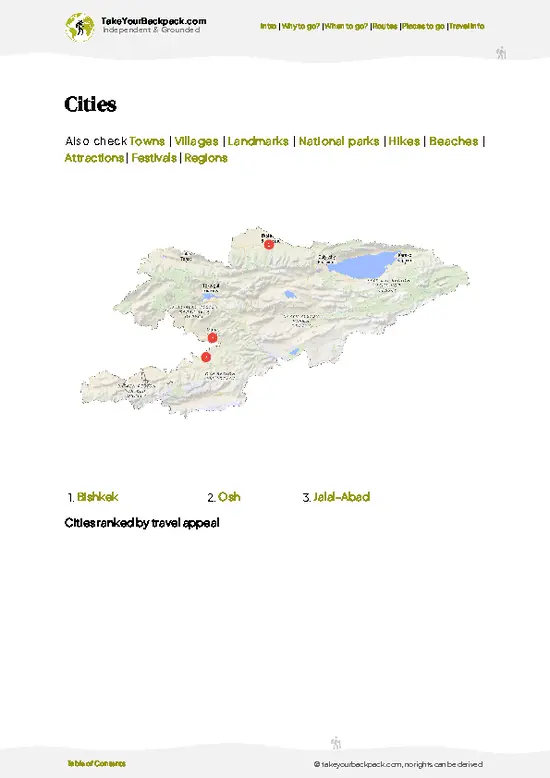
example page 2 from our offline Travel Guide for Kyrgyzstan
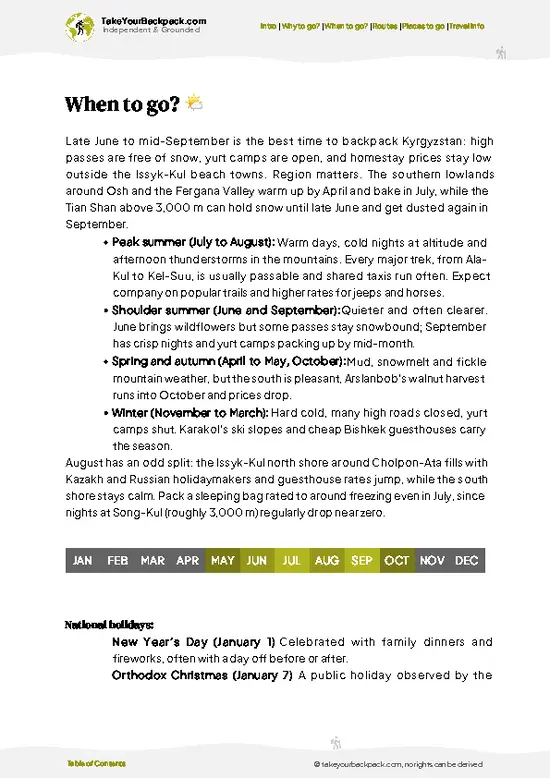
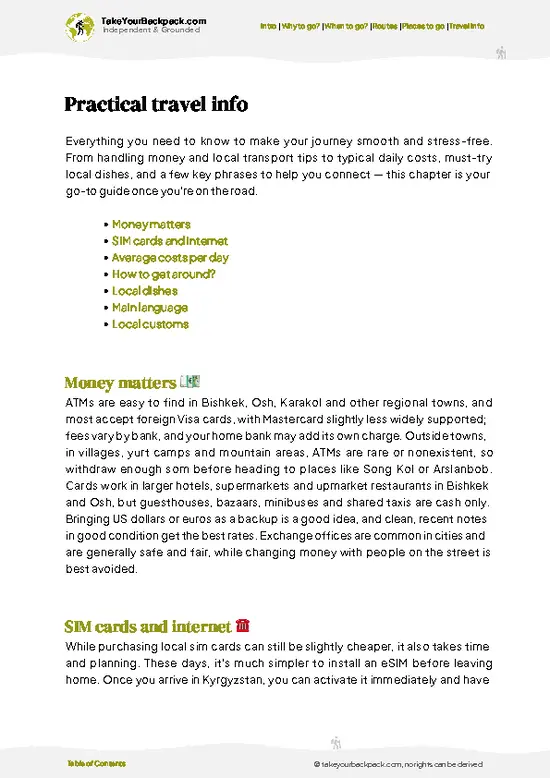
example page 3 from our offline Travel Guide for Kyrgyzstan
example page 4 from our offline Travel Guide for Kyrgyzstan
example page 5 from our offline Travel Guide for Kyrgyzstan
example page 6 from our offline Travel Guide for Kyrgyzstan
example page 7 from our offline Travel Guide for Kyrgyzstan
The digital guide (232 pages) contains:-page digital guide:
✅ Ready-made 5, 10 & 15-day routes
✅ All 67 places ranked, so you skip the overrated ones
✅ Works offline, all in 1 guide
✅ Cities, national parks, landmarks, beaches
✅ How to get around
👉 Click to see all 30+ guide features

📅 Plan smarter in minutes, not weeks
✅ Month by month travel advice
✅ Festivals & national holidays
✅ Budget expectations

🗺️ Go to the right places, skip the overrated ones
✅ Honest pros & cons of destinations
✅ Top hikes, parks & viewpoints
✅ Lesser-known places most travelers miss
✅ Clear “worth it vs skip it” guidance

🛏️ Travel smoothly without rookie mistakes
✅ Best areas to stay
✅ Transport systems explained simply
✅ Common scams & safety advice
✅ SIM cards, money & practical tips

🌍 Understand the country, not just visit it
✅ Culture & traditions
✅ 52 Essential phrases & customs
✅ Festivals worth planning around
✅ Traveler-friendly historical context
✅ Insights that make places more meaningful

📱 Built for real travel conditions
✅ Fully downloadable PDF
✅ Works completely offline
✅ Optimized for phone use
✅ Useful in remote areas & buses
✅ All in 1 guide
Stop searching, start planning
Get instant access to your full guide. 30‑day money-back guarantee.


By proceeding you agree to our terms.
Sent to your inbox immediately after payment • 100% Secure Checkout
Best Backpacking Travel Advisor 2025 tourism awardBest Backpacking
Travel Advisor
2025
What others say about Take Your Backpack Guides:
⭐⭐⭐⭐⭐
Fantastic, amazing amount of information!
⭐⭐⭐⭐⭐
My goodness this is amazing, it's what I've been looking for hats off too you!
⭐⭐⭐⭐⭐
I think this is absolutely BRILLIANT
⭐⭐⭐⭐
Very complete and informative. It's still missing places, but I gotta to commend you
⭐⭐⭐⭐⭐
This is truly amazing, thank you, can't wait to explore it with my kids!
⭐⭐⭐⭐⭐
Awesome resource, thank you!
⭐⭐⭐⭐⭐
This is amazing! Can't wait to explore the ones I haven't seen
⭐⭐⭐⭐
I love this! Well done, great idea.
⭐⭐⭐⭐⭐
Thanks for taking the time to make this gem!
⭐⭐⭐⭐⭐
This might be the best website I've ever seen.
⭐⭐⭐⭐⭐
Congratulations, and thank you so much for your work; it's incredibly valuable.
⭐⭐⭐⭐
In all seriousness I think you did a great job pointing out the important spots
⭐⭐⭐⭐⭐
10/10 very good
⭐⭐⭐⭐⭐
As someone who's only just starting to visit regularly this is awesome, thank you.
⭐⭐⭐⭐
Thank you very much! I'm going to visit my dad, it's going to be very useful!
⭐⭐⭐⭐⭐
This is really cool! We'll be travelling for the first time and this definitely come in handy.
⭐⭐⭐⭐⭐
You are now our minister of culture, congratulations 👨‍💼
⭐⭐⭐⭐⭐
Just wanted to tell you that this is a pearl! Going to follow your recommendations.
⭐⭐⭐⭐⭐
This is so cool. I'll definitely be using the resource for my travels soon.
⭐⭐⭐⭐⭐
This is very impressive! Good work.
⭐⭐⭐⭐⭐
This is an amazing and informative site. Very well done!

🛏️ Where to stay?Accommodation Highlights

Kyrgyzstan has plenty of hostels and guesthouses, with dorm beds typically running 500 to 1,000 som (about US$6 to 12) and family-run homestays covering most rural areas where hostels don’t exist. In Bishkek, the blocks around Ala-Too Square and Chuy Avenue put you within walking distance of most bars, cafes and the main sights, while the streets near Osh Bazaar are cheaper and handy for westbound marshrutkas but noisier and less polished. In Karakol the guesthouses clustered in the quiet grid near the center make the best trekking base, and in Osh the lanes around the bazaar and Sulaiman-Too keep you close to the sights at the cost of early-morning market noise.

If you enjoy meeting fellow travelers, … read more 👉
Kyrgyzstan has plenty of hostels and guesthouses, with dorm beds typically running 500 to 1,000 som (about US$6 to 12) and family-run homestays covering most rural areas where hostels don’t exist. In Bishkek, the blocks around Ala-Too Square and Chuy Avenue put you within walking distance of most bars, cafes and the main sights, while the streets near Osh Bazaar are cheaper and handy for westbound marshrutkas but noisier and less polished. In Karakol the guesthouses clustered in the quiet grid near the center make the best trekking base, and in Osh the lanes around the bazaar and Sulaiman-Too keep you close to the sights at the cost of early-morning market noise.

If you enjoy meeting fellow travelers, consider choosing hostels with high ratings for atmosphere. On the other hand, if you prefer having your own space, a hotel might be a better option.

KyrgyzstanSee More of Kyrgyzstan

👋 Meet the founderWho’s Behind Take Your Backpack?

Johan, backpacker and founder of TakeYourBackpackHi, I’m Johan (Netherlands 🇳🇱), the creator of TakeYourBackpack. Over the past 30 years, I’ve backpacked through 88 countries across six continents, gaining extensive experience with independent travel, long-term trips, and overland routes.

This site is built on a combination of firsthand travel experience and carefully curated insights from other backpackers. Many guides are based on places I’ve personally visited, while others bring together tips, observations, and practical advice shared by trusted travelers I’ve met along the way.

The goal is to provide realistic, experience-driven guidance — not generic itineraries — so you can explore destinations with better context, clearer expectations, and more confidence.