×

Kyrgyzstan🇰🇬 | best hikesDiscover the 9 Best hikes Across Kyrgyzstan

Kyrgyzstan hands you mountains without a gate: roughly 90 percent of the country sits above 1,500 meters, and you can walk out of a village into high pasture with no permit queue and no fee. Trails split by region. The Issyk-Kul shore and Karakol area has the best infrastructure, with guesthouses, marshrutkas and day hikes from town. The Song-Kul and Naryn side means yurt stays and horse-trail routes. The Fergana Range and Alay in the south run wilder, pricier to reach and nearly empty. Independent backpackers can do most of it with shared taxis, a tent and a few Russian words. Pick your region, pack for four seasons in one day, and go.

By Johan Kruseman 🇳🇱 | Updated October 19, 2026
Explore the best beaches in Kyrgyzstan

Why go?Why Travelers Love These Spots

Kyrgyzstan rewrites the hiking rulebook through nomadic geography. Herders have moved livestock up to jailoo summer pastures for centuries, and that web of seasonal tracks, bridges and yurt camps is the backbone of most routes today. Walking here means crossing working grazing land, not a curated park. Soviet-era mountaineering camps and border-zone surveys left behind good maps and old trailheads in the Tian Shan, while the Pamir-Alay in the south stays far less developed.

The terrain is huge and abrupt. Passes of 3,500 to 4,000 meters sit within a day of valley towns, so altitude is a real planning factor, and weather can swing from sun to sleet within an hour. Community-based tourism networks (CBT) arrange homestays, horses and guides in many villages, which makes independent travel easier … read more 👉
Kyrgyzstan rewrites the hiking rulebook through nomadic geography. Herders have moved livestock up to jailoo summer pastures for centuries, and that web of seasonal tracks, bridges and yurt camps is the backbone of most routes today. Walking here means crossing working grazing land, not a curated park. Soviet-era mountaineering camps and border-zone surveys left behind good maps and old trailheads in the Tian Shan, while the Pamir-Alay in the south stays far less developed.

The terrain is huge and abrupt. Passes of 3,500 to 4,000 meters sit within a day of valley towns, so altitude is a real planning factor, and weather can swing from sun to sleet within an hour. Community-based tourism networks (CBT) arrange homestays, horses and guides in many villages, which makes independent travel easier than the remoteness suggests.

Know before you choose: border permits are required for zones near China and Tajikistan, public transport thins out fast beyond the main towns, bridges and river crossings can be hazardous in summer melt, and mobile coverage vanishes on most high routes. Bring a paper or offline map, a warm layer for every season, and an appetite for fermented mare’s milk when a herder offers it.
Evaluating the Top Choices
The list of best hikes in Kyrgyzstan is created based on scenery, challenge, trail quality, landmarks, and overall enjoyment. If you feel a hike is missing in this list, please let us know.

When to go?Optimal Periods for Travel

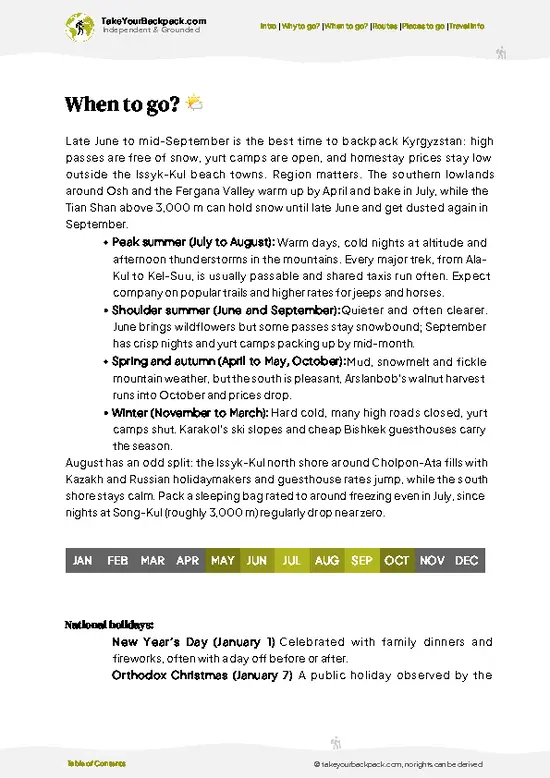
Best months and weather: July to early September is the best window for hikes in Kyrgyzstan, because high passes at 3,000 to 4,000 meters are snow-free and the jailoo pastures are occupied, so yurt camps and horses are running. Daytime temperatures in the mountains run roughly 15 to 25°C, while nights above 3,000 meters drop to near or below freezing even in midsummer. Afternoon thunderstorms are common in the Tian Shan, so start early and be off ridges by early afternoon.
Shoulder seasons and regions: June and late September are quieter and cheaper, but June can still hold snow on passes and swollen rivers, while late September brings frosts, yellow valleys and many yurt camps packing up. Lower routes around Karakol, Arslanbob and the Issyk-Kul foothills open earlier, often from mid-May, and … read more 👉
Best months and weather: July to early September is the best window for hikes in Kyrgyzstan, because high passes at 3,000 to 4,000 meters are snow-free and the jailoo pastures are occupied, so yurt camps and horses are running. Daytime temperatures in the mountains run roughly 15 to 25°C, while nights above 3,000 meters drop to near or below freezing even in midsummer. Afternoon thunderstorms are common in the Tian Shan, so start early and be off ridges by early afternoon.
Shoulder seasons and regions: June and late September are quieter and cheaper, but June can still hold snow on passes and swollen rivers, while late September brings frosts, yellow valleys and many yurt camps packing up. Lower routes around Karakol, Arslanbob and the Issyk-Kul foothills open earlier, often from mid-May, and stay walkable into October. Southern Alay and Pamir-side routes lean toward July and August, when approach roads are clear.
Crowds and prices: July and August bring the most visitors and the highest prices for yurt stays, horses and shared transport. Even then, trails stay thin by European standards, with crowds concentrated near Karakol and Song-Kul. Expect off-season discounts of perhaps 10 to 20 percent on guesthouses. Winter, from November to March, is for ski touring and snowshoeing, not standard backpacking.

hike hoppingTips for Visiting Multiple Destinations

How long you need: A trip linking several hikes in Kyrgyzstan needs 14 to 21 days, with 10 days as a tight minimum if you stick to two regions. Bishkek is the logical entry and exit hub, with the main international airport and onward transport to everywhere.
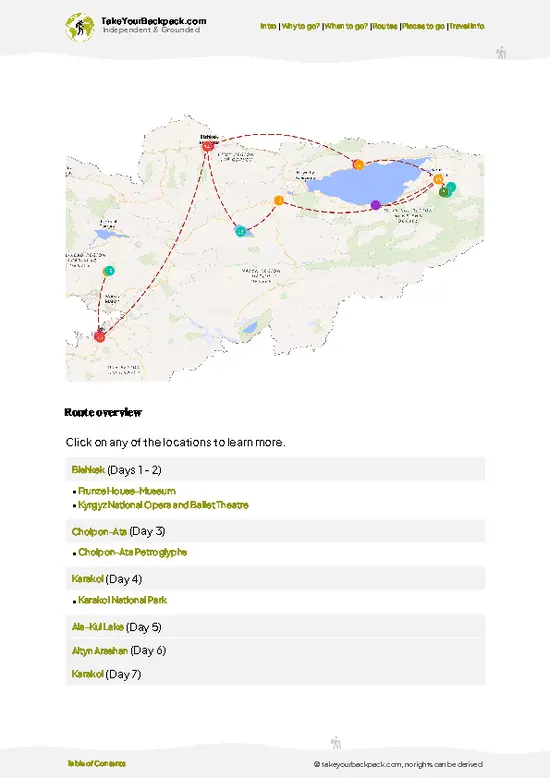
Grouping regions and direction: The north clusters well: Bishkek, the Issyk-Kul shore and Karakol sit within about 4 to 7 hours of each other by marshrutka or shared taxi. Naryn and Song-Kul link on from the lake, roughly 5 to 7 hours from Kochkor, and then the long road south toward Osh and the Fergana or Alay areas takes about 9 to 12 hours by shared taxi from Naryn or Bishkek. A sensible loop runs Bishkek, east to Karakol, west along the lake, over to Song-Kul, then south to Osh, finishing with a short flight back to Bishkek (about an … read more 👉
How long you need: A trip linking several hikes in Kyrgyzstan needs 14 to 21 days, with 10 days as a tight minimum if you stick to two regions. Bishkek is the logical entry and exit hub, with the main international airport and onward transport to everywhere.
Grouping regions and direction: The north clusters well: Bishkek, the Issyk-Kul shore and Karakol sit within about 4 to 7 hours of each other by marshrutka or shared taxi. Naryn and Song-Kul link on from the lake, roughly 5 to 7 hours from Kochkor, and then the long road south toward Osh and the Fergana or Alay areas takes about 9 to 12 hours by shared taxi from Naryn or Bishkek. A sensible loop runs Bishkek, east to Karakol, west along the lake, over to Song-Kul, then south to Osh, finishing with a short flight back to Bishkek (about an hour), which saves a full day of driving.
Time per stop and common mistakes: Allow 3 to 5 days per region, including a rest day for travel and gear. The usual error is cramming too many regions into too little time. Mountain roads move slower than the map suggests, and a 200 km leg can eat six hours. Another is skipping acclimatization: gain altitude gradually and sleep low after high passes. Travelers also forget permit lead times for border zones, which can take several days to arrange, so apply in Bishkek or Karakol before heading to the edges. Build in one spare day for weather.

The ListMust-Visit hikes in Kyrgyzstan

1 Ala-Kul Lake

Turquoise lake, 3,860 m pass, scree climb, Karakol start

Climb from the Karakol valley over a steep, rocky pass to a bright turquoise lake sitting beneath glaciated peaks.

kyrgyzstan-hike-ala-kul-lake
© Google |

2 Altyn Arashan

Hot springs, spruce gorge, wooden huts, Karakol approach

Walk or ride up a forested gorge from Karakol to a small hut settlement where sulfur springs soak tired legs.

3 Song Kol Lake

Yurt camps, 3,000 m plateau, horse herds, summer-only access

Cross a high plateau on foot or horseback, sleeping in yurt camps beside a wide lake and grazing herds.

4 Köl-Suu Lake

Border permit, granite walls, 3,500 m shoreline, horse approach

Ride or hike for several hours toward a deep-blue lake framed by sheer granite walls, close to the Kazakh border.

5 Arslanbob Walnut Forest

Walnut groves, twin waterfalls, village homestays, Jalal-Abad hills

Wander through the world’s largest natural walnut forest, then continue uphill to waterfalls above a village of homestays.

kyrgyzstan-hike-arslanbob-walnut-forest
© Google |

6 Kol Tor

Alpine lake, grazing slopes, summer yurts, steady ascent

Gain altitude through grazing pastures to a high lake, passing shepherd camps that appear only in the summer months.

7 Belogorka Waterfall

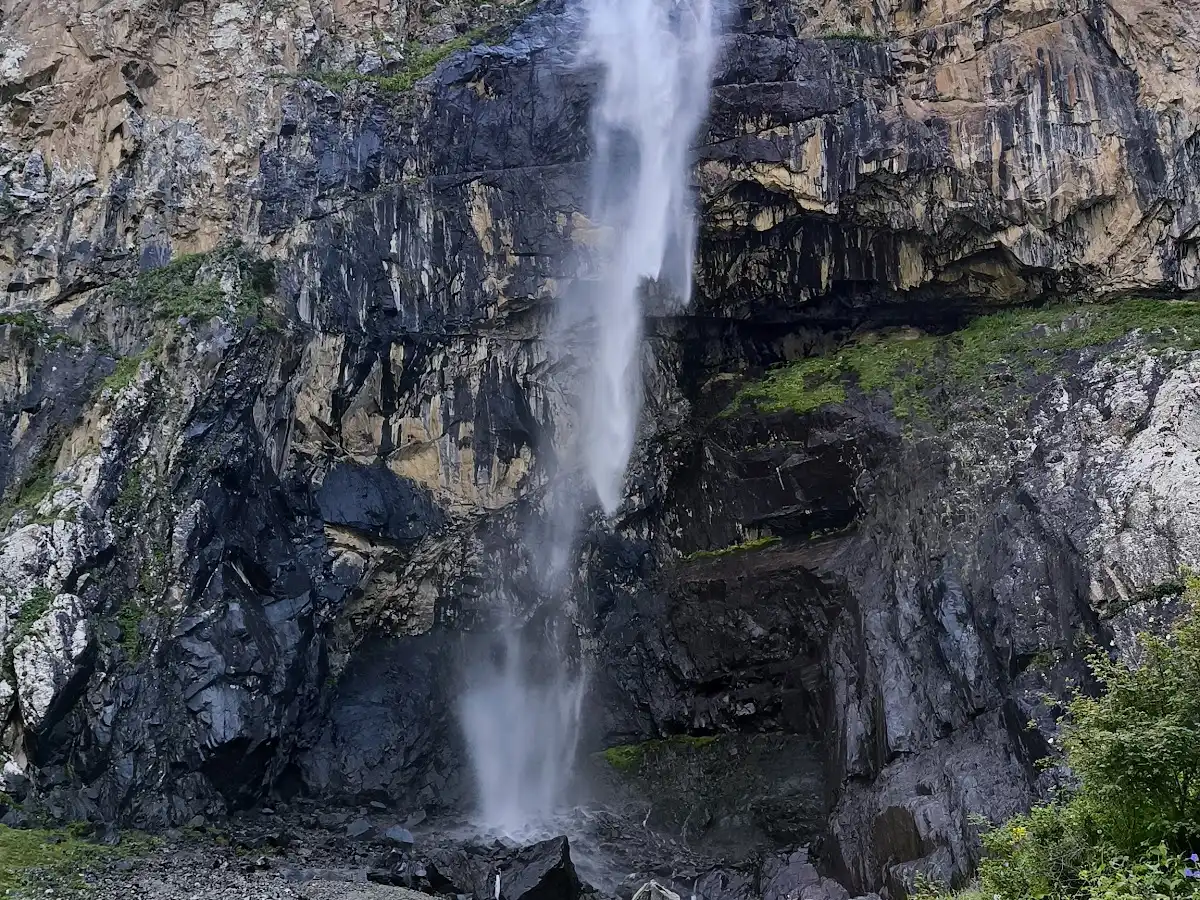
Bishkek day trip, narrow gorge, short waterfall, village trailhead

Escape the capital for a half-day walk through a narrow gorge to a modest waterfall, easy to reach by taxi.

kyrgyzstan-hike-belogorka-waterfall
© Google |

8 Ak Kayyn

Valley trail, river crossings, quiet side route, flexible length

Follow a Kyrgyz valley trail at an easy pace, with river crossings and open slopes that suit a long day or an overnight.

9 Bant Suusu

Remote valley, high meadows, shepherd tracks, self-sufficient stages

Cross open meadows and quiet ridgelines on shepherd tracks where you will meet few other hikers and need to carry your own supplies.

Loading the map 🌍

Expert viewPro Tips for Exploring the Best

How many hikes to plan: Three to five hikes is the right number for most trips of two to three weeks. That gives you time to acclimatize, recover from long transfers and still have a weather buffer, because storms and washed-out roads will claim at least one day. Packing in seven or eight turns the trip into a transport marathon, and you lose the evenings in yurts where a herder pours kymyz and the stars come out in thousands.
Choosing your kind of hike: Newer hikers should start with day hikes from Karakol or Kochkor, where trailheads are close to guesthouses and you can bail out easily. Confident multi-day walkers get more from hut-and-yurt routes across high passes, where you carry a light pack and sleep on felt. Experienced mountain travelers who want solitude should look south to Alay … read more 👉
How many hikes to plan: Three to five hikes is the right number for most trips of two to three weeks. That gives you time to acclimatize, recover from long transfers and still have a weather buffer, because storms and washed-out roads will claim at least one day. Packing in seven or eight turns the trip into a transport marathon, and you lose the evenings in yurts where a herder pours kymyz and the stars come out in thousands.
Choosing your kind of hike: Newer hikers should start with day hikes from Karakol or Kochkor, where trailheads are close to guesthouses and you can bail out easily. Confident multi-day walkers get more from hut-and-yurt routes across high passes, where you carry a light pack and sleep on felt. Experienced mountain travelers who want solitude should look south to Alay and Fergana, where you may walk a whole day without seeing another person, but you must bring navigation, food and a plan B. Horse trekking suits anyone who wants to cover distance without carrying a load, and the saddle view over a green valley is worth the sore thighs.
What it costs: Budget US$25 to 45 a day for independent hiking, covering a homestay or yurt bed (about US$10 to 20 with meals), shared transport and food. Add a guide at roughly US$40 to 80 a day, and horses at about US$20 to 40 a day per animal plus a wrangler. Shared taxis to trailheads run US$5 to 20 per seat, and a private 4x4 for remote starts can reach US$80 to 150 a day. Border-zone permits are inexpensive, usually under US$15 to 30, though agency fees for arranging them may add more. Some national parks charge small entry fees, generally US$1 to 5. A typical three to five hike trip lands around US$500 to 1,000 excluding flights.
Safety and culture: Altitude sickness is the most common problem: ascend gradually, drink plenty and descend if headaches worsen. Sheepdogs guard flocks and can be aggressive, so stop, pick up a stone gesture and walk around the flock widely. Rivers swell in the afternoon, so cross early and unclip your hip belt. Carry a satellite messenger or at least tell your guesthouse your route, since coverage is patchy and rescue is slow. Dress modestly in villages, accept tea or bread when offered (refusing outright can offend), remove shoes at yurt doors and ask before photographing people. Carry some cash in som, because cards disappear outside Bishkek, Osh and Karakol, and a warm sleeping bag for yurt nights.

✈️ The backpacker research shortcutKyrgyzstan Travel Guide

An offline-friendly backpacking guide with optimized travel routes, ranked highlights, transport advice, and the best areas to stay.
example page 0 from our offline Travel Guide for Kyrgyzstan
example page 1 from our offline Travel Guide for Kyrgyzstan
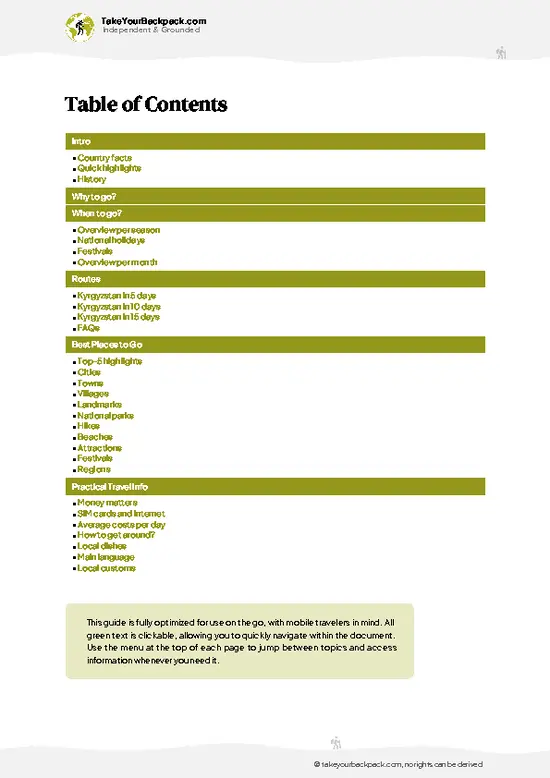
example page 2 from our offline Travel Guide for Kyrgyzstan
example page 3 from our offline Travel Guide for Kyrgyzstan
example page 4 from our offline Travel Guide for Kyrgyzstan
example page 5 from our offline Travel Guide for Kyrgyzstan
example page 6 from our offline Travel Guide for Kyrgyzstan
example page 7 from our offline Travel Guide for Kyrgyzstan
The digital guide (242 pages) contains:
✅ 73 highlights, ranked by travel appeal
✅ Optimized 5, 10 & 15-day travel routes
✅ Cities, national parks, landmarks, beaches
✅ How to get around
✅ Offline-friendly for travel without Wi-Fi
👉 Click to see all 30+ guide features

📅 Plan smarter in minutes, not weeks
✅ Month by month travel advice
✅ Festivals & national holidays
✅ Budget expectations

🗺️ Go to the right places, skip the overrated ones
✅ Honest pros & cons of destinations
✅ Top hikes, parks & viewpoints
✅ Lesser-known places most travelers miss
✅ Clear “worth it vs skip it” guidance

🛏️ Travel smoothly without rookie mistakes
✅ Best areas to stay
✅ Transport systems explained simply
✅ Common scams & safety advice
✅ SIM cards, money & practical tips

🌍 Understand the country, not just visit it
✅ Culture & traditions
✅ 52 Essential phrases & customs
✅ Festivals worth planning around
✅ Traveler-friendly historical context
✅ Insights that make places more meaningful

📱 Built for real travel conditions
✅ Fully downloadable PDF
✅ Works completely offline
✅ Optimized for phone use
✅ Useful in remote areas & buses
✅ Everything in one place
Stop searching, start planning
Get instant access to your full guide. 30‑day money-back guarantee.
+ Add another guide for just

By proceeding you agree to our terms.
Sent to your inbox immediately after payment • 100% Secure Checkout
Best Backpacking Travel Advisor 2025 tourism awardBest Backpacking
Travel Advisor
2025
What others say about Take Your Backpack Guides:
⭐⭐⭐⭐⭐
Fantastic, amazing amount of information!
⭐⭐⭐⭐⭐
My goodness this is amazing, it's what I've been looking for hats off too you!
⭐⭐⭐⭐⭐
I think this is absolutely BRILLIANT
⭐⭐⭐⭐
Very complete and informative. It's still missing places, but I gotta to commend you
⭐⭐⭐⭐⭐
This is truly amazing, thank you, can't wait to explore it with my kids!
⭐⭐⭐⭐⭐
Awesome resource, thank you!
⭐⭐⭐⭐⭐
This is amazing! Can't wait to explore the ones I haven't seen
⭐⭐⭐⭐
I love this! Well done, great idea.
⭐⭐⭐⭐⭐
Thanks for taking the time to make this gem!
⭐⭐⭐⭐⭐
This might be the best website I've ever seen.
⭐⭐⭐⭐⭐
Congratulations, and thank you so much for your work; it's incredibly valuable.
⭐⭐⭐⭐
In all seriousness I think you did a great job pointing out the important spots
⭐⭐⭐⭐⭐
10/10 very good
⭐⭐⭐⭐⭐
As someone who's only just starting to visit regularly this is awesome, thank you.
⭐⭐⭐⭐
Thank you very much! I'm going to visit my dad, it's going to be very useful!
⭐⭐⭐⭐⭐
This is really cool! We'll be travelling for the first time and this definitely come in handy.
⭐⭐⭐⭐⭐
You are now our minister of culture, congratulations 👨‍💼
⭐⭐⭐⭐⭐
Just wanted to tell you that this is a pearl! Going to follow your recommendations.
⭐⭐⭐⭐⭐
This is so cool. I'll definitely be using the resource for my travels soon.
⭐⭐⭐⭐⭐
This is very impressive! Good work.
⭐⭐⭐⭐⭐
This is an amazing and informative site. Very well done!

🛏️ Where to stay?Top Places to Consider Staying

Kyrgyzstan has plenty of hostels and guesthouses, with dorm beds typically running 500 to 1,000 som (about US$6 to 12) and family-run homestays covering most rural areas where hostels don’t exist. In Bishkek, the blocks around Ala-Too Square and Chuy Avenue put you within walking distance of most bars, cafes and the main sights, while the streets near Osh Bazaar are cheaper and handy for westbound marshrutkas but noisier and less polished. In Karakol the guesthouses clustered in the quiet grid near the center make the best trekking base, and in Osh the lanes around the bazaar and Sulaiman-Too keep you close to the sights at the cost of early-morning market noise.

If you enjoy meeting fellow travelers, … read more 👉
Kyrgyzstan has plenty of hostels and guesthouses, with dorm beds typically running 500 to 1,000 som (about US$6 to 12) and family-run homestays covering most rural areas where hostels don’t exist. In Bishkek, the blocks around Ala-Too Square and Chuy Avenue put you within walking distance of most bars, cafes and the main sights, while the streets near Osh Bazaar are cheaper and handy for westbound marshrutkas but noisier and less polished. In Karakol the guesthouses clustered in the quiet grid near the center make the best trekking base, and in Osh the lanes around the bazaar and Sulaiman-Too keep you close to the sights at the cost of early-morning market noise.

If you enjoy meeting fellow travelers, consider choosing hostels with high ratings for atmosphere. On the other hand, if you prefer having your own space, a hotel might be a better option.

KyrgyzstanMore Places Across Kyrgyzstan

👋 Meet the founderWho’s Behind Take Your Backpack?

Johan, backpacker and founder of TakeYourBackpackHi, I’m Johan (Netherlands 🇳🇱), the creator of TakeYourBackpack. Over the past 3 decades, I’ve backpacked through 90+ countries across six continents, gaining extensive experience with independent travel, long-term trips, and overland routes.

This site is built on a combination of firsthand travel experience and carefully curated insights from other backpackers. Many guides are based on places I’ve personally visited, while others bring together tips, observations, and practical advice shared by trusted travelers I’ve met along the way.

The goal is to provide realistic, experience-driven guidance — not generic itineraries — so you can explore destinations with better context, clearer expectations, and more confidence.