×

Kyrgyzstan🇰🇬 | villagesKyzyl-TuuEagle hunters, Issyk-Kul south shore, yurt camps, felt crafts | things to do and best time to go

Explore Kyzyl-OiExplore Tamga

Backpacking in Kyzyl-Tuu
👀 For curious travelersvillage ranked #10
By Johan Kruseman 🇳🇱 | Updated October 15, 2026

Come with cash and a morning free, because the best discovery here is that workshops run on family schedules, so you can often watch a frame being steamed and bent without any tour booking. Kyzyl Tuu sits on the south shore of Issyk-Kul in Kyrgyzstan’s Issyk-Kul Region, a short hop off the lakeside road. Getting here means a marshrutka or shared taxi along the shore, then a short local ride. It is quiet, with almost no hostel scene and few other backpackers. Compared with busy Karakol or Cholpon-Ata, it feels rural and practical. Treat it as a half-day stop that pairs well with Skazka Canyon.

Discover everything you want to know in the 📖 Kyrgyzstan Travel Guide.


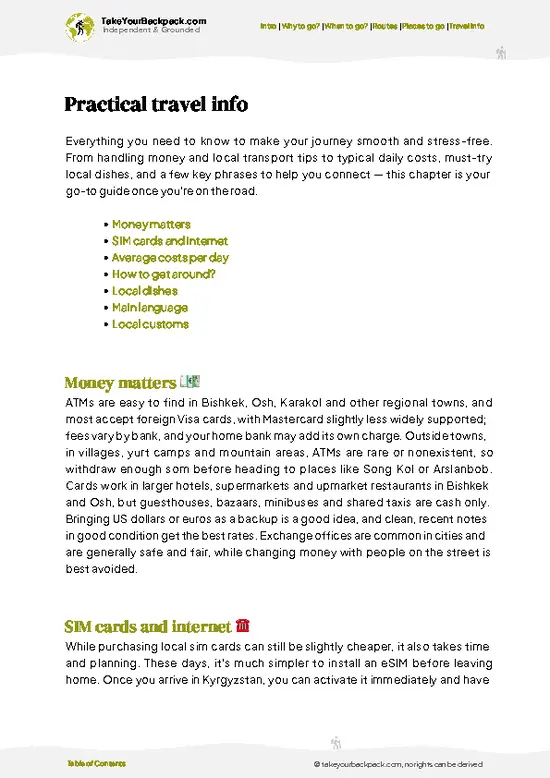
example page 0 from our offline Travel Guide for Kyrgyzstan
example page 1 from our offline Travel Guide for Kyrgyzstan
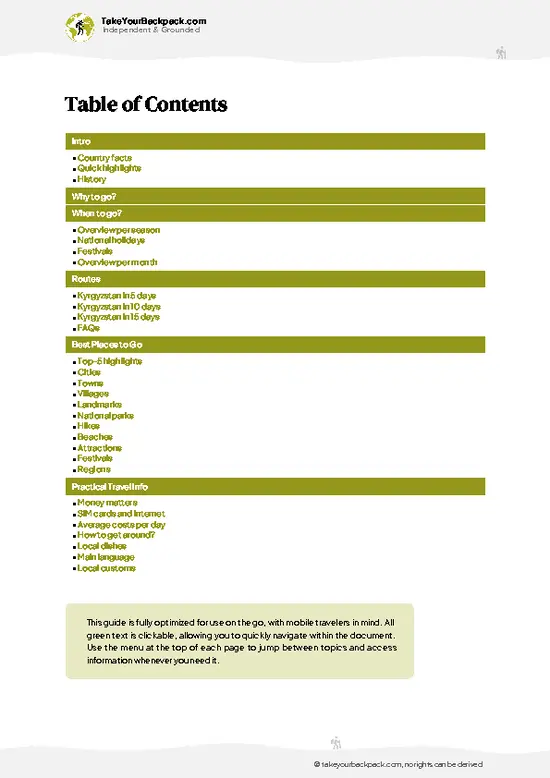
example page 2 from our offline Travel Guide for Kyrgyzstan
example page 3 from our offline Travel Guide for Kyrgyzstan
example page 4 from our offline Travel Guide for Kyrgyzstan
example page 5 from our offline Travel Guide for Kyrgyzstan
example page 6 from our offline Travel Guide for Kyrgyzstan
example page 7 from our offline Travel Guide for Kyrgyzstan
Loading the map 🌍
CLICK TO FILTER
cities
towns
villages
landmarks
national parks
hikes
beaches
attractions
festivals
regions
SHOW COUNTRY’S BESTSHOW ALL

✨ Why go?
Ranked #10 village in Kyrgyzstan
Why visitors keep coming back

Go for craft you can actually watch. Families here still shape the wooden yurt frames, and seeing willow or birch lattice sections bent and lashed explains more about nomad life than any museum label. It suits slow travelers, photographers and anyone curious about Kyrgyz tradition who wants to talk with makers rather than shop in a gift stall. Most people stay a few hours or one night in a homestay, eating home-cooked food and walking toward the lake in the evening. Do not expect nightlife, cafés or a crowd of fellow backpackers. It rewards solo travelers and small groups who are happy with silence, village dogs and chai on a family’s floor cushions. If you want ticking boxes, skip it.

💡 HighlightsThe experiences that define the visit

  1. Household yurt-frame workshops. Families here bend and lash the lattice walls (kerege) of yurts. Ask at your homestay to be introduced, since doors open informally. Go in the morning on a dry day. Expect a small tip or purchase rather than a fixed fee, and allow 1 to 2 hours.
  2. Roof poles and crown work. Watch how the curved roof poles (uuk) are shaped and fitted into the wooden crown (tunduk), the part that appears on Kyrgyzstan’s flag. It is the most technical stage and clarifies the whole structure. Allow about 30 to 60 minutes with the same families.
  3. Village lanes on foot. A walk past orchards, stacked timber and finished frames drying in yards shows how the trade fits into daily life. Late afternoon light is best. It is free and takes 1 to 2 hours.
  4. Lakeshore stroll. The village lies close
… read more 👉
  1. Household yurt-frame workshops. Families here bend and lash the lattice walls (kerege) of yurts. Ask at your homestay to be introduced, since doors open informally. Go in the morning on a dry day. Expect a small tip or purchase rather than a fixed fee, and allow 1 to 2 hours.
  2. Roof poles and crown work. Watch how the curved roof poles (uuk) are shaped and fitted into the wooden crown (tunduk), the part that appears on Kyrgyzstan’s flag. It is the most technical stage and clarifies the whole structure. Allow about 30 to 60 minutes with the same families.
  3. Village lanes on foot. A walk past orchards, stacked timber and finished frames drying in yards shows how the trade fits into daily life. Late afternoon light is best. It is free and takes 1 to 2 hours.
  4. Lakeshore stroll. The village lies close to the south shore of Issyk-Kul, so a walk toward the water makes a quiet end to the day, with the Kungey Ala-Too range across the lake in clear weather. Summer is warmest. It costs nothing and takes about 1 to 2 hours return.
  5. Homestay meal. Eating bread, jam, laghman or whatever the family cooks gives you the social side of the village. Meals usually cost roughly US$4 to 8 per person if arranged ahead. Plan 1 hour.
Close by on the south shore you can reach Skazka (Fairytale) Canyon with its red sandstone formations, the Barskoon waterfall valley and the Jeti-Oguz rocks farther east. I would go to Skazka Canyon first, because it is the nearest and sunset turns the cliffs deep orange.
Spotted a mistake or missing something? Contact us.

Things to do near Kyzyl-Tuu

Ratings based on Tripadvisor reviews. When you book through this link, you support our work at no extra cost to you.

🏘️ NeighborhoodsHow different areas shape the experience

Kyzyl Tuu is small enough to cover on foot in an afternoon, so lace up and follow the sound of mallets and the smell of fresh-cut willow.
  • Craft lanes near the main road: This is where yurt-frame households cluster. Walk in, watch families steam and bend willow poles into kerege lattice, then see them lash the joints with rawhide. Most workshops sit within a 10 to 15 minute walk of each other, and an experienced traveler asks before photographing, because the work is a livelihood, not a show.
  • Village center: A short strip of shops, a bazaar corner and a few canteens. Grab lagman, samsa or fresh bread here and stock up on water, since farther out there is little to buy. Quiet after dark, with no nightlife to speak of.
  • Lakeside edge: Push toward the shore for open views of the water, grazing horses
… read more 👉
Kyzyl Tuu is small enough to cover on foot in an afternoon, so lace up and follow the sound of mallets and the smell of fresh-cut willow.
  • Craft lanes near the main road: This is where yurt-frame households cluster. Walk in, watch families steam and bend willow poles into kerege lattice, then see them lash the joints with rawhide. Most workshops sit within a 10 to 15 minute walk of each other, and an experienced traveler asks before photographing, because the work is a livelihood, not a show.
  • Village center: A short strip of shops, a bazaar corner and a few canteens. Grab lagman, samsa or fresh bread here and stock up on water, since farther out there is little to buy. Quiet after dark, with no nightlife to speak of.
  • Lakeside edge: Push toward the shore for open views of the water, grazing horses and evening light on the mountains. The paths are flat and walkable, though some stretches are unpaved and muddy after rain. Go at sunset, when the herds come home.
  • Outer farmland and pastures: Cross fields to spot yurts in use and ask locals about walking routes. Distances grow, so bring water and a hat.

⌛️ 1 dayWhat you can realistically do in a day

A slow day here is built around watching craftspeople at work, with the lake as a backdrop.
8:30 AM: Homestay breakfast. Start with bread, cream and tea while your host explains which neighbors are working today. Ask them to call ahead, which is how smart visitors get welcomed.
10:00 AM: Frame workshop. Walk to a household yard and watch lattice sections being bent and lashed. Ask questions and buy a small souvenir if one is offered. Stay about 90 minutes.
12:00 PM: Roof poles and crown. Move to a second family if possible to see uuk and tunduk work, which shows the harder joinery.
1:30 PM: Lunch. Eat at the homestay, where laghman or plov is typical and easy to arrange.
3:00 PM: Back lanes. Wander the side streets away from the main road, where finished frames dry in yards and orchards line the … read more 👉
A slow day here is built around watching craftspeople at work, with the lake as a backdrop.
8:30 AM: Homestay breakfast. Start with bread, cream and tea while your host explains which neighbors are working today. Ask them to call ahead, which is how smart visitors get welcomed.
10:00 AM: Frame workshop. Walk to a household yard and watch lattice sections being bent and lashed. Ask questions and buy a small souvenir if one is offered. Stay about 90 minutes.
12:00 PM: Roof poles and crown. Move to a second family if possible to see uuk and tunduk work, which shows the harder joinery.
1:30 PM: Lunch. Eat at the homestay, where laghman or plov is typical and easy to arrange.
3:00 PM: Back lanes. Wander the side streets away from the main road, where finished frames dry in yards and orchards line the paths. This part is rarely on a standard itinerary.
5:00 PM: Lakeshore. Walk or ride the short distance to the water and watch the light change on the northern mountains.
7:00 PM: Dinner and tea. Return for an unhurried evening with your hosts.

🌤️ When to go?Weather, crowds, and seasonal trade-offs

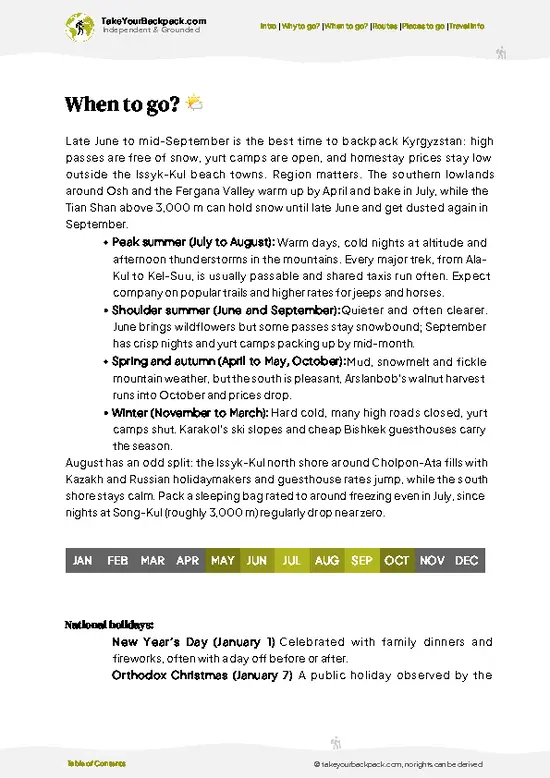
June to September is the best window for Kyzyl Tuu, with long days and open roads. Frame-making continues year-round, but summer is when yurts are raised and used.
  • Summer (June to August): Days reach 22 to 28°C (72 to 82°F), with about 15 hours of daylight. Visitor numbers and guesthouse prices peak.
  • Autumn (September to October): Highs of 10 to 20°C (50 to 68°F), clear skies and quieter workshops. Prices ease.
  • Winter (November to March): Lows of -10 to -20°C (14 to -4°F) and snow, with short days. Few travelers, and some lodging closes.
  • Spring (April to May): 5 to 15°C (41 to 59°F), muddy lanes and changeable weather, but green hills and low prices.
Book a few days ahead in July and August, or visit in early September for the same weather with fewer people.

source: climatestotravel.comJANJanuary: below average for travelingFEBFebruary: below average for travelingMARMarch: fair for travelingAPRApril: good for travelingMAYMay: highly recommended for travelingJUNJune: excellent for travelingJULJuly: excellent for travelingAUGAugust: excellent for travelingSEPSeptember: highly recommended for travelingOCTOctober: good for travelingNOVNovember: fair for travelingDECDecember: below average for traveling
when-to-go

✈️ The backpacker research shortcutKyrgyzstan Travel Guide

An offline-friendly backpacking guide with optimized travel routes, ranked highlights, transport advice, and the best areas to stay.
example page 0 from our offline Travel Guide for Kyrgyzstan
example page 1 from our offline Travel Guide for Kyrgyzstan
example page 2 from our offline Travel Guide for Kyrgyzstan
example page 3 from our offline Travel Guide for Kyrgyzstan
example page 4 from our offline Travel Guide for Kyrgyzstan
example page 5 from our offline Travel Guide for Kyrgyzstan
example page 6 from our offline Travel Guide for Kyrgyzstan
example page 7 from our offline Travel Guide for Kyrgyzstan
The digital guide (242 pages) contains:
✅ 73 highlights, ranked by travel appeal
✅ Optimized 5, 10 & 15-day travel routes
✅ Cities, national parks, landmarks, beaches
✅ How to get around
✅ Offline-friendly for travel without Wi-Fi
👉 Click to see all 30+ guide features

📅 Plan smarter in minutes, not weeks
✅ Month by month travel advice
✅ Festivals & national holidays
✅ Budget expectations

🗺️ Go to the right places, skip the overrated ones
✅ Honest pros & cons of destinations
✅ Top hikes, parks & viewpoints
✅ Lesser-known places most travelers miss
✅ Clear “worth it vs skip it” guidance

🛏️ Travel smoothly without rookie mistakes
✅ Best areas to stay
✅ Transport systems explained simply
✅ Common scams & safety advice
✅ SIM cards, money & practical tips

🌍 Understand the country, not just visit it
✅ Culture & traditions
✅ 52 Essential phrases & customs
✅ Festivals worth planning around
✅ Traveler-friendly historical context
✅ Insights that make places more meaningful

📱 Built for real travel conditions
✅ Fully downloadable PDF
✅ Works completely offline
✅ Optimized for phone use
✅ Useful in remote areas & buses
✅ Everything in one place
Stop searching, start planning
Get instant access to your full guide. 30‑day money-back guarantee.
+ Add another guide for just

By proceeding you agree to our terms.
Sent to your inbox immediately after payment • 100% Secure Checkout
Best Backpacking Travel Advisor 2025 tourism awardBest Backpacking
Travel Advisor
2025
What others say about Take Your Backpack Guides:
⭐⭐⭐⭐⭐
Fantastic, amazing amount of information!
⭐⭐⭐⭐⭐
My goodness this is amazing, it's what I've been looking for hats off too you!
⭐⭐⭐⭐⭐
I think this is absolutely BRILLIANT
⭐⭐⭐⭐
Very complete and informative. It's still missing places, but I gotta to commend you
⭐⭐⭐⭐⭐
This is truly amazing, thank you, can't wait to explore it with my kids!
⭐⭐⭐⭐⭐
Awesome resource, thank you!
⭐⭐⭐⭐⭐
This is amazing! Can't wait to explore the ones I haven't seen
⭐⭐⭐⭐
I love this! Well done, great idea.
⭐⭐⭐⭐⭐
Thanks for taking the time to make this gem!
⭐⭐⭐⭐⭐
This might be the best website I've ever seen.
⭐⭐⭐⭐⭐
Congratulations, and thank you so much for your work; it's incredibly valuable.
⭐⭐⭐⭐
In all seriousness I think you did a great job pointing out the important spots
⭐⭐⭐⭐⭐
10/10 very good
⭐⭐⭐⭐⭐
As someone who's only just starting to visit regularly this is awesome, thank you.
⭐⭐⭐⭐
Thank you very much! I'm going to visit my dad, it's going to be very useful!
⭐⭐⭐⭐⭐
This is really cool! We'll be travelling for the first time and this definitely come in handy.
⭐⭐⭐⭐⭐
You are now our minister of culture, congratulations 👨‍💼
⭐⭐⭐⭐⭐
Just wanted to tell you that this is a pearl! Going to follow your recommendations.
⭐⭐⭐⭐⭐
This is so cool. I'll definitely be using the resource for my travels soon.
⭐⭐⭐⭐⭐
This is very impressive! Good work.
⭐⭐⭐⭐⭐
This is an amazing and informative site. Very well done!

🛏️ Where to stay?Best areas to stay in Kyrgyzstan

The best budget option is a family guesthouse or homestay inside the village itself, close to the craft lanes. Kyzyl Tuu has no hostel scene, so beds are in family homes or small guesthouses, typically US$10 to 25 a night including breakfast, with dinner often available for a few dollars more. These are simple, clean, and usually have shared bathrooms.

The second choice is the lakeside edge, where a yurt camp or a guesthouse near the shore offers quieter nights and big skies. Expect to share a yurt with other travelers, with mattresses on the floor and blankets provided, for about US$10 to 20. … read more 👉
The best budget option is a family guesthouse or homestay inside the village itself, close to the craft lanes. Kyzyl Tuu has no hostel scene, so beds are in family homes or small guesthouses, typically US$10 to 25 a night including breakfast, with dinner often available for a few dollars more. These are simple, clean, and usually have shared bathrooms.

The second choice is the lakeside edge, where a yurt camp or a guesthouse near the shore offers quieter nights and big skies. Expect to share a yurt with other travelers, with mattresses on the floor and blankets provided, for about US$10 to 20. Nights are dark and cold even in summer, so bring a warm layer.

Both areas are safe at night, with little noise beyond dogs and roosters. The village center has the better transport links, since minibuses and taxis pass through there, while the lakeside is a 15 to 30 minute walk or short ride away. Book ahead in July and August, as capacity is small.

🚌 Getting aroundHow to get from A to B

A shared marshrutka or minibus ride toward Kyzyl Tuu typically costs a few dozen Kyrgyz som (roughly US$0.50 to 3 for short hops), paid in cash to the driver on boarding or when you get off. Carry small notes, because drivers rarely have change for large ones. The village itself is compact and flat, so you will mostly walk, and traffic is light apart from livestock and the odd truck. Public transport is infrequent and runs by daylight, so plan around it.
  • Walking: Free, and the best way to find workshops tucked behind gates. Most of the village is covered in 30 to 60 minutes, and walking lets you stop when someone waves you toward a half-built frame.
  • Marshrutka and shared minibuses: The standard way to reach the village from larger towns, roughly US$1 to 4 depending on the distance. They leave
… read more 👉
A shared marshrutka or minibus ride toward Kyzyl Tuu typically costs a few dozen Kyrgyz som (roughly US$0.50 to 3 for short hops), paid in cash to the driver on boarding or when you get off. Carry small notes, because drivers rarely have change for large ones. The village itself is compact and flat, so you will mostly walk, and traffic is light apart from livestock and the odd truck. Public transport is infrequent and runs by daylight, so plan around it.
  • Walking: Free, and the best way to find workshops tucked behind gates. Most of the village is covered in 30 to 60 minutes, and walking lets you stop when someone waves you toward a half-built frame.
  • Marshrutka and shared minibuses: The standard way to reach the village from larger towns, roughly US$1 to 4 depending on the distance. They leave when full, so go early in the morning, since afternoon departures thin out and the last ones often leave by late afternoon.
  • Shared taxi: Fast and flexible, around US$3 to 8 per seat on regional runs. Fares are agreed before you get in, so confirm the price and the drop-off point first. Splitting a whole car with other travelers usually works out cheaper per person than waiting for a bus.
  • Local taxi or hired car: A driver for a few hours of village and lakeside hopping runs about US$10 to 25. Ask your host to call someone they trust rather than flagging a stranger, and negotiate a round-trip rate so you are not stranded at the shore.
  • Bicycle or horse: Some families rent horses, and a bike works well on flat lanes. Expect roughly US$5 to 15 for a few hours, and agree on the price in advance.

👛 Costs (as of 15 October 2026)Typical daily expenses

Backpacking in Kyzyl Tuu typically costs about US$25 to 50 a day, driven mostly by guesthouse beds and meals.
CategoryBudget RangeLocal Reality
Dorm accommodationUS$10 to 20Homestay beds or shared yurts, often with breakfast.
MealsUS$6 to 14Lagman, plov and samsa at small canteens, plus homemade dinner at a guesthouse.
Local transportUS$2 to 10Minibuses are cheap, while shared taxis cost more.
Basic activities/entry feesUS$0 to 8Workshop visits are often free, but buying a small craft item or tipping a host is expected.
Miscellaneous expensesUS$3 to 6Water, snacks, SIM data and small gifts.
Total Daily BudgetUS$25 to 50Lower if you walk everywhere and eat with your host.
Book dinner with your host rather than eating out, since family meals are usually cheaper and bigger.
⚠️ Prices can change and everyone travels differently, so take this as a rough guide. Hope it helps you plan your adventure!

🚌 Day tripsShort trips worth adding

Kyzyl Tuu works well as a base for day trips, because the south-shore road gives you marshrutka and taxi access to canyons, gorges and a lakeside town within one to two hours.
Skazka Canyon:
The red and orange sandstone formations here are the easiest half-day from the village, about 30 to 40 km west along the south shore. A shared taxi or marshrutka toward Bokonbayevo gets you to the turnoff, and the last stretch is a short walk or a quick hitch. Entry is a small fee, and the whole outing costs roughly US$5 to 12. Go in late afternoon when the light turns the walls deep red, and carry water because there is no shade on the ridge paths. First-timers often arrive at midday in July and cook.
👉 Explore Skazka Canyon
Jeti-Oguz Gorge:
The red rock cliffs and a forested valley above Karakol make this … read more 👉
Kyzyl Tuu works well as a base for day trips, because the south-shore road gives you marshrutka and taxi access to canyons, gorges and a lakeside town within one to two hours.
Skazka Canyon:
The red and orange sandstone formations here are the easiest half-day from the village, about 30 to 40 km west along the south shore. A shared taxi or marshrutka toward Bokonbayevo gets you to the turnoff, and the last stretch is a short walk or a quick hitch. Entry is a small fee, and the whole outing costs roughly US$5 to 12. Go in late afternoon when the light turns the walls deep red, and carry water because there is no shade on the ridge paths. First-timers often arrive at midday in July and cook.
👉 Explore Skazka Canyon
Jeti-Oguz Gorge:
The red rock cliffs and a forested valley above Karakol make this the classic day out, roughly 2 to 2.5 hours each way by marshrutka via Karakol, then a local minibus. Budget US$12 to 25 including transport and a simple lunch. Walk up the valley toward the meadow, or add a horse ride for around US$10 to 15. June to September is best. Many people rush back before the afternoon minibuses thin out, so confirm the last return in Karakol.

Barskoon Gorge and Waterfalls:
This gorge on the south shore sits about 1 to 1.5 hours east and is the quickest way to feel the Terskey Ala-Too up close. Shared taxis from the main road drop you near the village of Barskoon, and a rough track climbs to waterfalls and a Yuri Gagarin monument. Plan US$8 to 20, more if you hire a driver for the upper valley. Visit from June to early October. The common mistake is assuming you can walk to the falls quickly. It is a long, dusty route, so arrange a ride.

🛡️ SafetyStaying Safe: What Travelers Should Know

Kyzyl Tuu is a calm, low-crime village, and the usual traveler problems are practical ones. Stray dogs can be loud at night, so carry a flashlight on unlit lanes and walk with confidence rather than running. Livestock and the odd fast truck share the road. Solo travelers, including women, generally report friendly treatment, though dressing modestly and accepting tea politely helps. Agree on taxi prices before you get in, and keep cash in more than one place, as no ATMs may be nearby. Ask permission before photographing people or workshops. Cold nights and sudden weather changes cause more trouble than people do.

FAQCommon questions from travelers

Kyzyl Tuu is worth visiting if you care about craft and want a village stop on the south shore of Issyk-Kul, but it is not a standalone destination. The draw is household yurt-frame workshops, where families bend and lash lattice walls, plus a homestay meal. Pair it with Skazka Canyon, which is the nearest major sight on the same road.
One night or a long half-day is enough for most travelers. Allow 3 to 4 hours for workshops and a walk, and add an overnight if you want an evening meal with a family and a lakeshore stroll. Two nights only make sense if you plan to base yourself here for day trips to Skazka Canyon or Barskoon.
Yes, it can be done as a day trip from Karakol or from Cholpon-Ata, using shared taxis or marshrutkas along the Issyk-Kul south shore road. Expect roughly 1.5 to 2.5 hours each way depending on your start point and connections. Leave early so you reach the workshops in the morning, when families are most active.
⚠️ Things can change over time, so always validate details locally before you go.

Other Kyrgyz villages near Kyzyl-Tuu

Explore more nearby:

  • Tamga—Issyk-Kul south shore, red sandstone cliffs, Skazka Canyon, beach guesthouses| 70 km away
  • Chong-Kemin—Kemin Valley, Chon-Kemin National Park, horse treks, yurt stays, apricot and honey stalls| 71 km away
  • Jyrgalan—Former coal town, ski touring, Karakol day hikes, homestays| 196 km away

💡 Not sure where to go next?
Create a personalized itinerary for Kyrgyzstan including Kyzyl-Tuu and the places that fit your trip.

Generate my itinerary

👉 Discover all villages

Or checkout all Kyrgyzstan has to offer (think cities, towns, villages, national parks, hikes, beaches, festivals)
Country photo of Kyrgyzstan

We 💚 feedbackFinal thoughts on visiting Kyzyl-Tuu

I came for the yurt frames and stayed for the conversation in a yard full of curved willow. Watching a family work wood by hand is a rare, unstaged experience. The honest downside is how little else there is. No bars, few other travelers, and limited English, so it suits curious, patient people more than anyone chasing action.

✈️ When did I visit Kyrgyzstan?
I started my 1.5 year travel around the world trip in June 2015 in Kyrgyzstan.

✍️ Help improve this page!
The information on this page is based on my own backpacking experience in Kyrgyzstan, supplemented with up-to-date research and feedback from other travelers. Travel details can change, so if you notice anything outdated or incomplete, feel free to let me know.


🙋‍♂️ Give feedback

👋 Meet the founderWho’s Behind Take Your Backpack?

Johan, backpacker and founder of TakeYourBackpackHi, I’m Johan (Netherlands 🇳🇱), the creator of TakeYourBackpack. Over the past 3 decades, I’ve backpacked through 90+ countries across six continents, gaining extensive experience with independent travel, long-term trips, and overland routes.

This site is built on a combination of firsthand travel experience and carefully curated insights from other backpackers. Many guides are based on places I’ve personally visited, while others bring together tips, observations, and practical advice shared by trusted travelers I’ve met along the way.

The goal is to provide realistic, experience-driven guidance — not generic itineraries — so you can explore destinations with better context, clearer expectations, and more confidence.