×

Lesotho🇱🇸 | regionsMaloti MountainsBasalt passes, pony treks, waterfalls, high-altitude snow | things to do and best time to go

Explore Maloti-Drakensberg ParkExplore Tsoelike Valley

Backpacking in Maloti Mountains
👍 Recommendedregion ranked #4
By Johan Kruseman 🇳🇱 | Updated October 22, 2026

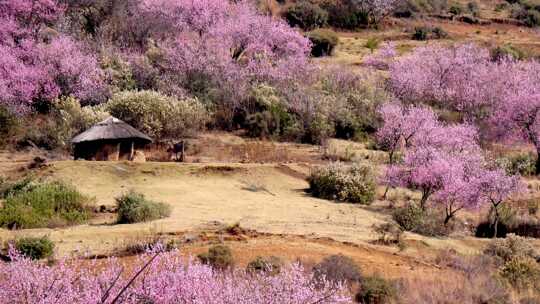
Decades ago the Maloti were a place you reached on horseback or by a rattling bus on gravel, and plenty of people still do. Today paved passes cut through the range, yet shepherds in Basotho blankets still walk the ridgelines. Maloti Mountains fill most of the highlands of Lesotho, running east and south of Maseru toward the Drakensberg escarpment. On the ground you get switchbacks that swing between bare basalt and green valleys, villages of round stone huts, and the clink of cowbells on the wind. Winter brings snow and frozen water bottles, summer brings sudden hail, and either way the horizon is huge. Towns are small and facilities thin, but the quiet, the pony treks and the warm greetings from passing herders make up for it. Crowds are almost nonexistent. Carry cash in small notes, because ATMs vanish once you leave the main towns.

Discover everything you want to know in the 📖 Lesotho Travel Guide.
Best time to go: March - October
Duration: 7 to 10 days
Distance: 10 kilometers
Total ascent: 1,000 to 2,500 meters


example page 0 from our offline Travel Guide for Lesotho
example page 1 from our offline Travel Guide for Lesotho
example page 2 from our offline Travel Guide for Lesotho
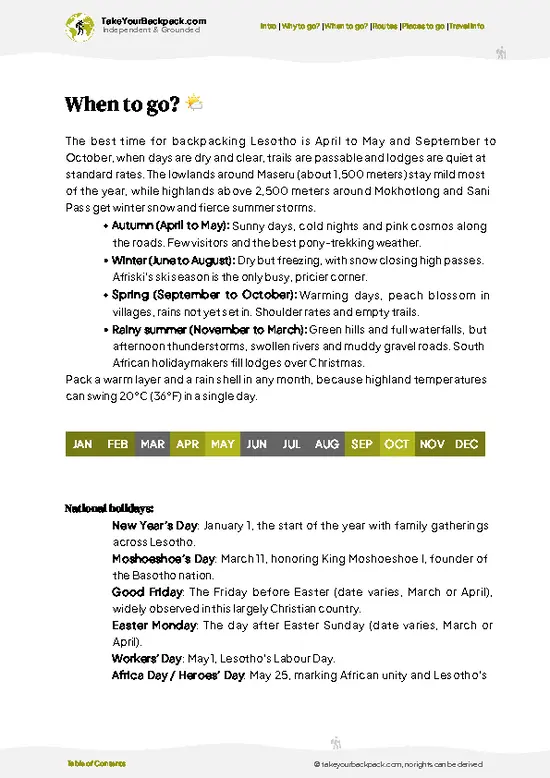
example page 3 from our offline Travel Guide for Lesotho
example page 4 from our offline Travel Guide for Lesotho
example page 5 from our offline Travel Guide for Lesotho
example page 6 from our offline Travel Guide for Lesotho
example page 7 from our offline Travel Guide for Lesotho
Loading the map 🌍
CLICK TO FILTER
cities
towns
villages
landmarks
national parks
hikes
attractions
festivals
regions
SHOW COUNTRY’S BESTSHOW ALL

✨ Why go?
Ranked #4 region in Lesotho
What sets this place apart

Maloti Mountains let you string together very different days without ever repacking your life. One morning you can be on a pony in a village near Semonkong, the next standing at the lip of Maletsunyane Falls, a drop of 192 meters. Hiking is the main draw, and the trails follow footpaths that herders have used for generations, so you walk through living communities rather than around them. Overnight stays in village homes and simple lodges mean your money lands directly with locals. Minibus taxis link the larger towns, and slow travel suits the range: with so few services, a hard day on foot ends with a bowl of papa and a fire. Winter skiing at Afriski, the only ski resort in southern Africa's high country, adds a rare option if you come in the cold months.

💡 HighlightsPlaces and moments you shouldn't skip

  1. Maletsunyane Falls: a single plunge of 192 meters into a basalt gorge near Semonkong, best viewed from the rim or on a guided walk to the base.
  2. Sani Pass: the steep gravel road that climbs to the Lesotho border, with hairpins, thin air and a famous pub at the top.
  3. Thaba-Bosiu: the flat-topped sandstone hill where King Moshoeshoe I founded the Basotho nation, with ruins, graves and a guide-led walk across the summit.
  4. Afriski Mountain Resort: high-altitude slopes near Mahlasela Pass, open for snow sports in winter and mountain biking in warmer months.
  5. Katse Dam: a vast arch dam in a deep valley, with a visitor center and tours that take you inside the wall.
  6. Pony trekking from Malealea: Basotho ponies carry you between villages and rock-art shelters on routes that locals have ridden for generations.
… read more 👉
  1. Maletsunyane Falls: a single plunge of 192 meters into a basalt gorge near Semonkong, best viewed from the rim or on a guided walk to the base.
  2. Sani Pass: the steep gravel road that climbs to the Lesotho border, with hairpins, thin air and a famous pub at the top.
  3. Thaba-Bosiu: the flat-topped sandstone hill where King Moshoeshoe I founded the Basotho nation, with ruins, graves and a guide-led walk across the summit.
  4. Afriski Mountain Resort: high-altitude slopes near Mahlasela Pass, open for snow sports in winter and mountain biking in warmer months.
  5. Katse Dam: a vast arch dam in a deep valley, with a visitor center and tours that take you inside the wall.
  6. Pony trekking from Malealea: Basotho ponies carry you between villages and rock-art shelters on routes that locals have ridden for generations.
  7. Ketane Falls: a 122-meter waterfall reached on a long walk or ride from Semonkong, quiet and rarely visited.
  8. Liphofung Cave: a small sandstone shelter near Butha-Buthe with San rock paintings and a modest cultural site.
  9. Bokong Nature Reserve: a high-altitude reserve on Mafika-Lisiu Pass with a waterfall, ice formations in winter and a short ridge walk.
  10. Tsehlanyane National Park: an unspoiled valley with forest patches, rivers and long hiking routes, usually empty of other walkers.
Maloti Mountains pair well in one day if you visit Bokong Nature Reserve in the morning and then drive on to Katse Dam for the afternoon.
Spotted a mistake or missing something? Contact us.

Things to do near Maloti Mountains

Ratings based on Tripadvisor reviews. When you book through this link, you support our work at no extra cost to you.

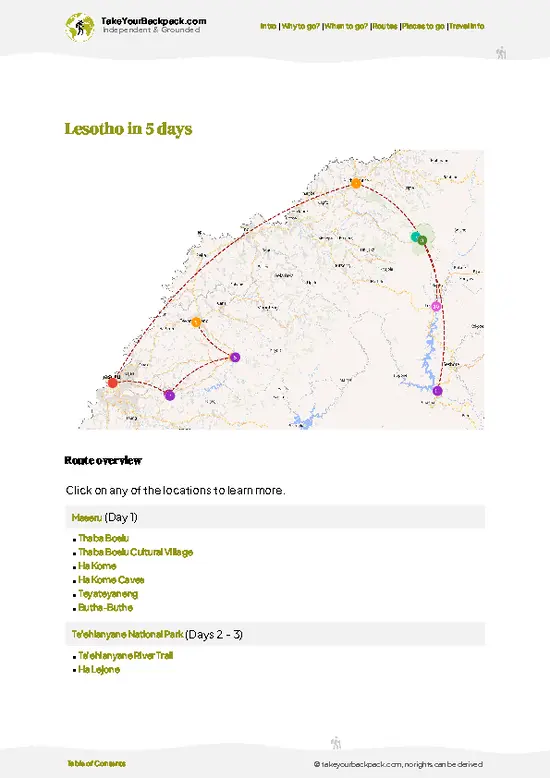
⌛️ 5 daysSeeing the highlights in 5 days

Day 1: Semonkong: A slow arrival day, because the road from Maseru winds and takes the whole morning. Settle into a lodge, walk to Maletsunyane Falls and watch the water drop into the gorge before dusk. Taxis run on a loose schedule here, so treat the first day as a buffer.
Day 2: Semonkong: Spend it on horseback or foot toward Ketane Falls or the base of Maletsunyane. Staying put saves you from a second day of transport and gives your legs a proper workout.
Day 3: Malealea: Move south by minibus and shared lifts, accepting that connections set the pace. Malealea sits in a valley of rock-art shelters, and the village lodge arranges treks with local guides.
Day 4: Malealea: Take a full day pony trek between villages. This is the heart of the route, with slow paths, shepherds and open ridgelines. … read more 👉
Day 1: Semonkong: A slow arrival day, because the road from Maseru winds and takes the whole morning. Settle into a lodge, walk to Maletsunyane Falls and watch the water drop into the gorge before dusk. Taxis run on a loose schedule here, so treat the first day as a buffer.
Day 2: Semonkong: Spend it on horseback or foot toward Ketane Falls or the base of Maletsunyane. Staying put saves you from a second day of transport and gives your legs a proper workout.
Day 3: Malealea: Move south by minibus and shared lifts, accepting that connections set the pace. Malealea sits in a valley of rock-art shelters, and the village lodge arranges treks with local guides.
Day 4: Malealea: Take a full day pony trek between villages. This is the heart of the route, with slow paths, shepherds and open ridgelines. Rest in the evening with music at the lodge.
Day 5: Thaba-Bosiu: Head back toward Maseru and stop at Thaba-Bosiu for a guided climb of the historic hill. As a detour, add Liphofung or the Roma valley if you have energy and a spare ride.
If you only get one day, make it Day 4: the pony ride across the ridges is what justifies the whole trip.

🌤️ When to go?Best time to visit Maloti Mountains

Late October to April brings the warmest, greenest hiking in the Maloti Mountains, though afternoon storms arrive with it. Here is how the year breaks down.
  • Summer (November to February): Days run 20 to 28°C (68 to 82°F) at altitude, with long light of about 14 hours. Thunderstorms roll in most afternoons, rivers swell, and trails turn slick. Pony trekking is at its most lush, and prices stay flat.
  • Autumn (March to May): Clear skies, 12 to 22°C (54 to 72°F) by day, and grass turning gold. Rain tapers off. This is calm, easy walking with few other trekkers.
  • Winter (June to August): Nights drop well below freezing, often to -10°C (14°F) on the high passes, and days reach 5 to 15°C (41 to 59°F). Snow can close roads, but Afriski near Mokhotlong opens for skiing. Daylight is about 10 hours.
  • Spring
… read more 👉
Late October to April brings the warmest, greenest hiking in the Maloti Mountains, though afternoon storms arrive with it. Here is how the year breaks down.
  • Summer (November to February): Days run 20 to 28°C (68 to 82°F) at altitude, with long light of about 14 hours. Thunderstorms roll in most afternoons, rivers swell, and trails turn slick. Pony trekking is at its most lush, and prices stay flat.
  • Autumn (March to May): Clear skies, 12 to 22°C (54 to 72°F) by day, and grass turning gold. Rain tapers off. This is calm, easy walking with few other trekkers.
  • Winter (June to August): Nights drop well below freezing, often to -10°C (14°F) on the high passes, and days reach 5 to 15°C (41 to 59°F). Snow can close roads, but Afriski near Mokhotlong opens for skiing. Daylight is about 10 hours.
  • Spring (September to October): Wind is strong and mornings are cold at 0 to 5°C (32 to 41°F), with warm afternoons. Waterfalls start to fill and lodges are quiet.
Book winter ski weekends well ahead, since beds near the slopes fill fast around South African school holidays.


source: climatestotravel.comJANJanuary: fair for travelingFEBFebruary: fair for travelingMARMarch: good for travelingAPRApril: highly recommended for travelingMAYMay: highly recommended for travelingJUNJune: good for travelingJULJuly: good for travelingAUGAugust: good for travelingSEPSeptember: excellent for travelingOCTOctober: excellent for travelingNOVNovember: fair for travelingDECDecember: fair for traveling
when-to-go

✈️ The backpacker research shortcutLesotho Travel Guide

An offline-friendly backpacking guide with optimized travel routes, ranked highlights, transport advice, and the best areas to stay.
example page 0 from our offline Travel Guide for Lesotho
example page 1 from our offline Travel Guide for Lesotho
example page 2 from our offline Travel Guide for Lesotho
example page 3 from our offline Travel Guide for Lesotho
example page 4 from our offline Travel Guide for Lesotho
example page 5 from our offline Travel Guide for Lesotho
example page 6 from our offline Travel Guide for Lesotho
example page 7 from our offline Travel Guide for Lesotho
The digital guide (154 pages) contains:
✅ 35 highlights, ranked by travel appeal
✅ Optimized 2, 3 & 5-day travel routes
✅ Cities, national parks, landmarks, beaches
✅ How to get around
✅ Offline-friendly for travel without Wi-Fi
👉 Click to see all 30+ guide features

📅 Plan smarter in minutes, not weeks
✅ Month by month travel advice
✅ Festivals & national holidays
✅ Budget expectations

🗺️ Go to the right places, skip the overrated ones
✅ Honest pros & cons of destinations
✅ Top hikes, parks & viewpoints
✅ Lesser-known places most travelers miss
✅ Clear “worth it vs skip it” guidance

🛏️ Travel smoothly without rookie mistakes
✅ Best areas to stay
✅ Transport systems explained simply
✅ Common scams & safety advice
✅ SIM cards, money & practical tips

🌍 Understand the country, not just visit it
✅ Culture & traditions
✅ 52 Essential phrases & customs
✅ Festivals worth planning around
✅ Traveler-friendly historical context
✅ Insights that make places more meaningful

📱 Built for real travel conditions
✅ Fully downloadable PDF
✅ Works completely offline
✅ Optimized for phone use
✅ Useful in remote areas & buses
✅ Everything in one place
Stop searching, start planning
Get instant access to your full guide. 30‑day money-back guarantee.
+ Add another guide for just

By proceeding you agree to our terms.
Sent to your inbox immediately after payment • 100% Secure Checkout
Best Backpacking Travel Advisor 2025 tourism awardBest Backpacking
Travel Advisor
2025
What others say about Take Your Backpack Guides:
⭐⭐⭐⭐⭐
Fantastic, amazing amount of information!
⭐⭐⭐⭐⭐
My goodness this is amazing, it's what I've been looking for hats off too you!
⭐⭐⭐⭐⭐
I think this is absolutely BRILLIANT
⭐⭐⭐⭐
Very complete and informative. It's still missing places, but I gotta to commend you
⭐⭐⭐⭐⭐
This is truly amazing, thank you, can't wait to explore it with my kids!
⭐⭐⭐⭐⭐
Awesome resource, thank you!
⭐⭐⭐⭐⭐
This is amazing! Can't wait to explore the ones I haven't seen
⭐⭐⭐⭐
I love this! Well done, great idea.
⭐⭐⭐⭐⭐
Thanks for taking the time to make this gem!
⭐⭐⭐⭐⭐
This might be the best website I've ever seen.
⭐⭐⭐⭐⭐
Congratulations, and thank you so much for your work; it's incredibly valuable.
⭐⭐⭐⭐
In all seriousness I think you did a great job pointing out the important spots
⭐⭐⭐⭐⭐
10/10 very good
⭐⭐⭐⭐⭐
As someone who's only just starting to visit regularly this is awesome, thank you.
⭐⭐⭐⭐
Thank you very much! I'm going to visit my dad, it's going to be very useful!
⭐⭐⭐⭐⭐
This is really cool! We'll be travelling for the first time and this definitely come in handy.
⭐⭐⭐⭐⭐
You are now our minister of culture, congratulations 👨‍💼
⭐⭐⭐⭐⭐
Just wanted to tell you that this is a pearl! Going to follow your recommendations.
⭐⭐⭐⭐⭐
This is so cool. I'll definitely be using the resource for my travels soon.
⭐⭐⭐⭐⭐
This is very impressive! Good work.
⭐⭐⭐⭐⭐
This is an amazing and informative site. Very well done!

🛏️ Where to stay?Best areas to stay in Lesotho

Semonkong is the best base in the Maloti Mountains for backpackers, with the 192-meter Maletsunyane Falls on its doorstep and a handful of social lodges. Expect dorms and camping at about US$10 to 20 a night, and an easy mix of trekkers, abseilers and pony riders around the fire.

Mokhotlong suits you if you are heading toward Sani Pass or the Afriski area. It is a working highland town with basic guesthouses, a market, and sharp morning cold, so it feels real rather than polished. Rooms run about US$15 to 30.

Malealea, a village in the western foothills, is the gentlest introduction. Community-run … read more 👉
Semonkong is the best base in the Maloti Mountains for backpackers, with the 192-meter Maletsunyane Falls on its doorstep and a handful of social lodges. Expect dorms and camping at about US$10 to 20 a night, and an easy mix of trekkers, abseilers and pony riders around the fire.

Mokhotlong suits you if you are heading toward Sani Pass or the Afriski area. It is a working highland town with basic guesthouses, a market, and sharp morning cold, so it feels real rather than polished. Rooms run about US$15 to 30.

Malealea, a village in the western foothills, is the gentlest introduction. Community-run lodging, village walks and pony treks start from the door, and you meet locals without any hard sell. Beds are typically US$10 to 25.

Bethlehem-side travelers often overnight in Butha-Buthe, a modest border-region town that works for resupplying before Liphofung or Ha Kome cave visits. Accommodation is plain but safe, with guesthouse rooms near US$15 to 30.

Stay put two or three nights wherever you land. The mountain roads are slow, and the walks from each base repay the extra time.

🚌 Getting aroundHow to get from A to B

Minibus taxis are the easiest way to cover the Maloti Mountains, because they run every main road, leave when full and cost a fraction of anything else. Reliability is moderate: routes are dependable, schedules are not, and you wait until the van packs out. Remote valleys beyond the tarmac need your own feet or a horse.
  • Minibus taxis: Fares run about US$2 to 8 for most hops, such as Maseru to Mokhotlong (roughly 5 to 7 hours, US$10 to 14). Vans are tightly packed, loud with gospel and kwaito, and smell of diesel and wool blankets. In return you sit shoulder to shoulder with Basotho families and watch the highlands unfold in the windows.
  • Long-distance buses: A few larger buses ply the main routes at similar prices, a little roomier and slower. You get a window seat and a steady view of rock-ringed
… read more 👉
Minibus taxis are the easiest way to cover the Maloti Mountains, because they run every main road, leave when full and cost a fraction of anything else. Reliability is moderate: routes are dependable, schedules are not, and you wait until the van packs out. Remote valleys beyond the tarmac need your own feet or a horse.
  • Minibus taxis: Fares run about US$2 to 8 for most hops, such as Maseru to Mokhotlong (roughly 5 to 7 hours, US$10 to 14). Vans are tightly packed, loud with gospel and kwaito, and smell of diesel and wool blankets. In return you sit shoulder to shoulder with Basotho families and watch the highlands unfold in the windows.
  • Long-distance buses: A few larger buses ply the main routes at similar prices, a little roomier and slower. You get a window seat and a steady view of rock-ringed passes like Mafika-Lisiu, often dusted with snow in winter.
  • Pony trekking: Basotho ponies carry you along trails to waterfalls and villages for about US$25 to 60 a day with a guide. Saddles creak, hooves click on basalt, and you arrive at stone huts where tea is already steaming.
  • Hiking: Walking is free and the real way to reach the high country, with 15 to 25 kilometers a day typical. Paths are rocky, streams are icy, and wind rattles your pack. The prize is silence, eagles and lunch beside a waterfall.
  • Hitchhiking and 4x4 shares: Pickup trucks on gravel roads take paying passengers for US$3 to 10 depending on distance. You ride in the open air among sacks of maize, dust in your teeth, with the best views of the trip.
Start early, since taxis thin out by early afternoon, and carry small bills, a warm layer and a day of spare food because mountain journeys can stretch longer than planned.

🍲 FoodLocal Cuisine & Drinks

Food in the Maloti Mountains is built for cold and altitude. Papa, a stiff maize porridge, is the anchor, scooped by hand and dragged through moroho, wild greens stewed until silky with a tang of onion. Add slow-cooked mutton or beef and you have a plate that stays with you for a 20-kilometer day. Steamed bread, called likhobe when cooked with beans and maize, comes warm and dense, often from a village kitchen.

For drinks, look for Maluti Premium lager, usually poured at a village shebeen. Joala, home-brewed sorghum beer, is sour, cloudy and lightly fizzy. A pole with a plastic bag tied on top outside a house means beer is for sale. Taste it politely and share the cup.

Eat where locals do: a small roadside stall with fried chicken and chips for US$3 to 5, a town market in Mokhotlong or Semonkong … read more 👉
Food in the Maloti Mountains is built for cold and altitude. Papa, a stiff maize porridge, is the anchor, scooped by hand and dragged through moroho, wild greens stewed until silky with a tang of onion. Add slow-cooked mutton or beef and you have a plate that stays with you for a 20-kilometer day. Steamed bread, called likhobe when cooked with beans and maize, comes warm and dense, often from a village kitchen.

For drinks, look for Maluti Premium lager, usually poured at a village shebeen. Joala, home-brewed sorghum beer, is sour, cloudy and lightly fizzy. A pole with a plastic bag tied on top outside a house means beer is for sale. Taste it politely and share the cup.

Eat where locals do: a small roadside stall with fried chicken and chips for US$3 to 5, a town market in Mokhotlong or Semonkong for fruit and bread, or a lodge kitchen where hearty set dinners run US$8 to 14. Stock up in larger towns, as shops in remote villages are thin.

Greet people before ordering, accept food with both hands or right hand supported by the left, and expect meals to arrive slowly. Cash is needed almost everywhere.

🛡️ SafetyStaying Safe: What Travelers Should Know

The Maloti Mountains offer a rugged beauty that demands respect but rewards effort. Weather can shift rapidly; sunny mornings can morph into chilly downpours by afternoon. Dress in layers and pack a waterproof jacket.

The trails are well-marked but can be steep and rocky. Watch your footing, especially on descents. Navigation is straightforward, but a map and compass are wise companions. River crossings may occur, so be prepared to get your feet wet—waterproof boots can save you from soggy socks.

Wildlife is present but generally shy. If you spot a baboon or a herd of sheep, keep your distance and don’t feed them.

Timing is key; start early to avoid afternoon storms. With the right gear and a steady pace, you’ll find the climb worth every step, culminating in breathtaking views that make the effort sing.

FAQTraveler FAQ

Plan four to five days for the Maloti Mountains if you want to see the main sights without rushing. Two days around Semonkong covers Maletsunyane Falls and a pony trek, while Malealea adds another day or two of village walks. Serious trekkers can easily fill a week or more on the high plateau near Mokhotlong and Sani Pass.
Minibus taxis are how you get around the Maloti Mountains without a car, linking Maseru, Semonkong, Mokhotlong and Butha-Buthe for roughly US$2 to 14 per trip. Rides take 2 to 7 hours depending on the road, and vans leave only when full, so start early. For remote valleys you will need to hike, hire a pony for about US$25 to 60 a day, or flag down a pickup truck.
The Maloti Mountains are known for high-altitude scenery, Basotho ponies and the blanket-wrapped herders who still live in stone-and-thatch villages. Maletsunyane Falls drops 192 meters near Semonkong and is a draw for abseiling and hiking. Winter brings snow and Afriski, southern Africa’s best-known ski resort, while Sani Pass offers one of the continent’s steepest 4x4 border climbs.
⚠️ Things can change over time, so always validate details locally before you go.

More places to explore across Lesotho

Maloti Mountains isn’t the only highlight in Lesotho. Explore all what Lesotho has to offer.
Country photo of Lesotho

We 💚 feedbackSumming up the experience

Maloti Mountains work best when you pair them with a northern Drakensberg stretch in South Africa, using Sani Pass as the doorway. Come with layers even in summer, and I would book at least one night in a village lodge rather than rushing through. Bring cash, a headlamp and patience for slow minibuses.

✍️ Help improve this page!
The information on this page is based on in-depth research, insights shared by experienced travelers, and feedback from the local travel community in Lesotho. While every effort is made to keep the information accurate and current, conditions can change — so if you spot anything incorrect or outdated, please get in touch.


🙋‍♂️ Give feedback

👋 Meet the founderWho’s Behind Take Your Backpack?

Johan, backpacker and founder of TakeYourBackpackHi, I’m Johan (Netherlands 🇳🇱), the creator of TakeYourBackpack. Over the past 3 decades, I’ve backpacked through 90+ countries across six continents, gaining extensive experience with independent travel, long-term trips, and overland routes.

This site is built on a combination of firsthand travel experience and carefully curated insights from other backpackers. Many guides are based on places I’ve personally visited, while others bring together tips, observations, and practical advice shared by trusted travelers I’ve met along the way.

The goal is to provide realistic, experience-driven guidance — not generic itineraries — so you can explore destinations with better context, clearer expectations, and more confidence.