×

Lesotho🇱🇸 | best regionsYour Guide to the 2 Best regions in Lesotho

Lesotho’s regions split along altitude, not borders. The Maloti highlands bring woodsmoke, thin cold air and blanket-wrapped herders on ponies, with few crowds and rough roads. The western lowlands around Maseru are hotter, dustier and easier to reach, with more buses and guesthouses. For backpackers and other independent travelers, the choice is between remote and cheap or accessible and comfortable.

By Johan Kruseman 🇳🇱 | Updated October 23, 2026
Explore the best cities in Lesotho

Why go?Key Factors That Shape the Experience

Lesotho is the only country in the world entirely above 1,000 meters, and its lowest point sits around 1,400 meters. That altitude shapes everything: air that stings your lungs on a climb, sharp morning light on basalt, frost on the grass in winter and sudden afternoon thunderstorms in summer. Villages sit far apart, linked by minibus taxis that leave when full and by roads that turn from tar to gravel to mud. Basotho culture centers on herding, so you share trails with shepherds, goats and ponies, and the pace of travel follows theirs. Before choosing Lesotho, know that distances are slow, services thin out quickly beyond the lowlands, and signal and cash machines vanish in the mountains. Bring layers, cash in maloti and patience.
Our Approach to Ranking
The list of best regions in Lesotho is created based on landscapes, local culture, attractions, vibes, and overall appeal. If you feel a region is missing in this list, please let us know.

When to go?When to Plan Your Trip

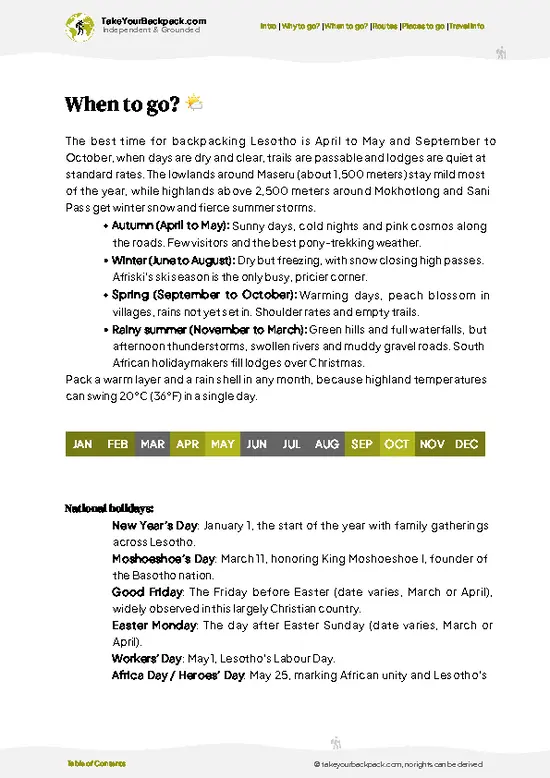
Best months: September to November and March to May are the best months for exploring regions in Lesotho, because days are mild and dry, roughly 15 to 25°C in the highlands, and the grass is green or golden rather than buried in snow or mud. Spring brings wildflowers and the smell of warming earth; autumn gives crisp, clear light.
Summer and winter: December to February is the rainy season, with most of the roughly 700 to 1,000 mm of annual rain falling in afternoon storms that turn tracks to slick clay and swell river crossings. Lowland days can pass 30°C. June to August is cold and dry, with highland nights well below freezing, frozen puddles and snow on the high passes, sometimes closing roads. Accommodation prices barely shift by season, but winter brings the fewest visitors, and highland lodges may run on reduced services.

region hoppingTips for Visiting Multiple Destinations

Trip length: A trip combining several regions in Lesotho needs 7 to 12 days, because travel eats far more time than the map suggests. Start in the lowlands near Maseru, where buses and taxis are frequent, then work upward into the mountains, finishing in the remote highlands so you are not racing a long ride back.
Pacing and transport: Plan 2 to 3 nights per stop, and allow 3 to 6 hours between regions. Minibus taxis leave only when full, often by early morning, and thin out by afternoon. Gravel roads and weather add hours, especially in the summer storms.
Common mistakes: Travelers try to cover too many stops in a week, count on afternoon departures and forget rivers can block roads after rain. Fewer stops, buffer days and early starts solve all three.

The ListThe Best regions of Lesotho

1 Tsoelike Valley

River gorge rim, rondavel hamlets, herders’ ridges, self-reliant walking

Follow footpaths between thatched hamlets and along the gorge rim, where shepherds graze the ridges and the Senqu runs warm below.

2 Maloti Mountains

Basalt passes, pony treks, waterfalls, high-altitude snow

Ride Basotho ponies between stone-hut villages, then climb gravel switchbacks to waterfalls, a dam wall and winter slopes above the clouds.

Loading the map 🌍

Expert viewInsights from Locals and Experts

How many regions: Two regions is the number I advise for a one-week trip, three for ten days or more. Roads are slow, taxis fill at their own pace, and a third stop usually means a day spent bouncing on a gravel seat instead of walking. Two stops let you actually settle into the thin air, the smell of dung-fire smoke at dusk and the quiet.
Choosing a kind: Hikers and pony trekkers should put the high mountains first: you get days of empty ridgelines, village hospitality and star-heavy nights. Travelers with limited time or who dislike rough rides do better in the lowlands, where tarred roads, shops and cash machines make life simple and you still see cliffs, sandstone and village markets. Culture-focused travelers can blend the two, since herding life is visible everywhere.
Costs: Budget about … read more 👉
How many regions: Two regions is the number I advise for a one-week trip, three for ten days or more. Roads are slow, taxis fill at their own pace, and a third stop usually means a day spent bouncing on a gravel seat instead of walking. Two stops let you actually settle into the thin air, the smell of dung-fire smoke at dusk and the quiet.
Choosing a kind: Hikers and pony trekkers should put the high mountains first: you get days of empty ridgelines, village hospitality and star-heavy nights. Travelers with limited time or who dislike rough rides do better in the lowlands, where tarred roads, shops and cash machines make life simple and you still see cliffs, sandstone and village markets. Culture-focused travelers can blend the two, since herding life is visible everywhere.
Costs: Budget about US$30 to 50 a day (roughly M550 to 900) if you use shared taxis, village homestays or basic lodges and cook some meals. Guides and ponies run about US$15 to 30 a day each, park or site fees are usually a few dollars, and minibus rides cost roughly US$2 to 10 per leg. Mountain lodges with meals cost more, around US$60 to 100, but the warm fire and hot dinner after a cold ridge are worth it.
Safety and culture: Weather is the main danger: storms, whiteout fog and freezing nights arrive fast, so carry a waterproof layer and a warm one even in summer. Cash is scarce outside towns, so withdraw before heading up. Greet everyone you pass, ask before photographing herders, and keep to marked paths around fields. Avoid walking alone at night in Maseru. Hiring a local guide gives you safer route knowledge and a seat at someone’s table.

✈️ The backpacker research shortcutLesotho Travel Guide

An offline-friendly backpacking guide with optimized travel routes, ranked highlights, transport advice, and the best areas to stay.
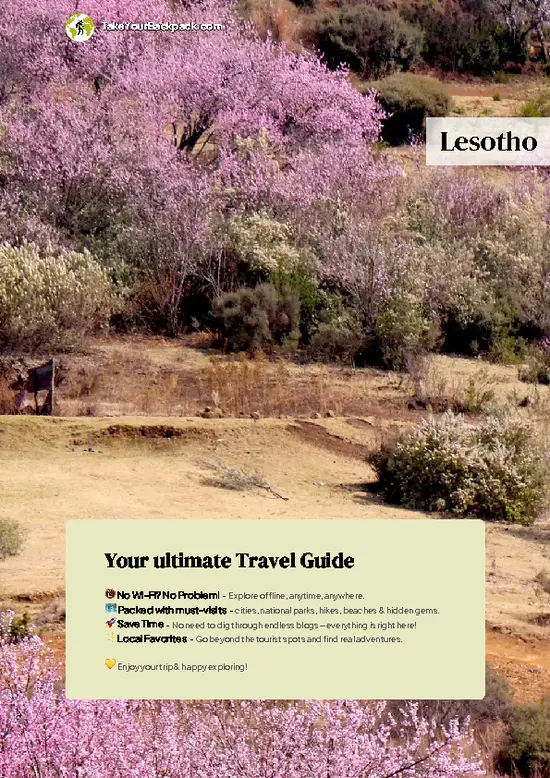
example page 0 from our offline Travel Guide for Lesotho
example page 1 from our offline Travel Guide for Lesotho
example page 2 from our offline Travel Guide for Lesotho
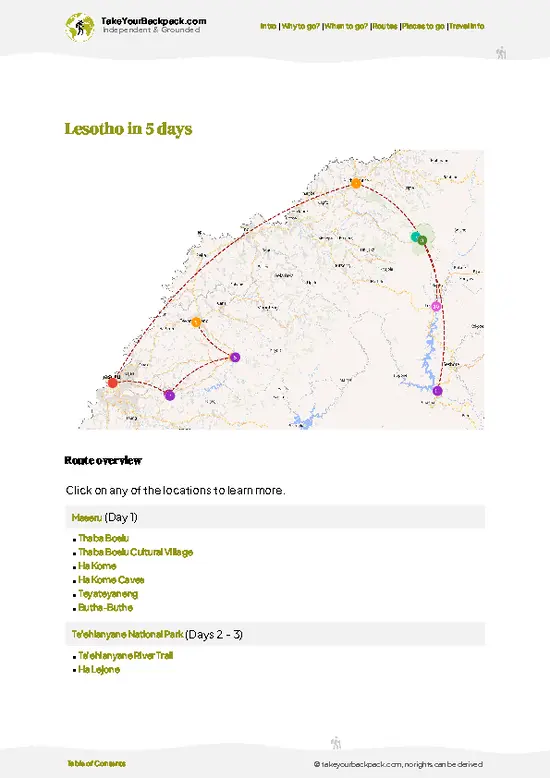
example page 3 from our offline Travel Guide for Lesotho
example page 4 from our offline Travel Guide for Lesotho
example page 5 from our offline Travel Guide for Lesotho
example page 6 from our offline Travel Guide for Lesotho
example page 7 from our offline Travel Guide for Lesotho
The digital guide (154 pages) contains:
✅ 35 highlights, ranked by travel appeal
✅ Optimized 2, 3 & 5-day travel routes
✅ Cities, national parks, landmarks, beaches
✅ How to get around
✅ Offline-friendly for travel without Wi-Fi
👉 Click to see all 30+ guide features

📅 Plan smarter in minutes, not weeks
✅ Month by month travel advice
✅ Festivals & national holidays
✅ Budget expectations

🗺️ Go to the right places, skip the overrated ones
✅ Honest pros & cons of destinations
✅ Top hikes, parks & viewpoints
✅ Lesser-known places most travelers miss
✅ Clear “worth it vs skip it” guidance

🛏️ Travel smoothly without rookie mistakes
✅ Best areas to stay
✅ Transport systems explained simply
✅ Common scams & safety advice
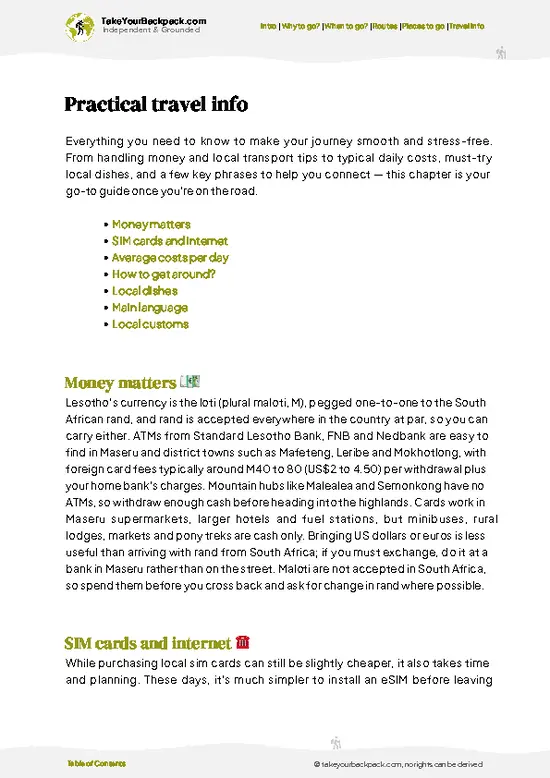
✅ SIM cards, money & practical tips

🌍 Understand the country, not just visit it
✅ Culture & traditions
✅ 52 Essential phrases & customs
✅ Festivals worth planning around
✅ Traveler-friendly historical context
✅ Insights that make places more meaningful

📱 Built for real travel conditions
✅ Fully downloadable PDF
✅ Works completely offline
✅ Optimized for phone use
✅ Useful in remote areas & buses
✅ Everything in one place
Stop searching, start planning
Get instant access to your full guide. 30‑day money-back guarantee.
+ Add another guide for just

By proceeding you agree to our terms.
Sent to your inbox immediately after payment • 100% Secure Checkout
Best Backpacking Travel Advisor 2025 tourism awardBest Backpacking
Travel Advisor
2025
What others say about Take Your Backpack Guides:
⭐⭐⭐⭐⭐
Fantastic, amazing amount of information!
⭐⭐⭐⭐⭐
My goodness this is amazing, it's what I've been looking for hats off too you!
⭐⭐⭐⭐⭐
I think this is absolutely BRILLIANT
⭐⭐⭐⭐
Very complete and informative. It's still missing places, but I gotta to commend you
⭐⭐⭐⭐⭐
This is truly amazing, thank you, can't wait to explore it with my kids!
⭐⭐⭐⭐⭐
Awesome resource, thank you!
⭐⭐⭐⭐⭐
This is amazing! Can't wait to explore the ones I haven't seen
⭐⭐⭐⭐
I love this! Well done, great idea.
⭐⭐⭐⭐⭐
Thanks for taking the time to make this gem!
⭐⭐⭐⭐⭐
This might be the best website I've ever seen.
⭐⭐⭐⭐⭐
Congratulations, and thank you so much for your work; it's incredibly valuable.
⭐⭐⭐⭐
In all seriousness I think you did a great job pointing out the important spots
⭐⭐⭐⭐⭐
10/10 very good
⭐⭐⭐⭐⭐
As someone who's only just starting to visit regularly this is awesome, thank you.
⭐⭐⭐⭐
Thank you very much! I'm going to visit my dad, it's going to be very useful!
⭐⭐⭐⭐⭐
This is really cool! We'll be travelling for the first time and this definitely come in handy.
⭐⭐⭐⭐⭐
You are now our minister of culture, congratulations 👨‍💼
⭐⭐⭐⭐⭐
Just wanted to tell you that this is a pearl! Going to follow your recommendations.
⭐⭐⭐⭐⭐
This is so cool. I'll definitely be using the resource for my travels soon.
⭐⭐⭐⭐⭐
This is very impressive! Good work.
⭐⭐⭐⭐⭐
This is an amazing and informative site. Very well done!

🛏️ Where to stay?Accommodation Highlights

Lesotho has very few true hostels, so budget travel here means backpacker lodges with dorms or camping (roughly M200 to 350, about US$11 to 19, for a bed) and simple guesthouses rather than party hostels. In Maseru, the city center around Kingsway puts you near minibus ranks, banks and the few bars but empties out and feels unsafe after dark, while Maseru West is quieter and safer with guesthouses near the embassies, though you will need taxis to get anywhere. The best-value stays sit outside the capital: Malealea and Semonkong have rustic mountain lodges right by pony trekking and hiking trails with zero nightlife, and Roma, a university town 35 km from Maseru, has calm, cheap lodging in a … read more 👉
Lesotho has very few true hostels, so budget travel here means backpacker lodges with dorms or camping (roughly M200 to 350, about US$11 to 19, for a bed) and simple guesthouses rather than party hostels. In Maseru, the city center around Kingsway puts you near minibus ranks, banks and the few bars but empties out and feels unsafe after dark, while Maseru West is quieter and safer with guesthouses near the embassies, though you will need taxis to get anywhere. The best-value stays sit outside the capital: Malealea and Semonkong have rustic mountain lodges right by pony trekking and hiking trails with zero nightlife, and Roma, a university town 35 km from Maseru, has calm, cheap lodging in a green valley.

If you enjoy meeting fellow travelers, consider choosing hostels with high ratings for atmosphere. On the other hand, if you prefer having your own space, a hotel might be a better option.

LesothoSee More of Lesotho

👋 Meet the founderWho’s Behind Take Your Backpack?

Johan, backpacker and founder of TakeYourBackpackHi, I’m Johan (Netherlands 🇳🇱), the creator of TakeYourBackpack. Over the past 3 decades, I’ve backpacked through 90+ countries across six continents, gaining extensive experience with independent travel, long-term trips, and overland routes.

This site is built on a combination of firsthand travel experience and carefully curated insights from other backpackers. Many guides are based on places I’ve personally visited, while others bring together tips, observations, and practical advice shared by trusted travelers I’ve met along the way.

The goal is to provide realistic, experience-driven guidance — not generic itineraries — so you can explore destinations with better context, clearer expectations, and more confidence.