×

Lesotho🇱🇸 | attractionsMorija Museum & ArchivesDinosaur tracks, Sesotho printing, mission archives, Moshoeshoe era | things to do and best time to go

Explore Thaba Bosiu Cultural VillageExplore Royal Palace, Maseru

Backpacking in Morija Museum & Archives
🌟 Highlightattraction ranked #3
By Johan Kruseman 🇳🇱 | Updated October 22, 2026

Behind the glass at Morija Museum & Archives, a Basotho hat sits near a rack of fossilized dinosaur bones, and the building smells of old paper and polished floorboards. Lesotho’s oldest and best-known museum stands in the village of Morija, south of Maseru, on the first mission station in the country. Crowds are not a problem. You may share the rooms with a school group or one or two other travelers, and the entry fee is small. The displays are modest, with handwritten labels, faded photographs and a few cramped rooms. What lifts it is the depth: Sesotho printing, King Moshoeshoe I’s era and the fossils all come from the surrounding hills. It is easy to reach by road, though public transport thins out in the afternoon. History readers and curious slow travelers will love it. If you want spectacle, thrills or polished interactive exhibits, you will find it too quiet.

Discover everything you want to know in the 📖 Lesotho Travel Guide.


example page 0 from our offline Travel Guide for Lesotho
example page 1 from our offline Travel Guide for Lesotho
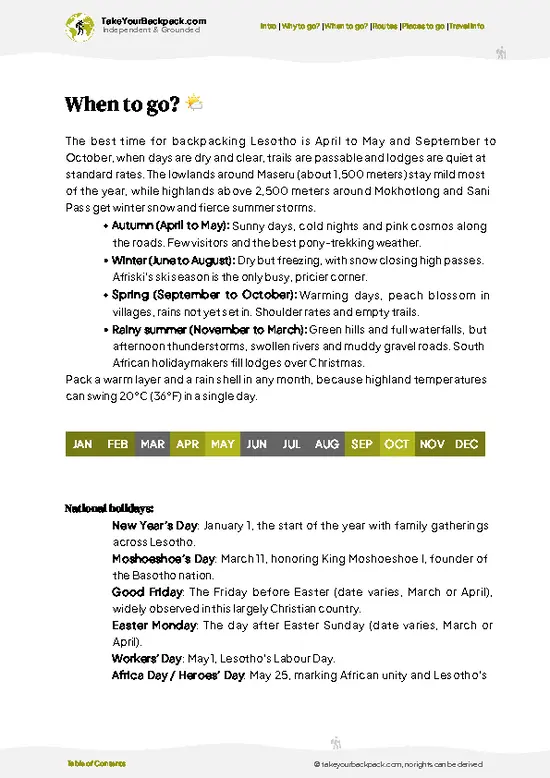
example page 2 from our offline Travel Guide for Lesotho
example page 3 from our offline Travel Guide for Lesotho
example page 4 from our offline Travel Guide for Lesotho
example page 5 from our offline Travel Guide for Lesotho
example page 6 from our offline Travel Guide for Lesotho
example page 7 from our offline Travel Guide for Lesotho
Loading the map 🌍
CLICK TO FILTER
cities
towns
villages
landmarks
national parks
hikes
attractions
festivals
regions
SHOW COUNTRY’S BESTSHOW ALL

✨ Why go?
Ranked #3 attraction in Lesotho
Why visitors keep coming back

Morija Museum & Archives is the clearest window into how the Basotho nation took shape, and nowhere else in Lesotho packs so much of that story under one roof. You can trace the arrival of the French missionaries in 1833, the printing of the first Sesotho books, and the diplomacy of Moshoeshoe I, all through objects and documents rather than a lecture.
The collection also reaches back much further than the mission era. Dinosaur fossils and footprints from the nearby sandstone show that the valley was crossed by animals long before any human arrived, and that gives the village a depth most trailheads in Lesotho cannot match.
On a route through the country, it works as a calm cultural anchor between Maseru and the highland trekking. After days of pony tracks and mountain passes, an hour among … read more 👉
Morija Museum & Archives is the clearest window into how the Basotho nation took shape, and nowhere else in Lesotho packs so much of that story under one roof. You can trace the arrival of the French missionaries in 1833, the printing of the first Sesotho books, and the diplomacy of Moshoeshoe I, all through objects and documents rather than a lecture.
The collection also reaches back much further than the mission era. Dinosaur fossils and footprints from the nearby sandstone show that the valley was crossed by animals long before any human arrived, and that gives the village a depth most trailheads in Lesotho cannot match.
On a route through the country, it works as a calm cultural anchor between Maseru and the highland trekking. After days of pony tracks and mountain passes, an hour among the mission archives makes the landscapes you walked through easier to read. It costs little, and it changes how you see the villages beyond.

💡 HighlightsKey sights and experiences for travelers

  1. Main museum galleries: The core exhibits cover Basotho life, Moshoeshoe I, mission history and the wars of the nineteenth century. Look for the blankets, hats, beadwork and household tools, which show how everyday objects carried meaning.
  2. Dinosaur fossils and footprints: The museum displays bones and track casts from the surrounding sandstone, and local guides can point out tracks on the rock itself. It is the sight that surprises people most, since few expect Jurassic-era creatures in a mission village.
  3. Morija Archives: The archive holds mission records, letters, photographs and early Sesotho texts. Researchers use it regularly, and casual visitors can often glimpse old handwriting and yellowed pages that tell the story first-hand.
  4. Morija Printing Works: Printing began in the village in the
… read more 👉
  1. Main museum galleries: The core exhibits cover Basotho life, Moshoeshoe I, mission history and the wars of the nineteenth century. Look for the blankets, hats, beadwork and household tools, which show how everyday objects carried meaning.
  2. Dinosaur fossils and footprints: The museum displays bones and track casts from the surrounding sandstone, and local guides can point out tracks on the rock itself. It is the sight that surprises people most, since few expect Jurassic-era creatures in a mission village.
  3. Morija Archives: The archive holds mission records, letters, photographs and early Sesotho texts. Researchers use it regularly, and casual visitors can often glimpse old handwriting and yellowed pages that tell the story first-hand.
  4. Morija Printing Works: Printing began in the village in the 1840s, and the printing tradition is still visible in the old presses and bound volumes. It explains how Sesotho became a written language.
  5. Morija Sesuto Book Depot: This bookshop sells Sesotho and English titles, including local history, and it is the best place in Lesotho for a meaningful souvenir.
  6. Morija Church and mission buildings: The stone church and the mission station around it show the original layout of the French settlement. Walk between them slowly, because the quiet and the old masonry do half the work.
  7. Morija Arts and Cultural Festival: Held in the village around early October, it brings music, dance, horse races and food stalls. If your dates line up, it turns the museum visit into a full cultural day.
Start with the main museum galleries, because the history they lay out makes everything else in the village, from the church to the printing works, mean more once you walk outside. Morija Museum & Archives rewards that order.
Spotted a mistake or missing something? Contact us.

Things to do near Morija Museum & Archives

Ratings based on Tripadvisor reviews. When you book through this link, you support our work at no extra cost to you.

🌤️ When to go?Seasonal considerations and timing

  • Summer (Oct to Mar): Days run 22 to 30°C (72 to 86°F), and afternoon thunderstorms roll in most days between December and February. Fields around Morija turn green, daylight stretches past 13 hours, and dirt roads can turn slick.
  • Autumn (Apr to May): Dry, clear days of 18 to 24°C (64 to 75°F) and cool nights near 5°C (41°F). Crowds are thin and the museum grounds are comfortable for long browsing.
  • Winter (Jun to Aug): Sunny days of 12 to 18°C (54 to 64°F), but nights drop below freezing. Daylight shrinks to about 10 hours. Snow can dust the high ranges, though Morija itself rarely sees it.
  • Festival Season: The Morija Arts and Cultural Festival usually fills the village in the dry months, around September or October, with music, horse racing and packed guesthouses. Prices for beds rise and need
… read more 👉
  • Summer (Oct to Mar): Days run 22 to 30°C (72 to 86°F), and afternoon thunderstorms roll in most days between December and February. Fields around Morija turn green, daylight stretches past 13 hours, and dirt roads can turn slick.
  • Autumn (Apr to May): Dry, clear days of 18 to 24°C (64 to 75°F) and cool nights near 5°C (41°F). Crowds are thin and the museum grounds are comfortable for long browsing.
  • Winter (Jun to Aug): Sunny days of 12 to 18°C (54 to 64°F), but nights drop below freezing. Daylight shrinks to about 10 hours. Snow can dust the high ranges, though Morija itself rarely sees it.
  • Festival Season: The Morija Arts and Cultural Festival usually fills the village in the dry months, around September or October, with music, horse racing and packed guesthouses. Prices for beds rise and need booking ahead.
  • Spring (Sep to Oct): Warming days of 17 to 26°C (63 to 79°F) and first rains.
Visit on a weekday in autumn for empty galleries and easy bargains on lodging.


source: climatestotravel.comJANJanuary: good for travelingFEBFebruary: highly recommended for travelingMARMarch: highly recommended for travelingAPRApril: highly recommended for travelingMAYMay: highly recommended for travelingJUNJune: fair for travelingJULJuly: fair for travelingAUGAugust: fair for travelingSEPSeptember: highly recommended for travelingOCTOctober: highly recommended for travelingNOVNovember: excellent for travelingDECDecember: good for traveling
lesotho-attraction-morija-museum-archives
© Google |

✈️ The backpacker research shortcutLesotho Travel Guide

An offline-friendly backpacking guide with optimized travel routes, ranked highlights, transport advice, and the best areas to stay.
example page 0 from our offline Travel Guide for Lesotho
example page 1 from our offline Travel Guide for Lesotho
example page 2 from our offline Travel Guide for Lesotho
example page 3 from our offline Travel Guide for Lesotho
example page 4 from our offline Travel Guide for Lesotho
example page 5 from our offline Travel Guide for Lesotho
example page 6 from our offline Travel Guide for Lesotho
example page 7 from our offline Travel Guide for Lesotho
The digital guide (154 pages) contains:
✅ 35 highlights, ranked by travel appeal
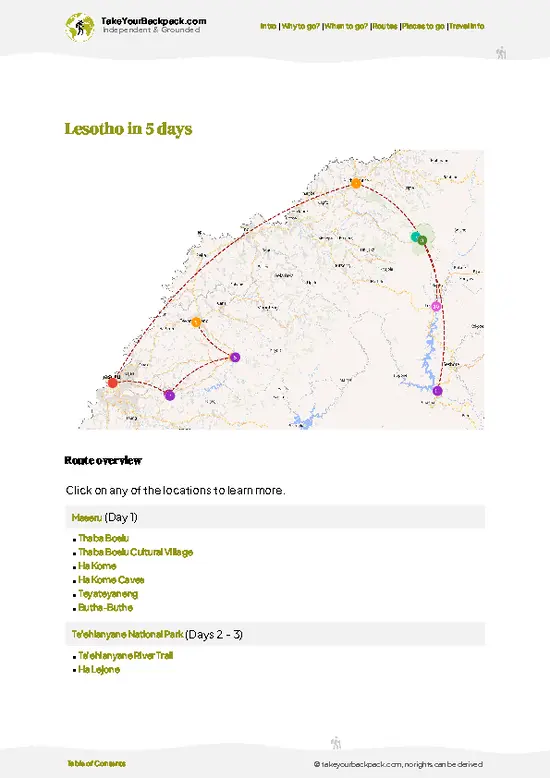
✅ Optimized 2, 3 & 5-day travel routes
✅ Cities, national parks, landmarks, beaches
✅ How to get around
✅ Offline-friendly for travel without Wi-Fi
👉 Click to see all 30+ guide features

📅 Plan smarter in minutes, not weeks
✅ Month by month travel advice
✅ Festivals & national holidays
✅ Budget expectations

🗺️ Go to the right places, skip the overrated ones
✅ Honest pros & cons of destinations
✅ Top hikes, parks & viewpoints
✅ Lesser-known places most travelers miss
✅ Clear “worth it vs skip it” guidance

🛏️ Travel smoothly without rookie mistakes
✅ Best areas to stay
✅ Transport systems explained simply
✅ Common scams & safety advice
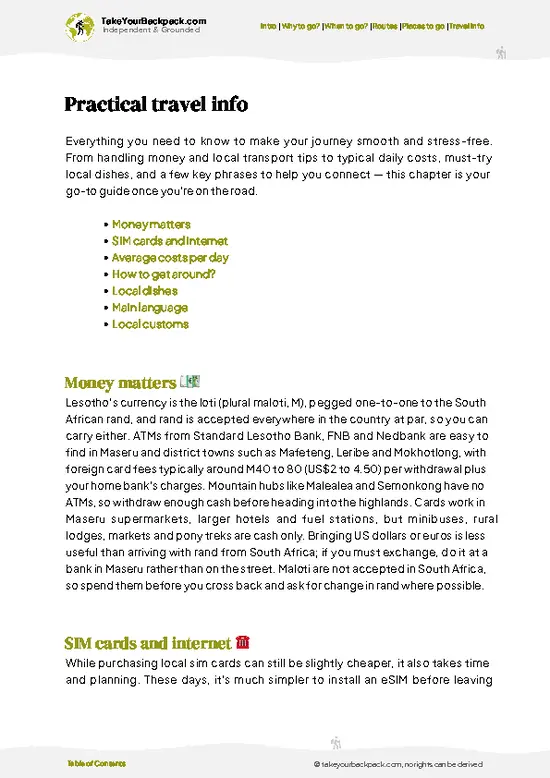
✅ SIM cards, money & practical tips

🌍 Understand the country, not just visit it
✅ Culture & traditions
✅ 52 Essential phrases & customs
✅ Festivals worth planning around
✅ Traveler-friendly historical context
✅ Insights that make places more meaningful

📱 Built for real travel conditions
✅ Fully downloadable PDF
✅ Works completely offline
✅ Optimized for phone use
✅ Useful in remote areas & buses
✅ Everything in one place
Stop searching, start planning
Get instant access to your full guide. 30‑day money-back guarantee.
+ Add another guide for just

By proceeding you agree to our terms.
Sent to your inbox immediately after payment • 100% Secure Checkout
Best Backpacking Travel Advisor 2025 tourism awardBest Backpacking
Travel Advisor
2025
What others say about Take Your Backpack Guides:
⭐⭐⭐⭐⭐
Fantastic, amazing amount of information!
⭐⭐⭐⭐⭐
My goodness this is amazing, it's what I've been looking for hats off too you!
⭐⭐⭐⭐⭐
I think this is absolutely BRILLIANT
⭐⭐⭐⭐
Very complete and informative. It's still missing places, but I gotta to commend you
⭐⭐⭐⭐⭐
This is truly amazing, thank you, can't wait to explore it with my kids!
⭐⭐⭐⭐⭐
Awesome resource, thank you!
⭐⭐⭐⭐⭐
This is amazing! Can't wait to explore the ones I haven't seen
⭐⭐⭐⭐
I love this! Well done, great idea.
⭐⭐⭐⭐⭐
Thanks for taking the time to make this gem!
⭐⭐⭐⭐⭐
This might be the best website I've ever seen.
⭐⭐⭐⭐⭐
Congratulations, and thank you so much for your work; it's incredibly valuable.
⭐⭐⭐⭐
In all seriousness I think you did a great job pointing out the important spots
⭐⭐⭐⭐⭐
10/10 very good
⭐⭐⭐⭐⭐
As someone who's only just starting to visit regularly this is awesome, thank you.
⭐⭐⭐⭐
Thank you very much! I'm going to visit my dad, it's going to be very useful!
⭐⭐⭐⭐⭐
This is really cool! We'll be travelling for the first time and this definitely come in handy.
⭐⭐⭐⭐⭐
You are now our minister of culture, congratulations 👨‍💼
⭐⭐⭐⭐⭐
Just wanted to tell you that this is a pearl! Going to follow your recommendations.
⭐⭐⭐⭐⭐
This is so cool. I'll definitely be using the resource for my travels soon.
⭐⭐⭐⭐⭐
This is very impressive! Good work.
⭐⭐⭐⭐⭐
This is an amazing and informative site. Very well done!

🛏️ Where to stay?Best areas and accommodation options

Stay in Morija village itself, because Morija Museum & Archives sits on the main road within a short walk of the guesthouses and the old mission buildings. The village is small, quiet and friendly, with people greeting you on the road, which makes it comfortable for solo travelers after dark in the early evening. Expect simple guesthouses, a few lodges and the occasional campsite or rondavel-style room, with dorm-style beds rare. Socializing happens over shared dinners at guesthouses rather than in bars, and you will meet researchers, church groups and hikers heading for the Maluti foothills. … read more 👉
Stay in Morija village itself, because Morija Museum & Archives sits on the main road within a short walk of the guesthouses and the old mission buildings. The village is small, quiet and friendly, with people greeting you on the road, which makes it comfortable for solo travelers after dark in the early evening. Expect simple guesthouses, a few lodges and the occasional campsite or rondavel-style room, with dorm-style beds rare. Socializing happens over shared dinners at guesthouses rather than in bars, and you will meet researchers, church groups and hikers heading for the Maluti foothills. Staying here lets you reach the museum at opening, walk to the Catholic and Protestant mission sites, and join local guides for dinosaur footprint visits nearby.
The alternative is Maseru, about 40 kilometers (25 miles) north, which has the widest choice of backpacker-friendly hostels and guesthouses, plus ATMs, supermarkets and the minibus taxi rank. Choose Maseru if you want nightlife and cheaper food, then travel to Morija for the day. For festival weekends, book Morija beds weeks ahead, or camp if the host allows it. Between rural trips, Roma, further east, suits those who want a university town atmosphere.

👛 Costs (as of 22 October 2026)What things cost and how to budget

Morija Museum & Archives can be done on roughly US$41 to 62 a day, including a village guesthouse, local meals and transport from Maseru. Entry itself is cheap. Pay in maloti, which is pegged to the South African rand, and carry small notes because card machines are unreliable in the village.
CategoryBudget RangeLocal Reality
Museum entryUS$1 to 3A small fee for adults, lower for students and children. Guided talks are usually available on request.
Accommodation (high season)US$25 to 40Guesthouse or lodge room in Morija, with prices rising during the arts festival. Camping costs less where offered.
Accommodation (low season)US$18 to 30Winter weekdays are quiet and rates are often negotiable.
Transport from MaseruUS$2 to 4 each wayShared minibus taxis run to Morija along the A2 and nearby roads,
… read more 👉
Morija Museum & Archives can be done on roughly US$41 to 62 a day, including a village guesthouse, local meals and transport from Maseru. Entry itself is cheap. Pay in maloti, which is pegged to the South African rand, and carry small notes because card machines are unreliable in the village.
CategoryBudget RangeLocal Reality
Museum entryUS$1 to 3A small fee for adults, lower for students and children. Guided talks are usually available on request.
Accommodation (high season)US$25 to 40Guesthouse or lodge room in Morija, with prices rising during the arts festival. Camping costs less where offered.
Accommodation (low season)US$18 to 30Winter weekdays are quiet and rates are often negotiable.
Transport from MaseruUS$2 to 4 each wayShared minibus taxis run to Morija along the A2 and nearby roads, with a short walk or local hop at the end.
FoodUS$8 to 15Simple meals of pap, stews and chicken at local spots, with guesthouse dinners costing more.
Guided extrasUS$5 to 15Local guides for dinosaur footprints or short village walks, priced per group.
Total Daily BudgetUS$41 to 62Based on high season accommodation, entry, transport, food and one guided extra.


source: morijamuseum.org
⚠️ Prices can change and everyone travels differently, so take this as a rough guide. Hope it helps you plan your adventure!

FAQFrequently asked questions about Morija Museum & Archives

Plan on 2 to 3 hours for Morija Museum & Archives itself, which covers Basotho history, missionary records, and archaeology and dinosaur displays. Add another 2 hours if you walk to the old mission buildings or hire a local guide for dinosaur footprints. Many backpackers stay one night in Morija to see everything calmly, particularly during the October festival period.
Morija Museum & Archives is worth the fee, which is only around US$1 to 3 for adults. You get the best collection on Basotho history in the country, including early printing press material, King Moshoeshoe-era records and fossils. Compared with entry prices in South Africa, nothing nearby gives this much depth for the money.
Reach Morija Museum & Archives by minibus taxi from Maseru, about 40 kilometers (25 miles) south, in roughly 1 hour for US$2 to 4. Taxis leave from the main rank when full, so go in the morning to avoid long waits. A rental car or private driver is faster, taking about 45 minutes on the paved road, and the museum is on the main village road.
⚠️ Things can change over time, so always validate details locally before you go.

Other Basotho attractions near Morija Museum & Archives

Explore more nearby:


💡 Not sure where to go next?
Create a personalized itinerary for Lesotho including Morija Museum & Archives and the places that fit your trip.

Generate my itinerary

👉 Discover all attractions

Or checkout all Lesotho has to offer (think cities, towns, villages, national parks, hikes, beaches, festivals)
Country photo of Lesotho

We 💚 feedbackIs it worth it?

Morija Museum & Archives fits well on a short loop south of Maseru, and I would pair it with a morning visit to Thaba Bosiu so the story of Moshoeshoe I runs from fortress to archive in one day. Bring cash for the bookshop, plan the visit before midday, and keep the late afternoon for an unhurried walk through the village.

✍️ Help improve this page!
The information on this page is based on in-depth research, insights shared by experienced travelers, and feedback from the local travel community in Lesotho. While every effort is made to keep the information accurate and current, conditions can change — so if you spot anything incorrect or outdated, please get in touch.


🙋‍♂️ Give feedback

👋 Meet the founderWho’s Behind Take Your Backpack?

Johan, backpacker and founder of TakeYourBackpackHi, I’m Johan (Netherlands 🇳🇱), the creator of TakeYourBackpack. Over the past 3 decades, I’ve backpacked through 90+ countries across six continents, gaining extensive experience with independent travel, long-term trips, and overland routes.

This site is built on a combination of firsthand travel experience and carefully curated insights from other backpackers. Many guides are based on places I’ve personally visited, while others bring together tips, observations, and practical advice shared by trusted travelers I’ve met along the way.

The goal is to provide realistic, experience-driven guidance — not generic itineraries — so you can explore destinations with better context, clearer expectations, and more confidence.