×

Lesotho🇱🇸 | national parksTs’ehlanyane National ParkNative cedar forest, roadless valleys, basalt river pools, vulture cliffs | things to do and best time to go

Explore Sehlabathebe National ParkExplore Maloti-Drakensberg Park

Backpacking in Ts’ehlanyane
🏆 Top picknational park ranked #1
By Johan Kruseman 🇳🇱 | Updated October 22, 2026

Ts’ehlanyane National Park has no shop, no restaurant and no fuel, so everything you eat for the stay has to arrive in your pack. It sits in the Maloti Mountains in the north of Lesotho, inland from the Hlotse and Butha-Buthe side, and the last stretch of road is rough gravel that slows every vehicle. That isolation is the appeal. You get cedar forest that smells of resin after rain, river water loud over basalt, and thin, cold air that bites at night even in summer. Wildlife is modest: grey rhebok, baboons, birds of prey wheeling over cliffs, and little of the big-animal drama. Crowds are almost absent, which means little help if a trail disappears in mist. Buy supplies in a town before you leave, carry a paper map, and pack a warm layer. A first day could be a slow walk along the river to a pool, lunch on a rock, and an early night in the tent.

Discover everything you want to know in the 📖 Lesotho Travel Guide.


example page 0 from our offline Travel Guide for Lesotho
example page 1 from our offline Travel Guide for Lesotho
example page 2 from our offline Travel Guide for Lesotho
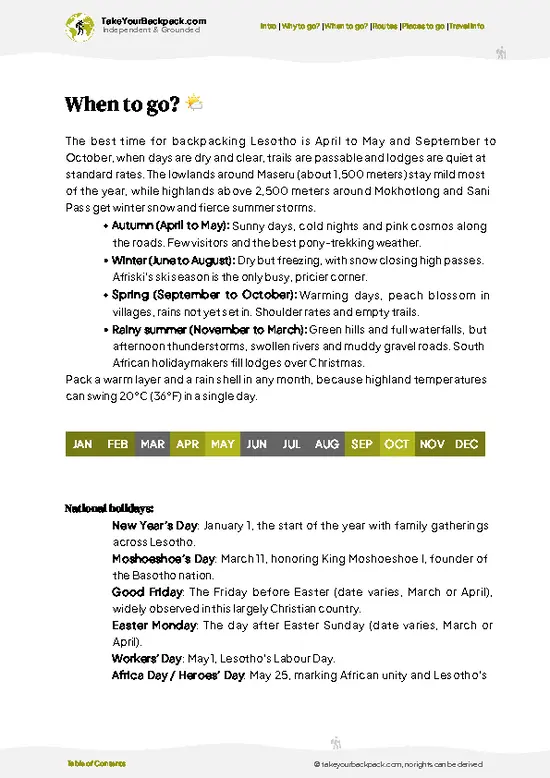
example page 3 from our offline Travel Guide for Lesotho
example page 4 from our offline Travel Guide for Lesotho
example page 5 from our offline Travel Guide for Lesotho
example page 6 from our offline Travel Guide for Lesotho
example page 7 from our offline Travel Guide for Lesotho
Loading the map 🌍
CLICK TO FILTER
cities
towns
villages
landmarks
national parks
hikes
attractions
festivals
regions
SHOW COUNTRY’S BESTSHOW ALL

✨ Why go?
Ranked #1 national park in Lesotho
What makes this national park worth exploring

Ts’ehlanyane National Park suits backpackers who like to walk without a guide and a schedule. The core attraction is a 5,600-hectare wilderness area in the Maloti range, where you can follow river valleys at your own pace, camp, and not see another group all day. It is quiet, cold at night and properly remote, so it pairs well with a backpack and a stove rather than a coach tour.
The second draw is the indigenous cedar forest, one of the few remaining stands of its kind in Lesotho. You walk under old, twisted trees on soft needle-covered ground, a texture you will not find on the open grassland plateaus elsewhere in the country. It is a short, easy way to feel the mountains without a big climb.
Finally, camping inside the park keeps things simple and cheap, and the river is your soundtrack. … read more 👉
Ts’ehlanyane National Park suits backpackers who like to walk without a guide and a schedule. The core attraction is a 5,600-hectare wilderness area in the Maloti range, where you can follow river valleys at your own pace, camp, and not see another group all day. It is quiet, cold at night and properly remote, so it pairs well with a backpack and a stove rather than a coach tour.
The second draw is the indigenous cedar forest, one of the few remaining stands of its kind in Lesotho. You walk under old, twisted trees on soft needle-covered ground, a texture you will not find on the open grassland plateaus elsewhere in the country. It is a short, easy way to feel the mountains without a big climb.
Finally, camping inside the park keeps things simple and cheap, and the river is your soundtrack. Guided pony trekking is available if you want a break from walking, but nothing forces you into a tour. Bring your own food, accept the basic setup, and you get a mountain stay that feels earned.

💡 HighlightsEssential experiences to have while exploring Ts’ehlanyane

  1. Indigenous cedar forest: The park’s best-known feature is a rare stand of native cedar, among the largest left in Lesotho. The bark is rough and the air under the canopy smells of resin, a sharp change from the bare plateau around it.
  2. Ts’ehlanyane River and rock pools: The river runs through the valley over basalt, forming cold pools that are good for a quick dip in warm months and for sitting beside with lunch.
  3. Wilderness area valleys: The undeveloped core of roughly 5,600 hectares has no roads. You walk, camp and read the terrain yourself, with grassy slopes, cliffs and side gorges.
  4. Bird watching: Cliffs above the valleys attract raptors, including bearded vultures and Cape vultures. Early morning on a ridge gives the best chance of seeing one gliding.
  5. Pony trekking: Basotho ponies are the local
… read more 👉
  1. Indigenous cedar forest: The park’s best-known feature is a rare stand of native cedar, among the largest left in Lesotho. The bark is rough and the air under the canopy smells of resin, a sharp change from the bare plateau around it.
  2. Ts’ehlanyane River and rock pools: The river runs through the valley over basalt, forming cold pools that are good for a quick dip in warm months and for sitting beside with lunch.
  3. Wilderness area valleys: The undeveloped core of roughly 5,600 hectares has no roads. You walk, camp and read the terrain yourself, with grassy slopes, cliffs and side gorges.
  4. Bird watching: Cliffs above the valleys attract raptors, including bearded vultures and Cape vultures. Early morning on a ridge gives the best chance of seeing one gliding.
  5. Pony trekking: Basotho ponies are the local way to cover steep ground. A ride through the valley is slower than a hike but gets you deeper into the high country with less effort.
  6. Maloti ridge viewpoints: Climbing out of the forest onto the open ridges reveals layered basalt ridgelines. Grey rhebok and baboons are the animals you are most likely to spot on the way.
Ts’ehlanyane National Park rewards you most if you start with the cedar forest, because it is close to the camp, easy on the legs, and shows you what makes the place different before you commit to a longer climb.
Spotted a mistake or missing something? Contact us.

Things to do near Ts’ehlanyane National Park

Ratings based on Tripadvisor reviews. When you book through this link, you support our work at no extra cost to you.

🌤️ When to go?Seasonal considerations and timing

  • Summer (November to March): Days run 20 to 28°C (68 to 82°F) with daylight stretching past 13 hours, and afternoon thunderstorms roll in often, so start hikes early. The indigenous forest and streams are at their greenest, and rivers can run high.
  • Autumn (April to May): Clear skies, highs of 15 to 22°C (59 to 72°F) and cool nights near 3 to 8°C (37 to 46°F). Crowds are thin and this is a steady window for multi-day walks.
  • Winter (June to August): Days reach 8 to 15°C (46 to 59°F) but nights drop well below freezing, and snow can dust the high ridges. Daylight shrinks to roughly 10 hours. Rates stay flat and you will often have the trails to yourself.
  • Spring (September to October): Highs of 14 to 24°C (57 to 75°F), wind on the ridges and the first wildflowers. Rain returns toward the end of the
… read more 👉
  • Summer (November to March): Days run 20 to 28°C (68 to 82°F) with daylight stretching past 13 hours, and afternoon thunderstorms roll in often, so start hikes early. The indigenous forest and streams are at their greenest, and rivers can run high.
  • Autumn (April to May): Clear skies, highs of 15 to 22°C (59 to 72°F) and cool nights near 3 to 8°C (37 to 46°F). Crowds are thin and this is a steady window for multi-day walks.
  • Winter (June to August): Days reach 8 to 15°C (46 to 59°F) but nights drop well below freezing, and snow can dust the high ridges. Daylight shrinks to roughly 10 hours. Rates stay flat and you will often have the trails to yourself.
  • Spring (September to October): Highs of 14 to 24°C (57 to 75°F), wind on the ridges and the first wildflowers. Rain returns toward the end of the season.
Weekends and South African school holidays (December and January, plus around Easter) fill the lodge and campsites, so book ahead or go midweek.


source: climatestotravel.comJANJanuary: excellent for travelingFEBFebruary: excellent for travelingMARMarch: excellent for travelingAPRApril: highly recommended for travelingMAYMay: fair for travelingJUNJune: below average for travelingJULJuly: below average for travelingAUGAugust: fair for travelingSEPSeptember: good for travelingOCTOctober: highly recommended for travelingNOVNovember: excellent for travelingDECDecember: highly recommended for traveling
lesotho-national-park-tsehlanyane-national-park
© Google |

✈️ The backpacker research shortcutLesotho Travel Guide

An offline-friendly backpacking guide with optimized travel routes, ranked highlights, transport advice, and the best areas to stay.
example page 0 from our offline Travel Guide for Lesotho
example page 1 from our offline Travel Guide for Lesotho
example page 2 from our offline Travel Guide for Lesotho
example page 3 from our offline Travel Guide for Lesotho
example page 4 from our offline Travel Guide for Lesotho
example page 5 from our offline Travel Guide for Lesotho
example page 6 from our offline Travel Guide for Lesotho
example page 7 from our offline Travel Guide for Lesotho
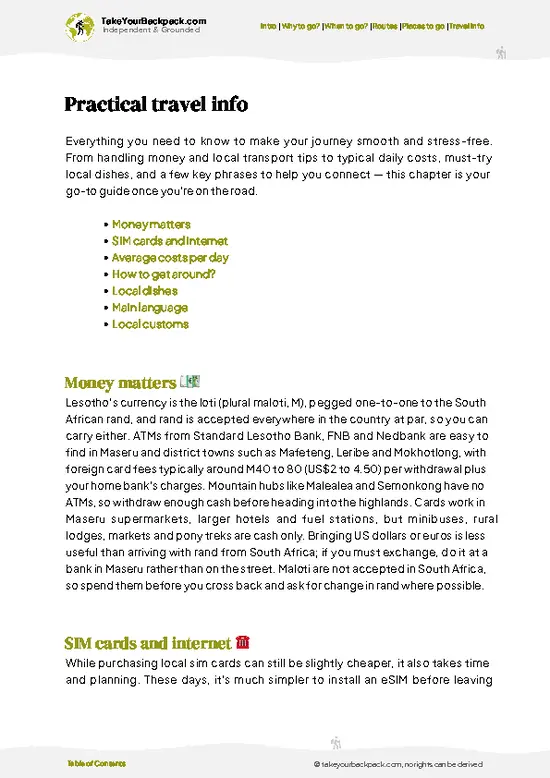
The digital guide (154 pages) contains:
✅ 35 highlights, ranked by travel appeal
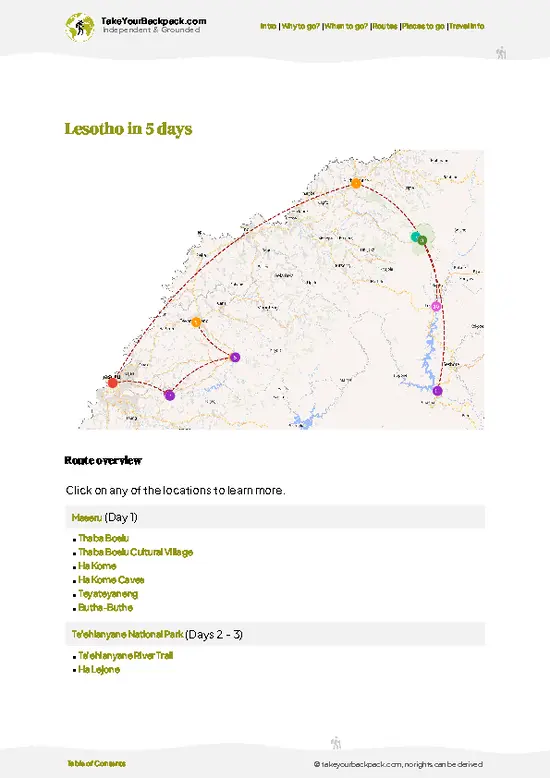
✅ Optimized 2, 3 & 5-day travel routes
✅ Cities, national parks, landmarks, beaches
✅ How to get around
✅ Offline-friendly for travel without Wi-Fi
👉 Click to see all 30+ guide features

📅 Plan smarter in minutes, not weeks
✅ Month by month travel advice
✅ Festivals & national holidays
✅ Budget expectations

🗺️ Go to the right places, skip the overrated ones
✅ Honest pros & cons of destinations
✅ Top hikes, parks & viewpoints
✅ Lesser-known places most travelers miss
✅ Clear “worth it vs skip it” guidance

🛏️ Travel smoothly without rookie mistakes
✅ Best areas to stay
✅ Transport systems explained simply
✅ Common scams & safety advice
✅ SIM cards, money & practical tips

🌍 Understand the country, not just visit it
✅ Culture & traditions
✅ 52 Essential phrases & customs
✅ Festivals worth planning around
✅ Traveler-friendly historical context
✅ Insights that make places more meaningful

📱 Built for real travel conditions
✅ Fully downloadable PDF
✅ Works completely offline
✅ Optimized for phone use
✅ Useful in remote areas & buses
✅ Everything in one place
Stop searching, start planning
Get instant access to your full guide. 30‑day money-back guarantee.
+ Add another guide for just

By proceeding you agree to our terms.
Sent to your inbox immediately after payment • 100% Secure Checkout
Best Backpacking Travel Advisor 2025 tourism awardBest Backpacking
Travel Advisor
2025
What others say about Take Your Backpack Guides:
⭐⭐⭐⭐⭐
Fantastic, amazing amount of information!
⭐⭐⭐⭐⭐
My goodness this is amazing, it's what I've been looking for hats off too you!
⭐⭐⭐⭐⭐
I think this is absolutely BRILLIANT
⭐⭐⭐⭐
Very complete and informative. It's still missing places, but I gotta to commend you
⭐⭐⭐⭐⭐
This is truly amazing, thank you, can't wait to explore it with my kids!
⭐⭐⭐⭐⭐
Awesome resource, thank you!
⭐⭐⭐⭐⭐
This is amazing! Can't wait to explore the ones I haven't seen
⭐⭐⭐⭐
I love this! Well done, great idea.
⭐⭐⭐⭐⭐
Thanks for taking the time to make this gem!
⭐⭐⭐⭐⭐
This might be the best website I've ever seen.
⭐⭐⭐⭐⭐
Congratulations, and thank you so much for your work; it's incredibly valuable.
⭐⭐⭐⭐
In all seriousness I think you did a great job pointing out the important spots
⭐⭐⭐⭐⭐
10/10 very good
⭐⭐⭐⭐⭐
As someone who's only just starting to visit regularly this is awesome, thank you.
⭐⭐⭐⭐
Thank you very much! I'm going to visit my dad, it's going to be very useful!
⭐⭐⭐⭐⭐
This is really cool! We'll be travelling for the first time and this definitely come in handy.
⭐⭐⭐⭐⭐
You are now our minister of culture, congratulations 👨‍💼
⭐⭐⭐⭐⭐
Just wanted to tell you that this is a pearl! Going to follow your recommendations.
⭐⭐⭐⭐⭐
This is so cool. I'll definitely be using the resource for my travels soon.
⭐⭐⭐⭐⭐
This is very impressive! Good work.
⭐⭐⭐⭐⭐
This is an amazing and informative site. Very well done!

🛏️ Where to stay?Choosing the right base

Ts’ehlanyane National Park has accommodation inside its boundaries, and that is where you should sleep. The main option is the Maliba-linked lodging area near the entrance, plus the park’s own self-catering chalets and a campsite beside the Tsehlanyane River, with prices of roughly US$10 to 20 for a tent pitch and US$55 to 100 for a chalet. The campsite has braai spots, ablutions and river noise at night, and it suits anyone carrying a tent and a stove. Bring your food, because there is no shop in the park.

For a long hike, the park runs basic mountain huts and designated wild-camping spots along … read more 👉
Ts’ehlanyane National Park has accommodation inside its boundaries, and that is where you should sleep. The main option is the Maliba-linked lodging area near the entrance, plus the park’s own self-catering chalets and a campsite beside the Tsehlanyane River, with prices of roughly US$10 to 20 for a tent pitch and US$55 to 100 for a chalet. The campsite has braai spots, ablutions and river noise at night, and it suits anyone carrying a tent and a stove. Bring your food, because there is no shop in the park.

For a long hike, the park runs basic mountain huts and designated wild-camping spots along the trails toward Bokong, so you can string together overnight stages. Check availability at the gate or through the Lesotho tourism authorities before you set out.

For supplies and a bed outside the park, the nearest town is Butha-Buthe, about 30 to 40 kilometers away, which has guesthouses at around US$25 to 50, small supermarkets, ATMs and the taxi rank for onward rides. Hlotse (Leribe) is a larger option further along the same road, with more shops and a few more guesthouses. Most backpackers stock up in Butha-Buthe, then head straight into the park and stay there.

👛 Costs (as of 22 October 2026)What things cost and how to budget

Ts’ehlanyane National Park costs a backpacker roughly US$48 to 72 per day, with camping and self-catered food keeping the total down. Everything is paid in Lesotho’s loti (or often South African rand), though the figures below are in US dollars.
CategoryBudget RangeLocal Reality
Entrance feeUS$3 to 6Charged per person at the gate, with a small extra for vehicles. Rates for non-residents are higher than for locals.
CampingUS$10 to 20A pitch by the river with basic ablutions. Low season is cheaper.
Chalet or lodge (high season)US$55 to 100Self-catering units that sleep several people, so splitting the price helps. Dorm-style options are rare.
Mountain hut or wild campingUS$5 to 12Basic overnight spots on the multi-day trail, usually paid at the gate or park office.
Food and suppliesUS$10 to 18Buy
… read more 👉
Ts’ehlanyane National Park costs a backpacker roughly US$48 to 72 per day, with camping and self-catered food keeping the total down. Everything is paid in Lesotho’s loti (or often South African rand), though the figures below are in US dollars.
CategoryBudget RangeLocal Reality
Entrance feeUS$3 to 6Charged per person at the gate, with a small extra for vehicles. Rates for non-residents are higher than for locals.
CampingUS$10 to 20A pitch by the river with basic ablutions. Low season is cheaper.
Chalet or lodge (high season)US$55 to 100Self-catering units that sleep several people, so splitting the price helps. Dorm-style options are rare.
Mountain hut or wild campingUS$5 to 12Basic overnight spots on the multi-day trail, usually paid at the gate or park office.
Food and suppliesUS$10 to 18Buy groceries in Butha-Buthe before you arrive, because the park has no shop. Cooking at camp keeps costs low.
Local transportUS$5 to 15Shared minibus taxis run from Butha-Buthe along the main road, but the final stretch to the gate often needs a negotiated ride or a hitch.
Guide or pony hireUS$15 to 30Optional, arranged locally. Useful for the higher routes and gives work to nearby villagers.
Total Daily BudgetUS$48 to 72Camping, self-catered meals and some transport. Chalets push the total much higher.
⚠️ Prices can change and everyone travels differently, so take this as a rough guide. Hope it helps you plan your adventure!

🥾 TrailsScenic routes and wildlife spotting in Ts’ehlanyane

Ts’ehlanyane National Park protects a steep, forested slice of the Maloti Mountains in northern Lesotho, and its walking splits into short valley strolls and long, committed backcountry routes. The terrain is the main character: indigenous Leucosidea and Widdringtonia (Clanwilliam cedar) pockets in the gorges, open grassland above, and basalt cliffs that funnel the Tsehlanyane River downstream. Wildlife is modest in size but easy to spot. Expect Cape grey mongoose, rock hyrax, baboons, eland on high ground, and raptors such as bearded vultures and Cape vultures riding the thermals.
  • Pools and Waterfall
… read more 👉
Ts’ehlanyane National Park protects a steep, forested slice of the Maloti Mountains in northern Lesotho, and its walking splits into short valley strolls and long, committed backcountry routes. The terrain is the main character: indigenous Leucosidea and Widdringtonia (Clanwilliam cedar) pockets in the gorges, open grassland above, and basalt cliffs that funnel the Tsehlanyane River downstream. Wildlife is modest in size but easy to spot. Expect Cape grey mongoose, rock hyrax, baboons, eland on high ground, and raptors such as bearded vultures and Cape vultures riding the thermals.
  • Pools and Waterfall Walk: Roughly 5 to 8 km round trip, 2 to 3 hours, easy to moderate. The path follows the river through boulders and scrub to cold swimming pools and small cascades. Footing is rocky in places, and river crossings can get tricky after rain.
  • Cedar Forest Trail: Around 6 to 10 km, 3 to 4 hours, moderate. It climbs through one of the few stands of wild Clanwilliam cedar in the region, with resinous shade and sharp views down the valley.
  • Pony and Horse Treks: Guided half-day and multi-day rides on Basotho ponies reach the high plateau and village-side tracks. Good for tired knees and steep terrain.
  • Ha Mohale and Ha Lejone Backcountry Route: Multi-day, hard, 2 to 4 days depending on your line. It crosses high ridges toward Bokong and Afriski side country with basic camping, little shade and fast-changing weather. A local guide is strongly advised.
Trail marking can be sparse above the tree line, so download an offline map and carry a paper one if available. Mist rolls in quickly on the ridges, and summer afternoons bring thunderstorms, so start early. Winter nights drop below freezing and snow can close the high passes.
Getting to Ts’ehlanyane National Park is easiest with your own wheels, since the gravel entrance road leaves the tarred Main North road near Butha-Buthe. Minibus taxis run along the main road, and from the junction you can arrange a lift or walk the rest with patience. Crowds are rare. On weekdays you may share the valley with only a few other visitors. An entrance fee applies, payable in maloti at the gate, and the staff there can book guides and ponies.
⚠️ Hiking info can sometimes be outdated or inaccurate. Before you hit the trail, check the latest conditions with locals. If you do spot anything that's off, I'd love to hear from you, so I can update it for fellow travelers.

🛡️ SafetySafety Tips and Common Scams in Ts’ehlanyane

Ts’ehlanyane National Park is a calm, well-managed place to hike, and the main hazards are weather and footing rather than people or animals. Afternoon thunderstorms in summer are common on the exposed ridges, so get up high in the morning and descend before the clouds stack up. Winter nights fall below freezing at altitude, and a proper sleeping bag, warm layers and a windproof shell matter more than any gadget. Trails climb steeply in places, with loose rock and a few stream crossings that swell after rain. Wait for the water to drop rather than forcing a crossing. Marking can be faint on the higher routes, so carry an offline map and a compass. Wildlife is limited to baboons, small antelope and birds such as the bearded vulture, none of which cause trouble if you keep food sealed and your … read more 👉
Ts’ehlanyane National Park is a calm, well-managed place to hike, and the main hazards are weather and footing rather than people or animals. Afternoon thunderstorms in summer are common on the exposed ridges, so get up high in the morning and descend before the clouds stack up. Winter nights fall below freezing at altitude, and a proper sleeping bag, warm layers and a windproof shell matter more than any gadget. Trails climb steeply in places, with loose rock and a few stream crossings that swell after rain. Wait for the water to drop rather than forcing a crossing. Marking can be faint on the higher routes, so carry an offline map and a compass. Wildlife is limited to baboons, small antelope and birds such as the bearded vulture, none of which cause trouble if you keep food sealed and your distance. Cell signal vanishes quickly, so tell the park office your route and expected return, and carry water treatment and sun protection, since the UV at 2,000 meters and above is strong.

FAQCommon questions from travelers

Two to three days is enough to cover Ts’ehlanyane National Park well, while a full multi-day trek toward Bokong takes four to five days. A single day gives you time for the river walks and the indigenous forest near the entrance, which sits around 2,000 meters above sea level. Add an extra night if you plan to reach the higher ridges or want a rest day by the campsite.
Reaching Ts’ehlanyane National Park without a car is possible but slow. Minibus taxis run from Maseru to Butha-Buthe (about 2.5 to 3 hours), and from there you need a local taxi or a negotiated ride for the remaining 30 to 40 kilometers to the gate. Hitching is common in Lesotho, and the park’s chalets and campsite can sometimes help arrange a pickup if you contact them ahead.
Yes, Ts’ehlanyane National Park charges an entrance fee, generally in the range of US$3 to 6 per person, with a small extra for vehicles. Overnight stays in the campsite, chalets or mountain huts are paid separately, and wild camping on the trail needs registration at the gate. No special hiking permit beyond the park fees is usually required, but sign the register and give your route to the staff before heading up.
⚠️ Things can change over time, so always validate details locally before you go.

Other Basotho national parks near Ts’ehlanyane

Explore more nearby:


💡 Not sure where to go next?
Create a personalized itinerary for Lesotho including Ts’ehlanyane and the places that fit your trip.

Generate my itinerary

👉 Discover all national parks

Or checkout all Lesotho has to offer (think cities, towns, villages, national parks, hikes, beaches, festivals)
Country photo of Lesotho

We 💚 feedbackIs it worth it?

Ts’ehlanyane National Park needs two nights at minimum, since the road in is slow and the first evening disappears into setting up camp. Three nights lets you do one long ridge day, one easy forest and river day, and a rest day. Stay longer only if you carry enough food. I would pack a proper warm sleeping bag and fill the car or pack with groceries before leaving town.

✍️ Help improve this page!
The information on this page is based on in-depth research, insights shared by experienced travelers, and feedback from the local travel community in Lesotho. While every effort is made to keep the information accurate and current, conditions can change — so if you spot anything incorrect or outdated, please get in touch.


🙋‍♂️ Give feedback

👋 Meet the founderWho’s Behind Take Your Backpack?

Johan, backpacker and founder of TakeYourBackpackHi, I’m Johan (Netherlands 🇳🇱), the creator of TakeYourBackpack. Over the past 3 decades, I’ve backpacked through 90+ countries across six continents, gaining extensive experience with independent travel, long-term trips, and overland routes.

This site is built on a combination of firsthand travel experience and carefully curated insights from other backpackers. Many guides are based on places I’ve personally visited, while others bring together tips, observations, and practical advice shared by trusted travelers I’ve met along the way.

The goal is to provide realistic, experience-driven guidance — not generic itineraries — so you can explore destinations with better context, clearer expectations, and more confidence.