×

Lesotho🇱🇸 | national parksBokong Nature ReserveLepaqoa Falls, 3,000-meter pass, ice curtains, pony rides | things to do and best time to go

Explore Ts’ehlanyane River TrailExplore Sehlabathebe National Park

Backpacking in Bokong Nature Reserve
👍 Recommendednational park ranked #3
By Johan Kruseman 🇳🇱 | Updated October 22, 2026

Bokong sits at about 3,000 meters, making it one of the highest reserves in southern Africa, and the road up the Mafika Lisiu Pass is gravel in places. The reserve lies in the north of Lesotho, in the Maloti Mountains, northeast of the town of Butha-Buthe. Expect thin, cold air, wind that hums over grass, and the roar of the Lepaqoa waterfall dropping about 90 meters into a basalt gorge. Hikes are short or long, as you like, and pony trekking is on offer. Birders may spot bearded vultures and Cape vultures, plus sani-type mountain wildlife such as eland and rock hyrax in the quieter corners. The downsides: weather flips fast, so pack a windproof and rain layer even in summer, and carry cash because card machines are unreliable, so withdraw money in town before the climb. Transport is thin, so line up a lift or a hire car early to avoid waiting at the roadside. Arrive by mid-morning, walk to the waterfall viewpoint, then eat a packed lunch beside the stream while the afternoon cloud rolls in.

Discover everything you want to know in the 📖 Lesotho Travel Guide.


example page 0 from our offline Travel Guide for Lesotho
example page 1 from our offline Travel Guide for Lesotho
example page 2 from our offline Travel Guide for Lesotho
example page 3 from our offline Travel Guide for Lesotho
example page 4 from our offline Travel Guide for Lesotho
example page 5 from our offline Travel Guide for Lesotho
example page 6 from our offline Travel Guide for Lesotho
example page 7 from our offline Travel Guide for Lesotho
Loading the map 🌍
CLICK TO FILTER
cities
towns
villages
landmarks
national parks
hikes
attractions
festivals
regions
SHOW COUNTRY’S BESTSHOW ALL

✨ Why go?
Ranked #3 national park in Lesotho
Why visitors keep coming back

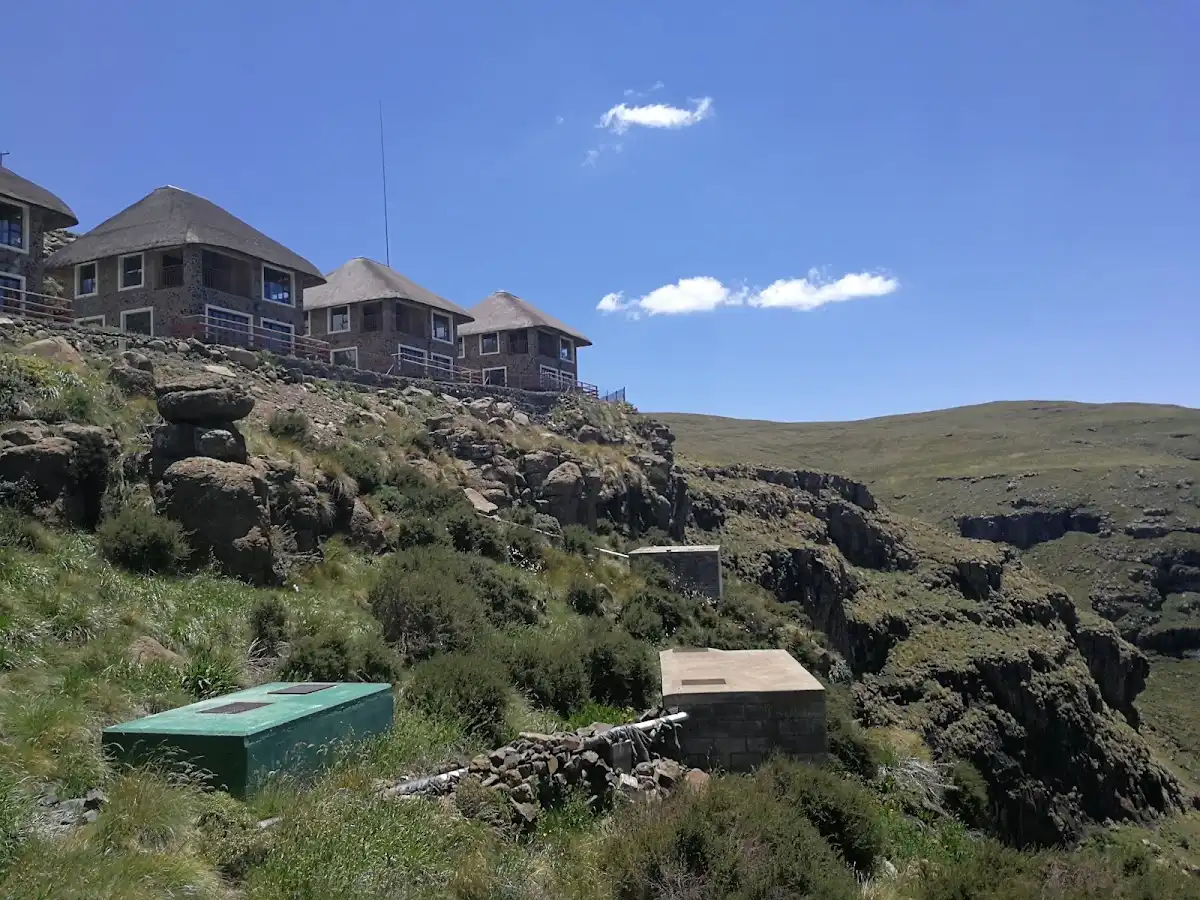
Bokong Nature Reserve suits self-guided hikers because the main trails are short, clearly worn paths that you can walk without a guide. The big draw is the Lepaqoa Falls, which freeze into ice columns in deep winter and thunder after summer rain. You get that sight a few hours from the border with no tour booking, which is rare in this part of the Maloti. The second reason is altitude. At roughly 3,000 meters you are walking in alpine grassland with wildflowers and sphagnum-like bogs, a landscape you will not find on the lowland hikes elsewhere in the country. Camping is simple and cheap, and the visitor center at the top of the pass, with its stone-and-thatch look, gives you a base to ask rangers about conditions. If you want a quiet, cold, big-sky mountain day without the crowds of South … read more 👉
Bokong Nature Reserve suits self-guided hikers because the main trails are short, clearly worn paths that you can walk without a guide. The big draw is the Lepaqoa Falls, which freeze into ice columns in deep winter and thunder after summer rain. You get that sight a few hours from the border with no tour booking, which is rare in this part of the Maloti. The second reason is altitude. At roughly 3,000 meters you are walking in alpine grassland with wildflowers and sphagnum-like bogs, a landscape you will not find on the lowland hikes elsewhere in the country. Camping is simple and cheap, and the visitor center at the top of the pass, with its stone-and-thatch look, gives you a base to ask rangers about conditions. If you want a quiet, cold, big-sky mountain day without the crowds of South Africa’s Drakensberg just across the border, this is where I would send you. Cloud and cold are the price, and they are part of the experience.

💡 HighlightsEssential experiences to have while exploring Bokong Nature Reserve

  1. Lepaqoa Waterfall: A drop of about 90 meters into a basalt gorge, reached on a short walk from the visitor center. It roars in summer and builds ice curtains in winter.
  2. Bokong Visitor Center: A thatched stone building at the pass, with exhibits on the area’s wildlife and a sweeping view across the highlands. Rangers here give trail advice.
  3. Pony trekking: Basotho ponies carry you along the ridges and down to the gorge edge. Rides run from an hour to a full day, and the ponies are sure-footed on steep, loose ground.
  4. Bearded vulture sightings: These huge scavengers glide along the cliff faces, and the reserve is one of the better places in southern Africa to see them. Bring binoculars.
  5. Alpine wetlands: Boggy meadows full of mosses and small flowers feed the streams. Boardwalks and stepping stones
… read more 👉
  1. Lepaqoa Waterfall: A drop of about 90 meters into a basalt gorge, reached on a short walk from the visitor center. It roars in summer and builds ice curtains in winter.
  2. Bokong Visitor Center: A thatched stone building at the pass, with exhibits on the area’s wildlife and a sweeping view across the highlands. Rangers here give trail advice.
  3. Pony trekking: Basotho ponies carry you along the ridges and down to the gorge edge. Rides run from an hour to a full day, and the ponies are sure-footed on steep, loose ground.
  4. Bearded vulture sightings: These huge scavengers glide along the cliff faces, and the reserve is one of the better places in southern Africa to see them. Bring binoculars.
  5. Alpine wetlands: Boggy meadows full of mosses and small flowers feed the streams. Boardwalks and stepping stones cross the wettest patches.
  6. Mafika Lisiu Pass views: The road to the reserve crosses one of the highest road passes in the country. Pull over at the viewpoints to see layers of ridgelines fading into haze.
  7. Mountain streams and gorges: Clear, cold water runs down from the heights, ideal for a rest stop. In dry weather you can hop across rocks to the far banks.
Bokong Nature Reserve can be covered in a full day, though a quick visit to the waterfall alone takes about two to three hours.
Spotted a mistake or missing something? Contact us.

Things to do near Bokong Nature Reserve

Ratings based on Tripadvisor reviews. When you book through this link, you support our work at no extra cost to you.

🌤️ When to go?Seasonal considerations and timing

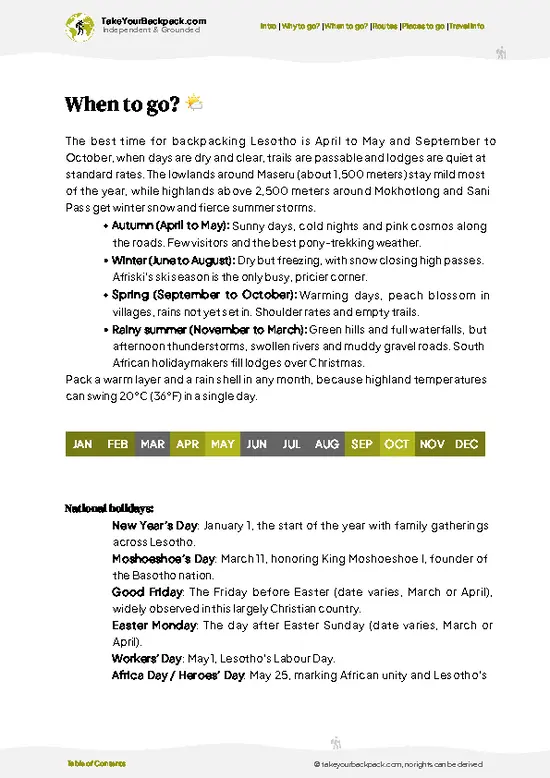
Bokong sits at about 3,000 meters on the Mafika Lisiu Pass road, so the best hiking window runs from roughly March to May and again from September to November.
  • Autumn (March to May): Clear skies, stable weather and daytime highs around 12 to 18°C (54 to 64°F). Nights drop toward 0°C (32°F) by May. Crowds are thin.
  • Winter (June to August): Cold and dry, with highs of 5 to 12°C (41 to 54°F) and nights down to -10°C (14°F). Snow can close the pass road, and the Lepaqoa waterfall often freezes into ice. Daylight is shortest, about 10 hours.
  • Spring (September to November): Warming days of 12 to 20°C (54 to 68°F), cold nights, and the first wildflowers. Wind can be strong.
  • Summer (December to February): Highs of 18 to 24°C (64 to 75°F), up to 14 hours of daylight, but afternoon thunderstorms and mist
… read more 👉
Bokong sits at about 3,000 meters on the Mafika Lisiu Pass road, so the best hiking window runs from roughly March to May and again from September to November.
  • Autumn (March to May): Clear skies, stable weather and daytime highs around 12 to 18°C (54 to 64°F). Nights drop toward 0°C (32°F) by May. Crowds are thin.
  • Winter (June to August): Cold and dry, with highs of 5 to 12°C (41 to 54°F) and nights down to -10°C (14°F). Snow can close the pass road, and the Lepaqoa waterfall often freezes into ice. Daylight is shortest, about 10 hours.
  • Spring (September to November): Warming days of 12 to 20°C (54 to 68°F), cold nights, and the first wildflowers. Wind can be strong.
  • Summer (December to February): Highs of 18 to 24°C (64 to 75°F), up to 14 hours of daylight, but afternoon thunderstorms and mist are frequent. Waterfall flow is at its fullest. Prices stay flat year-round, though South African school holidays bring more weekend traffic.
Arrive early in the day in any season, because storms and cloud build after midday.


source: climatestotravel.comJANJanuary: excellent for travelingFEBFebruary: excellent for travelingMARMarch: highly recommended for travelingAPRApril: highly recommended for travelingMAYMay: fair for travelingJUNJune: below average for travelingJULJuly: below average for travelingAUGAugust: below average for travelingSEPSeptember: fair for travelingOCTOctober: highly recommended for travelingNOVNovember: highly recommended for travelingDECDecember: excellent for traveling
lesotho-national-park-bokong-nature-reserve
© Google |

✈️ The backpacker research shortcutLesotho Travel Guide

An offline-friendly backpacking guide with optimized travel routes, ranked highlights, transport advice, and the best areas to stay.
example page 0 from our offline Travel Guide for Lesotho
example page 1 from our offline Travel Guide for Lesotho
example page 2 from our offline Travel Guide for Lesotho
example page 3 from our offline Travel Guide for Lesotho
example page 4 from our offline Travel Guide for Lesotho
example page 5 from our offline Travel Guide for Lesotho
example page 6 from our offline Travel Guide for Lesotho
example page 7 from our offline Travel Guide for Lesotho
The digital guide (154 pages) contains:
✅ 35 highlights, ranked by travel appeal
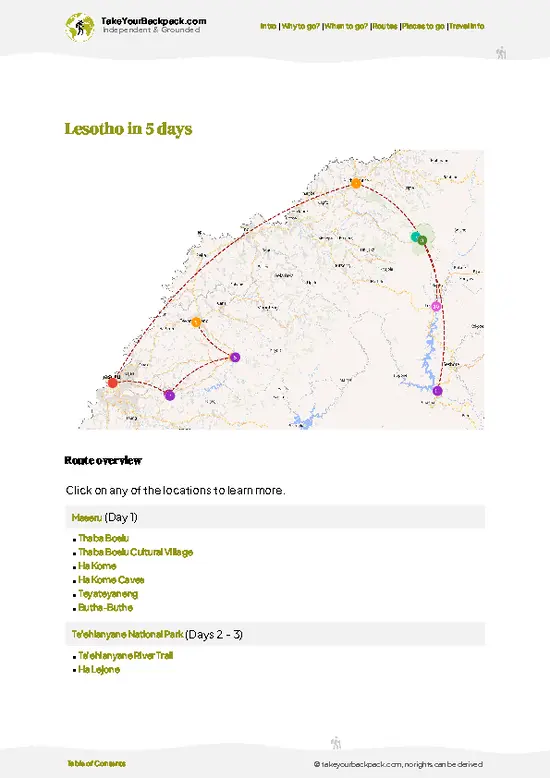
✅ Optimized 2, 3 & 5-day travel routes
✅ Cities, national parks, landmarks, beaches
✅ How to get around
✅ Offline-friendly for travel without Wi-Fi
👉 Click to see all 30+ guide features

📅 Plan smarter in minutes, not weeks
✅ Month by month travel advice
✅ Festivals & national holidays
✅ Budget expectations

🗺️ Go to the right places, skip the overrated ones
✅ Honest pros & cons of destinations
✅ Top hikes, parks & viewpoints
✅ Lesser-known places most travelers miss
✅ Clear “worth it vs skip it” guidance

🛏️ Travel smoothly without rookie mistakes
✅ Best areas to stay
✅ Transport systems explained simply
✅ Common scams & safety advice
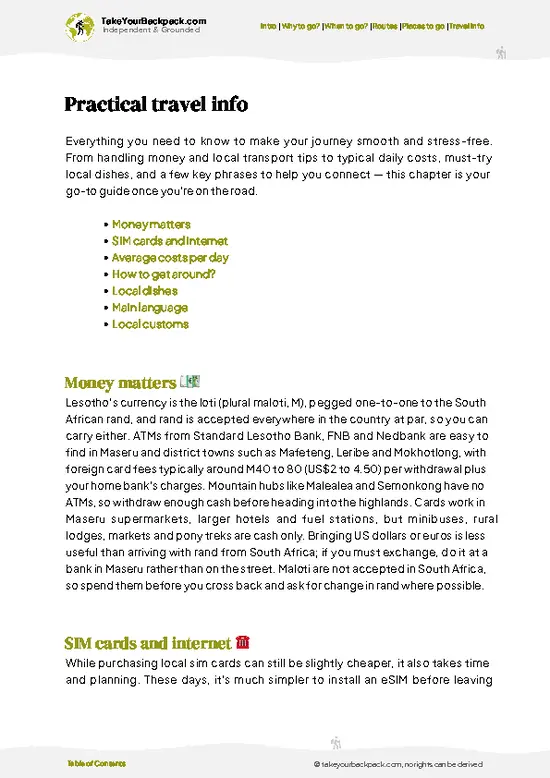
✅ SIM cards, money & practical tips

🌍 Understand the country, not just visit it
✅ Culture & traditions
✅ 52 Essential phrases & customs
✅ Festivals worth planning around
✅ Traveler-friendly historical context
✅ Insights that make places more meaningful

📱 Built for real travel conditions
✅ Fully downloadable PDF
✅ Works completely offline
✅ Optimized for phone use
✅ Useful in remote areas & buses
✅ Everything in one place
Stop searching, start planning
Get instant access to your full guide. 30‑day money-back guarantee.
+ Add another guide for just

By proceeding you agree to our terms.
Sent to your inbox immediately after payment • 100% Secure Checkout
Best Backpacking Travel Advisor 2025 tourism awardBest Backpacking
Travel Advisor
2025
What others say about Take Your Backpack Guides:
⭐⭐⭐⭐⭐
Fantastic, amazing amount of information!
⭐⭐⭐⭐⭐
My goodness this is amazing, it's what I've been looking for hats off too you!
⭐⭐⭐⭐⭐
I think this is absolutely BRILLIANT
⭐⭐⭐⭐
Very complete and informative. It's still missing places, but I gotta to commend you
⭐⭐⭐⭐⭐
This is truly amazing, thank you, can't wait to explore it with my kids!
⭐⭐⭐⭐⭐
Awesome resource, thank you!
⭐⭐⭐⭐⭐
This is amazing! Can't wait to explore the ones I haven't seen
⭐⭐⭐⭐
I love this! Well done, great idea.
⭐⭐⭐⭐⭐
Thanks for taking the time to make this gem!
⭐⭐⭐⭐⭐
This might be the best website I've ever seen.
⭐⭐⭐⭐⭐
Congratulations, and thank you so much for your work; it's incredibly valuable.
⭐⭐⭐⭐
In all seriousness I think you did a great job pointing out the important spots
⭐⭐⭐⭐⭐
10/10 very good
⭐⭐⭐⭐⭐
As someone who's only just starting to visit regularly this is awesome, thank you.
⭐⭐⭐⭐
Thank you very much! I'm going to visit my dad, it's going to be very useful!
⭐⭐⭐⭐⭐
This is really cool! We'll be travelling for the first time and this definitely come in handy.
⭐⭐⭐⭐⭐
You are now our minister of culture, congratulations 👨‍💼
⭐⭐⭐⭐⭐
Just wanted to tell you that this is a pearl! Going to follow your recommendations.
⭐⭐⭐⭐⭐
This is so cool. I'll definitely be using the resource for my travels soon.
⭐⭐⭐⭐⭐
This is very impressive! Good work.
⭐⭐⭐⭐⭐
This is an amazing and informative site. Very well done!

🛏️ Where to stay?Best areas to stay in Lesotho

The best base is the Bokong Visitor Centre area itself, where the reserve runs its own lodge, rondavel-style chalets and a basic campsite. The lodge at the Bokong Visitor Centre sits right on the road at the top of the Mafika Lisiu Pass, so you can walk to the Lepaqoa waterfall and the gorge viewpoint without transport. Expect rooms and rondavels in the US$30 to 60 range, with camping around US$8 to 12 per person. Facilities are simple, nights are cold, and you should bring a warm sleeping bag even in summer. Book ahead for weekends in high season.
Pony trekking and guided hikes can be arranged … read more 👉
The best base is the Bokong Visitor Centre area itself, where the reserve runs its own lodge, rondavel-style chalets and a basic campsite. The lodge at the Bokong Visitor Centre sits right on the road at the top of the Mafika Lisiu Pass, so you can walk to the Lepaqoa waterfall and the gorge viewpoint without transport. Expect rooms and rondavels in the US$30 to 60 range, with camping around US$8 to 12 per person. Facilities are simple, nights are cold, and you should bring a warm sleeping bag even in summer. Book ahead for weekends in high season.
Pony trekking and guided hikes can be arranged on site, which saves you lining up a guide elsewhere.
For more choice, Butha-Buthe is the nearest town, roughly 50 kilometers west, with guesthouses at about US$25 to 50, a supermarket, banks, and minibus taxis. Katse and Mokhotlong lie further in either direction and work as stops on longer journeys through the highlands. Self-caterers should stock up in Butha-Buthe, since food at the reserve is limited. Dropping into Butha-Buthe each night adds a long cold drive, so staying at the reserve is the better call.

👛 Costs (as of 22 October 2026)Travel costs and budget guide for Bokong Nature Reserve

Bokong Nature Reserve costs roughly US$55 to 119 per day for a backpacker who sleeps at the reserve and cooks or eats simply.
CategoryBudget RangeLocal Reality
Entrance FeeUS$2 to 4Paid at the visitor centre gate, per person, in Lesotho currency or sometimes South African rand.
Accommodation (high season)US$30 to 60Rondavels and lodge rooms at the reserve. Camping is cheaper at about US$8 to 12 per person.
Local TransportUS$10 to 20Minibus taxis from Butha-Buthe toward Mokhotlong pass the reserve road. Pay extra if you need a drop at the gate.
Food and SuppliesUS$8 to 15The reserve has limited meals, so buy groceries in Butha-Buthe beforehand.
Guides and ActivitiesUS$5 to 20Guided hikes and pony rides are priced by duration and arranged on site.
Total Daily BudgetUS$55 to 119Lower end assumes camping
… read more 👉
Bokong Nature Reserve costs roughly US$55 to 119 per day for a backpacker who sleeps at the reserve and cooks or eats simply.
CategoryBudget RangeLocal Reality
Entrance FeeUS$2 to 4Paid at the visitor centre gate, per person, in Lesotho currency or sometimes South African rand.
Accommodation (high season)US$30 to 60Rondavels and lodge rooms at the reserve. Camping is cheaper at about US$8 to 12 per person.
Local TransportUS$10 to 20Minibus taxis from Butha-Buthe toward Mokhotlong pass the reserve road. Pay extra if you need a drop at the gate.
Food and SuppliesUS$8 to 15The reserve has limited meals, so buy groceries in Butha-Buthe beforehand.
Guides and ActivitiesUS$5 to 20Guided hikes and pony rides are priced by duration and arranged on site.
Total Daily BudgetUS$55 to 119Lower end assumes camping and self-catering. Carry cash since cards are unreliable.
⚠️ Prices can change and everyone travels differently, so take this as a rough guide. Hope it helps you plan your adventure!

🥾 TrailsBest hikes in Bokong Nature Reserve national park

Bokong Nature Reserve offers short, accessible walks that start near the visitor center and wander across high grassland, with longer pony-assisted routes for those who want more. Terrain is open and exposed, with rocky paths, boggy patches and a few steep drops near the gorge edge. Weather changes quickly at this height, so mist and cold wind can arrive within minutes.
  • Waterfall walk: The main path leads from the visitor center to a viewpoint above Lepaqoa Falls, roughly 1 to 2 hours return. Easy to moderate, with a rocky, uneven trail.
  • Gorge edge trail: A rougher route follows the rim of the gorge
… read more 👉
Bokong Nature Reserve offers short, accessible walks that start near the visitor center and wander across high grassland, with longer pony-assisted routes for those who want more. Terrain is open and exposed, with rocky paths, boggy patches and a few steep drops near the gorge edge. Weather changes quickly at this height, so mist and cold wind can arrive within minutes.
  • Waterfall walk: The main path leads from the visitor center to a viewpoint above Lepaqoa Falls, roughly 1 to 2 hours return. Easy to moderate, with a rocky, uneven trail.
  • Gorge edge trail: A rougher route follows the rim of the gorge for views down into the basalt walls. Allow 2 to 3 hours, moderate difficulty, and keep well back from unstable edges.
  • Pony trek routes: Guided rides head across the ridges and meadows, from a one-hour loop to a day trip. Beginners are fine, since the ponies set their own pace.
  • Wildlife: Look for eland, rock hyrax, ground-nesting birds and the vultures that ride the updrafts.
Public transport to Bokong is limited. Minibus taxis run from Butha-Buthe toward Mokhotlong along the main road, and you can ask the driver to drop you at the reserve gate, but expect long waits for a ride back, so a hire car or an arranged lift is far easier. The reserve is usually quiet, with a few visitors on weekends and holidays. There is an entrance fee, paid at the gate in local currency, and it is small compared with South African parks. Bring warm layers, sun protection and enough water.
⚠️ Hiking info can sometimes be outdated or inaccurate. Before you hit the trail, check the latest conditions with locals. If you do spot anything that's off, I'd love to hear from you, so I can update it for fellow travelers.

🛡️ SafetyTraveler Safety Guide

Bokong Nature Reserve is straightforward and well managed, with the main risk being weather at high altitude. At about 3,000 meters, the air is thin enough that you may feel winded on the steps down to the waterfall and gorge. Walk slowly, drink water, and allow extra time on the return climb. Afternoon storms in summer bring lightning and fog, so start early and turn back when clouds darken. Winter nights are hard frost, and snow can make the pass road slippery, so check conditions before driving.
Trails are marked but rocky, and footing gets slick near the falls. Sturdy boots, layers, a rain shell, sun protection and plenty of water are the basics, since the UV is strong. Rangers at the visitor centre can point you to routes and arrange guides if you plan to go further.
Wildlife is mild: you … read more 👉
Bokong Nature Reserve is straightforward and well managed, with the main risk being weather at high altitude. At about 3,000 meters, the air is thin enough that you may feel winded on the steps down to the waterfall and gorge. Walk slowly, drink water, and allow extra time on the return climb. Afternoon storms in summer bring lightning and fog, so start early and turn back when clouds darken. Winter nights are hard frost, and snow can make the pass road slippery, so check conditions before driving.
Trails are marked but rocky, and footing gets slick near the falls. Sturdy boots, layers, a rain shell, sun protection and plenty of water are the basics, since the UV is strong. Rangers at the visitor centre can point you to routes and arrange guides if you plan to go further.
Wildlife is mild: you may see eland, baboons and the bearded vulture. Keep your distance and never feed animals. Carry cash, because card machines are unreliable out here.

FAQFrequently asked questions about Bokong Nature Reserve

One full day covers the highlights of Bokong Nature Reserve, but two days is better if you want to sleep at the reserve. The Lepaqoa waterfall and gorge viewpoint take about 2 to 4 hours, and a pony trek or longer hike fills another half day. Add a third day if you want to continue to Katse or Mokhotlong.
Yes, Bokong Nature Reserve can be reached without a car, though it takes patience. Minibus taxis run from Butha-Buthe along the mountain road toward Mokhotlong and can drop you at the entrance, roughly 1.5 to 2 hours depending on road and stops. Services thin out by afternoon, so travel early and plan to stay overnight at the lodge or campsite.
Yes, Bokong Nature Reserve charges a small entrance fee, usually around US$2 to 4 per person, paid at the visitor centre. No separate hiking permit is required for the main trails to the waterfall and viewpoints. Guides, pony rides and overnight stays cost extra, and cash is the safest way to pay.
⚠️ Things can change over time, so always validate details locally before you go.

Other Basotho national parks near Bokong Nature Reserve

Explore more nearby:


💡 Not sure where to go next?
Create a personalized itinerary for Lesotho including Bokong Nature Reserve and the places that fit your trip.

Generate my itinerary

👉 Discover all national parks

Or checkout all Lesotho has to offer (think cities, towns, villages, national parks, hikes, beaches, festivals)
Country photo of Lesotho

We 💚 feedbackIs it worth it?

Bokong Nature Reserve works best as a stop on the high route between Butha-Buthe and Katse, or on the road toward Mokhotlong and Sani Pass. I would pair it with Liphofung Cave Cultural Historical Site for a low-altitude counterpoint. Go early, carry a thick jacket even in summer, and leave the pony ride for a clear morning when the views open up.

✍️ Help improve this page!
The information on this page is based on in-depth research, insights shared by experienced travelers, and feedback from the local travel community in Lesotho. While every effort is made to keep the information accurate and current, conditions can change — so if you spot anything incorrect or outdated, please get in touch.


🙋‍♂️ Give feedback

👋 Meet the founderWho’s Behind Take Your Backpack?

Johan, backpacker and founder of TakeYourBackpackHi, I’m Johan (Netherlands 🇳🇱), the creator of TakeYourBackpack. Over the past 3 decades, I’ve backpacked through 90+ countries across six continents, gaining extensive experience with independent travel, long-term trips, and overland routes.

This site is built on a combination of firsthand travel experience and carefully curated insights from other backpackers. Many guides are based on places I’ve personally visited, while others bring together tips, observations, and practical advice shared by trusted travelers I’ve met along the way.

The goal is to provide realistic, experience-driven guidance — not generic itineraries — so you can explore destinations with better context, clearer expectations, and more confidence.