×

Liberia🇱🇷 | national parksMarshall WetlandsTidal creeks, reed-bed birds, river mouth, low-tide mudflats | things to do and best time to go

Explore Lofa-Mano National ParkExplore Bomi Hills

Backpacking in Marshall Wetlands
👀 For curious travelersnational park ranked #5
By Johan Kruseman 🇳🇱 | Updated October 22, 2026

Marshall Wetlands is a Ramsar-listed site, which means its mangroves and swamps are protected habitat, and that shapes how you visit. It lies in Liberia, on the coast southeast of Monrovia near Marshall, along the Farmington and Du rivers' mouths. Expect brackish water the color of weak tea, mud that grips boots, and the rattle of weaver birds over reeds. Paths here are not formal trails, so locals with canoes are the real transport, and an experienced traveler hires one for the day instead of trying to walk. Birdlife and mangrove channels are the draw; big wildlife is shy and tours are few. Facilities are thin because the area sees few visitors, so bring water and snacks. A first day could mean a morning paddle through the channels with a guide, a lunch of grilled fish in a nearby village, and an afternoon watching waders at low tide.

Discover everything you want to know in the 📖 Liberia Travel Guide.


example page 0 from our offline Travel Guide for Liberia
example page 1 from our offline Travel Guide for Liberia
example page 2 from our offline Travel Guide for Liberia
example page 3 from our offline Travel Guide for Liberia
example page 4 from our offline Travel Guide for Liberia
example page 5 from our offline Travel Guide for Liberia
example page 6 from our offline Travel Guide for Liberia
example page 7 from our offline Travel Guide for Liberia
Loading the map 🌍
CLICK TO FILTER
cities
towns
landmarks
national parks
hikes
beaches
attractions
festivals
regions
SHOW COUNTRY’S BESTSHOW ALL

✨ Why go?
Ranked #5 national park in Liberia
Why visitors keep coming back

Marshall Wetlands suits people who like to arrange things themselves, because there is no ticket office, no fixed itinerary and no tour queue. You find a local canoe paddler, agree on a route and set the pace. That freedom is the main reason to come, and it costs little compared with organized trips elsewhere in West Africa.
The second reason is the birdlife. The Ramsar-listed mangrove and swamp system shelters herons, egrets, kingfishers and migrants that stop over on the Atlantic flyway. Early morning on the water is when they feed, and the light is soft enough for photography without a long lens.
The third is contrast with the capital. Within a short ride you swap traffic for quiet tidal channels and villages where fishing shapes the day. Self-guided travelers who can handle basic logistics … read more 👉
Marshall Wetlands suits people who like to arrange things themselves, because there is no ticket office, no fixed itinerary and no tour queue. You find a local canoe paddler, agree on a route and set the pace. That freedom is the main reason to come, and it costs little compared with organized trips elsewhere in West Africa.
The second reason is the birdlife. The Ramsar-listed mangrove and swamp system shelters herons, egrets, kingfishers and migrants that stop over on the Atlantic flyway. Early morning on the water is when they feed, and the light is soft enough for photography without a long lens.
The third is contrast with the capital. Within a short ride you swap traffic for quiet tidal channels and villages where fishing shapes the day. Self-guided travelers who can handle basic logistics and a lack of signage will find it far more rewarding than a quick guided visit.

💡 HighlightsEssential experiences to have while exploring Marshall Wetlands

  1. Mangrove channels by canoe: The signature experience. Narrow tidal creeks lined with red mangrove roots, quiet enough to hear fish splash and branches creak.
  2. Birdwatching at the reed beds: Herons, egrets, kingfishers and weavers gather along the edges, with the best activity at dawn.
  3. Farmington River mouth: A wide brackish stretch where river meets Atlantic, good for open views and passing waders.
  4. Marshall fishing villages: Smoke racks, drying nets and wooden canoes show how people use the wetland daily. Buy fish straight from the boats.
  5. Low-tide mudflats: When water drops, shorebirds probe the mud and crabs scuttle among the roots. The smell is salty and sulfurous, and entirely natural.
  6. Atlantic beach at the coast edge: A long sandy strip with Atlantic surf, handy for a walk after the swamp heat.
… read more 👉
  1. Mangrove channels by canoe: The signature experience. Narrow tidal creeks lined with red mangrove roots, quiet enough to hear fish splash and branches creak.
  2. Birdwatching at the reed beds: Herons, egrets, kingfishers and weavers gather along the edges, with the best activity at dawn.
  3. Farmington River mouth: A wide brackish stretch where river meets Atlantic, good for open views and passing waders.
  4. Marshall fishing villages: Smoke racks, drying nets and wooden canoes show how people use the wetland daily. Buy fish straight from the boats.
  5. Low-tide mudflats: When water drops, shorebirds probe the mud and crabs scuttle among the roots. The smell is salty and sulfurous, and entirely natural.
  6. Atlantic beach at the coast edge: A long sandy strip with Atlantic surf, handy for a walk after the swamp heat.
The canoe paddle and the fishing villages combine well in one day, with the boat in the cool morning and a village meal at midday.
Spotted a mistake or missing something? Contact us.

🌤️ When to go?Best time to explore Marshall Wetlands

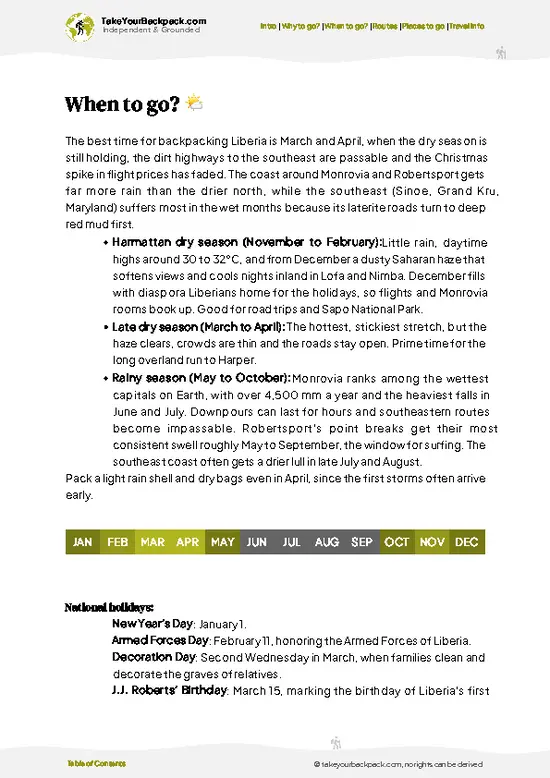
  • Dry Season (November to April): Expect 24 to 33°C (75 to 91°F), with the least rain and the easiest access along the Monrovia-Harbel road. Birdwatching from the marsh edges is at its most comfortable, and mud stays minimal.
  • Early Rains (May to June): Heat eases slightly to 23 to 31°C (73 to 88°F) as downpours build. Migratory activity drops, but water levels rise and the wetland looks lush.
  • Peak Rains (July to October): Monrovia area gets some of the heaviest rainfall in West Africa, often over 400 mm a month. Tracks flood, boat trips get canceled, and humidity stays high. Guesthouse rates may dip slightly.
  • Migratory Birds (November to March): Waders and shorebirds from Europe arrive, and weekend visitors from Monrovia are the main crowds.
Daylight stays close to twelve hours all year, so plan … read more 👉
  • Dry Season (November to April): Expect 24 to 33°C (75 to 91°F), with the least rain and the easiest access along the Monrovia-Harbel road. Birdwatching from the marsh edges is at its most comfortable, and mud stays minimal.
  • Early Rains (May to June): Heat eases slightly to 23 to 31°C (73 to 88°F) as downpours build. Migratory activity drops, but water levels rise and the wetland looks lush.
  • Peak Rains (July to October): Monrovia area gets some of the heaviest rainfall in West Africa, often over 400 mm a month. Tracks flood, boat trips get canceled, and humidity stays high. Guesthouse rates may dip slightly.
  • Migratory Birds (November to March): Waders and shorebirds from Europe arrive, and weekend visitors from Monrovia are the main crowds.
Daylight stays close to twelve hours all year, so plan to finish by mid-afternoon.
Go on a weekday morning in January or February for dry paths and quiet marsh.


source: climatestotravel.comJANJanuary: excellent for travelingFEBFebruary: excellent for travelingMARMarch: excellent for travelingAPRApril: highly recommended for travelingMAYMay: fair for travelingJUNJune: below average for travelingJULJuly: below average for travelingAUGAugust: below average for travelingSEPSeptember: fair for travelingOCTOctober: fair for travelingNOVNovember: highly recommended for travelingDECDecember: excellent for traveling
when-to-go

✈️ The backpacker research shortcutLiberia Travel Guide

An offline-friendly backpacking guide with optimized travel routes, ranked highlights, transport advice, and the best areas to stay.
example page 0 from our offline Travel Guide for Liberia
example page 1 from our offline Travel Guide for Liberia
example page 2 from our offline Travel Guide for Liberia
example page 3 from our offline Travel Guide for Liberia
example page 4 from our offline Travel Guide for Liberia
example page 5 from our offline Travel Guide for Liberia
example page 6 from our offline Travel Guide for Liberia
example page 7 from our offline Travel Guide for Liberia
The digital guide (211 pages) contains:
✅ 49 highlights, ranked by travel appeal
✅ Optimized 5, 10 & 15-day travel routes
✅ Cities, national parks, landmarks, beaches
✅ How to get around
✅ Offline-friendly for travel without Wi-Fi
👉 Click to see all 30+ guide features

📅 Plan smarter in minutes, not weeks
✅ Month by month travel advice
✅ Festivals & national holidays
✅ Budget expectations

🗺️ Go to the right places, skip the overrated ones
✅ Honest pros & cons of destinations
✅ Top hikes, parks & viewpoints
✅ Lesser-known places most travelers miss
✅ Clear “worth it vs skip it” guidance

🛏️ Travel smoothly without rookie mistakes
✅ Best areas to stay
✅ Transport systems explained simply
✅ Common scams & safety advice
✅ SIM cards, money & practical tips

🌍 Understand the country, not just visit it
✅ Culture & traditions
✅ Local customs
✅ Festivals worth planning around
✅ Traveler-friendly historical context
✅ Insights that make places more meaningful

📱 Built for real travel conditions
✅ Fully downloadable PDF
✅ Works completely offline
✅ Optimized for phone use
✅ Useful in remote areas & buses
✅ Everything in one place
Stop searching, start planning
Get instant access to your full guide. 30‑day money-back guarantee.
+ Add another guide for just

By proceeding you agree to our terms.
Sent to your inbox immediately after payment • 100% Secure Checkout
Best Backpacking Travel Advisor 2025 tourism awardBest Backpacking
Travel Advisor
2025
What others say about Take Your Backpack Guides:
⭐⭐⭐⭐⭐
Fantastic, amazing amount of information!
⭐⭐⭐⭐⭐
My goodness this is amazing, it's what I've been looking for hats off too you!
⭐⭐⭐⭐⭐
I think this is absolutely BRILLIANT
⭐⭐⭐⭐
Very complete and informative. It's still missing places, but I gotta to commend you
⭐⭐⭐⭐⭐
This is truly amazing, thank you, can't wait to explore it with my kids!
⭐⭐⭐⭐⭐
Awesome resource, thank you!
⭐⭐⭐⭐⭐
This is amazing! Can't wait to explore the ones I haven't seen
⭐⭐⭐⭐
I love this! Well done, great idea.
⭐⭐⭐⭐⭐
Thanks for taking the time to make this gem!
⭐⭐⭐⭐⭐
This might be the best website I've ever seen.
⭐⭐⭐⭐⭐
Congratulations, and thank you so much for your work; it's incredibly valuable.
⭐⭐⭐⭐
In all seriousness I think you did a great job pointing out the important spots
⭐⭐⭐⭐⭐
10/10 very good
⭐⭐⭐⭐⭐
As someone who's only just starting to visit regularly this is awesome, thank you.
⭐⭐⭐⭐
Thank you very much! I'm going to visit my dad, it's going to be very useful!
⭐⭐⭐⭐⭐
This is really cool! We'll be travelling for the first time and this definitely come in handy.
⭐⭐⭐⭐⭐
You are now our minister of culture, congratulations 👨‍💼
⭐⭐⭐⭐⭐
Just wanted to tell you that this is a pearl! Going to follow your recommendations.
⭐⭐⭐⭐⭐
This is so cool. I'll definitely be using the resource for my travels soon.
⭐⭐⭐⭐⭐
This is very impressive! Good work.
⭐⭐⭐⭐⭐
This is an amazing and informative site. Very well done!

🛏️ Where to stay?Best areas and accommodation options

Most backpackers sleep in Monrovia, roughly 30 to 45 minutes by road from the wetlands depending on traffic. Marshall Wetlands has no formal lodging inside the protected area, so plan a day visit and return to the city by afternoon.
Monrovia has the widest choice. Sinkor is the most practical district, with guesthouses and small hotels at about US$25 to 60 a night, plus restaurants, ATMs and shared taxis within walking distance. Mamba Point sits closer to the embassies and costs more, typically US$80 to 150, with reliable generators and Wi-Fi. Central Monrovia is cheaper but noisier and less comfortable … read more 👉
Most backpackers sleep in Monrovia, roughly 30 to 45 minutes by road from the wetlands depending on traffic. Marshall Wetlands has no formal lodging inside the protected area, so plan a day visit and return to the city by afternoon.
Monrovia has the widest choice. Sinkor is the most practical district, with guesthouses and small hotels at about US$25 to 60 a night, plus restaurants, ATMs and shared taxis within walking distance. Mamba Point sits closer to the embassies and costs more, typically US$80 to 150, with reliable generators and Wi-Fi. Central Monrovia is cheaper but noisier and less comfortable after dark.
Closer to the wetlands, the Marshall and Harbel corridor has a few simple local guesthouses, often US$15 to 30, with basic rooms, fans and patchy power. They suit travelers who want an early start for birdwatching at dawn.
Book ahead in Monrovia during the dry season, when aid workers and business travelers fill mid-range rooms. Ask about generator hours and water supply before you pay. Bring cash in US dollars, since cards are rarely accepted outside the larger hotels.

👛 Costs (as of 22 October 2026)Typical daily expenses

Marshall Wetlands costs roughly US$53 to 110 a day for a backpacker based in Monrovia. Expect to pay in cash, and bring US dollars in small, undamaged bills.
CategoryBudget RangeLocal Reality
Entrance and GuideUS$5 to 15Fees are informal and vary. A local guide for a morning is often US$10 to 20.
Accommodation (high season)US$25 to 45Sinkor guesthouses with fans or air conditioning. Low season, rooms can drop to US$20 to 35.
Local TransportUS$8 to 20Shared taxis and motorbike taxis cost a few dollars each way. A private car for the day costs more.
Food and WaterUS$10 to 20Rice dishes at local cookshops cost US$3 to 6, while restaurants in Monrovia charge US$8 to 15.
Boat or ExtrasUS$5 to 10Small canoe trips depend on negotiation and water levels. Insect repellent and snacks add up.
Total Daily BudgetUS$53
… read more 👉
Marshall Wetlands costs roughly US$53 to 110 a day for a backpacker based in Monrovia. Expect to pay in cash, and bring US dollars in small, undamaged bills.
CategoryBudget RangeLocal Reality
Entrance and GuideUS$5 to 15Fees are informal and vary. A local guide for a morning is often US$10 to 20.
Accommodation (high season)US$25 to 45Sinkor guesthouses with fans or air conditioning. Low season, rooms can drop to US$20 to 35.
Local TransportUS$8 to 20Shared taxis and motorbike taxis cost a few dollars each way. A private car for the day costs more.
Food and WaterUS$10 to 20Rice dishes at local cookshops cost US$3 to 6, while restaurants in Monrovia charge US$8 to 15.
Boat or ExtrasUS$5 to 10Small canoe trips depend on negotiation and water levels. Insect repellent and snacks add up.
Total Daily BudgetUS$53 to 110Lower end with shared transport and local food, higher end with a private driver.
⚠️ Prices can change and everyone travels differently, so take this as a rough guide. Hope it helps you plan your adventure!

🥾 TrailsHiking Marshall Wetlands national park: highlights and difficulty

Marshall Wetlands has no formal, signed trail network, so the walks and paddles people actually do are informal and led by locals.
  • Canoe route through the mangroves: Starts from a village landing near Marshall and winds through tidal creeks for roughly two to four hours, depending on tide. Easy physically, but you sit still in the sun, so bring a hat.
  • Village and shoreline walk: A flat stroll along sandy tracks and edges of the reeds, passing fish-smoking racks and houses. About one to two hours at an easy pace.
  • Beach walk: Sand along the Atlantic side, flat and easy, with soft footing that tires
… read more 👉
Marshall Wetlands has no formal, signed trail network, so the walks and paddles people actually do are informal and led by locals.
  • Canoe route through the mangroves: Starts from a village landing near Marshall and winds through tidal creeks for roughly two to four hours, depending on tide. Easy physically, but you sit still in the sun, so bring a hat.
  • Village and shoreline walk: A flat stroll along sandy tracks and edges of the reeds, passing fish-smoking racks and houses. About one to two hours at an easy pace.
  • Beach walk: Sand along the Atlantic side, flat and easy, with soft footing that tires legs on longer stretches.
  • Birding at dawn: Short wanders along the marsh edge, where herons and kingfishers are active. Footing is muddy, so wear waterproof shoes or sandals you can lose.
Terrain is flat and wet. Mud, roots and standing water are constant, and insects are heavy at dusk, so cover up and carry repellent. Wildlife is mostly birds, crabs, mudskippers and fish. Larger animals are rarely seen.
Getting there is straightforward from Monrovia by shared taxi or minibus heading toward Marshall, then a motorbike or walk to the water. Roads can be rutted in heavy rain. Visitors are few, so you will probably have the channels to yourself. There is no formal entrance system, but expect to pay a small fee for a canoe and guide, agreed in advance and paid in cash.
⚠️ Hiking info can sometimes be outdated or inaccurate. Before you hit the trail, check the latest conditions with locals. If you do spot anything that's off, I'd love to hear from you, so I can update it for fellow travelers.

🛡️ SafetyTraveler Safety Guide

Marshall Wetlands is a low-risk, low-intensity destination, and the main hazards are heat, mud and mosquitoes. Wear closed shoes or rubber boots, since the marsh edges are soft and slippery after rain. Bring at least 2 liters of water per person, a hat, and strong repellent, and check with your doctor about malaria prophylaxis before arriving.
Trails are informal, so hire a local guide or ask nearby villagers for directions rather than relying on a phone map. Water levels shift quickly in the rainy season, and flooded tracks can hide holes.
Wildlife is mostly birds, fish and small reptiles. Keep your distance from snakes and avoid wading in stagnant water, which can carry parasites. Crocodiles may be present in some channels, so stay on dry ground.
Petty theft is the other risk. Carry only what … read more 👉
Marshall Wetlands is a low-risk, low-intensity destination, and the main hazards are heat, mud and mosquitoes. Wear closed shoes or rubber boots, since the marsh edges are soft and slippery after rain. Bring at least 2 liters of water per person, a hat, and strong repellent, and check with your doctor about malaria prophylaxis before arriving.
Trails are informal, so hire a local guide or ask nearby villagers for directions rather than relying on a phone map. Water levels shift quickly in the rainy season, and flooded tracks can hide holes.
Wildlife is mostly birds, fish and small reptiles. Keep your distance from snakes and avoid wading in stagnant water, which can carry parasites. Crocodiles may be present in some channels, so stay on dry ground.
Petty theft is the other risk. Carry only what you need, avoid walking alone at dusk, and be back in Monrovia before dark.

FAQTraveler FAQ

A single morning is enough for Marshall Wetlands, and a full day lets you add a second birdwatching session at dusk. Most backpackers go from Monrovia, which is roughly 30 to 45 minutes away by road. Staying two nights nearby only makes sense if you want dawn and dusk birding.
Yes, you can reach Marshall Wetlands without a car, but it takes some planning. Shared taxis run from Monrovia toward Marshall and Harbel for about US$2 to 5, and motorbike taxis cover the final stretch for US$2 to 4. A private driver for the day is more comfortable at roughly US$40 to 70.
Marshall Wetlands has no fixed entrance fee or permit system for casual visitors, though local communities may ask for a small contribution of about US$5 to 10. A guide for a morning typically costs US$10 to 20 and helps with access. Carry small US dollar bills, since change is rarely available.
⚠️ Things can change over time, so always validate details locally before you go.

Other Liberian national parks near Marshall Wetlands

Explore more nearby:


💡 Not sure where to go next?
Create a personalized itinerary for Liberia including Marshall Wetlands and the places that fit your trip.

Generate my itinerary

👉 Discover all national parks

Or checkout all Liberia has to offer (think cities, towns, villages, national parks, hikes, beaches, festivals)
Country photo of Liberia

We 💚 feedbackSumming up the experience

Marshall Wetlands works best as a single long day or one overnight, not a multi-day stop, because the channels reveal themselves in one good morning paddle. If you stay longer, I would add a second dawn for birds and then move on. Bring cash, water and bug spray.

✍️ Help improve this page!
The information on this page is based on in-depth research, insights shared by experienced travelers, and feedback from the local travel community in Liberia. While every effort is made to keep the information accurate and current, conditions can change — so if you spot anything incorrect or outdated, please get in touch.


🙋‍♂️ Give feedback

👋 Meet the founderWho’s Behind Take Your Backpack?

Johan, backpacker and founder of TakeYourBackpackHi, I’m Johan (Netherlands 🇳🇱), the creator of TakeYourBackpack. Over the past 3 decades, I’ve backpacked through 90+ countries across six continents, gaining extensive experience with independent travel, long-term trips, and overland routes.

This site is built on a combination of firsthand travel experience and carefully curated insights from other backpackers. Many guides are based on places I’ve personally visited, while others bring together tips, observations, and practical advice shared by trusted travelers I’ve met along the way.

The goal is to provide realistic, experience-driven guidance — not generic itineraries — so you can explore destinations with better context, clearer expectations, and more confidence.