v2.webp)
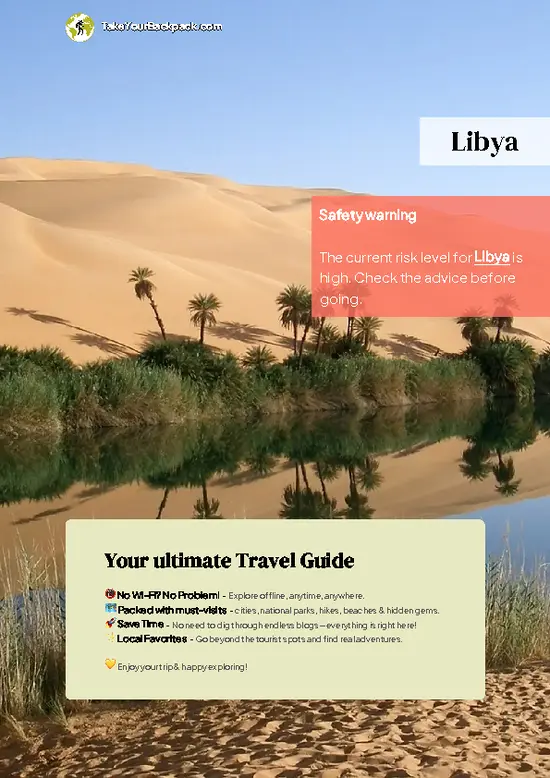
- Ghadames Old Town (the Medina) — The reason people come: a compact, UNESCO-listed mudbrick medina of narrow shaded alleys, courtyard homes and a living traditional layout that’s unusually intact. Walk it slowly; the whole quarter is the main attraction.
- Rooftop terraces and skyline walks — The flat roofs are public social space here. Climb up at sunset for a remarkable panorama of whitewashed houses, the palm oasis and the low desert beyond — an intimate way to read the town’s layout.
- Covered alley network — Those winding, low-ceilinged lanes aren’t just picturesque; they’re a centuries-old climatic solution. Walking them gives a visceral sense of how people adapted to Saharan heat and privacy rules — and they’re delightfully cool in midday.
- Traditional courtyard houses (interiors) —
- Ghadames Old Town (the Medina) — The reason people come: a compact, UNESCO-listed mudbrick medina of narrow shaded alleys, courtyard homes and a living traditional layout that’s unusually intact. Walk it slowly; the whole quarter is the main attraction.
- Rooftop terraces and skyline walks — The flat roofs are public social space here. Climb up at sunset for a remarkable panorama of whitewashed houses, the palm oasis and the low desert beyond — an intimate way to read the town’s layout.
- Covered alley network — Those winding, low-ceilinged lanes aren’t just picturesque; they’re a centuries-old climatic solution. Walking them gives a visceral sense of how people adapted to Saharan heat and privacy rules — and they’re delightfully cool in midday.
- Traditional courtyard houses (interiors) — Several family homes still show the painted walls, carved doors and internal layouts that define Ghadames architecture. When owners open them, you’ll see how rooms, light and privacy work together — much more meaningful than a photo.
- Great Mosque (Friday Mosque) — The mosque sits at the spiritual center of town. The exterior mudbrick form and quiet interior courtyards are worth seeing for both architecture and the peaceful atmosphere; remember to respect prayer times and local dress codes.
- Old Jewish quarter and synagogue remains — Ghadames had a historic Jewish community; the surviving quarter and its architectural traces (narrow lanes, a prayer-house structure) tell that lesser-known chapter of the town’s story. It’s a sensitive, tangible link to Ghadames’ multicultural past.
- Local souk and craft stalls — Small markets and family stalls sell dates, handwoven textiles, simple silver and everyday goods. It’s not a tourist mall — it’s where you meet makers, try local dates and pick up small, authentic souvenirs.
- Palm-grove oasis and irrigation channels — The village sits in an oasis; walking into the palm groves and seeing the traditional irrigation and date cultivation gives context to how the town survives in the desert. Great for a shaded stroll and conversation with farmers.
- Ghadames local museum — A modest municipal/museum space preserves traditional tools, costume and photographs that help stitch together what you see in the streets. It’s small but valuable for background before or after wandering the medina.
- City gates, watchpoints and defensive structures — Walk the edge of the old quarter to find surviving gates and lookout spots that explain how Ghadames controlled movement and protected the oasis. They’re practical, atmospheric and give good photo angles without being crowded.
Spotted a mistake or missing something? Contact us.

 Best Backpacking
.jpg) Hi, I’m Johan (Netherlands 🇳🇱), the creator of TakeYourBackpack. Over the past 3 decades, I’ve backpacked through 90+ countries across six continents, gaining extensive experience with independent travel, long-term trips, and overland routes.
Hi, I’m Johan (Netherlands 🇳🇱), the creator of TakeYourBackpack. Over the past 3 decades, I’ve backpacked through 90+ countries across six continents, gaining extensive experience with independent travel, long-term trips, and overland routes.