×

Luxembourg🇱🇺 | best villagesThe Must-See 5 villages in Luxembourg

Villages in Luxembourg sit in a country smaller than most US counties, so the differences come from landscape and rail access. The Ardennes-style Oesling in the north is wooded, quiet and slower to reach. The Moselle in the east is vineyard country with frequent buses. Mullerthal in the east offers sandstone trails. Independent travelers benefit because public transport is free nationwide.

By Johan Kruseman 🇳🇱 | Updated October 18, 2026
Explore the best landmarks in Luxembourg

Why go?Understanding Their Importance

Luxembourg suits villages because of compact geography and a free public transport network (buses, trains and trams, with only first class costing extra). Nearly everything lies within about 80 km north to south, so you can reach most places in under two hours. Three landscapes sit side by side: the forested, hilly Oesling in the north, the sandstone Gutland in the center and south, and the Moselle valley along the eastern border. Castles, a Franco-Germanic mix of architecture and a tri-lingual culture (Luxembourgish, French, German) shape what you see and hear. Know before you choose: bus frequency drops sharply in the Oesling and on Sundays, prices are among Europe’s highest, and many villages have few or no hostels, so plan sleeping logistics early.
Evaluating the Top Choices
The list of best villages in Luxembourg is created based on authenticity, scenic beauty, community spirit, traditions, and overall character. If you feel a village is missing in this list, please let us know.

When to go?Optimal Periods for Travel

Best months and why: May to September is best for villages in Luxembourg because daytime temperatures run about 17 to 24°C, daylight lasts until 9 or 10 pm in summer, and the trails and outdoor terraces are fully open. The Moselle wine villages peak from late August to October during harvest, when cellars and festivals are busiest. Shoulder seasons and winter: April and October are cooler, around 8 to 15°C, with lower accommodation prices and fewer visitors, but rain is frequent (roughly 60 to 80 mm a month). The Oesling in the north stays colder and wetter than the south, with frost and occasional snow from December to February. Many campsites, small museums and some seasonal cafés close from November to March, and hostel rates can fall by 10 to 25 percent. July and August are the busiest, … read more 👉
Best months and why: May to September is best for villages in Luxembourg because daytime temperatures run about 17 to 24°C, daylight lasts until 9 or 10 pm in summer, and the trails and outdoor terraces are fully open. The Moselle wine villages peak from late August to October during harvest, when cellars and festivals are busiest. Shoulder seasons and winter: April and October are cooler, around 8 to 15°C, with lower accommodation prices and fewer visitors, but rain is frequent (roughly 60 to 80 mm a month). The Oesling in the north stays colder and wetter than the south, with frost and occasional snow from December to February. Many campsites, small museums and some seasonal cafés close from November to March, and hostel rates can fall by 10 to 25 percent. July and August are the busiest, especially in Mullerthal and along the Moselle, so book beds ahead on weekends.

village hoppingOptimizing Your Multi-Stop Itinerary

How many days to allow: A trip combining several villages in Luxembourg needs 4 to 6 days, because buses, not distance, set the pace. Luxembourg City is the practical hub, with trains and buses reaching all regions. Group stops by region: Moselle in the east, Mullerthal in the east-center and the Oesling in the north. Moving from the Moselle through Mullerthal and then north works well because each leg is short, typically 45 to 90 minutes by bus with one change. Allow 2 to 4 hours per village, or a half day if you hike. Planning mistakes: Travelers often cram three villages into one day, then lose hours to waiting for infrequent buses, especially on Sundays and in the north. Check timetables on the mobility.lu app and base yourself in one or two bed hubs instead of moving every night. Another … read more 👉
How many days to allow: A trip combining several villages in Luxembourg needs 4 to 6 days, because buses, not distance, set the pace. Luxembourg City is the practical hub, with trains and buses reaching all regions. Group stops by region: Moselle in the east, Mullerthal in the east-center and the Oesling in the north. Moving from the Moselle through Mullerthal and then north works well because each leg is short, typically 45 to 90 minutes by bus with one change. Allow 2 to 4 hours per village, or a half day if you hike. Planning mistakes: Travelers often cram three villages into one day, then lose hours to waiting for infrequent buses, especially on Sundays and in the north. Check timetables on the mobility.lu app and base yourself in one or two bed hubs instead of moving every night. Another common error is returning to the capital between regions; connect through local hubs such as Echternach or Ettelbruck.

The ListMust-Visit villages in Luxembourg

1 Vianden

Medieval fortress, riverside promenade, hillside streets

Climb winding streets to a restored castle, stroll along the river, and discover layers of history in every corner of the old town.

luxembourg-city-vianden
© Google | Iet Goossens

2 Berdorf

Sandstone cliffs, forest trails, panoramic viewpoints

Hike through dense woodlands and dramatic rock formations, then pause at clifftop lookouts for far-reaching views across the Mullerthal landscape.

luxembourg-city-berdorf
© Google |

3 Schengen

Moselle riverbank, border markers, treaty monument

Stand at the meeting point of three countries, follow riverside paths, and reflect on the site where European borders were reshaped.

4 Kleinmacher

Moselle vineyards, wine cellars, riverside promenade

Sample local vintages in a small village where daily life revolves around grape harvests, river views, and relaxed evenings by the water.

5 Grund

riverside quarter, stone bridges, cliffside lanes

Descend into a low-lying neighborhood where narrow streets, water views, and steep paths reveal a different side of Luxembourg City.

luxembourg-city-grund
© Google |
Loading the map 🌍

Expert viewWhat You Should Know

How many villages to visit: Plan on 4 to 6 villages in total, with no more than two in a day. Buses thin out in rural areas, and each place rewards 2 to 4 hours of walking, a meal and a rest. Beyond six, you start repeating the same castle-and-church pattern. Prioritizing by travel style: Hikers should favor the Mullerthal and Oesling villages, where marked trails start at the edge of town. Wine and food travelers should concentrate on the Moselle, where tastings are easy on foot. History seekers do best with castle villages near the main rail lines, which cut transport time. Budget: Luxembourg is expensive. A realistic backpacker budget is US$80 to 130 a day (about €75 to 120). Dorm beds in hostels run roughly €25 to 40, campsites €10 to 20 per person and a restaurant main course €18 to 30. … read more 👉
How many villages to visit: Plan on 4 to 6 villages in total, with no more than two in a day. Buses thin out in rural areas, and each place rewards 2 to 4 hours of walking, a meal and a rest. Beyond six, you start repeating the same castle-and-church pattern. Prioritizing by travel style: Hikers should favor the Mullerthal and Oesling villages, where marked trails start at the edge of town. Wine and food travelers should concentrate on the Moselle, where tastings are easy on foot. History seekers do best with castle villages near the main rail lines, which cut transport time. Budget: Luxembourg is expensive. A realistic backpacker budget is US$80 to 130 a day (about €75 to 120). Dorm beds in hostels run roughly €25 to 40, campsites €10 to 20 per person and a restaurant main course €18 to 30. A bakery lunch costs €6 to 10. Transport is free, which is the biggest saving. Castle entries typically cost €5 to 10, wine tastings €5 to 15, and guided tours around €10 to 20. Carry a refillable bottle, since tap water is safe, and shop at supermarkets such as Cactus or Delhaize for picnics. Safety and culture: Villages are very safe, with low crime and well-marked trails. Watch for sudden rain on sandstone paths, which get slippery, and for narrow stairs in the Mullerthal gorges. Greet shopkeepers with a “Moien” or “Bonjour” before asking for anything, and speak French or German if English is not understood. Many shops close on Sunday and often at midday. Quiet hours are taken seriously, so keep noise down after 10 pm. Cash is rarely needed, but a few small farm stands and cellars prefer it.

✈️ The backpacker research shortcutLuxembourg Travel Guide

An offline-friendly backpacking guide with optimized travel routes, ranked highlights, transport advice, and the best areas to stay.
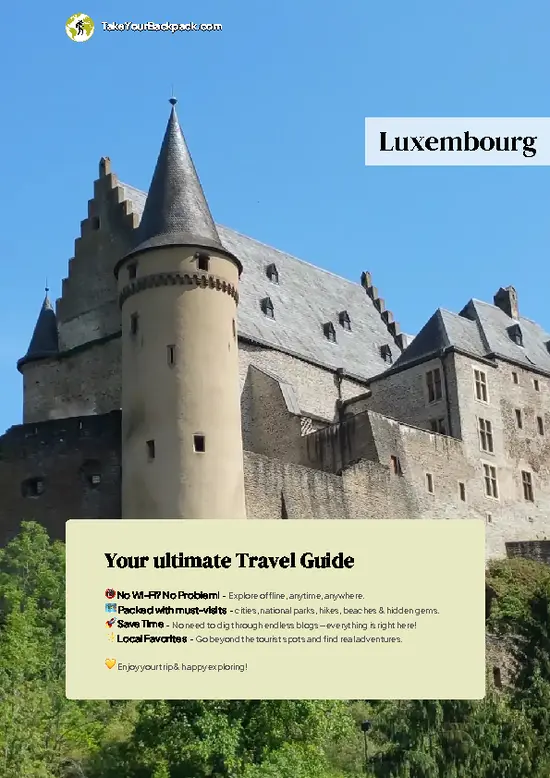
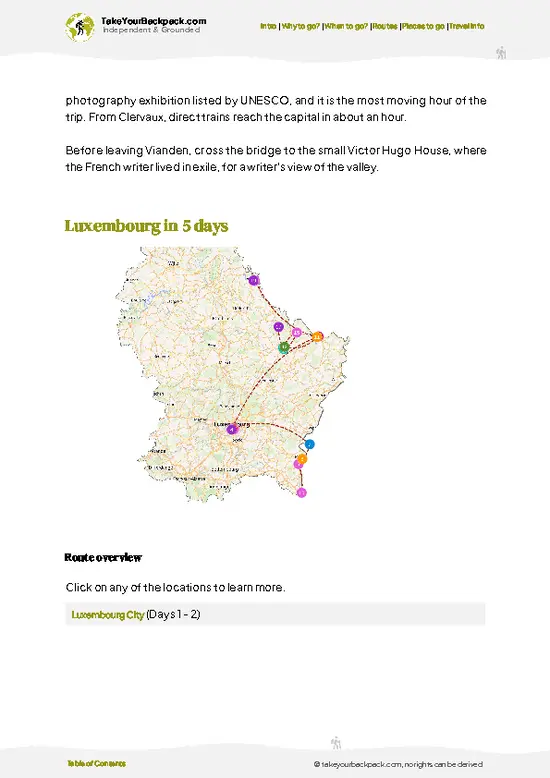
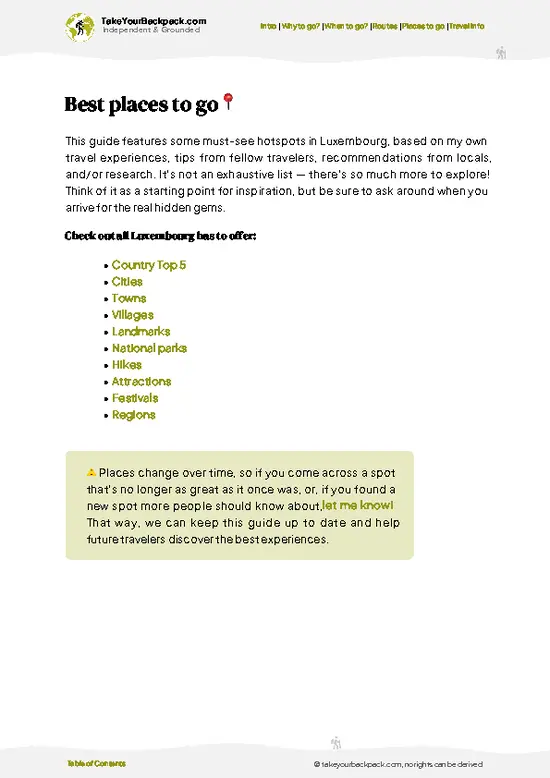
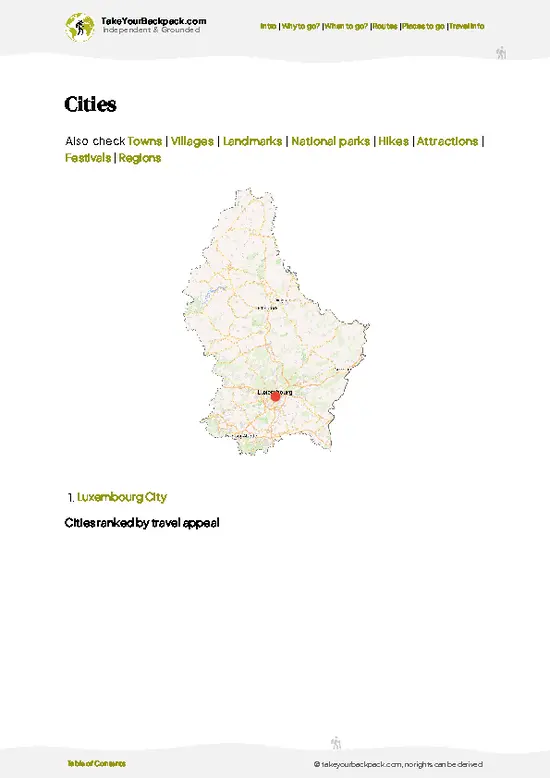
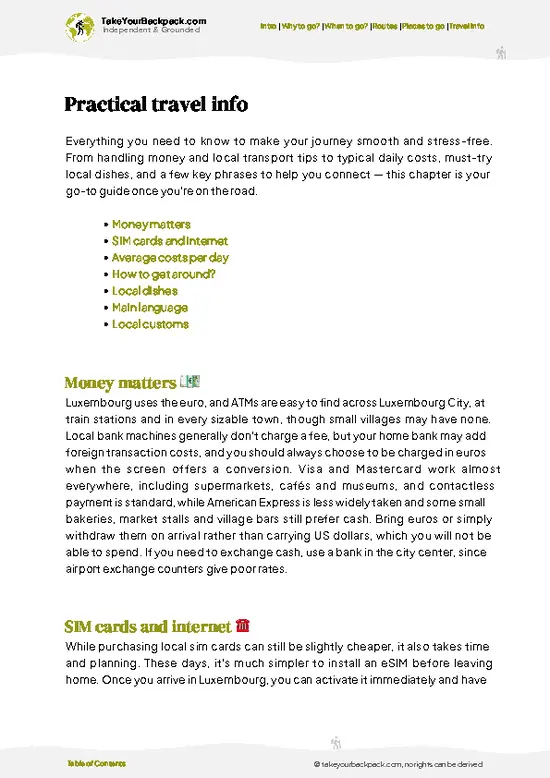
example page 0 from our offline Travel Guide for Luxembourg
example page 1 from our offline Travel Guide for Luxembourg
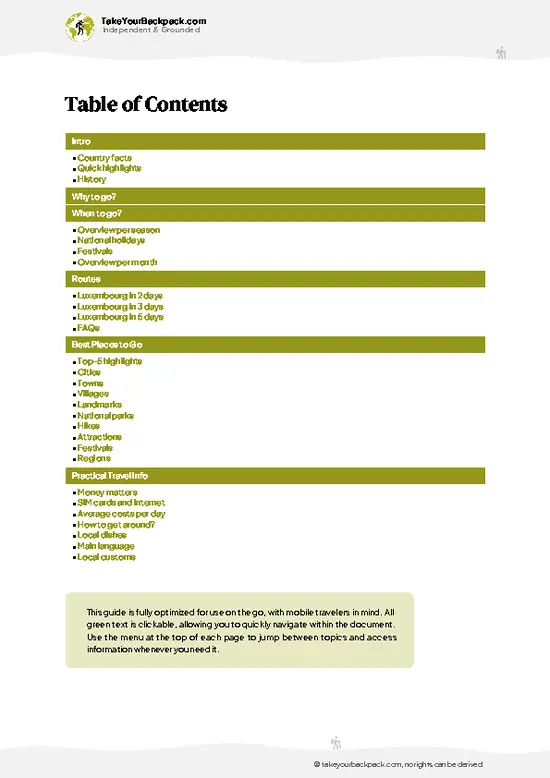
example page 2 from our offline Travel Guide for Luxembourg
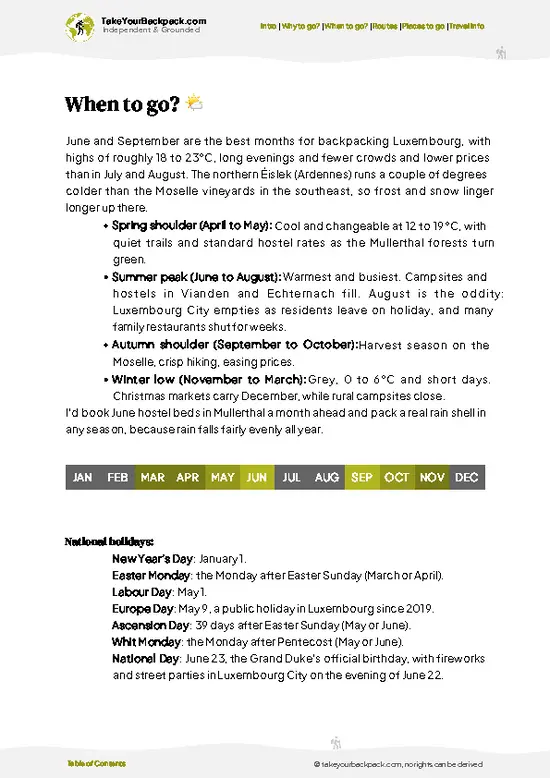
example page 3 from our offline Travel Guide for Luxembourg
example page 4 from our offline Travel Guide for Luxembourg
example page 5 from our offline Travel Guide for Luxembourg
example page 6 from our offline Travel Guide for Luxembourg
example page 7 from our offline Travel Guide for Luxembourg
The digital guide (153 pages) contains:
✅ 36 highlights, ranked by travel appeal
✅ Optimized 2, 3 & 5-day travel routes
✅ Cities, national parks, landmarks, beaches
✅ How to get around
✅ Offline-friendly for travel without Wi-Fi
👉 Click to see all 30+ guide features

📅 Plan smarter in minutes, not weeks
✅ Month by month travel advice
✅ Festivals & national holidays
✅ Budget expectations

🗺️ Go to the right places, skip the overrated ones
✅ Honest pros & cons of destinations
✅ Top hikes, parks & viewpoints
✅ Lesser-known places most travelers miss
✅ Clear “worth it vs skip it” guidance

🛏️ Travel smoothly without rookie mistakes
✅ Best areas to stay
✅ Transport systems explained simply
✅ Common scams & safety advice
✅ SIM cards, money & practical tips

🌍 Understand the country, not just visit it
✅ Culture & traditions
✅ 52 Essential phrases & customs
✅ Festivals worth planning around
✅ Traveler-friendly historical context
✅ Insights that make places more meaningful

📱 Built for real travel conditions
✅ Fully downloadable PDF
✅ Works completely offline
✅ Optimized for phone use
✅ Useful in remote areas & buses
✅ Everything in one place
Stop searching, start planning
Get instant access to your full guide. 30‑day money-back guarantee.
+ Add another guide for just

By proceeding you agree to our terms.
Sent to your inbox immediately after payment • 100% Secure Checkout
Best Backpacking Travel Advisor 2025 tourism awardBest Backpacking
Travel Advisor
2025
What others say about Take Your Backpack Guides:
⭐⭐⭐⭐⭐
Fantastic, amazing amount of information!
⭐⭐⭐⭐⭐
My goodness this is amazing, it's what I've been looking for hats off too you!
⭐⭐⭐⭐⭐
I think this is absolutely BRILLIANT
⭐⭐⭐⭐
Very complete and informative. It's still missing places, but I gotta to commend you
⭐⭐⭐⭐⭐
This is truly amazing, thank you, can't wait to explore it with my kids!
⭐⭐⭐⭐⭐
Awesome resource, thank you!
⭐⭐⭐⭐⭐
This is amazing! Can't wait to explore the ones I haven't seen
⭐⭐⭐⭐
I love this! Well done, great idea.
⭐⭐⭐⭐⭐
Thanks for taking the time to make this gem!
⭐⭐⭐⭐⭐
This might be the best website I've ever seen.
⭐⭐⭐⭐⭐
Congratulations, and thank you so much for your work; it's incredibly valuable.
⭐⭐⭐⭐
In all seriousness I think you did a great job pointing out the important spots
⭐⭐⭐⭐⭐
10/10 very good
⭐⭐⭐⭐⭐
As someone who's only just starting to visit regularly this is awesome, thank you.
⭐⭐⭐⭐
Thank you very much! I'm going to visit my dad, it's going to be very useful!
⭐⭐⭐⭐⭐
This is really cool! We'll be travelling for the first time and this definitely come in handy.
⭐⭐⭐⭐⭐
You are now our minister of culture, congratulations 👨‍💼
⭐⭐⭐⭐⭐
Just wanted to tell you that this is a pearl! Going to follow your recommendations.
⭐⭐⭐⭐⭐
This is so cool. I'll definitely be using the resource for my travels soon.
⭐⭐⭐⭐⭐
This is very impressive! Good work.
⭐⭐⭐⭐⭐
This is an amazing and informative site. Very well done!

🛏️ Where to stay?Best Places to Stay in Luxembourg

But Luxembourg has few true hostels, mostly in a nationwide youth hostel network, so dorm beds run about €35 to €50 a night and book up early in summer, while budget hotels in the capital rarely go below €90 to €120 for a double. In Luxembourg City, Gare has the most affordable rooms and the best train and tram links, though its main streets feel scruffy after dark, while Grund and Pfaffenthal sit in the valley below the old town with riverside pubs and quiet nights (plus steep climbs or the free elevators to get back up). Ville Haute puts you steps from the main sights at higher prices, and Kirchberg on the tram line is calm and often discounted on weekends but short on evening life.

If you … read more 👉
But Luxembourg has few true hostels, mostly in a nationwide youth hostel network, so dorm beds run about €35 to €50 a night and book up early in summer, while budget hotels in the capital rarely go below €90 to €120 for a double. In Luxembourg City, Gare has the most affordable rooms and the best train and tram links, though its main streets feel scruffy after dark, while Grund and Pfaffenthal sit in the valley below the old town with riverside pubs and quiet nights (plus steep climbs or the free elevators to get back up). Ville Haute puts you steps from the main sights at higher prices, and Kirchberg on the tram line is calm and often discounted on weekends but short on evening life.

If you enjoy meeting fellow travelers, consider choosing hostels with high ratings for atmosphere. On the other hand, if you prefer having your own space, a hotel might be a better option.

LuxembourgExplore Luxembourg

👋 Meet the founderWho’s Behind Take Your Backpack?

Johan, backpacker and founder of TakeYourBackpackHi, I’m Johan (Netherlands 🇳🇱), the creator of TakeYourBackpack. Over the past 3 decades, I’ve backpacked through 90+ countries across six continents, gaining extensive experience with independent travel, long-term trips, and overland routes.

This site is built on a combination of firsthand travel experience and carefully curated insights from other backpackers. Many guides are based on places I’ve personally visited, while others bring together tips, observations, and practical advice shared by trusted travelers I’ve met along the way.

The goal is to provide realistic, experience-driven guidance — not generic itineraries — so you can explore destinations with better context, clearer expectations, and more confidence.