
×

Madagascar🇲🇬 | national parksRanomafana National ParkGolden bamboo lemur, steamy highland trails, thermal baths, leaf-tailed geckos | things to do and best time to go

Explore Masoala National ParkExplore Tsingy de Bemaraha National Park

Backpacking in Ranomafana
🏆 Top picknational park ranked #2
By Johan Kruseman 🇳🇱 | Updated October 15, 2026

Hot springs run through the village of Ranomafana itself, and the name means “hot water” in Malagasy; the Namorona River steams beside the old thermal bath building near the park entrance. The park is best known for its golden bamboo lemur, found here in 1986, and lies in the southeastern highlands of Madagascar, a long, winding road from Fianarantsoa. Trails are muddy, steep and mossy, with tree ferns, orchids and the clicking calls of unseen frogs. The reward is seeing lemurs at close range in dripping rainforest. When I asked my guide Hery where the bamboo lemurs were that morning, he grinned, tapped his ear and said, “Wait for the crunching.” Ten minutes later we heard stalks snapping, then found one chewing a shoot, cyanide and all. Compared with Andasibe, which is easier to reach from the capital and has the famous indri calls, Ranomafana is wetter, hillier, quieter and richer in species.

Discover everything you want to know in the 📖 Madagascar Travel Guide.


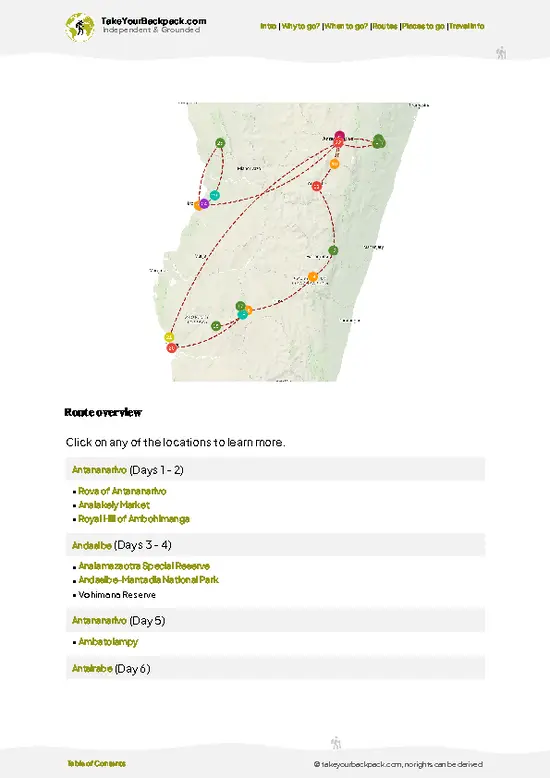
example page 0 from our offline Travel Guide for Madagascar
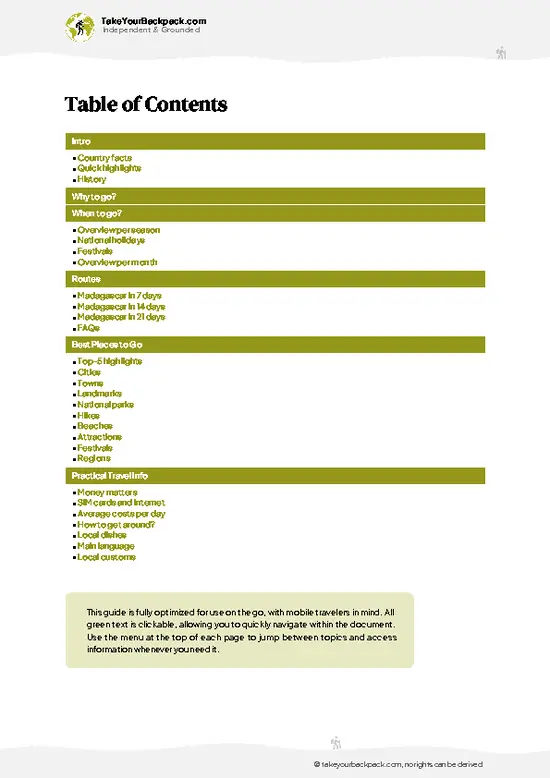
example page 1 from our offline Travel Guide for Madagascar
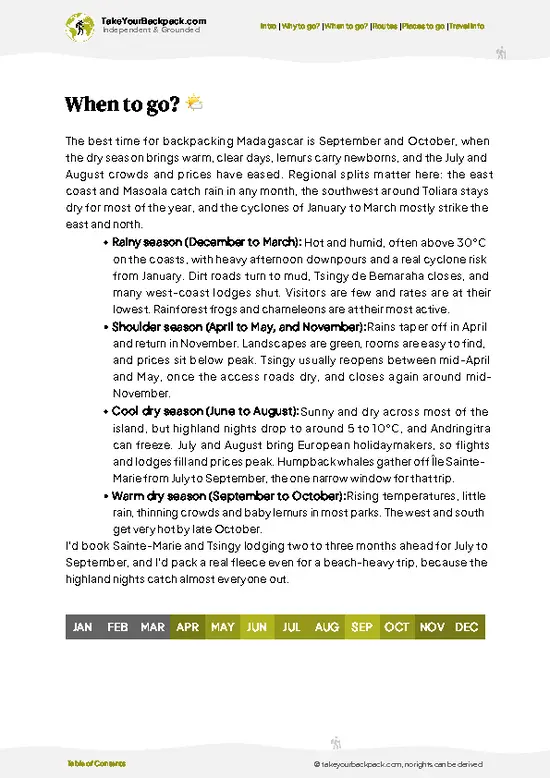
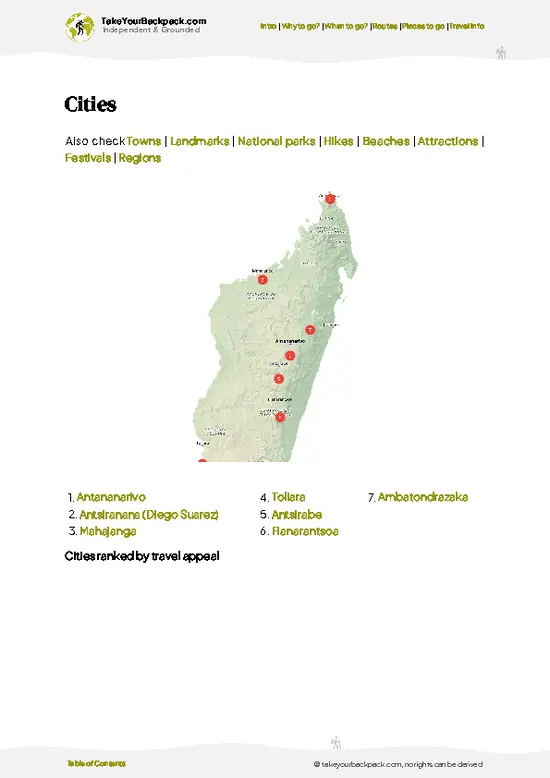
example page 2 from our offline Travel Guide for Madagascar
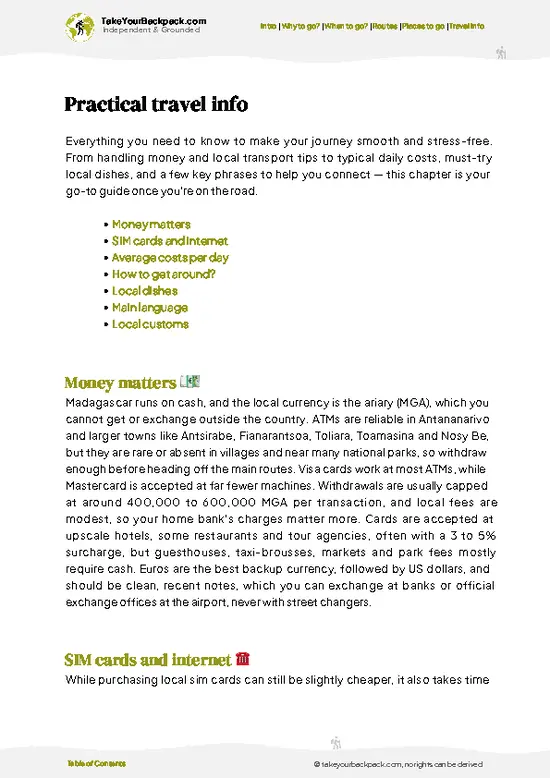
example page 3 from our offline Travel Guide for Madagascar
example page 4 from our offline Travel Guide for Madagascar
example page 5 from our offline Travel Guide for Madagascar
example page 6 from our offline Travel Guide for Madagascar
example page 7 from our offline Travel Guide for Madagascar
Loading the map 🌍
CLICK TO FILTER
cities
towns
landmarks
national parks
hikes
beaches
attractions
festivals
regions
SHOW COUNTRY’S BESTSHOW ALL

✨ Why go?
Ranked #2 national park in Madagascar
Why visitors keep coming back

Backpackers pick Ranomafana because it works without a tour package. The village sits right at the gate, so you can walk to the park entrance from a guesthouse, hire a local guide at the ticket office and set your own pace. Guides are required on trails, but you choose how many hours and which route, and the fees support the community association.

The second pull is the animal count. The park protects twelve lemur species, including the golden bamboo lemur, greater bamboo lemur and red-fronted brown lemur, plus chameleons, leaf-tailed geckos and a lot of birds. Few places in Madagascar pack that variety into trails you can finish before lunch.

The third is the night walk. After dark, guides take small groups along the road and forest edge to spot mouse lemurs, frogs and sleeping chameleons … read more 👉
Backpackers pick Ranomafana because it works without a tour package. The village sits right at the gate, so you can walk to the park entrance from a guesthouse, hire a local guide at the ticket office and set your own pace. Guides are required on trails, but you choose how many hours and which route, and the fees support the community association.

The second pull is the animal count. The park protects twelve lemur species, including the golden bamboo lemur, greater bamboo lemur and red-fronted brown lemur, plus chameleons, leaf-tailed geckos and a lot of birds. Few places in Madagascar pack that variety into trails you can finish before lunch.

The third is the night walk. After dark, guides take small groups along the road and forest edge to spot mouse lemurs, frogs and sleeping chameleons by torchlight. It is cheap, short and different from the daytime hikes. The village also has hot-spring soaking, small restaurants and traveler-friendly rooms, so rest days are easy after muddy climbs.

💡 HighlightsWhat this place is best known for

  1. Golden Bamboo Lemur: The park’s signature animal, a small honey-colored lemur that feeds on giant bamboo. Guides track it by the sound of cracking stalks, and sightings are common on the main trails.
  2. Greater Bamboo Lemur: One of the rarest lemurs on the island, reddish-gray and larger than its golden cousin. A sighting is never guaranteed, which makes it special.
  3. Red-fronted Brown Lemur Groups: Noisy, curious troops that often cross trails and sometimes come close enough to hear their grunts.
  4. Waterfall Trail Views: A trail climbs through ferny forest to a small waterfall and a viewpoint over the canopy and valley, with mist often rolling through.
  5. Night Walk: Torchlight outings reveal mouse lemurs, tiny tree frogs, stick insects and sleeping chameleons on branches beside the road.
  6. Namorona River
… read more 👉
  1. Golden Bamboo Lemur: The park’s signature animal, a small honey-colored lemur that feeds on giant bamboo. Guides track it by the sound of cracking stalks, and sightings are common on the main trails.
  2. Greater Bamboo Lemur: One of the rarest lemurs on the island, reddish-gray and larger than its golden cousin. A sighting is never guaranteed, which makes it special.
  3. Red-fronted Brown Lemur Groups: Noisy, curious troops that often cross trails and sometimes come close enough to hear their grunts.
  4. Waterfall Trail Views: A trail climbs through ferny forest to a small waterfall and a viewpoint over the canopy and valley, with mist often rolling through.
  5. Night Walk: Torchlight outings reveal mouse lemurs, tiny tree frogs, stick insects and sleeping chameleons on branches beside the road.
  6. Namorona River Hot Springs: Thermal water feeds the village baths by the river. A soak after a day of wet-boot hiking is the best way to finish.
  7. Chameleons and Geckos: Guides have sharp eyes for the tiny Brookesia leaf chameleon and the camouflaged satanic leaf-tailed gecko, which is almost invisible against bark.
  8. Rainforest Birds: Birders can look for the brown mesite, pitta-like ground-roller and other forest specialists at dawn, when the canopy is loudest.
Most visitors skip the early-morning bird walk, yet the forest is quietest then and the ground-rollers are easiest to find.
Spotted a mistake or missing something? Contact us.

Things to do near Ranomafana National Park

Ratings based on Tripadvisor reviews. When you book through this link, you support our work at no extra cost to you.

🌤️ When to go?Best time to explore Ranomafana

  • Cool Dry Season (May to September): Lemur sightings are easiest and trails firmest, but mornings in the rainforest drop to 5 to 12°C (41 to 54°F) and days reach 18 to 24°C (64 to 75°F). Daylight runs roughly 5:45 am to 5:30 pm. Bring a fleece. July and August bring the most visitors and the highest lodge rates.
  • Hot Wet Season (December to March): Expect 17 to 28°C (63 to 82°F) and downpours most afternoons, plus cyclone risk in January and February. Leeches multiply, trails turn to red mud, and roads can wash out. Rates are lowest and you may have the forest nearly to yourself. Frogs and chameleons are at their most active.
  • Shoulder Months (April, October, November): Showers are lighter, temperatures sit at 12 to 25°C (54 to 77°F), and sunrise comes around 5:15 am by November. Many lemur females
… read more 👉
  • Cool Dry Season (May to September): Lemur sightings are easiest and trails firmest, but mornings in the rainforest drop to 5 to 12°C (41 to 54°F) and days reach 18 to 24°C (64 to 75°F). Daylight runs roughly 5:45 am to 5:30 pm. Bring a fleece. July and August bring the most visitors and the highest lodge rates.
  • Hot Wet Season (December to March): Expect 17 to 28°C (63 to 82°F) and downpours most afternoons, plus cyclone risk in January and February. Leeches multiply, trails turn to red mud, and roads can wash out. Rates are lowest and you may have the forest nearly to yourself. Frogs and chameleons are at their most active.
  • Shoulder Months (April, October, November): Showers are lighter, temperatures sit at 12 to 25°C (54 to 77°F), and sunrise comes around 5:15 am by November. Many lemur females carry infants in November and December. Crowds thin out and prices ease.
Book night walks and the guide for your first morning early if you arrive in July or August.


source: climatestotravel.comJANJanuary: fair for travelingFEBFebruary: fair for travelingMARMarch: fair for travelingAPRApril: fair for travelingMAYMay: highly recommended for travelingJUNJune: excellent for travelingJULJuly: excellent for travelingAUGAugust: excellent for travelingSEPSeptember: highly recommended for travelingOCTOctober: excellent for travelingNOVNovember: fair for travelingDECDecember: fair for traveling
when-to-go

✈️ The backpacker research shortcutMadagascar Travel Guide

An offline-friendly backpacking guide with optimized travel routes, ranked highlights, transport advice, and the best areas to stay.
example page 0 from our offline Travel Guide for Madagascar
example page 1 from our offline Travel Guide for Madagascar
example page 2 from our offline Travel Guide for Madagascar
example page 3 from our offline Travel Guide for Madagascar
example page 4 from our offline Travel Guide for Madagascar
example page 5 from our offline Travel Guide for Madagascar
example page 6 from our offline Travel Guide for Madagascar
example page 7 from our offline Travel Guide for Madagascar
The digital guide (301 pages) contains:
✅ 96 highlights, ranked by travel appeal
✅ Optimized 7, 14 & 21-day travel routes
✅ Cities, national parks, landmarks, beaches
✅ How to get around
✅ Offline-friendly for travel without Wi-Fi
👉 Click to see all 30+ guide features

📅 Plan smarter in minutes, not weeks
✅ Month by month travel advice
✅ Festivals & national holidays
✅ Budget expectations

🗺️ Go to the right places, skip the overrated ones
✅ Honest pros & cons of destinations
✅ Top hikes, parks & viewpoints
✅ Lesser-known places most travelers miss
✅ Clear “worth it vs skip it” guidance

🛏️ Travel smoothly without rookie mistakes
✅ Best areas to stay
✅ Transport systems explained simply
✅ Common scams & safety advice
✅ SIM cards, money & practical tips

🌍 Understand the country, not just visit it
✅ Culture & traditions
✅ 52 Essential phrases & customs
✅ Festivals worth planning around
✅ Traveler-friendly historical context
✅ Insights that make places more meaningful

📱 Built for real travel conditions
✅ Fully downloadable PDF
✅ Works completely offline
✅ Optimized for phone use
✅ Useful in remote areas & buses
✅ Everything in one place
Stop searching, start planning
Get instant access to your full guide. 30‑day money-back guarantee.
+ Add another guide for just

By proceeding you agree to our terms.
Sent to your inbox immediately after payment • 100% Secure Checkout
Best Backpacking Travel Advisor 2025 tourism awardBest Backpacking
Travel Advisor
2025
What others say about Take Your Backpack Guides:
⭐⭐⭐⭐⭐
Fantastic, amazing amount of information!
⭐⭐⭐⭐⭐
My goodness this is amazing, it's what I've been looking for hats off too you!
⭐⭐⭐⭐⭐
I think this is absolutely BRILLIANT
⭐⭐⭐⭐
Very complete and informative. It's still missing places, but I gotta to commend you
⭐⭐⭐⭐⭐
This is truly amazing, thank you, can't wait to explore it with my kids!
⭐⭐⭐⭐⭐
Awesome resource, thank you!
⭐⭐⭐⭐⭐
This is amazing! Can't wait to explore the ones I haven't seen
⭐⭐⭐⭐
I love this! Well done, great idea.
⭐⭐⭐⭐⭐
Thanks for taking the time to make this gem!
⭐⭐⭐⭐⭐
This might be the best website I've ever seen.
⭐⭐⭐⭐⭐
Congratulations, and thank you so much for your work; it's incredibly valuable.
⭐⭐⭐⭐
In all seriousness I think you did a great job pointing out the important spots
⭐⭐⭐⭐⭐
10/10 very good
⭐⭐⭐⭐⭐
As someone who's only just starting to visit regularly this is awesome, thank you.
⭐⭐⭐⭐
Thank you very much! I'm going to visit my dad, it's going to be very useful!
⭐⭐⭐⭐⭐
This is really cool! We'll be travelling for the first time and this definitely come in handy.
⭐⭐⭐⭐⭐
You are now our minister of culture, congratulations 👨‍💼
⭐⭐⭐⭐⭐
Just wanted to tell you that this is a pearl! Going to follow your recommendations.
⭐⭐⭐⭐⭐
This is so cool. I'll definitely be using the resource for my travels soon.
⭐⭐⭐⭐⭐
This is very impressive! Good work.
⭐⭐⭐⭐⭐
This is an amazing and informative site. Very well done!

🛏️ Where to stay?Where staying makes the most sense

Most backpackers sleep in Ranomafana village, which sits at the park entrance and has simple guesthouses for roughly 30,000 to 80,000 Ariary (US$7 to 18) a night. There are no lodges inside the park itself, only basic campsites at spots such as Camp Miarisoa and Campsite Vohiparara, which you reach on multi-day treks with a guide.

In the village, small family-run hotels line the main road and the hillside above the hot springs. Expect cold showers, shared bathrooms in the cheapest rooms, and rice-and-zebu menus downstairs. Mid-range lodges with hot water and valley views run about 100,000 to … read more 👉
Most backpackers sleep in Ranomafana village, which sits at the park entrance and has simple guesthouses for roughly 30,000 to 80,000 Ariary (US$7 to 18) a night. There are no lodges inside the park itself, only basic campsites at spots such as Camp Miarisoa and Campsite Vohiparara, which you reach on multi-day treks with a guide.

In the village, small family-run hotels line the main road and the hillside above the hot springs. Expect cold showers, shared bathrooms in the cheapest rooms, and rice-and-zebu menus downstairs. Mid-range lodges with hot water and valley views run about 100,000 to 250,000 Ariary (US$22 to 55). Choose a place within a ten-minute walk of the ticket office so you can reach the 7 am start without a taxi-brousse or tuk-tuk.

Fianarantsoa, the nearest large city about 65 kilometers west, has more budget and mid-range hotels plus ATMs and a bus station. It makes sense as a night before or after the park, not as a base, since the drive takes roughly 2 to 3 hours on the RN45 route. Ambositra, to the north, is a handy stop for wood-carving shops if you are continuing toward Antananarivo.

👛 Costs (as of 15 October 2026)Typical daily expenses

A realistic backpacker budget for Ranomafana National Park runs about US$32 to 65 a day, including park fees, a guide, and a village guesthouse.
CategoryBudget RangeLocal Reality
Park entranceUS$11 to 14Roughly 50,000 to 60,000 Ariary per day for foreigners, paid at the Madagascar National Parks office. Multi-day passes cost less per day.
GuideUS$5 to 9A guide is compulsory. The fee is set per group of up to 5 people, so splitting it cuts the cost. Tip extra if the service is good.
Accommodation (high season)US$8 to 20Basic guesthouse rooms in the village. Mid-range lodges cost more. Camping inside the park costs a small fee.
FoodUS$6 to 12Rice with zebu, chicken, or vegetables at local eateries costs about US$2 to 4. Hotel dinners cost more.
Local transportUS$2 to 5Shared taxi-brousse from Fianarantsoa
… read more 👉
A realistic backpacker budget for Ranomafana National Park runs about US$32 to 65 a day, including park fees, a guide, and a village guesthouse.
CategoryBudget RangeLocal Reality
Park entranceUS$11 to 14Roughly 50,000 to 60,000 Ariary per day for foreigners, paid at the Madagascar National Parks office. Multi-day passes cost less per day.
GuideUS$5 to 9A guide is compulsory. The fee is set per group of up to 5 people, so splitting it cuts the cost. Tip extra if the service is good.
Accommodation (high season)US$8 to 20Basic guesthouse rooms in the village. Mid-range lodges cost more. Camping inside the park costs a small fee.
FoodUS$6 to 12Rice with zebu, chicken, or vegetables at local eateries costs about US$2 to 4. Hotel dinners cost more.
Local transportUS$2 to 5Shared taxi-brousse from Fianarantsoa costs roughly US$4 to 7 one way. Walking in the village is free.
Night walkUS$0 to 5An optional extra with its own ticket and guide fee. Many travelers split the cost.
Total Daily BudgetUS$32 to 65Lower end assumes shared guide fees and local food. Rates peak in July and August.
⚠️ Prices can change and everyone travels differently, so take this as a rough guide. Hope it helps you plan your adventure!

🥾 TrailsPlan your hike in Ranomafana: routes, terrain, and sights

The park is steep, humid and slippery, so expect muddy boots, stone steps and root tangles rather than groomed paths. Guides are mandatory, and the ticket office offers several loops that pair easily with a night walk.
  • Waterfall Trail: A moderate half-day walk of roughly 3 to 4 hours through primary forest, with a climb to a waterfall and a canopy viewpoint. Good for brown lemurs and orchids.
  • Bamboo Lemur Circuit: A moderate to hard outing of about 4 to 6 hours, depending on where the animals are feeding that day. Terrain is steep and wet, and you may leave the path to follow a troop.
  • Summit Route:
… read more 👉
The park is steep, humid and slippery, so expect muddy boots, stone steps and root tangles rather than groomed paths. Guides are mandatory, and the ticket office offers several loops that pair easily with a night walk.
  • Waterfall Trail: A moderate half-day walk of roughly 3 to 4 hours through primary forest, with a climb to a waterfall and a canopy viewpoint. Good for brown lemurs and orchids.
  • Bamboo Lemur Circuit: A moderate to hard outing of about 4 to 6 hours, depending on where the animals are feeding that day. Terrain is steep and wet, and you may leave the path to follow a troop.
  • Summit Route: A hard full-day trek of 6 to 8 hours up to the higher ridge for views and montane forest, with muddy slopes and fewer other hikers.
  • Night Walk: Easy and short, about 1.5 to 2 hours on the road and forest edge, for mouse lemurs, frogs and chameleons.
  • Roadside Walks: Easy strolls near the entrance, ideal for birds and for a first look without committing to a full day.
Most wildlife is seen in the early morning, so start at the gate soon after it opens. Bring waterproof layers, grippy shoes, a headlamp and gaiters if you dislike leeches, which are active after rain.

Access is by road to the village, usually through Fianarantsoa, using shared taxi-brousse minibuses on a winding mountain road. Sealed sections are in decent shape, but the ride is slow. The park draws moderate crowds, mainly in the dry months, and trail groups stay small because guides split visitors. An entrance fee applies, and the guide fee is paid separately at the park office.
⚠️ Hiking info can sometimes be outdated or inaccurate. Before you hit the trail, check the latest conditions with locals. If you do spot anything that's off, I'd love to hear from you, so I can update it for fellow travelers.

🛡️ SafetySafety Tips and Common Scams in Ranomafana

Ranomafana is a well-managed park with licensed guides at every entrance, and the main risks are mud, cold, and tired legs rather than dangerous animals. Trails climb and drop steeply through wet forest, and red clay turns slick after rain, so wear shoes with real grip and carry a trekking pole if you have one. Leeches are common in the wet months; long socks and a dab of salt or repellent at the ankles help.

The park is not high in altitude, but mornings feel cold, and rain can arrive within minutes in any season, so pack a light waterproof layer. Stay on marked paths, because the forest is dense and easy to get turned around in. Lemurs are habituated but wild, so keep a few meters back, never feed them, and keep your voice low. Guides are mandatory and spot the animals for you, which is … read more 👉
Ranomafana is a well-managed park with licensed guides at every entrance, and the main risks are mud, cold, and tired legs rather than dangerous animals. Trails climb and drop steeply through wet forest, and red clay turns slick after rain, so wear shoes with real grip and carry a trekking pole if you have one. Leeches are common in the wet months; long socks and a dab of salt or repellent at the ankles help.

The park is not high in altitude, but mornings feel cold, and rain can arrive within minutes in any season, so pack a light waterproof layer. Stay on marked paths, because the forest is dense and easy to get turned around in. Lemurs are habituated but wild, so keep a few meters back, never feed them, and keep your voice low. Guides are mandatory and spot the animals for you, which is the point. Carry at least 1.5 liters of water and a headlamp for night walks.

FAQFrequently asked questions about Ranomafana

Two to three days is the practical minimum. That gives you one full morning on the main trails, a night walk, and time for the Varijatsy waterfall circuit or a longer day toward Belle Vue. Keen wildlife watchers often stay four days to add a hike to the campsites.
Yes, though it takes some planning. Shared taxi-brousses run from Fianarantsoa to Ranomafana village in about 2 to 3 hours for roughly 15,000 to 25,000 Ariary (US$4 to 7), and from the village you walk to the park entrance in 10 to 15 minutes. Most guesthouses and the hot springs are within walking distance, and guides lead all trails on foot.
Yes, an entrance ticket is needed, and a guide is compulsory for all trails. Foreign adults pay around 50,000 to 60,000 Ariary (about US$11 to 14) for one day, with lower per-day rates on multi-day passes. Guide fees are extra at roughly 25,000 to 45,000 Ariary per group, and the night walk is a separate ticket.
⚠️ Things can change over time, so always validate details locally before you go.

Other Malagasy national parks near Ranomafana

Explore more nearby:


💡 Not sure where to go next?
Create a personalized itinerary for Madagascar including Ranomafana and the places that fit your trip.

Generate my itinerary

👉 Discover all national parks

Or checkout all Madagascar has to offer (think cities, towns, villages, national parks, hikes, beaches, festivals)
Country photo of Madagascar

We 💚 feedbackParting advice and final tips

The leeches and the mud are part of the deal, so skip the fancy gear and wear old trousers tucked into socks. Many first-timers overlook the village edge, where small bright frogs call from rice paddies at dusk. I would book the night walk on your first evening, because you will already know which sounds to listen for.

✈️ When did I visit Madagascar?
Madagascar I went backpacking in October 2019. With a friend I rented a 4WD and drove around the southern part of Madagascar.

✍️ Help improve this page!
The information on this page is based on my own backpacking experience in Madagascar, supplemented with up-to-date research and feedback from other travelers. Travel details can change, so if you notice anything outdated or incomplete, feel free to let me know.


🙋‍♂️ Give feedback

👋 Meet the founderWho’s Behind Take Your Backpack?

Johan, backpacker and founder of TakeYourBackpackHi, I’m Johan (Netherlands 🇳🇱), the creator of TakeYourBackpack. Over the past 3 decades, I’ve backpacked through 90+ countries across six continents, gaining extensive experience with independent travel, long-term trips, and overland routes.

This site is built on a combination of firsthand travel experience and carefully curated insights from other backpackers. Many guides are based on places I’ve personally visited, while others bring together tips, observations, and practical advice shared by trusted travelers I’ve met along the way.

The goal is to provide realistic, experience-driven guidance — not generic itineraries — so you can explore destinations with better context, clearer expectations, and more confidence.