×

Maldives🇲🇻 | best landmarksYour Guide to the Best landmarks in Maldives

Landmarks in Maldives are rarely monuments. Think old coral-stone mosques, lighthouses, sandbank viewpoints and wreck sites, scattered across 26 atolls. Malé packs history into a few walkable blocks for almost nothing. Local islands on a backpacking budget cost far less than resorts, though you reach them by ferry, so check the timetable before you plan, and book early for Fridays.

By Johan Kruseman 🇳🇱 | Updated October 23, 2026
Explore the best national parks in Maldives

Why go?Why Travelers Love These Spots

The Maldives has no mountains, no ancient cities and no big monument circuit, so its landmarks come from the sea, the faith and the islands’ isolation. The country is almost entirely Sunni Muslim, and its oldest buildings are coral-stone mosques and tombs, shaped by centuries on the Indian Ocean trade routes. Sites are small, free or cheap, and often sit on inhabited islands where modest dress matters. Distances are the real obstacle. Atolls are separated by open water, so a landmark that looks close on a map may need a boat. Public ferries are cheap but slow and follow fixed schedules, while speedboats cost more. Choose the Maldives for character and small-scale discovery, and skip it if you want a long list of ticketed sights.
Behind the Scenes of Selection
The list of best unique sites in Maldives is created based on history or culture, wow factor, atmosphere, quirks, and memorability. If you feel a unique site is missing in this list, please let us know.

When to go?Best Time to Visit Maldives for landmarks

Best months and weather: The best months are December to April, when the northeast monsoon brings sunny, dry days, calmer seas and temperatures around 28 to 31°C. That means smoother ferry crossings and clearer light for outdoor sites. Shoulder and wet season: May to November is the southwest monsoon. Expect showers, gusty wind, rougher crossings and monthly rainfall often above 200 mm, though sunny spells still happen. Boats can be delayed or canceled in rough weather, so leave slack. Prices and crowds: Peak season runs December to March, and guesthouse rates can run 20 to 40 percent higher, especially around Christmas and New Year. Book then. May to October brings lower prices and quieter islands. During Ramadan, daytime cafés on local islands often close, and opening hours shift.

unique site hoppingSuggested Travel Strategies

Days needed and direction: A trip linking several landmarks needs 7 to 12 days, because transfers eat more time than sightseeing. Start in Malé and the nearby Kaafu Atoll, then continue to one or two neighboring atolls instead of crossing the whole country. Time per stop and transfers: Allow half a day to two days per island, depending on how far the site is from the harbor. Speedboats within an atoll take 30 to 90 minutes, public ferries 2 to 6 hours, and domestic flights to distant atolls around 1 to 1.5 hours plus airport waiting. Mistakes to avoid: Travelers often try to cover too many atolls or ignore ferry schedules, which usually run only a few days a week. Fix this by choosing one cluster, confirming return boats first, and keeping a spare buffer day before your flight home.

The ListThe Best landmarks of Maldives

1 Utheemu

historic palace, local village, northern atoll, heritage site

Walk through a preserved sultan’s home and observe daily life in a remote island community shaped by centuries of Maldivian history.

Loading the map 🌍

Expert viewExpert Commentary on landmarks

How many to visit: I would advise four to six landmarks on a typical trip. Beyond that, you spend more on boats than you gain in new things to see, and each additional island adds a transfer. Four to six keeps the days relaxed and leaves room for swimming. Choosing a kind: For history, mosques, tombs and old town sites in Malé give the most for the least money, often free or under US$5 to 10 for a museum ticket. For nature lovers, sandbanks, lighthouses and wreck dives cost more because you need a boat. A shared boat trip is usually US$15 to 40 per person, while a private speedboat can run US$100 or more. Dive-linked sites add US$40 to 90 per dive. The best value for a backpacker is a base on a local island guesthouse and a mix of free walking sights with one paid boat excursion. Daily budget: … read more 👉
How many to visit: I would advise four to six landmarks on a typical trip. Beyond that, you spend more on boats than you gain in new things to see, and each additional island adds a transfer. Four to six keeps the days relaxed and leaves room for swimming. Choosing a kind: For history, mosques, tombs and old town sites in Malé give the most for the least money, often free or under US$5 to 10 for a museum ticket. For nature lovers, sandbanks, lighthouses and wreck dives cost more because you need a boat. A shared boat trip is usually US$15 to 40 per person, while a private speedboat can run US$100 or more. Dive-linked sites add US$40 to 90 per dive. The best value for a backpacker is a base on a local island guesthouse and a mix of free walking sights with one paid boat excursion. Daily budget: Expect US$60 to 120 a day on local islands, including a guesthouse room (US$40 to 90), local meals, ferries (US$1 to 5 in most cases) and small entry fees. Resort-linked visits cost far more. Bring cash in US dollars or rufiyaa for small shops, since card machines can fail. Safety and etiquette: Dress modestly on local islands, with shoulders and knees covered away from designated bikini beaches. Do not enter a mosque outside visiting times, remove shoes, and ask before photographing people. Alcohol is illegal on local islands. Currents can be strong at reef sites, so swim only with a guide, wear sun protection and carry plenty of water.

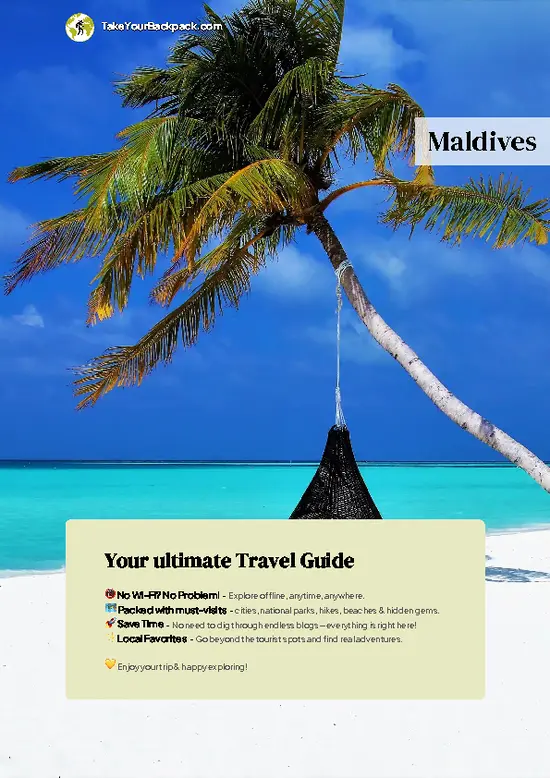
✈️ The backpacker research shortcutMaldives Travel Guide

An offline-friendly backpacking guide with optimized travel routes, ranked highlights, transport advice, and the best areas to stay.
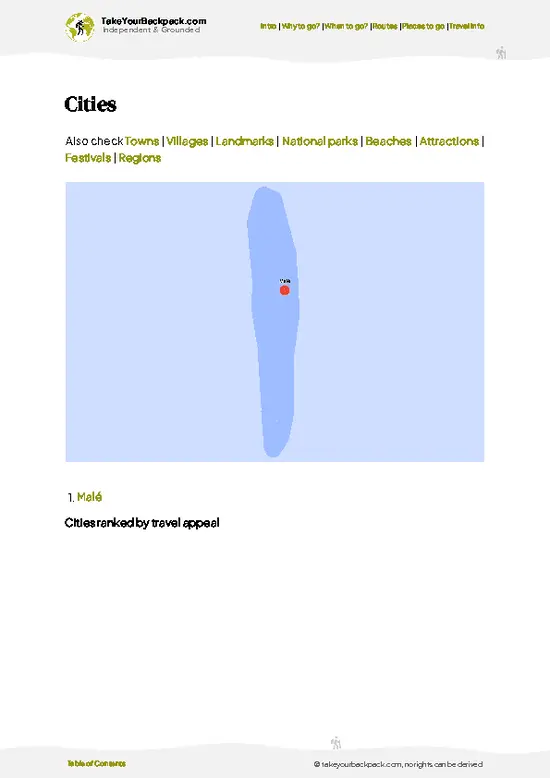
example page 0 from our offline Travel Guide for Maldives
example page 1 from our offline Travel Guide for Maldives
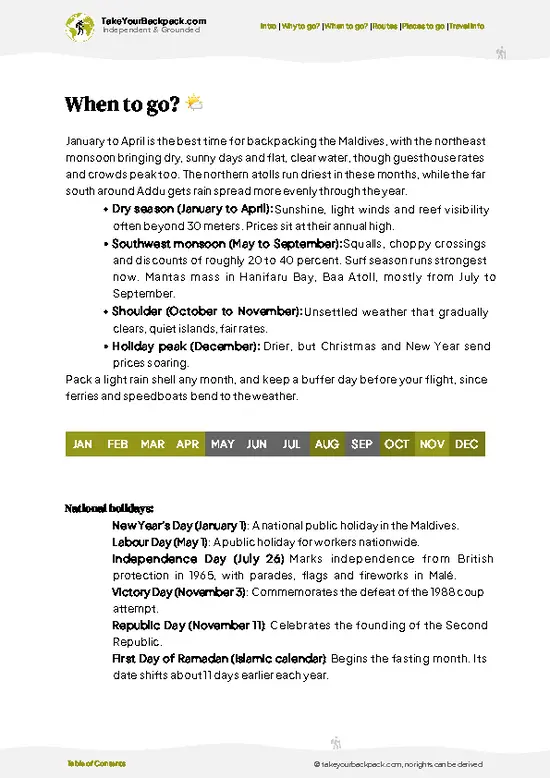
example page 2 from our offline Travel Guide for Maldives
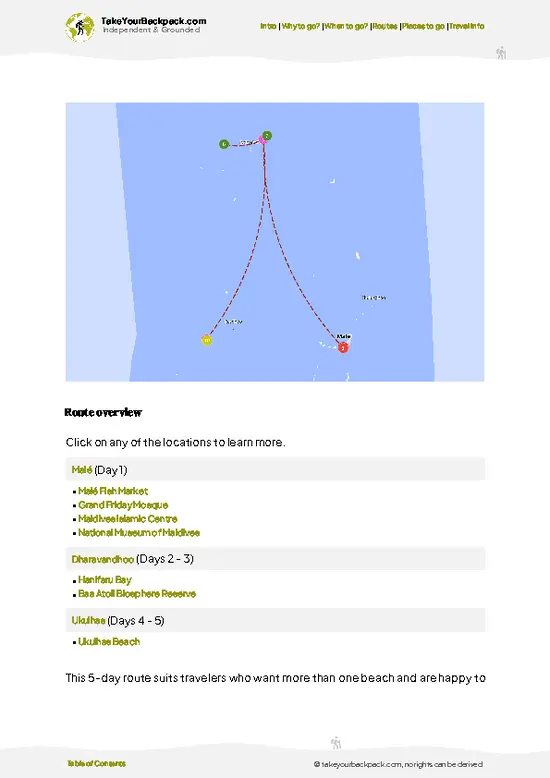
example page 3 from our offline Travel Guide for Maldives
example page 4 from our offline Travel Guide for Maldives
example page 5 from our offline Travel Guide for Maldives
example page 6 from our offline Travel Guide for Maldives
example page 7 from our offline Travel Guide for Maldives
The digital guide (177 pages) contains:
✅ 42 highlights, ranked by travel appeal
✅ Optimized 2, 3 & 5-day travel routes
✅ Cities, national parks, landmarks, beaches
✅ How to get around
✅ Offline-friendly for travel without Wi-Fi
👉 Click to see all 30+ guide features

📅 Plan smarter in minutes, not weeks
✅ Month by month travel advice
✅ Festivals & national holidays
✅ Budget expectations

🗺️ Go to the right places, skip the overrated ones
✅ Honest pros & cons of destinations
✅ Top hikes, parks & viewpoints
✅ Lesser-known places most travelers miss
✅ Clear “worth it vs skip it” guidance

🛏️ Travel smoothly without rookie mistakes
✅ Best areas to stay
✅ Transport systems explained simply
✅ Common scams & safety advice
✅ SIM cards, money & practical tips

🌍 Understand the country, not just visit it
✅ Culture & traditions
✅ 52 Essential phrases & customs
✅ Festivals worth planning around
✅ Traveler-friendly historical context
✅ Insights that make places more meaningful

📱 Built for real travel conditions
✅ Fully downloadable PDF
✅ Works completely offline
✅ Optimized for phone use
✅ Useful in remote areas & buses
✅ Everything in one place
Stop searching, start planning
Get instant access to your full guide. 30‑day money-back guarantee.
+ Add another guide for just

By proceeding you agree to our terms.
Sent to your inbox immediately after payment • 100% Secure Checkout
Best Backpacking Travel Advisor 2025 tourism awardBest Backpacking
Travel Advisor
2025
What others say about Take Your Backpack Guides:
⭐⭐⭐⭐⭐
Fantastic, amazing amount of information!
⭐⭐⭐⭐⭐
My goodness this is amazing, it's what I've been looking for hats off too you!
⭐⭐⭐⭐⭐
I think this is absolutely BRILLIANT
⭐⭐⭐⭐
Very complete and informative. It's still missing places, but I gotta to commend you
⭐⭐⭐⭐⭐
This is truly amazing, thank you, can't wait to explore it with my kids!
⭐⭐⭐⭐⭐
Awesome resource, thank you!
⭐⭐⭐⭐⭐
This is amazing! Can't wait to explore the ones I haven't seen
⭐⭐⭐⭐
I love this! Well done, great idea.
⭐⭐⭐⭐⭐
Thanks for taking the time to make this gem!
⭐⭐⭐⭐⭐
This might be the best website I've ever seen.
⭐⭐⭐⭐⭐
Congratulations, and thank you so much for your work; it's incredibly valuable.
⭐⭐⭐⭐
In all seriousness I think you did a great job pointing out the important spots
⭐⭐⭐⭐⭐
10/10 very good
⭐⭐⭐⭐⭐
As someone who's only just starting to visit regularly this is awesome, thank you.
⭐⭐⭐⭐
Thank you very much! I'm going to visit my dad, it's going to be very useful!
⭐⭐⭐⭐⭐
This is really cool! We'll be travelling for the first time and this definitely come in handy.
⭐⭐⭐⭐⭐
You are now our minister of culture, congratulations 👨‍💼
⭐⭐⭐⭐⭐
Just wanted to tell you that this is a pearl! Going to follow your recommendations.
⭐⭐⭐⭐⭐
This is so cool. I'll definitely be using the resource for my travels soon.
⭐⭐⭐⭐⭐
This is very impressive! Good work.
⭐⭐⭐⭐⭐
This is an amazing and informative site. Very well done!

🛏️ Where to stay?Top Areas to Stay

Budget accommodation in the Maldives means guesthouses on inhabited local islands, where doubles typically run US$40 to 90 a night plus the US$6 green tax, while true dorm beds are rare and mostly found in Malé and Hulhumalé. Maafushi has the biggest cluster of guesthouses and the easiest snorkel and sandbank trips, with a designated bikini beach and floating bars offshore (local islands are alcohol-free), but it gets crowded; Hulhumalé is quiet, safe and 10 minutes from the airport with a long city beach, making it the obvious pick for first and last nights. Malé itself puts you next to the public ferry terminals and cheap local cafés, though it is dense, noisy and has no nightlife to speak … read more 👉
Budget accommodation in the Maldives means guesthouses on inhabited local islands, where doubles typically run US$40 to 90 a night plus the US$6 green tax, while true dorm beds are rare and mostly found in Malé and Hulhumalé. Maafushi has the biggest cluster of guesthouses and the easiest snorkel and sandbank trips, with a designated bikini beach and floating bars offshore (local islands are alcohol-free), but it gets crowded; Hulhumalé is quiet, safe and 10 minutes from the airport with a long city beach, making it the obvious pick for first and last nights. Malé itself puts you next to the public ferry terminals and cheap local cafés, though it is dense, noisy and has no nightlife to speak of, while Thoddoo, Dhigurah and Fulidhoo trade convenience for empty beaches and slow evenings.

If you enjoy meeting fellow travelers, consider choosing hostels with high ratings for atmosphere. On the other hand, if you prefer having your own space, a hotel might be a better option.

MaldivesDiscover the Country

👋 Meet the founderWho’s Behind Take Your Backpack?

Johan, backpacker and founder of TakeYourBackpackHi, I’m Johan (Netherlands 🇳🇱), the creator of TakeYourBackpack. Over the past 3 decades, I’ve backpacked through 90+ countries across six continents, gaining extensive experience with independent travel, long-term trips, and overland routes.

This site is built on a combination of firsthand travel experience and carefully curated insights from other backpackers. Many guides are based on places I’ve personally visited, while others bring together tips, observations, and practical advice shared by trusted travelers I’ve met along the way.

The goal is to provide realistic, experience-driven guidance — not generic itineraries — so you can explore destinations with better context, clearer expectations, and more confidence.