×

Maldives🇲🇻 | best national parksYour Guide to the 4 Best national parks in Maldives

Maldives has no gated parks with trail networks. What you get are marine protected areas, a UNESCO biosphere reserve and a few wetland reserves spread across the atolls. The central atolls are easy to reach but pricier, and the far south is quieter once you land. Backpackers do best staying on local islands, where a guesthouse bed replaces a resort villa and boat trips fill the days.

By Johan Kruseman 🇳🇱 | Updated October 23, 2026
Explore the best beaches in Maldives

Why go?Why Travelers Love These Spots

Maldives is about 99 percent sea, so its protected areas are reefs, channels and lagoons rather than forests or mountains. Most islands are barely a meter above sea level, which means protection focuses on plankton, rays, sharks and coral. Tourism rules the economy, and local-island guesthouses only became legal in 2009, so independent access is recent and still developing.
Before you commit, know that everything runs on boats and planes. Entry is usually a small fee paid through a guesthouse or dive center, and a licensed guide or operator is often required. Local islands are Muslim communities, so alcohol is not sold and modest dress is expected away from the designated bikini beach. Bring your own reef-safe sunscreen and a rash guard, which saves money and awkward moments.
Our Approach to Ranking
The list of best national parks in Maldives is created based on landscapes, wildlife, adventure opportunities, facilities, and overall experience. If you feel a national park is missing in this list, please let us know.

When to go?Best Time to Visit Maldives for national parks

Best months and why: The best months are December to April, when the northeast monsoon brings the driest, calmest conditions, with sea visibility often 20 to 30 meters and little rain. Air temperature sits at 28 to 31°C all year, and the water stays around 27 to 30°C.Shoulder and wet season: From May to November the southwest monsoon brings showers, wind and choppier crossings, and annual rainfall totals roughly 1,800 to 2,000 mm. Visibility drops, but plankton blooms draw filter feeders to the central atolls, with the strongest activity in the middle of that wet stretch. Prices fall too, with guesthouse rooms often 20 to 40 percent cheaper than in peak season.Peak periods: Christmas through New Year is the one window to dodge. Rooms sell out weeks ahead and rates jump, so book early or shift … read more 👉
Best months and why: The best months are December to April, when the northeast monsoon brings the driest, calmest conditions, with sea visibility often 20 to 30 meters and little rain. Air temperature sits at 28 to 31°C all year, and the water stays around 27 to 30°C.Shoulder and wet season: From May to November the southwest monsoon brings showers, wind and choppier crossings, and annual rainfall totals roughly 1,800 to 2,000 mm. Visibility drops, but plankton blooms draw filter feeders to the central atolls, with the strongest activity in the middle of that wet stretch. Prices fall too, with guesthouse rooms often 20 to 40 percent cheaper than in peak season.Peak periods: Christmas through New Year is the one window to dodge. Rooms sell out weeks ahead and rates jump, so book early or shift to January's second half. Ramadan, which moves each year, changes restaurant hours on local islands.

national park hoppingSuggested Travel Strategies

How long you need: A trip linking several protected areas needs 8 to 12 days, because every move between atolls costs half a day or more. Malé and its airport are the hub for everything.Grouping and direction: The central and northern atolls cluster well: speedboats from Malé take roughly 2 to 3 hours to nearer atolls, and domestic flights to farther ones take 30 to 60 minutes. The far south needs a flight of about 1.5 hours, so treat it as its own leg at the end. Move from nearest to farthest and keep your international departure in Malé with a buffer day.Pacing and mistakes: Plan 3 to 4 nights per atoll. Trying to do one atoll per two days leaves you in transit most of the time. Public ferries run only a few days a week and rarely on Fridays, so check the schedule before booking beds. Also … read more 👉
How long you need: A trip linking several protected areas needs 8 to 12 days, because every move between atolls costs half a day or more. Malé and its airport are the hub for everything.Grouping and direction: The central and northern atolls cluster well: speedboats from Malé take roughly 2 to 3 hours to nearer atolls, and domestic flights to farther ones take 30 to 60 minutes. The far south needs a flight of about 1.5 hours, so treat it as its own leg at the end. Move from nearest to farthest and keep your international departure in Malé with a buffer day.Pacing and mistakes: Plan 3 to 4 nights per atoll. Trying to do one atoll per two days leaves you in transit most of the time. Public ferries run only a few days a week and rarely on Fridays, so check the schedule before booking beds. Also avoid booking a flight home the same morning you return by boat, since rough seas delay crossings.

The ListThe Best national parks of Maldives

1 Baa Atoll Biosphere Reserve

UNESCO site, coral reefs, manta congregation

Experience a protected marine area where seasonal gatherings of manta rays and diverse coral habitats support both snorkeling and conservation-focused travel.

2 Hanifaru Bay

plankton blooms, feeding mantas, whale shark hotspot

Swim alongside large groups of manta rays and occasional whale sharks drawn by rich plankton, with strict visitor limits to protect the ecosystem.

3 Fuvahmulah Nature Park

freshwater lakes, unique flora, island wildlife

Walk through an island with rare freshwater wetlands, endemic plants, and birdlife not found elsewhere in the Maldives, best explored on foot or by bicycle.

4 Rasdhoo Madivaru

channel dives, sandbanks, reef sharks

Dive in clear channels frequented by reef sharks, relax on shifting sandbanks, and enjoy easy access to some of the Maldives’ most reliable marine encounters.

maldives-national-park-rasdhoo-madivaru
© Google |
Loading the map 🌍

Expert viewExpert Commentary on national parks

How many to visit: I advise two or three protected areas, no more. Each one takes a full day on the water and often a transfer day on either side, so a fourth adds travel without adding much. Two strong stops on different atolls beat four rushed ones.Which kind suits you: For snorkelers and divers, choose marine protected areas, where the wildlife is the point. For travelers who like walking and birds, the wetland and nature reserves of the south are low-key, free or nearly free, and good on a bicycle. Families and first-timers get the most from the central atolls, where guides, boats and gear rental are easiest.What it costs: Budget US$70 to 130 a day on local islands. A guesthouse room runs US$40 to 100, meals US$10 to 25, and public ferries US$2 to 8. Protected-area fees are usually modest, … read more 👉
How many to visit: I advise two or three protected areas, no more. Each one takes a full day on the water and often a transfer day on either side, so a fourth adds travel without adding much. Two strong stops on different atolls beat four rushed ones.Which kind suits you: For snorkelers and divers, choose marine protected areas, where the wildlife is the point. For travelers who like walking and birds, the wetland and nature reserves of the south are low-key, free or nearly free, and good on a bicycle. Families and first-timers get the most from the central atolls, where guides, boats and gear rental are easiest.What it costs: Budget US$70 to 130 a day on local islands. A guesthouse room runs US$40 to 100, meals US$10 to 25, and public ferries US$2 to 8. Protected-area fees are usually modest, around US$10 to 30 a person, but a guided boat trip or snorkel excursion costs US$30 to 80 on top. A seaplane transfer is US$300 to 500 return, so skip it and take a ferry or domestic flight, which saves the most money for the least comfort lost. Per visit, count on US$50 to 120 all in.Safety and etiquette: Currents in channels can be strong. Use a licensed operator and wear a bright rash guard or float vest, because boat traffic is real. Never touch rays, turtles or coral, and keep 3 to 4 meters from large animals. Drones are restricted, and permits are needed. On local islands, cover shoulders and knees in the village and keep swimwear for the designated beach. Alcohol is illegal on local islands, and Fridays are quiet because of prayers. Pack a dry bag, since the boats get wet.

✈️ The backpacker research shortcutMaldives Travel Guide

An offline-friendly backpacking guide with optimized travel routes, ranked highlights, transport advice, and the best areas to stay.
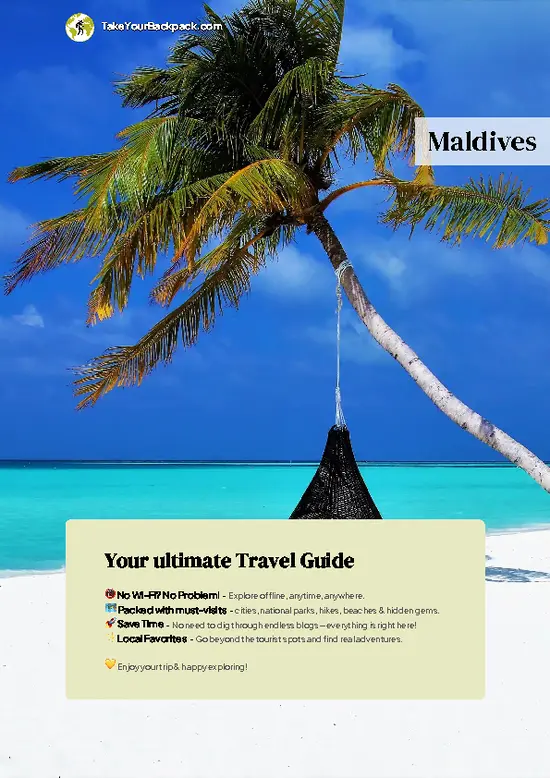
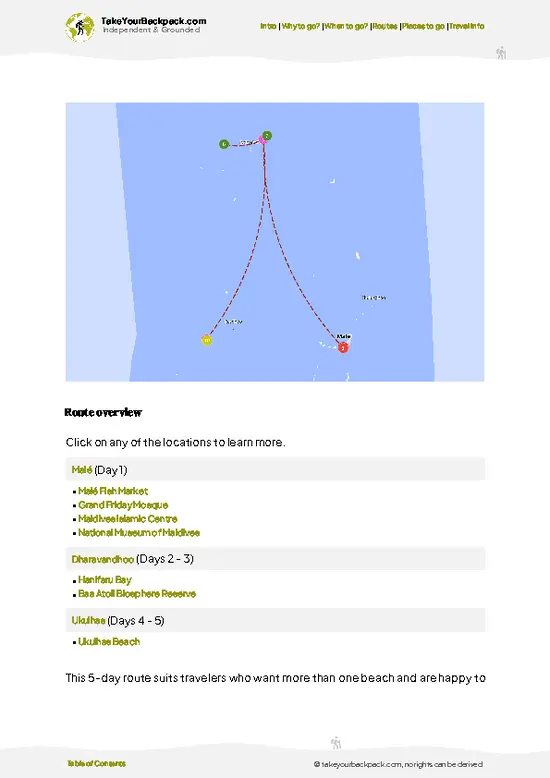
example page 0 from our offline Travel Guide for Maldives
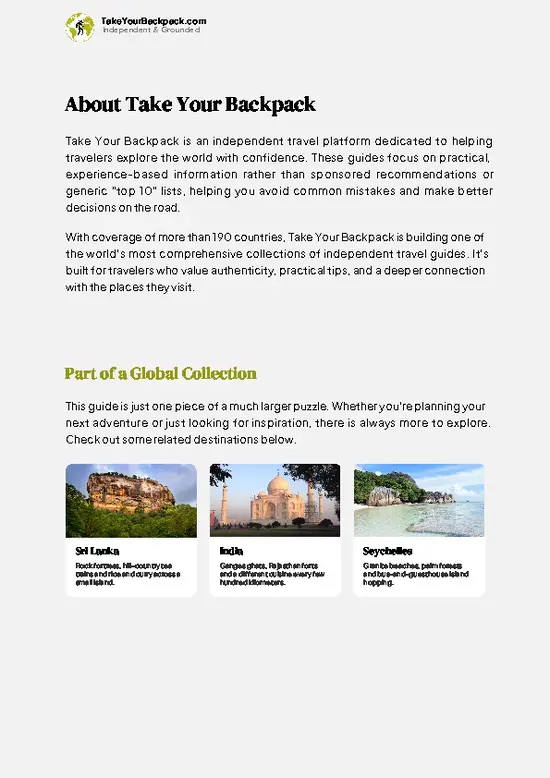
example page 1 from our offline Travel Guide for Maldives
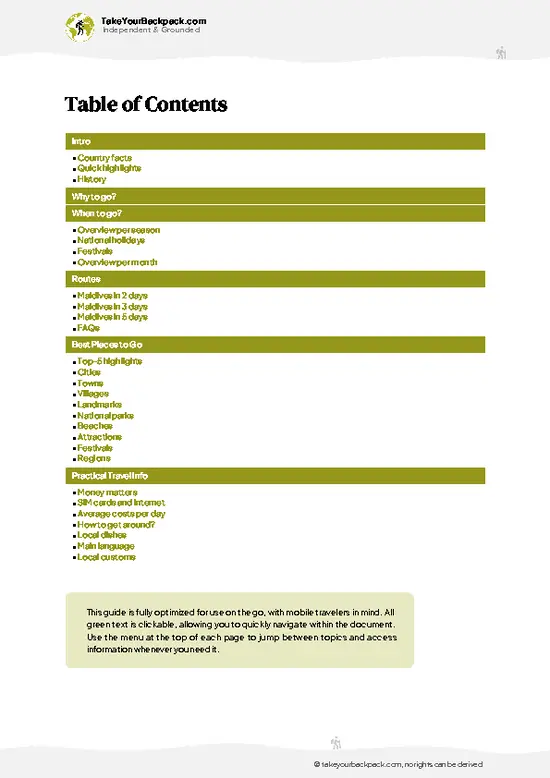
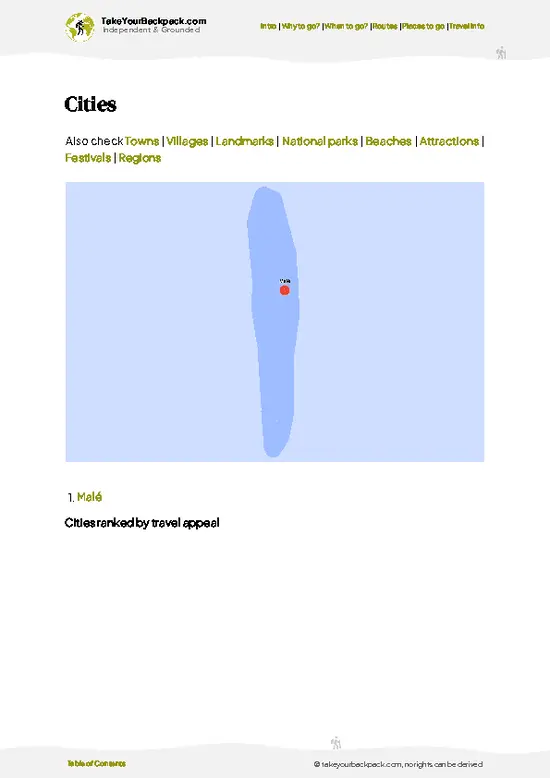
example page 2 from our offline Travel Guide for Maldives
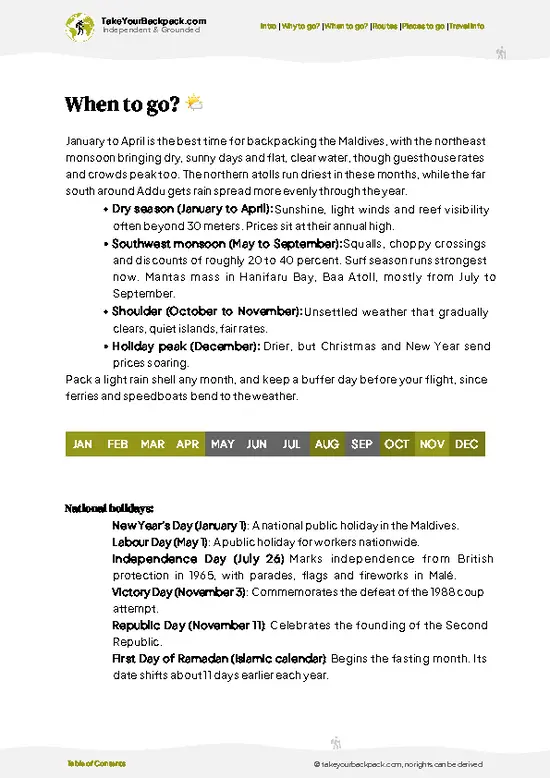
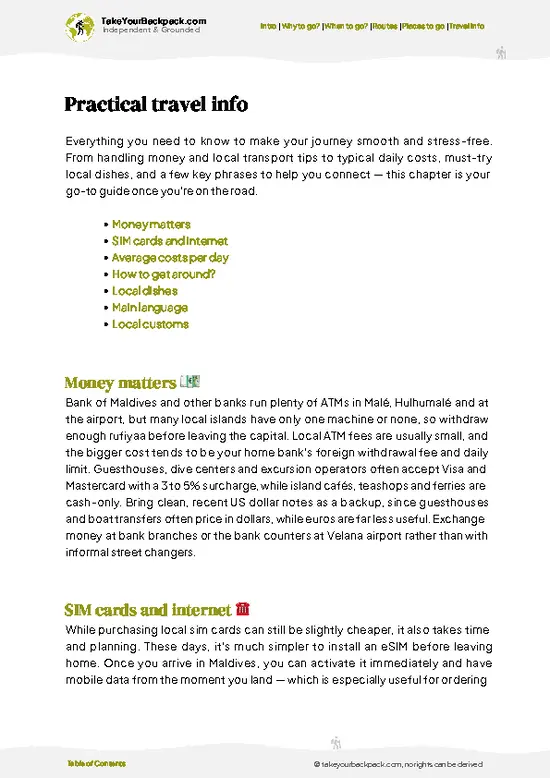
example page 3 from our offline Travel Guide for Maldives
example page 4 from our offline Travel Guide for Maldives
example page 5 from our offline Travel Guide for Maldives
example page 6 from our offline Travel Guide for Maldives
example page 7 from our offline Travel Guide for Maldives
The digital guide (177 pages) contains:
✅ 42 highlights, ranked by travel appeal
✅ Optimized 2, 3 & 5-day travel routes
✅ Cities, national parks, landmarks, beaches
✅ How to get around
✅ Offline-friendly for travel without Wi-Fi
👉 Click to see all 30+ guide features

📅 Plan smarter in minutes, not weeks
✅ Month by month travel advice
✅ Festivals & national holidays
✅ Budget expectations

🗺️ Go to the right places, skip the overrated ones
✅ Honest pros & cons of destinations
✅ Top hikes, parks & viewpoints
✅ Lesser-known places most travelers miss
✅ Clear “worth it vs skip it” guidance

🛏️ Travel smoothly without rookie mistakes
✅ Best areas to stay
✅ Transport systems explained simply
✅ Common scams & safety advice
✅ SIM cards, money & practical tips

🌍 Understand the country, not just visit it
✅ Culture & traditions
✅ 52 Essential phrases & customs
✅ Festivals worth planning around
✅ Traveler-friendly historical context
✅ Insights that make places more meaningful

📱 Built for real travel conditions
✅ Fully downloadable PDF
✅ Works completely offline
✅ Optimized for phone use
✅ Useful in remote areas & buses
✅ Everything in one place
Stop searching, start planning
Get instant access to your full guide. 30‑day money-back guarantee.
+ Add another guide for just

By proceeding you agree to our terms.
Sent to your inbox immediately after payment • 100% Secure Checkout
Best Backpacking Travel Advisor 2025 tourism awardBest Backpacking
Travel Advisor
2025
What others say about Take Your Backpack Guides:
⭐⭐⭐⭐⭐
Fantastic, amazing amount of information!
⭐⭐⭐⭐⭐
My goodness this is amazing, it's what I've been looking for hats off too you!
⭐⭐⭐⭐⭐
I think this is absolutely BRILLIANT
⭐⭐⭐⭐
Very complete and informative. It's still missing places, but I gotta to commend you
⭐⭐⭐⭐⭐
This is truly amazing, thank you, can't wait to explore it with my kids!
⭐⭐⭐⭐⭐
Awesome resource, thank you!
⭐⭐⭐⭐⭐
This is amazing! Can't wait to explore the ones I haven't seen
⭐⭐⭐⭐
I love this! Well done, great idea.
⭐⭐⭐⭐⭐
Thanks for taking the time to make this gem!
⭐⭐⭐⭐⭐
This might be the best website I've ever seen.
⭐⭐⭐⭐⭐
Congratulations, and thank you so much for your work; it's incredibly valuable.
⭐⭐⭐⭐
In all seriousness I think you did a great job pointing out the important spots
⭐⭐⭐⭐⭐
10/10 very good
⭐⭐⭐⭐⭐
As someone who's only just starting to visit regularly this is awesome, thank you.
⭐⭐⭐⭐
Thank you very much! I'm going to visit my dad, it's going to be very useful!
⭐⭐⭐⭐⭐
This is really cool! We'll be travelling for the first time and this definitely come in handy.
⭐⭐⭐⭐⭐
You are now our minister of culture, congratulations 👨‍💼
⭐⭐⭐⭐⭐
Just wanted to tell you that this is a pearl! Going to follow your recommendations.
⭐⭐⭐⭐⭐
This is so cool. I'll definitely be using the resource for my travels soon.
⭐⭐⭐⭐⭐
This is very impressive! Good work.
⭐⭐⭐⭐⭐
This is an amazing and informative site. Very well done!

🛏️ Where to stay?Top Areas to Stay

Budget accommodation in the Maldives means guesthouses on inhabited local islands, where doubles typically run US$40 to 90 a night plus the US$6 green tax, while true dorm beds are rare and mostly found in Malé and Hulhumalé. Maafushi has the biggest cluster of guesthouses and the easiest snorkel and sandbank trips, with a designated bikini beach and floating bars offshore (local islands are alcohol-free), but it gets crowded; Hulhumalé is quiet, safe and 10 minutes from the airport with a long city beach, making it the obvious pick for first and last nights. Malé itself puts you next to the public ferry terminals and cheap local cafés, though it is dense, noisy and has no nightlife to speak … read more 👉
Budget accommodation in the Maldives means guesthouses on inhabited local islands, where doubles typically run US$40 to 90 a night plus the US$6 green tax, while true dorm beds are rare and mostly found in Malé and Hulhumalé. Maafushi has the biggest cluster of guesthouses and the easiest snorkel and sandbank trips, with a designated bikini beach and floating bars offshore (local islands are alcohol-free), but it gets crowded; Hulhumalé is quiet, safe and 10 minutes from the airport with a long city beach, making it the obvious pick for first and last nights. Malé itself puts you next to the public ferry terminals and cheap local cafés, though it is dense, noisy and has no nightlife to speak of, while Thoddoo, Dhigurah and Fulidhoo trade convenience for empty beaches and slow evenings.

If you enjoy meeting fellow travelers, consider choosing hostels with high ratings for atmosphere. On the other hand, if you prefer having your own space, a hotel might be a better option.

MaldivesDiscover the Country

👋 Meet the founderWho’s Behind Take Your Backpack?

Johan, backpacker and founder of TakeYourBackpackHi, I’m Johan (Netherlands 🇳🇱), the creator of TakeYourBackpack. Over the past 3 decades, I’ve backpacked through 90+ countries across six continents, gaining extensive experience with independent travel, long-term trips, and overland routes.

This site is built on a combination of firsthand travel experience and carefully curated insights from other backpackers. Many guides are based on places I’ve personally visited, while others bring together tips, observations, and practical advice shared by trusted travelers I’ve met along the way.

The goal is to provide realistic, experience-driven guidance — not generic itineraries — so you can explore destinations with better context, clearer expectations, and more confidence.