
×

Maldives🇲🇻 | regionsBaa AtollUNESCO biosphere, manta gatherings, remote reefs | things to do and best time to go

Explore Rasdhoo Atoll Nature ParkExplore Fuvahmulah

Backpacking in Baa Atoll
🏆 Top pickregion ranked #1
By Johan Kruseman 🇳🇱 | Updated June 5, 2026

Ten years ago Baa Atoll felt like a rumor: a few sleepy islands, a couple of dive lodges, and manta nerds trading sightings over instant coffee. Now it’s the Maldives’ cool kid that got discovered—still wild in pockets, but ringed with serious luxury money. Geographically, it sits northwest of Malé in the central-north Maldives, a separate atoll from the classic honeymoon strips closer to the capital.

For backpackers, Baa is the trade: you get world-class reefs, Hanifaru Bay’s manta mayhem in season, and real local-island life on places like Dharavandhoo and Thulhaadhoo, but you pay more than in cheaper atolls like Lhaviyani or parts of Ari. Guesthouses are growing, ferries exist but are slow and irregular, and speedboats or domestic flights burn cash fast. The vibe swings: resort bubbles feel curated and pricey, while local islands still have evening haruge chats, fishing dhonis, and kids playing football at sunset—if you’re willing to work around conservative norms, limited nightlife, and some very Instagram-heavy crowds in peak manta season.

Discover everything you want to know in the 📖 Maldives Travel Guide.


Get your Maldives guide
56 ranked highlights, routes & tips, works offline (223 pages)
Loading the map 🌍
CLICK TO FILTER
cities
towns
villages
landmarks
national parks
hikes
beaches
attractions
festivals
regions
SHOW COUNTRY’S BESTSHOW ALL

✨ Why go?
Ranked #1 region in Maldives
Why Baa Atoll should be on your travel list

Backpackers flock to Baa Atoll for a reason. It’s not just about the beaches—though they’re stunning. The variety of landscapes here is a game changer. You can hop from lush islands to vibrant coral reefs without the hassle of constant relocation. This means more time soaking in the local culture and less time on a boat.

Transport flexibility is key. You can choose between speedboats or seaplanes, making it easy to explore at your own pace. Want to dive into the underwater world one day and sip coconut water on a secluded beach the next? You can do that here.

The beauty of Baa Atoll lies in its ability to blend nature and culture seamlessly. You can spend mornings snorkeling with manta rays and afternoons wandering through traditional villages. This is slow travel at its finest. You’re … read more 👉
Backpackers flock to Baa Atoll for a reason. It’s not just about the beaches—though they’re stunning. The variety of landscapes here is a game changer. You can hop from lush islands to vibrant coral reefs without the hassle of constant relocation. This means more time soaking in the local culture and less time on a boat.

Transport flexibility is key. You can choose between speedboats or seaplanes, making it easy to explore at your own pace. Want to dive into the underwater world one day and sip coconut water on a secluded beach the next? You can do that here.

The beauty of Baa Atoll lies in its ability to blend nature and culture seamlessly. You can spend mornings snorkeling with manta rays and afternoons wandering through traditional villages. This is slow travel at its finest. You’re not just ticking boxes; you’re living the experience.

So, if you’re looking for a place where you can savor every moment without breaking the bank or sacrificing comfort, Baa Atoll is your ticket.
Want to include Baa Atoll in your Maldives route?
Create a personalized Maldives itinerary that includes Baa Atoll and the places that fit your trip — based on your travel style, budget, and available time. Get your route in seconds.

Generate my trip

💡 HighlightsDon't-miss highlights and experiences

  • Hanifaru Bay — The headline act: a UNESCO biosphere feeding ground where, in season (roughly May-November), hundreds of manta rays — sometimes whale sharks too — converge to feed. It’s a one-of-a-kind snorkel experience that defines Baa Atoll’s marine fame.
  • Thulhaadhoo lacquer workshops — A cultural pocket you won’t find in resort gift shops: local artisans making the distinctive Thulhaadhoo lacquerware (boxes, bowls, combs) by hand. Watching the layers being built and buying directly from makers is a proper islandly, tactile souvenir.
  • Dharavandhoo Thila (dive/snorkel site) — A compact powerhouse reef near Dharavandhoo loved by divers for steep walls, concentrated coral life and regular big-spec visitors. It’s where you see the atoll’s reef ecology up close without the resort-fan crowd.
read more 👉
  • Hanifaru Bay — The headline act: a UNESCO biosphere feeding ground where, in season (roughly May-November), hundreds of manta rays — sometimes whale sharks too — converge to feed. It’s a one-of-a-kind snorkel experience that defines Baa Atoll’s marine fame.
  • Thulhaadhoo lacquer workshops — A cultural pocket you won’t find in resort gift shops: local artisans making the distinctive Thulhaadhoo lacquerware (boxes, bowls, combs) by hand. Watching the layers being built and buying directly from makers is a proper islandly, tactile souvenir.
  • Dharavandhoo Thila (dive/snorkel site) — A compact powerhouse reef near Dharavandhoo loved by divers for steep walls, concentrated coral life and regular big-spec visitors. It’s where you see the atoll’s reef ecology up close without the resort-fan crowd.
  • Eydhafushi local market & Friday mosque — Eydhafushi is the atoll capital: real marketplaces, small cafés, and the rhythm of island life centered on the Friday mosque. Good place to watch daily routines, try simple local food and grab a fresh catch off the quay.
  • Fulhadhoo beach — Hidden gem. A long, near-empty white-sand beach and shallow turquoise lagoon that feel like your own private Maldives postcard. Quiet guesthouses and slow island life make it ideal for low-key beach days and big sunsets.
  • Maalhos mangrove channels and sandbanks — Hidden gem. Maalhos offers peaceful walks through narrow island lanes into mangrove creeks and nearby sandbanks that are brilliant for shell-hunting, birdwatching and calm shallow snorkeling — very different to the open-reef scenes.
  • Goidhoo island lagoon — Hidden gem. Small, off-the-radar island with a sheltered, glassy lagoon perfect for paddling, snorkeling the inner reef and meeting fishermen who still use traditional lines. Great for a slow day away from dive-boat routes.
  • Day trip to local sandbanks — The atoll is speckled with uninhabited sandbanks you can reach by dhoni; spend an afternoon picnicking, snorkeling in thigh-deep blue water, or sleeping under a sunshade while the tide paints surreal colors across the flats.
  • Dawn fishing with island fishermen — A cultural experience: head out before sunrise with local anglers to learn handline or pole-and-line tuna techniques, land the catch, and share a simple island breakfast. It’s real, hands-on, and personal — not a packaged tourist show.
  • Traditional island walking tours (coral-stone houses & local life) — Walk small inhabited islands to see coral-stone foundations, narrow lanes, local schools and workshops; chat at the harbour and get a sense of everyday Maldivian community life that resorts never show you. Low-key, human, and revealing.
Spotted a mistake or missing something? Contact us.

⌛️ 5 daysWhat you can realistically do in a week

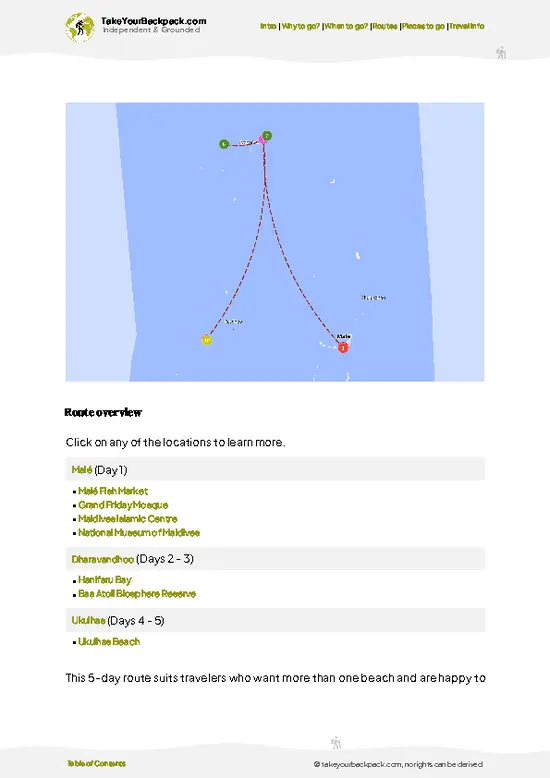
Day 1: Thulusdhoo


Start your adventure in Thulusdhoo, a local island that’s a quick speedboat ride from Malé. This is where you’ll get your bearings. The island is small, but it’s packed with character. You’ll find local eateries serving fresh fish curry and the chance to mingle with residents. The vibe here is relaxed, and it sets the tone for your trip. Plus, you’ll save time and money by skipping the expensive resort islands right off the bat.

Day 2: Huraa


Next, hop over to Huraa, just a short boat ride away. This island is known for its stunning house reefs. Spend your day snorkeling or lounging on the beach. The transport is straightforward, and the island’s compact size means you can explore without feeling rushed. This is where you can really soak in the local culture, and the … read more 👉

Day 1: Thulusdhoo


Start your adventure in Thulusdhoo, a local island that’s a quick speedboat ride from Malé. This is where you’ll get your bearings. The island is small, but it’s packed with character. You’ll find local eateries serving fresh fish curry and the chance to mingle with residents. The vibe here is relaxed, and it sets the tone for your trip. Plus, you’ll save time and money by skipping the expensive resort islands right off the bat.

Day 2: Huraa


Next, hop over to Huraa, just a short boat ride away. This island is known for its stunning house reefs. Spend your day snorkeling or lounging on the beach. The transport is straightforward, and the island’s compact size means you can explore without feeling rushed. This is where you can really soak in the local culture, and the laid-back atmosphere is a perfect contrast to the hustle of Malé.

Day 3: Rasdhoo


On Day 3, make your way to Rasdhoo. This island is a bit larger and offers more activities, like diving and water sports. The ferry system is reliable, but be mindful of the schedule. You’ll want to maximize your time here, so plan your dives in advance. The underwater life is vibrant, and you’ll want to capture every moment.

Day 4: Off-Path Reward - Ukulhas


Take a detour to Ukulhas, known for its eco-friendly initiatives and pristine beaches. It’s a longer boat ride, but the reward is worth it. The island is less touristy, and you can enjoy a quieter experience. Rent a bike and explore the island’s lush interior. This is where you’ll find the real Maldives, away from the crowds.

Day 5: Back to Thulusdhoo


Wrap up your trip back in Thulusdhoo. This final day is perfect for reflection and relaxation. Enjoy a leisurely breakfast, then hit the beach one last time. The return trip to Malé is easy, and you’ll feel accomplished having explored the heart of Baa Atoll.

The must-do day? Day 4 in Ukulhas. It’s the perfect blend of adventure and tranquility, giving you a taste of the Maldives that many miss.
Turn your Baa Atoll visit into an Maldives adventure
Build a complete Maldives route with Baa Atoll, hidden gems, must-see destinations, and realistic travel times included.

Generate my trip

🌤️ When to go?Best time to visit Baa Atoll


  • Weather: The dry season from November to April is your best bet—think clear skies and calm seas. May through October brings monsoon rains and rough waters, which can seriously cramp your snorkeling and diving plans.

  • Temperature: Expect a steady tropical warmth year-round, hovering between 27°C and 31°C (81°F to 88°F). Nights stay mild, rarely dipping below 25°C (77°F), so pack light but be ready for humidity.

  • Daylight Hours: Roughly 11 to 12 hours of daylight year-round, with sunrise around 6:30 AM and sunset near 6:30 PM. Early mornings are prime for beating crowds and catching that perfect light on the water.

  • Crowds: Peak season (December to March) draws honeymooners and luxury travelers, so expect higher prices and busier spots. Off-season means fewer people, but you’ll need to
read more 👉

  • Weather: The dry season from November to April is your best bet—think clear skies and calm seas. May through October brings monsoon rains and rough waters, which can seriously cramp your snorkeling and diving plans.

  • Temperature: Expect a steady tropical warmth year-round, hovering between 27°C and 31°C (81°F to 88°F). Nights stay mild, rarely dipping below 25°C (77°F), so pack light but be ready for humidity.

  • Daylight Hours: Roughly 11 to 12 hours of daylight year-round, with sunrise around 6:30 AM and sunset near 6:30 PM. Early mornings are prime for beating crowds and catching that perfect light on the water.

  • Crowds: Peak season (December to March) draws honeymooners and luxury travelers, so expect higher prices and busier spots. Off-season means fewer people, but you’ll need to dodge the rain and choppier seas.

  • Seasonal Activities: Whale shark sightings peak from May to November—if you’re chasing that, plan accordingly. Conversely, the dry season is ideal for diving and island hopping without weather interruptions.

  • Price Fluctuations: Prices spike during the dry season, especially around Christmas and New Year. Booking just before or after this window can save you a bundle without sacrificing too much on weather.


Pro-tip: Slide in late April or early November for a sweet spot—good weather, fewer crowds, and better deals. It’s the insider’s timing for backpackers who want the Maldives magic without the premium price tag.


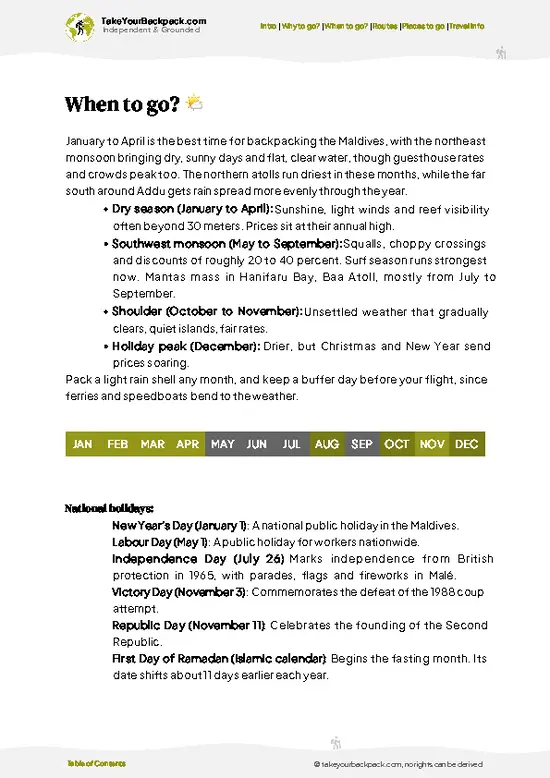
source: climatestotravel.comJANJanuary: excellent for travelingFEBFebruary: excellent for travelingMARMarch: excellent for travelingAPRApril: highly recommended for travelingMAYMay: fair for travelingJUNJune: fair for travelingJULJuly: fair for travelingAUGAugust: fair for travelingSEPSeptember: fair for travelingOCTOctober: fair for travelingNOVNovember: highly recommended for travelingDECDecember: excellent for traveling
when-to-go

✈️ The backpacker research shortcutMaldives Travel Guide

An offline-friendly backpacking guide with optimized travel routes, ranked highlights, transport advice, and the best areas to stay.
example page 0 from our offline Travel Guide for Maldives
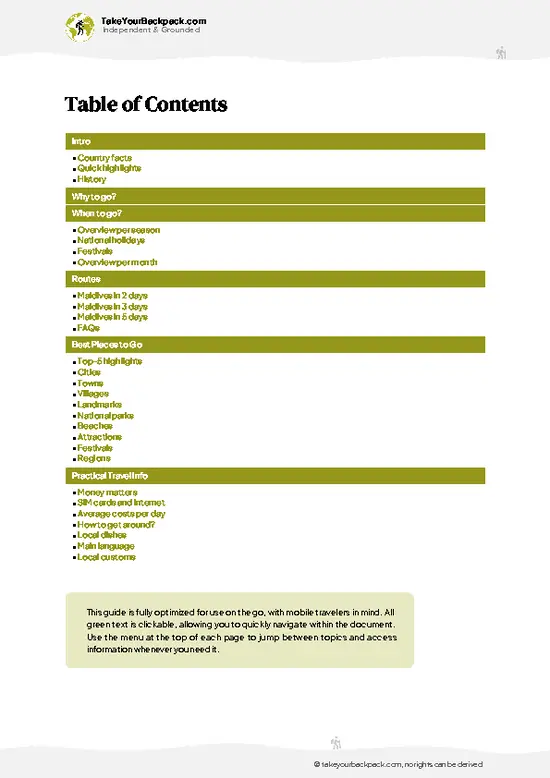
example page 1 from our offline Travel Guide for Maldives
example page 2 from our offline Travel Guide for Maldives
example page 3 from our offline Travel Guide for Maldives
example page 4 from our offline Travel Guide for Maldives
example page 5 from our offline Travel Guide for Maldives
example page 6 from our offline Travel Guide for Maldives
example page 7 from our offline Travel Guide for Maldives
The digital guide (223 pages) contains:
56 highlights, ranked by travel appeal
Optimized 2, 3 & 5-day travel routes
Cities, national parks, landmarks, beaches
How to get around
Offline-friendly for travel without Wi-Fi
👉 Click to see all 30+ guide features

📅 Plan smarter in minutes, not weeks
Month by month travel advice
Festivals & national holidays
Budget expectations

🗺️ Go to the right places, skip the overrated ones
Honest pros & cons of destinations
Top hikes, parks & viewpoints
Lesser-known places most travelers miss
Clear “worth it vs skip it” guidance

🛏️ Travel smoothly without rookie mistakes
Best areas to stay
Transport systems explained simply
Common scams & safety advice
SIM cards, money & practical tips

🌍 Understand the country, not just visit it
Culture & traditions
52 Essential phrases & customs
Festivals worth planning around
Traveler-friendly historical context
Insights that make places more meaningful

📱 Built for real travel conditions
Fully downloadable PDF
Works completely offline
Optimized for phone use
Useful in remote areas & buses
Everything in one place
Save weeks of stressful planning
Get instant access to your full guide. 30‑day money-back guarantee.


By proceeding you agree to our terms.
Sent to your inbox immediately after payment • 100% Secure Checkout
Best Backpacking Travel Advisor 2025 tourism awardBest Backpacking
Travel Advisor
2025
What others say about Take Your Backpack Guides:
⭐⭐⭐⭐⭐
Fantastic, amazing amount of information!
⭐⭐⭐⭐⭐
My goodness this is amazing, it's what I've been looking for hats off too you!
⭐⭐⭐⭐⭐
I think this is absolutely BRILLIANT
⭐⭐⭐⭐
Very complete and informative. It's still missing places, but I gotta to commend you
⭐⭐⭐⭐⭐
This is truly amazing, thank you, can't wait to explore it with my kids!
⭐⭐⭐⭐⭐
Awesome resource, thank you!
⭐⭐⭐⭐⭐
This is amazing! Can't wait to explore the ones I haven't seen
⭐⭐⭐⭐
I love this! Well done, great idea.
⭐⭐⭐⭐⭐
Thanks for taking the time to make this gem!
⭐⭐⭐⭐⭐
This might be the best website I've ever seen.
⭐⭐⭐⭐⭐
Congratulations, and thank you so much for your work; it's incredibly valuable.
⭐⭐⭐⭐
In all seriousness I think you did a great job pointing out the important spots
⭐⭐⭐⭐⭐
10/10 very good
⭐⭐⭐⭐⭐
As someone who's only just starting to visit regularly this is awesome, thank you.
⭐⭐⭐⭐
Thank you very much! I'm going to visit my dad, it's going to be very useful!
⭐⭐⭐⭐⭐
This is really cool! We'll be travelling for the first time and this definitely come in handy.
⭐⭐⭐⭐⭐
You are now our minister of culture, congratulations 👨‍💼
⭐⭐⭐⭐⭐
Just wanted to tell you that this is a pearl! Going to follow your recommendations.
⭐⭐⭐⭐⭐
This is so cool. I'll definitely be using the resource for my travels soon.
⭐⭐⭐⭐⭐
This is very impressive! Good work.
⭐⭐⭐⭐⭐
This is an amazing and informative site. Very well done!

🛏️ Where to stay?How to pick the right area

When you hit Baa Atoll, you’re diving into a backpacker’s paradise. Let’s break down the best spots to lay your head, where safety meets social vibes, and your wallet won’t scream in agony.

First up, Thulhaadhoo. This local island is a treasure trove of culture. You’ll find friendly faces and a genuine Maldivian experience. The beaches are pristine, and the snorkeling? Off the charts. It’s a great place to connect with locals and fellow travelers without the resort price tag.

Next, consider Dhigufaru. It’s a bit quieter, but that’s the charm. You can kick back, enjoy the laid-back atmosphere, … read more 👉
When you hit Baa Atoll, you’re diving into a backpacker’s paradise. Let’s break down the best spots to lay your head, where safety meets social vibes, and your wallet won’t scream in agony.

First up, Thulhaadhoo. This local island is a treasure trove of culture. You’ll find friendly faces and a genuine Maldivian experience. The beaches are pristine, and the snorkeling? Off the charts. It’s a great place to connect with locals and fellow travelers without the resort price tag.

Next, consider Dhigufaru. It’s a bit quieter, but that’s the charm. You can kick back, enjoy the laid-back atmosphere, and still find a few bars and cafes where you can swap stories with other backpackers. The sunsets here are killer, and you’ll want to soak them in with a cold drink in hand.

Lastly, Kudarikilu offers a unique blend of social life and tranquility. It’s popular among budget travelers, with plenty of communal spaces to meet others. Plus, the local food scene is vibrant and affordable.

Each of these spots gives you a taste of the Maldives without the luxury markup. Choose wisely, and you’ll unlock the real magic of Baa Atoll.

🚌 Getting aroundHow to get from A to B

Baa Atoll is a dance of water and time, where schedules are more like suggestions than rules. Picture this: the sun dips low, casting golden hues over the turquoise waves, and you’re not just waiting for a boat; you’re soaking in the rhythm of island life. Here, the flow is relaxed, but that doesn’t mean you can’t navigate it like a pro. The key is to embrace the chaos while keeping your eyes peeled for those sweet moments that make your trip feel like a secret adventure.

Here’s the lowdown on getting around Baa Atoll without breaking the bank:


  • Speedboat Transfers: These are your lifeline between islands. Prices range from $30 to $100 depending on distance. Expect a ride of about 30 minutes to 1 hour. They run frequently, but check the last boat times—usually around 5 PM. Comfort is decent,
read more 👉
Baa Atoll is a dance of water and time, where schedules are more like suggestions than rules. Picture this: the sun dips low, casting golden hues over the turquoise waves, and you’re not just waiting for a boat; you’re soaking in the rhythm of island life. Here, the flow is relaxed, but that doesn’t mean you can’t navigate it like a pro. The key is to embrace the chaos while keeping your eyes peeled for those sweet moments that make your trip feel like a secret adventure.

Here’s the lowdown on getting around Baa Atoll without breaking the bank:


  • Speedboat Transfers: These are your lifeline between islands. Prices range from $30 to $100 depending on distance. Expect a ride of about 30 minutes to 1 hour. They run frequently, but check the last boat times—usually around 5 PM. Comfort is decent, but hold on tight; the waves can get choppy!


  • Dhoni Boats: Traditional wooden boats that add a splash of authenticity to your journey. Costs are around $10 to $50, depending on the route. They’re slower, taking about 1 to 2 hours, but the experience is worth it. They operate on a more flexible schedule, often leaving when full, so be patient and enjoy the scenery.


  • Seaplane Transfers: For a splurge that’s worth every penny, hop on a seaplane. Prices start at around $300 one-way, but the aerial views of the atoll are jaw-dropping. Flights take about 30 minutes, and they usually operate from early morning until late afternoon. It’s a luxurious way to travel, but book in advance to secure your spot.


  • Public Ferries: The budget-friendly option, costing around $5 to $10. They run on a fixed schedule, typically once or twice a day, so plan accordingly. The ride can take 2 to 3 hours, but you’ll mingle with locals and get a real taste of island life. Just be ready for a bit of a wait.


Here’s your tactical tip: always check the local schedules the day before you travel. Timing can shift based on weather or demand, so staying in the loop will save you from unexpected delays. Embrace the flow, and you’ll find that the journey is just as rewarding as the destination.

🍲 FoodEating & Drinking in Baa Atoll

In the **Baa Atoll**, food is a celebration of the sea and local culture. Dive into **mas huni**, a breakfast staple made from tuna, coconut, onion, and chili, all scooped up with soft, warm flatbread. The **flavors** are fresh and vibrant, a perfect start to your day. Don’t miss out on **garudhiya**, a fish soup served with rice and lime; it’s simple yet packed with the essence of the ocean.

For a true local experience, hit up the **markets**. The bustling stalls are filled with the aroma of grilled fish and spices. Grab a plate of **fihunu mas**, grilled fish marinated in a spicy paste, and enjoy it with a side of **roshi**. Street food vendors offer **short eats** like **samosas** and **bajiya**, perfect for a quick snack while you explore.

When it comes to drinks, try the **coconut water** … read more 👉
In the **Baa Atoll**, food is a celebration of the sea and local culture. Dive into **mas huni**, a breakfast staple made from tuna, coconut, onion, and chili, all scooped up with soft, warm flatbread. The **flavors** are fresh and vibrant, a perfect start to your day. Don’t miss out on **garudhiya**, a fish soup served with rice and lime; it’s simple yet packed with the essence of the ocean.

For a true local experience, hit up the **markets**. The bustling stalls are filled with the aroma of grilled fish and spices. Grab a plate of **fihunu mas**, grilled fish marinated in a spicy paste, and enjoy it with a side of **roshi**. Street food vendors offer **short eats** like **samosas** and **bajiya**, perfect for a quick snack while you explore.

When it comes to drinks, try the **coconut water** straight from the shell—refreshing and hydrating after a day in the sun. If you’re feeling adventurous, sample **raa**, a traditional Maldivian drink made from fermented coconut sap.

Dining here is relaxed. Locals often eat with their hands, so don’t be shy to join in. Just remember to use your right hand—it’s a cultural norm. Embrace the flavors, the warmth of the people, and the laid-back vibe; it’s all part of the experience.

Other Maldivian regions near Baa Atoll

Explore more nearby:

  • Fulidhoo—Small local island, traditional bodu beru, nurse shark sites| 123 km away
  • Fuvahmulah—Single-island atoll, freshwater lakes, tiger shark dives| 612 km away

💡 Not sure where to go next?
Create a personalized itinerary for Maldives including Baa Atoll and the places that fit your trip.

Generate my itinerary

👉 Discover all regions

Or checkout all Maldives has to offer (think cities, towns, villages, national parks, hikes, beaches, festivals)
Country photo of Maldives

We 💚 feedbackFinal thoughts on visiting Baa Atoll

Baa Atoll is a slice of paradise where time slows down. The vibe? Chill yet vibrant, with locals who genuinely want to share their culture. Don’t miss the manta ray season; it’s a jaw-dropper. But here’s the scoop: some resorts can feel a bit too polished. Seek out the smaller guesthouses for that authentic touch. And remember, the best sunsets are often found on the less-traveled beaches—just you, the horizon, and a cocktail in hand. Trust me, it’s worth the wander.

✍️ Help improve this page!
The information on this page is based on in-depth research, insights shared by experienced travelers, and feedback from the local travel community in Maldives. While every effort is made to keep the information accurate and current, conditions can change — so if you spot anything incorrect or outdated, please get in touch.


🙋‍♂️ Give feedback

👋 Meet the founderWho’s Behind Take Your Backpack?

Johan, backpacker and founder of TakeYourBackpackHi, I’m Johan (Netherlands 🇳🇱), the creator of TakeYourBackpack. Over the past decade, I’ve backpacked through 80+ countries across six continents, gaining extensive experience with independent travel, long-term trips, and overland routes.

This site is built on a combination of firsthand travel experience and carefully curated insights from other backpackers. Many guides are based on places I’ve personally visited, while others bring together tips, observations, and practical advice shared by trusted travelers I’ve met along the way.

The goal is to provide realistic, experience-driven guidance — not generic itineraries — so you can explore destinations with better context, clearer expectations, and more confidence.

Get full Maldives guide •
Instant download • 56 highlights • Full Offline guide