×

Mali🇲🇱 | national parksAnsongo-Ménaka ReserveNiger River banks, Tilemsi valley, acacia plains, Ménaka Tuareg herders | things to do and best time to go

Explore Fina ReserveExplore Baoulé Loop Biosphere Reserve

Backpacking in Ansongo-Ménaka Reserve
🌟 Highlightnational park ranked #3
By Johan Kruseman 🇳🇱 | Updated October 22, 2026

The decision that matters most is whether to go at all, and the security situation tips it: armed groups are active across this stretch of eastern Mali, so most travelers should wait. Ansongo-Ménaka Reserve sits in the east of Mali, in the Sahel east of Gao, between the Niger River town of Ansongo and the desert-edge town of Ménaka. The appeal is empty acacia plains, dunes and seasonal pools with gazelles and ostriches. The drawbacks are heavy: no marked trails, no visitor center, few roads and hardly any crowds because hardly anyone gets in. Do not pay for a vehicle until a local guide with current knowledge confirms the route, and carry all water, fuel and spare tires, because none can be bought inside. Skip trying to cover it in a rush. A realistic first day means arranging a driver and permission in town, then a short, guided look at the river edge and nearest scrubland.

Discover everything you want to know in the 📖 Mali Travel Guide.
Safety warning

The current risk level for Mali is high. Check the advice before going.


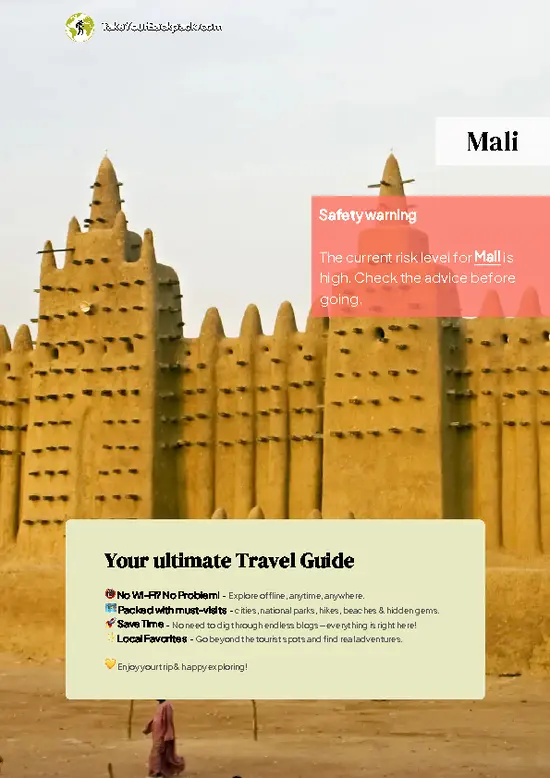
example page 0 from our offline Travel Guide for Mali
example page 1 from our offline Travel Guide for Mali
example page 2 from our offline Travel Guide for Mali
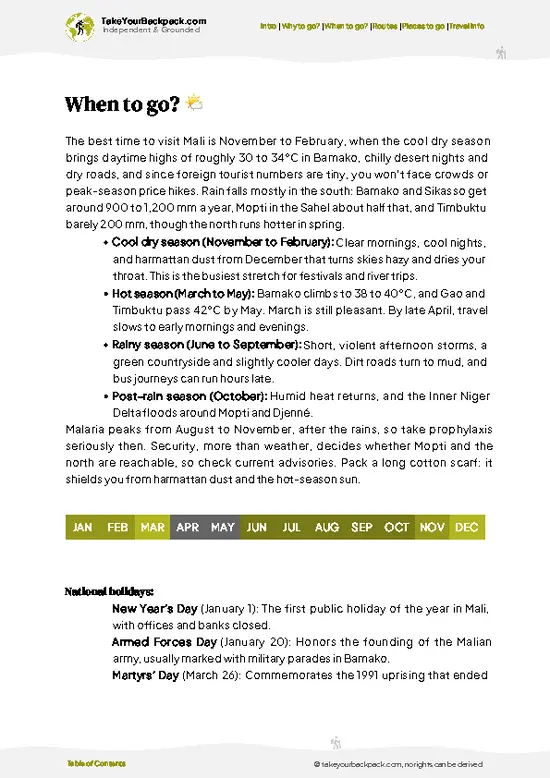
example page 3 from our offline Travel Guide for Mali
example page 4 from our offline Travel Guide for Mali
example page 5 from our offline Travel Guide for Mali
example page 6 from our offline Travel Guide for Mali
example page 7 from our offline Travel Guide for Mali
Loading the map 🌍
CLICK TO FILTER
cities
towns
landmarks
national parks
hikes
attractions
festivals
regions
SHOW COUNTRY’S BESTSHOW ALL

✨ Why go?
Ranked #3 national park in Mali
Reasons people choose to explore here

Ansongo-Ménaka Reserve draws a very particular kind of backpacker: someone who wants raw Sahel with no ticket booth, no lodge and no other vehicle tracks. The acacia plains and sand dunes between the Niger valley and the desert edge give you a landscape that changes from river green to pale gravel within a single drive. Independent exploration is the whole point here, and it only works with local partners. Tours do not run in any organized way, so self-reliance matters, but so does a guide from the Songhai, Tuareg or Daoussahak communities who knows which tracks are passable and which water points hold in the dry months. The wildlife is the second pull. Antelope and gazelle species, ostriches and desert birds live in thin numbers across a huge area, so sightings are rare and feel earned. Add … read more 👉
Ansongo-Ménaka Reserve draws a very particular kind of backpacker: someone who wants raw Sahel with no ticket booth, no lodge and no other vehicle tracks. The acacia plains and sand dunes between the Niger valley and the desert edge give you a landscape that changes from river green to pale gravel within a single drive. Independent exploration is the whole point here, and it only works with local partners. Tours do not run in any organized way, so self-reliance matters, but so does a guide from the Songhai, Tuareg or Daoussahak communities who knows which tracks are passable and which water points hold in the dry months. The wildlife is the second pull. Antelope and gazelle species, ostriches and desert birds live in thin numbers across a huge area, so sightings are rare and feel earned. Add the Niger River at Ansongo, where fishing pirogues and irrigated plots sit against dry country, and you have a rare contrast. This is a place for experienced, well-prepared overlanders only.

💡 HighlightsKey sights and experiences for travelers

  1. Niger River at Ansongo: The green edge of the reserve region, where wide brown water, fishing boats and small rice and vegetable plots contrast sharply with the dust beyond. Birdlife is best along the banks.
  2. Acacia and scrub plains: The core landscape, flat Sahelian grassland dotted with thorn trees. After rains it turns green and holds grazing animals, which makes it the best chance to spot gazelles.
  3. Desert gazelles and ostriches: The reserve was set up to protect Sahelian fauna, and the sparse herds of gazelle and the occasional ostrich are the wildlife highlight. Sightings are brief and distant, so binoculars matter.
  4. Tilemsi valley: An ancient dry watercourse running north from the Niger region, lined with tamarisk and acacia. Its sandy floor makes the clearest route through otherwise featureless
… read more 👉
  1. Niger River at Ansongo: The green edge of the reserve region, where wide brown water, fishing boats and small rice and vegetable plots contrast sharply with the dust beyond. Birdlife is best along the banks.
  2. Acacia and scrub plains: The core landscape, flat Sahelian grassland dotted with thorn trees. After rains it turns green and holds grazing animals, which makes it the best chance to spot gazelles.
  3. Desert gazelles and ostriches: The reserve was set up to protect Sahelian fauna, and the sparse herds of gazelle and the occasional ostrich are the wildlife highlight. Sightings are brief and distant, so binoculars matter.
  4. Tilemsi valley: An ancient dry watercourse running north from the Niger region, lined with tamarisk and acacia. Its sandy floor makes the clearest route through otherwise featureless terrain.
  5. Seasonal pools and wadis: After the rainy season, shallow ponds appear and draw herders, waterbirds and wildlife. They are the best places to sit still and watch.
  6. Ménaka and Tuareg pastoral culture: The desert-edge town and the camps around it give context to the land, with camel and goat herds moving between wells and pastures. Greeting etiquette and tea matter more than any itinerary.
Ansongo-Ménaka Reserve has no entry gate that anyone staffs reliably, so the Niger riverbank and the open plains cost nothing to look at, while the guide and vehicle are your only real expense.
Spotted a mistake or missing something? Contact us.

🌤️ When to go?Weather, crowds, and seasonal trade-offs

  • Cool Dry Season (November to February): Days reach 28 to 35°C (82 to 95°F) and nights drop to 14 to 20°C (57 to 68°F), so walking is feasible. Daylight runs roughly 11 to 11.5 hours. Dust-laden Harmattan wind can haze the sky. Demand and lodging prices in Gao peak now.
  • Hot Season (March to June): Highs of 40 to 47°C (104 to 117°F) make midday movement punishing, and water becomes the limiting factor. Animals gather near the Niger River and remaining pools. Days stretch to about 12.5 hours.
  • Rains (July to September): Highs of 32 to 38°C (90 to 100°F) with storms. Sandy tracks turn to mud and wadis flood, which can cut off the reserve for days. Greenery is at its best but access is at its worst. Rooms and rides cost least.
  • Shoulder Weeks (October): Tracks are drying, heat is easing, and traffic
… read more 👉
  • Cool Dry Season (November to February): Days reach 28 to 35°C (82 to 95°F) and nights drop to 14 to 20°C (57 to 68°F), so walking is feasible. Daylight runs roughly 11 to 11.5 hours. Dust-laden Harmattan wind can haze the sky. Demand and lodging prices in Gao peak now.
  • Hot Season (March to June): Highs of 40 to 47°C (104 to 117°F) make midday movement punishing, and water becomes the limiting factor. Animals gather near the Niger River and remaining pools. Days stretch to about 12.5 hours.
  • Rains (July to September): Highs of 32 to 38°C (90 to 100°F) with storms. Sandy tracks turn to mud and wadis flood, which can cut off the reserve for days. Greenery is at its best but access is at its worst. Rooms and rides cost least.
  • Shoulder Weeks (October): Tracks are drying, heat is easing, and traffic is light.
Aim for late November to January, and book transport with a buffer day in case of delays.


source: climatestotravel.comJANJanuary: excellent for travelingFEBFebruary: excellent for travelingMARMarch: highly recommended for travelingAPRApril: good for travelingMAYMay: fair for travelingJUNJune: below average for travelingJULJuly: below average for travelingAUGAugust: below average for travelingSEPSeptember: below average for travelingOCTOctober: fair for travelingNOVNovember: highly recommended for travelingDECDecember: excellent for traveling
when-to-go

✈️ The backpacker research shortcutMali Travel Guide

An offline-friendly backpacking guide with optimized travel routes, ranked highlights, transport advice, and the best areas to stay.
example page 0 from our offline Travel Guide for Mali
example page 1 from our offline Travel Guide for Mali
example page 2 from our offline Travel Guide for Mali
example page 3 from our offline Travel Guide for Mali
example page 4 from our offline Travel Guide for Mali
example page 5 from our offline Travel Guide for Mali
example page 6 from our offline Travel Guide for Mali
example page 7 from our offline Travel Guide for Mali
The digital guide (266 pages) contains:
✅ 61 highlights, ranked by travel appeal
✅ Optimized 5, 10 & 15-day travel routes
✅ Cities, national parks, landmarks, beaches
✅ How to get around
✅ Offline-friendly for travel without Wi-Fi
👉 Click to see all 30+ guide features

📅 Plan smarter in minutes, not weeks
✅ Month by month travel advice
✅ Festivals & national holidays
✅ Budget expectations

🗺️ Go to the right places, skip the overrated ones
✅ Honest pros & cons of destinations
✅ Top hikes, parks & viewpoints
✅ Lesser-known places most travelers miss
✅ Clear “worth it vs skip it” guidance

🛏️ Travel smoothly without rookie mistakes
✅ Best areas to stay
✅ Transport systems explained simply
✅ Common scams & safety advice
✅ SIM cards, money & practical tips

🌍 Understand the country, not just visit it
✅ Culture & traditions
✅ 52 Essential phrases & customs
✅ Festivals worth planning around
✅ Traveler-friendly historical context
✅ Insights that make places more meaningful

📱 Built for real travel conditions
✅ Fully downloadable PDF
✅ Works completely offline
✅ Optimized for phone use
✅ Useful in remote areas & buses
✅ Everything in one place
Stop searching, start planning
Get instant access to your full guide. 30‑day money-back guarantee.
+ Add another guide for just

By proceeding you agree to our terms.
Sent to your inbox immediately after payment • 100% Secure Checkout
Best Backpacking Travel Advisor 2025 tourism awardBest Backpacking
Travel Advisor
2025
What others say about Take Your Backpack Guides:
⭐⭐⭐⭐⭐
Fantastic, amazing amount of information!
⭐⭐⭐⭐⭐
My goodness this is amazing, it's what I've been looking for hats off too you!
⭐⭐⭐⭐⭐
I think this is absolutely BRILLIANT
⭐⭐⭐⭐
Very complete and informative. It's still missing places, but I gotta to commend you
⭐⭐⭐⭐⭐
This is truly amazing, thank you, can't wait to explore it with my kids!
⭐⭐⭐⭐⭐
Awesome resource, thank you!
⭐⭐⭐⭐⭐
This is amazing! Can't wait to explore the ones I haven't seen
⭐⭐⭐⭐
I love this! Well done, great idea.
⭐⭐⭐⭐⭐
Thanks for taking the time to make this gem!
⭐⭐⭐⭐⭐
This might be the best website I've ever seen.
⭐⭐⭐⭐⭐
Congratulations, and thank you so much for your work; it's incredibly valuable.
⭐⭐⭐⭐
In all seriousness I think you did a great job pointing out the important spots
⭐⭐⭐⭐⭐
10/10 very good
⭐⭐⭐⭐⭐
As someone who's only just starting to visit regularly this is awesome, thank you.
⭐⭐⭐⭐
Thank you very much! I'm going to visit my dad, it's going to be very useful!
⭐⭐⭐⭐⭐
This is really cool! We'll be travelling for the first time and this definitely come in handy.
⭐⭐⭐⭐⭐
You are now our minister of culture, congratulations 👨‍💼
⭐⭐⭐⭐⭐
Just wanted to tell you that this is a pearl! Going to follow your recommendations.
⭐⭐⭐⭐⭐
This is so cool. I'll definitely be using the resource for my travels soon.
⭐⭐⭐⭐⭐
This is very impressive! Good work.
⭐⭐⭐⭐⭐
This is an amazing and informative site. Very well done!

🛏️ Where to stay?Best areas and accommodation options

No lodging exists inside Ansongo-Ménaka Reserve, so you sleep in the towns around it. Ansongo, on the Niger River, is the closest base to the western edge. It has a few basic guesthouses and family-run rooms for about €8 to 15 a night, usually with a fan and bucket showers, and electricity that comes and goes. Gao, roughly 100 km northwest of Ansongo, has the widest choice. Expect simple hotels with air-conditioning at €20 to 40 and cheaper auberges at €10 to 20. Gao also has the markets where you stock up on water, bread, canned fish and fuel. Ménaka, in the east, has only very limited rooms … read more 👉
No lodging exists inside Ansongo-Ménaka Reserve, so you sleep in the towns around it. Ansongo, on the Niger River, is the closest base to the western edge. It has a few basic guesthouses and family-run rooms for about €8 to 15 a night, usually with a fan and bucket showers, and electricity that comes and goes. Gao, roughly 100 km northwest of Ansongo, has the widest choice. Expect simple hotels with air-conditioning at €20 to 40 and cheaper auberges at €10 to 20. Gao also has the markets where you stock up on water, bread, canned fish and fuel. Ménaka, in the east, has only very limited rooms and no real tourist services, so arrange hosts in advance. Camping in the reserve itself is not set up for visitors. Bring a sleeping mat and a mosquito net for any night away from town, because rooms often lack them. Dust is constant, so pack a scarf and keep gear zipped. Ask your host to introduce you to local officials, which matters more here than any review score.

👛 Costs (as of 22 October 2026)What things cost and how to budget

Ansongo-Ménaka Reserve costs roughly €58 to 133 per day for one traveler, with escorts and transport driving most of the bill. Figures below are estimates since the reserve has no regular visitor services, and payment is in cash.
CategoryBudget RangeLocal Reality
Entrance and permits€0 to 6No standard published ticket. Authorization is arranged through regional authorities in Gao.
Accommodation (high season, November to February)€12 to 25Basic guesthouses in Ansongo or Gao. Low season runs €8 to 18.
Local transport€10 to 30Shared vehicles between Gao and Ansongo cost little. Hiring a 4x4 for reserve tracks costs far more.
Food and supplies€6 to 12Rice, millet dishes, grilled fish from the Niger and bread. Bottled water adds up in the heat.
Guide and escort€30 to 60Essential for local knowledge and
… read more 👉
Ansongo-Ménaka Reserve costs roughly €58 to 133 per day for one traveler, with escorts and transport driving most of the bill. Figures below are estimates since the reserve has no regular visitor services, and payment is in cash.
CategoryBudget RangeLocal Reality
Entrance and permits€0 to 6No standard published ticket. Authorization is arranged through regional authorities in Gao.
Accommodation (high season, November to February)€12 to 25Basic guesthouses in Ansongo or Gao. Low season runs €8 to 18.
Local transport€10 to 30Shared vehicles between Gao and Ansongo cost little. Hiring a 4x4 for reserve tracks costs far more.
Food and supplies€6 to 12Rice, millet dishes, grilled fish from the Niger and bread. Bottled water adds up in the heat.
Guide and escort€30 to 60Essential for local knowledge and safe passage, and priced by the day.
Total Daily Budget€58 to 133Single traveler, high season.
⚠️ Prices can change and everyone travels differently, so take this as a rough guide. Hope it helps you plan your adventure!

🥾 TrailsTrail guide for Ansongo-Ménaka Reserve national park

Ansongo-Ménaka Reserve has no signed, named trails, so the walking people actually do is short and guided, starting from a vehicle drop-off or a village edge. Most outings are one to three hours on foot, then back to the vehicle, since heat, distance and open ground make long unsupported treks unwise.
  • River edge walk: Starts on the Niger banks near Ansongo, follows footpaths between fishing landings and small gardens. Flat, easy, about one to two hours, with herons, egrets and kingfishers.
  • Plains walk: Leaves from a vehicle stop on the acacia plains, ambling between thorn trees to scan for gazelles
… read more 👉
Ansongo-Ménaka Reserve has no signed, named trails, so the walking people actually do is short and guided, starting from a vehicle drop-off or a village edge. Most outings are one to three hours on foot, then back to the vehicle, since heat, distance and open ground make long unsupported treks unwise.
  • River edge walk: Starts on the Niger banks near Ansongo, follows footpaths between fishing landings and small gardens. Flat, easy, about one to two hours, with herons, egrets and kingfishers.
  • Plains walk: Leaves from a vehicle stop on the acacia plains, ambling between thorn trees to scan for gazelles and ostrich tracks. Flat but hot, with sandy and gravelly ground and almost no shade. Allow two to three hours.
  • Wadi and valley walk: Follows a dry watercourse such as the Tilemsi valley floor. The sand is soft and tiring, difficulty is moderate, and it is best taken slowly with plenty of water.
  • Pool watch: A short stroll to a seasonal pond after the rains, then a long sit. Easy terrain, rewarding for birds and for herders watering animals.
Terrain is mostly flat Sahel with low dunes, laterite crusts and sandy tracks, so the challenge is heat and navigation rather than climbing. Carry more water than seems sensible, a hat, a GPS device and a satellite communicator. Tracks are unmarked and can vanish after wind or rain, and a local guide is the only dependable way to find your way.
Practical access is the hard part. There is no scheduled public transport into the reserve, and reaching it means traveling from Gao on rough roads by private vehicle. Armed groups operate in the region, and road conditions and checkpoints change quickly, so independent travel without current local advice is not realistic. Crowds are not a concern; you may see only herders. No reliable entrance fee system is in place, though local authorities and community guides expect payment for their services.
⚠️ Hiking info can sometimes be outdated or inaccurate. Before you hit the trail, check the latest conditions with locals. If you do spot anything that's off, I'd love to hear from you, so I can update it for fellow travelers.

🛡️ SafetyTraveler Safety Guide

Security is the dominant issue at Ansongo-Ménaka Reserve, far above trail hazards. Armed groups operate across the Gao and Ménaka regions, roads are subject to ambushes and checkpoints, and many governments advise against all travel to the area. There are no ranger patrols or rescue services you can rely on, so independent backpacking here is not realistic. If you go at all, it would be only with a local guide who has current knowledge, official authorization, and an approved escort, and you should drop the plan whenever advice changes. On the ground, the environment is flat to gently rolling Sahel scrub and sand. Heat is the main physical risk, so carry at least 4 to 6 liters of water per person per day, wear a wide hat, and rest through midday. Navigation in sandy terrain is easy to lose, … read more 👉
Security is the dominant issue at Ansongo-Ménaka Reserve, far above trail hazards. Armed groups operate across the Gao and Ménaka regions, roads are subject to ambushes and checkpoints, and many governments advise against all travel to the area. There are no ranger patrols or rescue services you can rely on, so independent backpacking here is not realistic. If you go at all, it would be only with a local guide who has current knowledge, official authorization, and an approved escort, and you should drop the plan whenever advice changes. On the ground, the environment is flat to gently rolling Sahel scrub and sand. Heat is the main physical risk, so carry at least 4 to 6 liters of water per person per day, wear a wide hat, and rest through midday. Navigation in sandy terrain is easy to lose, so travel with a vehicle and a satellite communicator. Elephants and other wildlife are wary and rarely seen.

FAQTraveler FAQ

Ansongo-Ménaka Reserve would need about 2 to 3 days on site, plus 1 to 2 days of travel from Gao. The reserve covers a huge, sparsely tracked area of Sahel scrub east of the Niger River. Ansongo is the nearest town on the western side, and Ménaka lies to the east. Current security conditions can make any visit impossible, so keep dates flexible.
Ansongo-Ménaka Reserve is not practical without a vehicle. There are no public buses inside it, and tracks are sandy and unsigned. Shared transport runs from Gao to Ansongo, about 100 km, in roughly 2 to 3 hours depending on road and checkpoint conditions, but you then need a hired 4x4 with a driver, typically €60 to 150 a day. Walking in is not realistic given the heat and distances.
Ansongo-Ménaka Reserve has no regular ticket office, so there is no fixed published entrance fee. Authorization is arranged through regional officials in Gao or Ménaka, and costs may run from nothing to around €6 plus a guide or escort of about €30 to 60 a day. Foreign governments advise against travel to this region, so check current advice before planning anything.
⚠️ Things can change over time, so always validate details locally before you go.

Other Malian national parks near Ansongo-Ménaka Reserve

Explore more nearby:


💡 Not sure where to go next?
Create a personalized itinerary for Mali including Ansongo-Ménaka Reserve and the places that fit your trip.

Generate my itinerary

👉 Discover all national parks

Or checkout all Mali has to offer (think cities, towns, villages, national parks, hikes, beaches, festivals)
Country photo of Mali

We 💚 feedbackSumming up the experience

Ansongo-Ménaka Reserve is best in the cooler dry months, roughly November to February, when the heat eases and the pools left by the rains still hold birds and grazing animals. Within a day, the first two hours after dawn give you cool air and moving wildlife. I would only go when current local advice says the roads are open, and I would bring double the water I think I need.

✍️ Help improve this page!
The information on this page is based on in-depth research, insights shared by experienced travelers, and feedback from the local travel community in Mali. While every effort is made to keep the information accurate and current, conditions can change — so if you spot anything incorrect or outdated, please get in touch.


🙋‍♂️ Give feedback

👋 Meet the founderWho’s Behind Take Your Backpack?

Johan, backpacker and founder of TakeYourBackpackHi, I’m Johan (Netherlands 🇳🇱), the creator of TakeYourBackpack. Over the past 3 decades, I’ve backpacked through 90+ countries across six continents, gaining extensive experience with independent travel, long-term trips, and overland routes.

This site is built on a combination of firsthand travel experience and carefully curated insights from other backpackers. Many guides are based on places I’ve personally visited, while others bring together tips, observations, and practical advice shared by trusted travelers I’ve met along the way.

The goal is to provide realistic, experience-driven guidance — not generic itineraries — so you can explore destinations with better context, clearer expectations, and more confidence.