×

Mali🇲🇱 | national parksGourma Elephants ReserveDesert elephants, Lake Banzena, Hombori Tondo, Fulani and Tuareg camps | things to do and best time to go

Explore Boucle du Baoulé National ParkExplore Kouroufing National Park

Backpacking in Gourma Elephants Reserve
🏆 Top picknational park ranked #2
By Johan Kruseman 🇳🇱 | Updated October 22, 2026

Gourma Elephants Reserve is best known for the last desert elephants in Mali, a herd of several hundred animals that walks a huge loop through thorn scrub, dunes and seasonal lakes. The reserve sits in the Gourma region in the center-east of Mali, south of the Niger bend and near the Hombori mountains. On the ground, it is flat red sand, acacia and dry riverbeds. You travel by 4x4 or on foot behind a tracker, and a sighting means a gray shape moving through the thorns and the sound of branches snapping. That is the draw. Do not expect marked trails, viewing platforms or a guaranteed sighting, because the herd migrates and a wet-season visit can mean empty bush. Dry-season waterholes are the better bet and the time to put the effort in. Skip any trip that promises elephants on a fixed schedule. Before going, know that this part of Mali is under strong government travel advisories, so current security information and a local guide are the first things to arrange.

Discover everything you want to know in the 📖 Mali Travel Guide.
Safety warning

The current risk level for Mali is high. Check the advice before going.


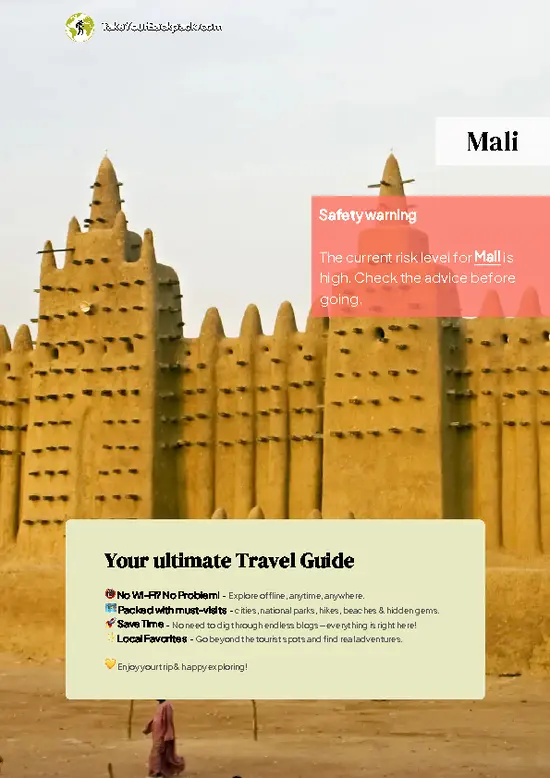
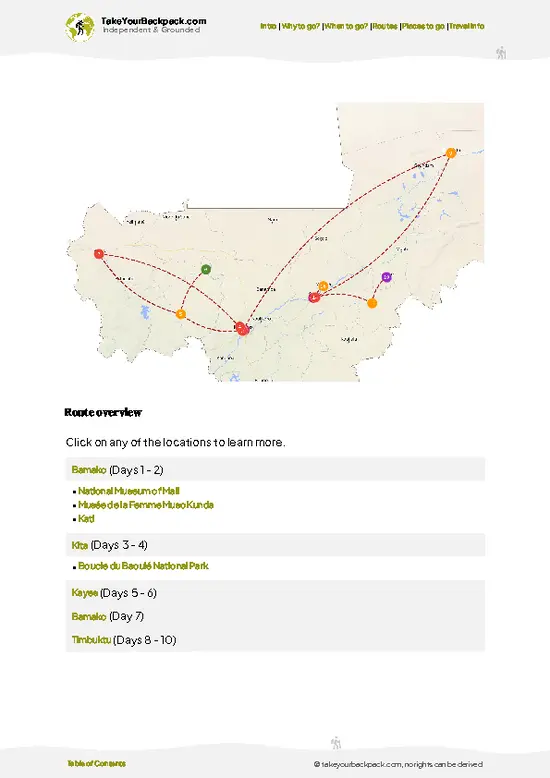
example page 0 from our offline Travel Guide for Mali
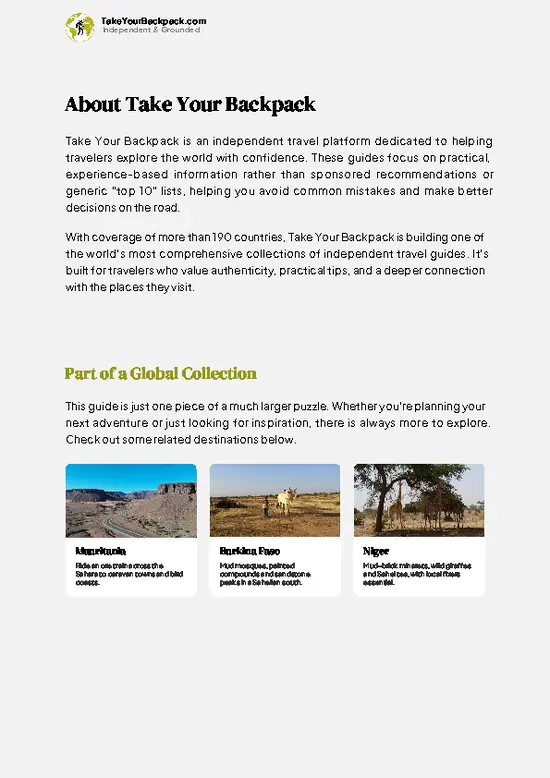
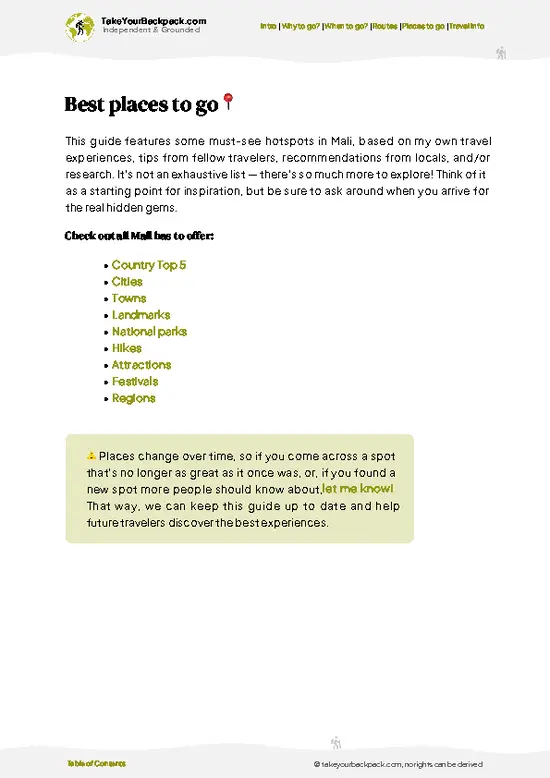
example page 1 from our offline Travel Guide for Mali
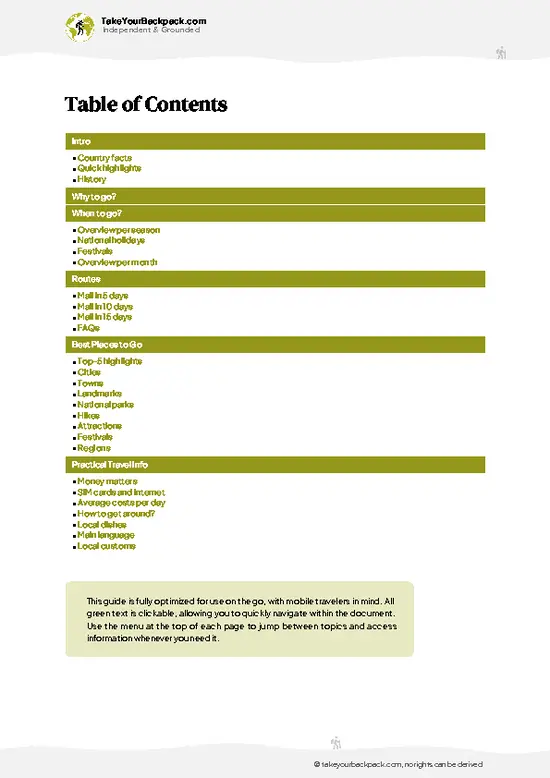
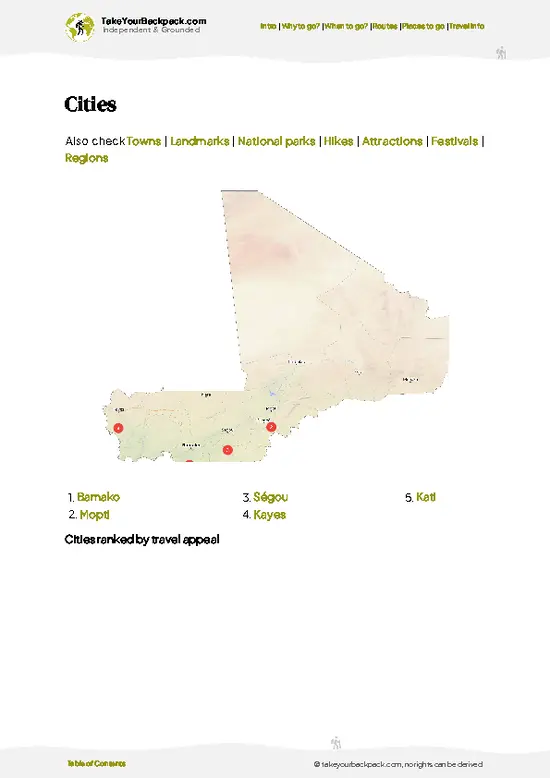
example page 2 from our offline Travel Guide for Mali
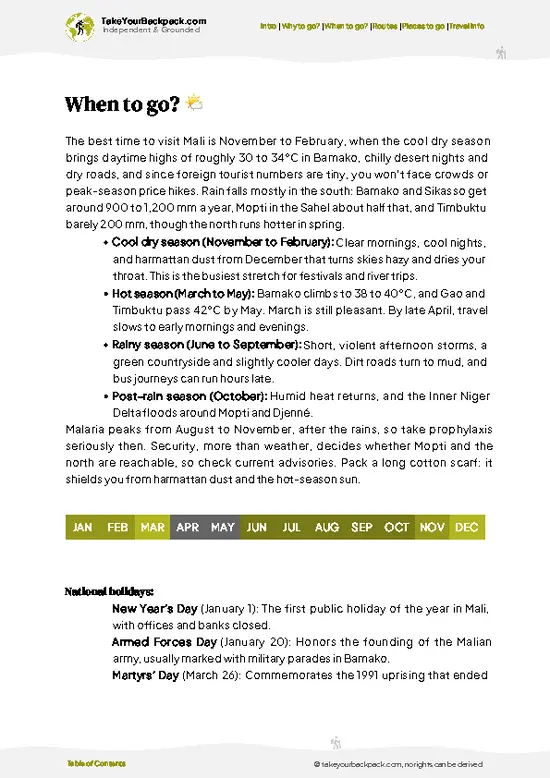
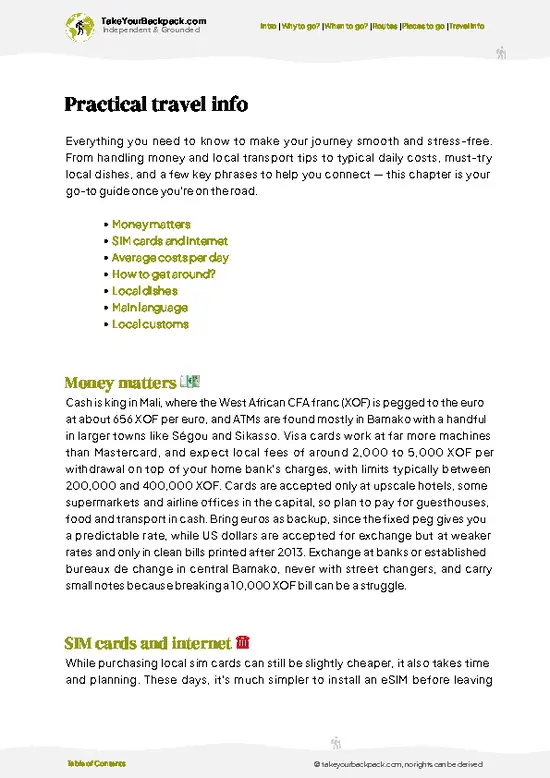
example page 3 from our offline Travel Guide for Mali
example page 4 from our offline Travel Guide for Mali
example page 5 from our offline Travel Guide for Mali
example page 6 from our offline Travel Guide for Mali
example page 7 from our offline Travel Guide for Mali
Loading the map 🌍
CLICK TO FILTER
cities
towns
landmarks
national parks
hikes
attractions
festivals
regions
SHOW COUNTRY’S BESTSHOW ALL

✨ Why go?
Ranked #2 national park in Mali
Reasons people choose to explore here

Gourma Elephants Reserve attracts backpackers who want wildlife without a safari-park circuit. The herd is the northernmost elephant population in Africa, and it walks a loop of hundreds of kilometers across the Sahel, so seeing it feels earned rather than purchased. There are no lodges, queues or minibus convoys. The experience works best when you travel independently and hire a local tracker, usually from Fulani or Tuareg communities who know where the animals drink and how the water moves from pond to pond.

The setting adds a second reason. The reserve sits close to the sandstone towers of Hombori Tondo, so you can pair elephant tracking with one of West Africa’s best desert climbs. The country between them is crossed by herders and camel caravans, which gives the trip a human side that … read more 👉
Gourma Elephants Reserve attracts backpackers who want wildlife without a safari-park circuit. The herd is the northernmost elephant population in Africa, and it walks a loop of hundreds of kilometers across the Sahel, so seeing it feels earned rather than purchased. There are no lodges, queues or minibus convoys. The experience works best when you travel independently and hire a local tracker, usually from Fulani or Tuareg communities who know where the animals drink and how the water moves from pond to pond.

The setting adds a second reason. The reserve sits close to the sandstone towers of Hombori Tondo, so you can pair elephant tracking with one of West Africa’s best desert climbs. The country between them is crossed by herders and camel caravans, which gives the trip a human side that fenced parks lack.

Self-guided travel here means arranging your own vehicle, water and a guide rather than joining a package. It suits experienced travelers who are comfortable with basic camping, long drives on sand and plans that change. If you want certainty, pick a park elsewhere. If you want the desert elephants of the Gourma, this is the only place to find them.

💡 HighlightsWhat this place is best known for

  1. Gourma desert elephants: The herd is the whole reason to come. These animals are slimmer and longer-legged than savanna elephants, built for long treks between water points across sand and thorn scrub. A good tracker can place you downwind at a respectful distance.
  2. Lake Banzena: One of the main seasonal waters in the Gourma, where elephants gather as other sources dry out. Sitting quietly on the shore in the dry months is the best chance of a long, calm sighting.
  3. Hombori Tondo: The highest peak in Mali at about 1,150 meters, a flat-topped sandstone massif rising from the plain. The climb is steep and rocky and needs a local guide, but the summit view of the Sahel stretches to the horizon.
  4. Hand of Fatima: A cluster of sandstone spires near Hombori that look like fingers raised from the plain.
… read more 👉
  1. Gourma desert elephants: The herd is the whole reason to come. These animals are slimmer and longer-legged than savanna elephants, built for long treks between water points across sand and thorn scrub. A good tracker can place you downwind at a respectful distance.
  2. Lake Banzena: One of the main seasonal waters in the Gourma, where elephants gather as other sources dry out. Sitting quietly on the shore in the dry months is the best chance of a long, calm sighting.
  3. Hombori Tondo: The highest peak in Mali at about 1,150 meters, a flat-topped sandstone massif rising from the plain. The climb is steep and rocky and needs a local guide, but the summit view of the Sahel stretches to the horizon.
  4. Hand of Fatima: A cluster of sandstone spires near Hombori that look like fingers raised from the plain. Rock climbers know them well, and for walkers they make a striking, shaded pause at the end of a long drive.
  5. Sahelian acacia scrub: The thorn-and-grass landscape between the lakes is the elephants’ pantry. Walking it with a tracker, you learn to read dung, bark damage and tracks, which makes sightings feel less like luck.
  6. Birdlife at the seasonal lakes: Waterbirds, raptors and small Sahel species cluster around the pools. It is a quiet bonus while you wait for the elephants to appear.
  7. Herder camps: Fulani and Tuareg families graze cattle and camels across the reserve. Greeting them and sharing tea, if invited, explains how people and elephants have shared the same water for generations.
At Gourma Elephants Reserve there are no tickets, but the Hombori climbs and any elephant tracking need a local guide and vehicle arranged ahead of time.
Spotted a mistake or missing something? Contact us.

🌤️ When to go?Seasonal considerations and timing

  • Cool Dry Season (November to February): Nights drop to 12-18°C (54-64°F) and days reach 28-33°C (82-91°F), the most comfortable walking weather. Daylight runs about 11 to 12 hours. Elephants are still spread around seasonal ponds, so sightings take tracking.
  • Hot Season (March to June): Highs of 38-44°C (100-111°F) make midday travel punishing. This is the peak for elephant viewing, because the herds concentrate around the few remaining water points, notably the lake near Gossi. Vehicle and guide prices are firmest now.
  • Rainy Season (July to September): Temperatures sit at 25-35°C (77-95°F), with storms that turn sandy tracks into mud and flood dry riverbeds. Elephants scatter across the open Sahel, vegetation is green, and sightings are hard to plan. Rates for 4x4 hire often soften.
  • Harmattan
… read more 👉
  • Cool Dry Season (November to February): Nights drop to 12-18°C (54-64°F) and days reach 28-33°C (82-91°F), the most comfortable walking weather. Daylight runs about 11 to 12 hours. Elephants are still spread around seasonal ponds, so sightings take tracking.
  • Hot Season (March to June): Highs of 38-44°C (100-111°F) make midday travel punishing. This is the peak for elephant viewing, because the herds concentrate around the few remaining water points, notably the lake near Gossi. Vehicle and guide prices are firmest now.
  • Rainy Season (July to September): Temperatures sit at 25-35°C (77-95°F), with storms that turn sandy tracks into mud and flood dry riverbeds. Elephants scatter across the open Sahel, vegetation is green, and sightings are hard to plan. Rates for 4x4 hire often soften.
  • Harmattan Weeks (December to February): Dust haze from the Sahara lowers visibility and flattens photos, though mornings are cool.
Book your vehicle for March to May, and start every drive at first light.


source: climatestotravel.comJANJanuary: excellent for travelingFEBFebruary: excellent for travelingMARMarch: excellent for travelingAPRApril: highly recommended for travelingMAYMay: fair for travelingJUNJune: below average for travelingJULJuly: below average for travelingAUGAugust: below average for travelingSEPSeptember: fair for travelingOCTOctober: fair for travelingNOVNovember: highly recommended for travelingDECDecember: excellent for traveling
when-to-go

✈️ The backpacker research shortcutMali Travel Guide

An offline-friendly backpacking guide with optimized travel routes, ranked highlights, transport advice, and the best areas to stay.
example page 0 from our offline Travel Guide for Mali
example page 1 from our offline Travel Guide for Mali
example page 2 from our offline Travel Guide for Mali
example page 3 from our offline Travel Guide for Mali
example page 4 from our offline Travel Guide for Mali
example page 5 from our offline Travel Guide for Mali
example page 6 from our offline Travel Guide for Mali
example page 7 from our offline Travel Guide for Mali
The digital guide (266 pages) contains:
✅ 61 highlights, ranked by travel appeal
✅ Optimized 5, 10 & 15-day travel routes
✅ Cities, national parks, landmarks, beaches
✅ How to get around
✅ Offline-friendly for travel without Wi-Fi
👉 Click to see all 30+ guide features

📅 Plan smarter in minutes, not weeks
✅ Month by month travel advice
✅ Festivals & national holidays
✅ Budget expectations

🗺️ Go to the right places, skip the overrated ones
✅ Honest pros & cons of destinations
✅ Top hikes, parks & viewpoints
✅ Lesser-known places most travelers miss
✅ Clear “worth it vs skip it” guidance

🛏️ Travel smoothly without rookie mistakes
✅ Best areas to stay
✅ Transport systems explained simply
✅ Common scams & safety advice
✅ SIM cards, money & practical tips

🌍 Understand the country, not just visit it
✅ Culture & traditions
✅ 52 Essential phrases & customs
✅ Festivals worth planning around
✅ Traveler-friendly historical context
✅ Insights that make places more meaningful

📱 Built for real travel conditions
✅ Fully downloadable PDF
✅ Works completely offline
✅ Optimized for phone use
✅ Useful in remote areas & buses
✅ Everything in one place
Stop searching, start planning
Get instant access to your full guide. 30‑day money-back guarantee.
+ Add another guide for just

By proceeding you agree to our terms.
Sent to your inbox immediately after payment • 100% Secure Checkout
Best Backpacking Travel Advisor 2025 tourism awardBest Backpacking
Travel Advisor
2025
What others say about Take Your Backpack Guides:
⭐⭐⭐⭐⭐
Fantastic, amazing amount of information!
⭐⭐⭐⭐⭐
My goodness this is amazing, it's what I've been looking for hats off too you!
⭐⭐⭐⭐⭐
I think this is absolutely BRILLIANT
⭐⭐⭐⭐
Very complete and informative. It's still missing places, but I gotta to commend you
⭐⭐⭐⭐⭐
This is truly amazing, thank you, can't wait to explore it with my kids!
⭐⭐⭐⭐⭐
Awesome resource, thank you!
⭐⭐⭐⭐⭐
This is amazing! Can't wait to explore the ones I haven't seen
⭐⭐⭐⭐
I love this! Well done, great idea.
⭐⭐⭐⭐⭐
Thanks for taking the time to make this gem!
⭐⭐⭐⭐⭐
This might be the best website I've ever seen.
⭐⭐⭐⭐⭐
Congratulations, and thank you so much for your work; it's incredibly valuable.
⭐⭐⭐⭐
In all seriousness I think you did a great job pointing out the important spots
⭐⭐⭐⭐⭐
10/10 very good
⭐⭐⭐⭐⭐
As someone who's only just starting to visit regularly this is awesome, thank you.
⭐⭐⭐⭐
Thank you very much! I'm going to visit my dad, it's going to be very useful!
⭐⭐⭐⭐⭐
This is really cool! We'll be travelling for the first time and this definitely come in handy.
⭐⭐⭐⭐⭐
You are now our minister of culture, congratulations 👨‍💼
⭐⭐⭐⭐⭐
Just wanted to tell you that this is a pearl! Going to follow your recommendations.
⭐⭐⭐⭐⭐
This is so cool. I'll definitely be using the resource for my travels soon.
⭐⭐⭐⭐⭐
This is very impressive! Good work.
⭐⭐⭐⭐⭐
This is an amazing and informative site. Very well done!

🛏️ Where to stay?How to pick the right area

No lodging exists inside Gourma Elephants Reserve, and the open Sahel around it has no formal campsites. Travelers sleep in towns on the edge of the reserve and drive out with a local guide.
Douentza is the practical gateway, on the main road between Mopti and Gao. Expect a few simple auberges with fan rooms and shared or basic private bathrooms for about €8-20 a night, plus roadside stalls for meals and fuel. It is the best place to hire a driver and a 4x4.
Hombori sits beneath the sandstone towers of the Hombori Tondo massif and has a small campement-style stay, around €6-15 a night, where you … read more 👉
No lodging exists inside Gourma Elephants Reserve, and the open Sahel around it has no formal campsites. Travelers sleep in towns on the edge of the reserve and drive out with a local guide.
Douentza is the practical gateway, on the main road between Mopti and Gao. Expect a few simple auberges with fan rooms and shared or basic private bathrooms for about €8-20 a night, plus roadside stalls for meals and fuel. It is the best place to hire a driver and a 4x4.
Hombori sits beneath the sandstone towers of the Hombori Tondo massif and has a small campement-style stay, around €6-15 a night, where you can pitch a tent or take a basic room. Climbers and photographers like it for the rock formations.
Boni and neighboring villages sometimes offer a mat or courtyard floor through a village chief, usually for a small gift or €3-6. Mopti and Sévaré are the larger bases, with more hotels (€15-45) and the bus connections, but they are a long drive from the reserve. Carry your own sleeping gear, water, and a headlamp, since power is patchy everywhere.

👛 Costs (as of 22 October 2026)Money, prices, and spending tips

A day around Gourma Elephants Reserve costs roughly €83 to €173 per person, and almost all of that is the vehicle and guide. Prices are paid in West African CFA francs, and the figures below are converted to euros. Costs fall if you split a 4x4 among three or four people.
CategoryBudget RangeLocal Reality
Entrance and community fees€3-8No fixed ticket office. Village or local conservation contributions are usually paid through your guide.
Accommodation (high season)€10-20Basic auberge rooms in Douentza or Hombori, or camping with your own gear for less.
Guide and 4x4 with driver€60-120The biggest expense. Fuel is included in most quotes, and rates rise from March to May when elephants gather at water.
Food and water€5-10Rice and sauce, grilled meat, bread, and tea at roadside stalls. Bottled water
… read more 👉
A day around Gourma Elephants Reserve costs roughly €83 to €173 per person, and almost all of that is the vehicle and guide. Prices are paid in West African CFA francs, and the figures below are converted to euros. Costs fall if you split a 4x4 among three or four people.
CategoryBudget RangeLocal Reality
Entrance and community fees€3-8No fixed ticket office. Village or local conservation contributions are usually paid through your guide.
Accommodation (high season)€10-20Basic auberge rooms in Douentza or Hombori, or camping with your own gear for less.
Guide and 4x4 with driver€60-120The biggest expense. Fuel is included in most quotes, and rates rise from March to May when elephants gather at water.
Food and water€5-10Rice and sauce, grilled meat, bread, and tea at roadside stalls. Bottled water costs more away from towns.
Local transport€5-15Shared buses or minibuses between Mopti, Sévaré, and Douentza, plus short motorbike hops.
Total Daily Budget€83-173Lower end assumes a shared vehicle and basic lodging.
⚠️ Prices can change and everyone travels differently, so take this as a rough guide. Hope it helps you plan your adventure!

🥾 TrailsBest hikes in Gourma Elephants Reserve national park

Gourma Elephants Reserve has no signed trail network. Walking here means following a tracker from a vehicle drop-off or from a camp, and routes shift with the herd. Terrain is flat to gently rolling sand, with rocky outcrops, dry stream beds and thorny scrub, and shade is scarce.
  • Elephant tracking on foot: Usually 2 to 4 hours, easy to moderate. You follow fresh tracks, dung and broken branches with a tracker and stop at a safe distance. Heat and soft sand are the real difficulty, not slopes.
  • Lakeside watch at Lake Banzena: Easy, 1 to 3 hours of sitting or short strolling. The best wildlife chance
… read more 👉
Gourma Elephants Reserve has no signed trail network. Walking here means following a tracker from a vehicle drop-off or from a camp, and routes shift with the herd. Terrain is flat to gently rolling sand, with rocky outcrops, dry stream beds and thorny scrub, and shade is scarce.
  • Elephant tracking on foot: Usually 2 to 4 hours, easy to moderate. You follow fresh tracks, dung and broken branches with a tracker and stop at a safe distance. Heat and soft sand are the real difficulty, not slopes.
  • Lakeside watch at Lake Banzena: Easy, 1 to 3 hours of sitting or short strolling. The best wildlife chance in the dry months, when elephants and livestock come to drink.
  • Hombori Tondo ascent: Hard, roughly 3 to 5 hours round trip. Steep scrambling over sandstone with a guide, rewarded by wide plains views.
  • Hand of Fatima base walk: Easy to moderate, 1 to 2 hours. Loose sand and rock lead to the base of the spires, and the scrambling is for climbers only.
  • Bush walks between camps: Easy to moderate, 2 to 3 hours. Watch for gazelles, jackals, baboons and a good range of birds.
Getting there is the hardest part. Public transport is limited to buses on the main highway toward Hombori, after which you need a hired 4x4 and driver to reach the elephants’ range. The area is remote, and conditions and security change quickly, so check current advice and use a trusted local fixer. The reserve is rarely crowded and you may meet nobody but herders. Carry more water than seems sensible, a hat, sun protection and your own food. Official entry arrangements are handled locally, so ask your guide what is due on the day.
⚠️ Hiking info can sometimes be outdated or inaccurate. Before you hit the trail, check the latest conditions with locals. If you do spot anything that's off, I'd love to hear from you, so I can update it for fellow travelers.

🛡️ SafetyScams, Hazards, and Annoyances

Security is the main issue here, far more than terrain or wildlife. The Gourma and the roads from Mopti toward Douentza and Hombori have seen armed group activity and banditry, and most governments advise against travel to this part of Mali. Check current advisories, move only with a trusted local guide, and avoid driving at night. Tell your hosts in Douentza your plan, and expect checkpoints where patience and photocopies of your passport help.
On the ground, the heat is the everyday hazard. Between March and June, carry at least 4 to 5 liters of water per person per day, and plan activity around the cooler hours. Tracks are sandy and unmarked, so a vehicle with a driver who knows the area and a spare tire matters. Elephants here are wary and wide-ranging. Keep at least 100 meters back, stay … read more 👉
Security is the main issue here, far more than terrain or wildlife. The Gourma and the roads from Mopti toward Douentza and Hombori have seen armed group activity and banditry, and most governments advise against travel to this part of Mali. Check current advisories, move only with a trusted local guide, and avoid driving at night. Tell your hosts in Douentza your plan, and expect checkpoints where patience and photocopies of your passport help.
On the ground, the heat is the everyday hazard. Between March and June, carry at least 4 to 5 liters of water per person per day, and plan activity around the cooler hours. Tracks are sandy and unmarked, so a vehicle with a driver who knows the area and a spare tire matters. Elephants here are wary and wide-ranging. Keep at least 100 meters back, stay inside the vehicle, and never position yourself between a herd and water.

FAQFrequently asked questions about Gourma Elephants Reserve

Plan on 3 to 4 days for Gourma Elephants Reserve, including travel. Douentza is roughly 1 day by road from Mopti and Sévaré, then you need 1 to 2 days tracking elephants with a local guide, and an extra half day to see the Hombori Tondo rock towers. The best sightings fall between March and June, when herds gather near water.
Reaching Gourma Elephants Reserve without a car is difficult. Buses and shared taxis run along the main road from Mopti and Sévaré to Douentza and Hombori, usually a few hours per leg at about €5-15, but the reserve itself is a wide stretch of sandy tracks with no public transport. You will need to hire a 4x4 with driver and guide locally, typically €60-120 a day, and security conditions mean going with someone who knows the area.
Gourma Elephants Reserve has no formal ticket booth or standard park pass, but you should expect small community and conservation contributions of about €3-8, usually collected through your local guide or village contact. Carry your passport and photocopies for the checkpoints along the road from Mopti to Douentza. Check current security advisories before booking, since movement in the area can be restricted.
⚠️ Things can change over time, so always validate details locally before you go.

Other Malian national parks near Gourma Elephants Reserve

Explore more nearby:


💡 Not sure where to go next?
Create a personalized itinerary for Mali including Gourma Elephants Reserve and the places that fit your trip.

Generate my itinerary

👉 Discover all national parks

Or checkout all Mali has to offer (think cities, towns, villages, national parks, hikes, beaches, festivals)
Country photo of Mali

We 💚 feedbackIs it worth it?

Gourma Elephants Reserve rewards you most in the late dry season, roughly May and early June, when the seasonal ponds shrink and the herd, the northernmost elephants in Africa, walks long distances to reach the water that remains. That is when your odds of seeing them are best. I would still plan around a few quiet days rather than a quick pass, bring all your own water, and hire a local guide from Douentza or Hombori, because the sandy tracks give no second chances.

✍️ Help improve this page!
The information on this page is based on in-depth research, insights shared by experienced travelers, and feedback from the local travel community in Mali. While every effort is made to keep the information accurate and current, conditions can change — so if you spot anything incorrect or outdated, please get in touch.


🙋‍♂️ Give feedback

👋 Meet the founderWho’s Behind Take Your Backpack?

Johan, backpacker and founder of TakeYourBackpackHi, I’m Johan (Netherlands 🇳🇱), the creator of TakeYourBackpack. Over the past 3 decades, I’ve backpacked through 90+ countries across six continents, gaining extensive experience with independent travel, long-term trips, and overland routes.

This site is built on a combination of firsthand travel experience and carefully curated insights from other backpackers. Many guides are based on places I’ve personally visited, while others bring together tips, observations, and practical advice shared by trusted travelers I’ve met along the way.

The goal is to provide realistic, experience-driven guidance — not generic itineraries — so you can explore destinations with better context, clearer expectations, and more confidence.