×

Mali🇲🇱 | regionsDogon CountryBandiagara Escarpment, cliff villages, Tellem granaries, mask traditions | things to do and best time to go

Explore Baoulé Loop Biosphere ReserveExplore Niger River

Backpacking in Dogon Country
UNESCO World Heritage site
🏆 Top pickregion ranked #1
By Johan Kruseman 🇳🇱 | Updated October 22, 2026

Dogon Country once meant planeloads of trekkers, a guide at every cliff stair and mask dances staged on schedule for tour groups. Today it is far quieter. Since the 2012 conflict and the violence in central Mali, visitor numbers have fallen sharply, and governments advise against travel here. The villages, though, are still lived in. Dogon Country sits in the center of Mali, east and southeast of Mopti, along the sandstone Bandiagara Escarpment, which runs about 150 km and drops as much as 500 m. The payoff is silence and scale: mud-brick granaries with pointed thatch hats, cave houses stuck to rock faces, onion fields on the plain below. Skip the souvenir stalls near the big villages, since the carved masks are mostly made for sale. Spend your time walking between hamlets, where a bowl of millet and a rooftop bed come with the view. Unlike the Hombori Mountains to the northeast, which are about rock towers and climbing, this is a place of cliff villages and living ritual.

Discover everything you want to know in the 📖 Mali Travel Guide.
Safety warning

The current risk level for Mali is high. Check the advice before going.


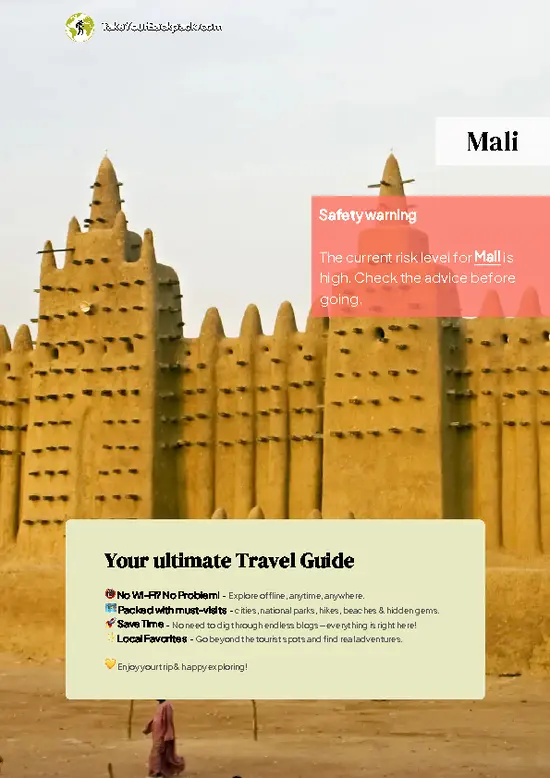
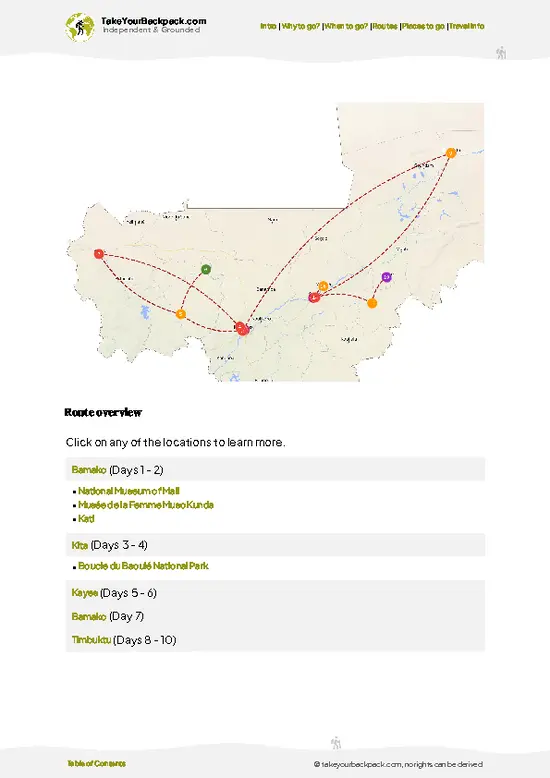
example page 0 from our offline Travel Guide for Mali
example page 1 from our offline Travel Guide for Mali
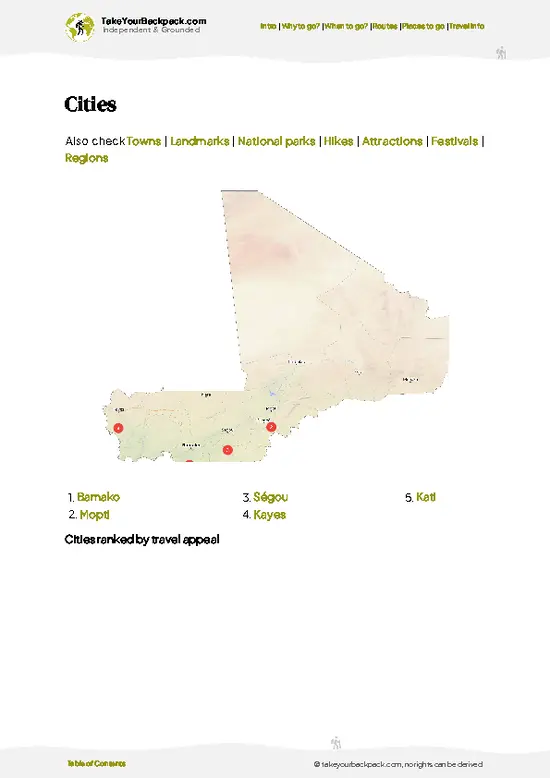
example page 2 from our offline Travel Guide for Mali
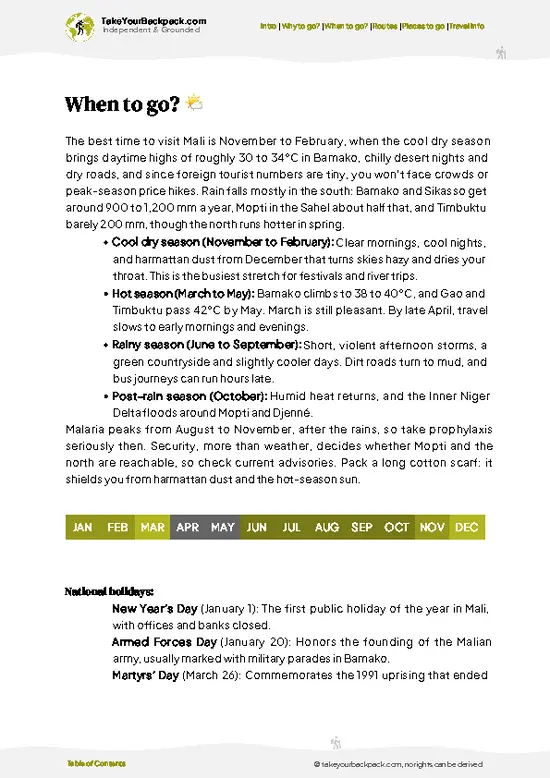
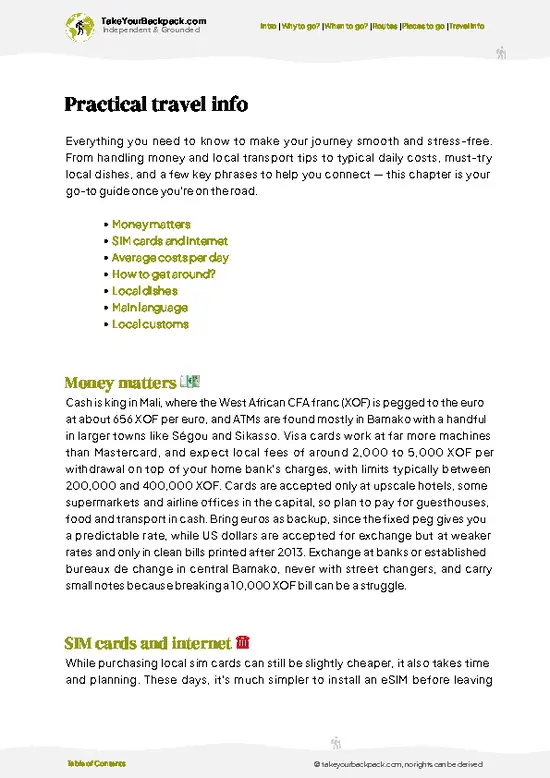
example page 3 from our offline Travel Guide for Mali
example page 4 from our offline Travel Guide for Mali
example page 5 from our offline Travel Guide for Mali
example page 6 from our offline Travel Guide for Mali
example page 7 from our offline Travel Guide for Mali
Loading the map 🌍
CLICK TO FILTER
cities
towns
landmarks
national parks
hikes
attractions
festivals
regions
SHOW COUNTRY’S BESTSHOW ALL

✨ Why go?
Ranked #1 region in Mali
Why Dogon Country should be on your travel list

Dogon Country gives you a full trek without a single flight or hotel change, because the whole show is strung along one wall of rock. The Bandiagara Escarpment stretches about 150 km, and the footpaths that run along its foot and up its gullies link village after village. You wake in a mud-walled courtyard, walk four or five hours past onion gardens and baobabs, and sleep on a rooftop under more stars than you can count. Nothing needs booking beyond a local guide, so you can lengthen or cut a trek halfway if your knees complain.

The culture sits right on the trail. In each village a low-roofed toguna, the men’s meeting shelter, holds the elders, and its ceiling is built so low that nobody can stand up and start a fight. Higher on the cliffs, the Tellem granaries predate the Dogon by centuries … read more 👉
Dogon Country gives you a full trek without a single flight or hotel change, because the whole show is strung along one wall of rock. The Bandiagara Escarpment stretches about 150 km, and the footpaths that run along its foot and up its gullies link village after village. You wake in a mud-walled courtyard, walk four or five hours past onion gardens and baobabs, and sleep on a rooftop under more stars than you can count. Nothing needs booking beyond a local guide, so you can lengthen or cut a trek halfway if your knees complain.

The culture sits right on the trail. In each village a low-roofed toguna, the men’s meeting shelter, holds the elders, and its ceiling is built so low that nobody can stand up and start a fight. Higher on the cliffs, the Tellem granaries predate the Dogon by centuries and still cling to ledges that look unreachable. A slow pace lets you see how farming, funerals and mask ceremonies fit together, which no half-day visit can show. Fewer travelers now means your hosts have time to talk, and the walking is yours alone.

💡 HighlightsMust-see experiences and standout moments

  1. Bandiagara Escarpment: The UNESCO-listed cliff line, about 150 km long and up to 500 m high, is the reason to come. Walk along its base and you pass villages built into every fold.
  2. Sangha (Sanga): The best-known village cluster, with a toguna, stone-and-mud lanes and some of the region’s most respected mask traditions. Views from the upper quarter run across the plain.
  3. Ireli: Tellem granaries cling to the cliff face right above the houses. Watching them from below, you begin to wonder how anyone built them.
  4. Teli: A village split between ledges and the plain, with a dramatic climb up the rock through narrow passages. It is a good place for photographs of cliff architecture.
  5. Songo: Known for a cave with red and white paintings used in circumcision rites. Local guides explain the symbols, which makes
… read more 👉
  1. Bandiagara Escarpment: The UNESCO-listed cliff line, about 150 km long and up to 500 m high, is the reason to come. Walk along its base and you pass villages built into every fold.
  2. Sangha (Sanga): The best-known village cluster, with a toguna, stone-and-mud lanes and some of the region’s most respected mask traditions. Views from the upper quarter run across the plain.
  3. Ireli: Tellem granaries cling to the cliff face right above the houses. Watching them from below, you begin to wonder how anyone built them.
  4. Teli: A village split between ledges and the plain, with a dramatic climb up the rock through narrow passages. It is a good place for photographs of cliff architecture.
  5. Songo: Known for a cave with red and white paintings used in circumcision rites. Local guides explain the symbols, which makes it one of the region’s best cultural stops.
  6. Tireli: A cliff-foot village at the mouth of a gorge, with a steep, rocky approach and fine views over fields. It is less crowded than Sangha.
  7. Kani Kombole: A lesser-known southern gateway where the escarpment starts to rise. A short climb leads to old Tellem ruins above the village.
  8. Arou: A quiet village near Sangha that is known as the home of the Hogon, a Dogon spiritual leader. The setting is intimate and visits are simple and respectful.
  9. Bandiagara market: The weekly market in the regional town brings in farmers, blacksmiths and weavers from surrounding villages. Come to see millet beer, indigo cloth and real local trade.
Dogon Country requires a local guide hired ahead, and each village charges a small entry fee paid on the spot.
Spotted a mistake or missing something? Contact us.

⌛️ 5 days5-day itinerary for Dogon Country

Day 1: Sangha: Start here, because it is the best-organized base, with several guesthouses, a toguna and views that explain the geography before you walk it. Use the first evening for a short stroll to the upper village and a rooftop sunset. Road access ends at the main villages, and from here everything is on foot, so every other day is set by how far your legs can go in the heat.

Day 2: Ireli: Walk down the plateau edge toward the cliff-foot paths. Ireli puts you directly beneath the Tellem granaries, and the walk keeps you in the shade of the rock during the hottest hours. Stay in a village guesthouse so a fire-cooked meal comes with the experience.

Day 3: Teli: This is the day that justifies the whole trip. Walk the base of the escarpment from Ireli to Teli, with onion terraces, wells … read more 👉
Day 1: Sangha: Start here, because it is the best-organized base, with several guesthouses, a toguna and views that explain the geography before you walk it. Use the first evening for a short stroll to the upper village and a rooftop sunset. Road access ends at the main villages, and from here everything is on foot, so every other day is set by how far your legs can go in the heat.

Day 2: Ireli: Walk down the plateau edge toward the cliff-foot paths. Ireli puts you directly beneath the Tellem granaries, and the walk keeps you in the shade of the rock during the hottest hours. Stay in a village guesthouse so a fire-cooked meal comes with the experience.

Day 3: Teli: This is the day that justifies the whole trip. Walk the base of the escarpment from Ireli to Teli, with onion terraces, wells and cliff houses overhead. Take the climb up through Teli’s rock passages, then rest in the shade. The slow walk shows how villages link together, and you will see more of daily life than anywhere else on the route.

Day 4: Songo: Go on to Songo and spend time at its painted cave. The path is shorter, leaving room for conversation with the guide about what the symbols mean. A detour to Arou adds the Hogon’s village without any extra transport: it is a short walk from Sangha and rewards a quiet, respectful visit.

Day 5: Bandiagara: Finish in the regional town by road. Market day gives you a full picture of the trade that supports the cliff villages, and the town is the easiest place to arrange onward transport.

🌤️ When to go?Best time to visit Dogon Country

  • Cool dry season (November to February): Dogon Country is at its most comfortable for trekking, with days around 30 to 34°C (86 to 93°F) and nights that can drop to 12 to 16°C (54 to 61°F) on the Bandiagara Escarpment. Harmattan dust often hazes the views. Guides and campements are busiest at Christmas, and prices are at their highest.
  • Hot season (March to May): Afternoons reach 38 to 42°C (100 to 108°F), so walking is only pleasant before mid-morning. Crowds thin out and rooms are easy to find. Plan to rest through the midday heat.
  • Rainy season (June to September): Expect 28 to 33°C (82 to 91°F), green millet fields, and storms that turn trails and dirt roads to mud. Some routes become hard to pass. Prices drop and you may have villages to yourself.
  • Onion and market days: Sangha and Bandiagara
… read more 👉
  • Cool dry season (November to February): Dogon Country is at its most comfortable for trekking, with days around 30 to 34°C (86 to 93°F) and nights that can drop to 12 to 16°C (54 to 61°F) on the Bandiagara Escarpment. Harmattan dust often hazes the views. Guides and campements are busiest at Christmas, and prices are at their highest.
  • Hot season (March to May): Afternoons reach 38 to 42°C (100 to 108°F), so walking is only pleasant before mid-morning. Crowds thin out and rooms are easy to find. Plan to rest through the midday heat.
  • Rainy season (June to September): Expect 28 to 33°C (82 to 91°F), green millet fields, and storms that turn trails and dirt roads to mud. Some routes become hard to pass. Prices drop and you may have villages to yourself.
  • Onion and market days: Sangha and Bandiagara hold weekly markets, and the Sunday market in Sangha is worth planning your trek around. Dances are staged mostly in the dry months.
  • Daylight: Days run roughly 11 to 13 hours, so start walking early.
Book your guide a few days ahead in December and January, and leave a spare day in case of a washed-out road.


source: climatestotravel.comJANJanuary: excellent for travelingFEBFebruary: excellent for travelingMARMarch: highly recommended for travelingAPRApril: good for travelingMAYMay: fair for travelingJUNJune: fair for travelingJULJuly: below average for travelingAUGAugust: below average for travelingSEPSeptember: fair for travelingOCTOctober: good for travelingNOVNovember: excellent for travelingDECDecember: excellent for traveling
when-to-go

✈️ The backpacker research shortcutMali Travel Guide

An offline-friendly backpacking guide with optimized travel routes, ranked highlights, transport advice, and the best areas to stay.
example page 0 from our offline Travel Guide for Mali
example page 1 from our offline Travel Guide for Mali
example page 2 from our offline Travel Guide for Mali
example page 3 from our offline Travel Guide for Mali
example page 4 from our offline Travel Guide for Mali
example page 5 from our offline Travel Guide for Mali
example page 6 from our offline Travel Guide for Mali
example page 7 from our offline Travel Guide for Mali
The digital guide (266 pages) contains:
✅ 61 highlights, ranked by travel appeal
✅ Optimized 5, 10 & 15-day travel routes
✅ Cities, national parks, landmarks, beaches
✅ How to get around
✅ Offline-friendly for travel without Wi-Fi
👉 Click to see all 30+ guide features

📅 Plan smarter in minutes, not weeks
✅ Month by month travel advice
✅ Festivals & national holidays
✅ Budget expectations

🗺️ Go to the right places, skip the overrated ones
✅ Honest pros & cons of destinations
✅ Top hikes, parks & viewpoints
✅ Lesser-known places most travelers miss
✅ Clear “worth it vs skip it” guidance

🛏️ Travel smoothly without rookie mistakes
✅ Best areas to stay
✅ Transport systems explained simply
✅ Common scams & safety advice
✅ SIM cards, money & practical tips

🌍 Understand the country, not just visit it
✅ Culture & traditions
✅ 52 Essential phrases & customs
✅ Festivals worth planning around
✅ Traveler-friendly historical context
✅ Insights that make places more meaningful

📱 Built for real travel conditions
✅ Fully downloadable PDF
✅ Works completely offline
✅ Optimized for phone use
✅ Useful in remote areas & buses
✅ Everything in one place
Stop searching, start planning
Get instant access to your full guide. 30‑day money-back guarantee.
+ Add another guide for just

By proceeding you agree to our terms.
Sent to your inbox immediately after payment • 100% Secure Checkout
Best Backpacking Travel Advisor 2025 tourism awardBest Backpacking
Travel Advisor
2025
What others say about Take Your Backpack Guides:
⭐⭐⭐⭐⭐
Fantastic, amazing amount of information!
⭐⭐⭐⭐⭐
My goodness this is amazing, it's what I've been looking for hats off too you!
⭐⭐⭐⭐⭐
I think this is absolutely BRILLIANT
⭐⭐⭐⭐
Very complete and informative. It's still missing places, but I gotta to commend you
⭐⭐⭐⭐⭐
This is truly amazing, thank you, can't wait to explore it with my kids!
⭐⭐⭐⭐⭐
Awesome resource, thank you!
⭐⭐⭐⭐⭐
This is amazing! Can't wait to explore the ones I haven't seen
⭐⭐⭐⭐
I love this! Well done, great idea.
⭐⭐⭐⭐⭐
Thanks for taking the time to make this gem!
⭐⭐⭐⭐⭐
This might be the best website I've ever seen.
⭐⭐⭐⭐⭐
Congratulations, and thank you so much for your work; it's incredibly valuable.
⭐⭐⭐⭐
In all seriousness I think you did a great job pointing out the important spots
⭐⭐⭐⭐⭐
10/10 very good
⭐⭐⭐⭐⭐
As someone who's only just starting to visit regularly this is awesome, thank you.
⭐⭐⭐⭐
Thank you very much! I'm going to visit my dad, it's going to be very useful!
⭐⭐⭐⭐⭐
This is really cool! We'll be travelling for the first time and this definitely come in handy.
⭐⭐⭐⭐⭐
You are now our minister of culture, congratulations 👨‍💼
⭐⭐⭐⭐⭐
Just wanted to tell you that this is a pearl! Going to follow your recommendations.
⭐⭐⭐⭐⭐
This is so cool. I'll definitely be using the resource for my travels soon.
⭐⭐⭐⭐⭐
This is very impressive! Good work.
⭐⭐⭐⭐⭐
This is an amazing and informative site. Very well done!

🛏️ Where to stay?Best areas to stay in Mali

Sangha is the best base for backpackers in Dogon Country, with several family-run campements, rooftop terraces and guides who know the cliff villages. A bed or mattress on a roof costs about €5 to 12 a night, often with dinner and breakfast available for a few euros more. It is the most social spot, since trekkers from different routes meet over evening meals, and it sits at the top of the escarpment. The Sunday market here is the reason many people time their stay.
Bandiagara is the practical gateway town. It has more services, a bank, and easy access to guides and transport, and rooms run about … read more 👉
Sangha is the best base for backpackers in Dogon Country, with several family-run campements, rooftop terraces and guides who know the cliff villages. A bed or mattress on a roof costs about €5 to 12 a night, often with dinner and breakfast available for a few euros more. It is the most social spot, since trekkers from different routes meet over evening meals, and it sits at the top of the escarpment. The Sunday market here is the reason many people time their stay.
Bandiagara is the practical gateway town. It has more services, a bank, and easy access to guides and transport, and rooms run about €8 to 20. It is calmer and less social, but it works well for the first or last night.
Down on the plain, Ireli, Djiguibombo and Banani offer a quiet alternative. Nights are simple: a mattress on a terrace under the stars, with no electricity in some places. You share a spot with only a handful of other walkers, so you meet people over the communal meal. Sleeping on the roof in the dry season is common and comfortable.
Sévaré, near Mopti, is useful for onward bus connections and has more standard rooms for around €10 to 25. It is not much fun in itself, so it suits one night before or after the trek.

🚌 Getting aroundGetting around like a local

Dogon Country has no train, and the bus from Bamako or Mopti drops you at Bandiagara or Sévaré, where shared taxis and motorbike taxis (about €1 to 2) cover the last few kilometers to the center. Most backpackers then walk the escarpment villages with a guide, using vehicles only to reach the trailheads. Roads are bumpy, schedules are loose, and nothing leaves on a strict timetable.
  • Long-distance bus: Buses from Bamako to Sévaré take around 10 to 12 hours and cost roughly €12 to 20. They are cramped and dusty, but they are the cheapest way in. You get a seat on an overnight run and arrive by morning.
  • Bush taxi (Sévaré to Bandiagara): These take about 45 minutes for €1 to 2 and leave when full. It is slow to fill, so be patient. You arrive in Bandiagara in time to arrange a guide.
  • Hired 4x4 or
… read more 👉
Dogon Country has no train, and the bus from Bamako or Mopti drops you at Bandiagara or Sévaré, where shared taxis and motorbike taxis (about €1 to 2) cover the last few kilometers to the center. Most backpackers then walk the escarpment villages with a guide, using vehicles only to reach the trailheads. Roads are bumpy, schedules are loose, and nothing leaves on a strict timetable.
  • Long-distance bus: Buses from Bamako to Sévaré take around 10 to 12 hours and cost roughly €12 to 20. They are cramped and dusty, but they are the cheapest way in. You get a seat on an overnight run and arrive by morning.
  • Bush taxi (Sévaré to Bandiagara): These take about 45 minutes for €1 to 2 and leave when full. It is slow to fill, so be patient. You arrive in Bandiagara in time to arrange a guide.
  • Hired 4x4 or pickup: Expect €50 to 90 a day with a driver to reach Sangha or the foot of the cliffs. It is worth the money when the rains have wrecked the road, because it saves hours of hauling a pack. Otherwise skip it. You get dry feet and an easier start on the trail.
  • Walking with a guide: Guides cost about €12 to 20 a day, with villages 3 to 5 hours apart on sandy paths below the cliff. Do this, because it is the reason to come. You get the view over the plain, and a bowl of millet porridge waiting at the campement.
  • Motorbike taxi: A short hop costs €1 to 3 and covers the gaps between villages. Dust is heavy, so it is not worth riding long distances. You get a quick lift when your legs are done.
Hire your guide in Bandiagara or Sévaré rather than on arrival at a village, and agree the price and route in advance.

🍲 FoodLocal Flavors for Backpackers

Dogon Country eats from the millet field. The staple is tô, a thick millet porridge scooped by hand and dipped into a sticky, tangy baobab leaf sauce or a peanut and okra stew. Expect rice with fish sauce and grilled chicken at the campements, often with fried onions, which are grown in the area and sold in dried balls at markets. Tea is brewed three rounds strong, sweet and bitter, poured from a height into small glasses.
The local drink is dolo, a cloudy millet beer, sour and slightly fizzy, served from calabash bowls in village tavernas, usually run by women. A bowl costs under €0.50. It is mildly alcoholic and tastes of bread and smoke.
Most travelers eat at their campement, where meals cost about €3 to 6 and are cooked over a fire, so allow time. Weekly village markets sell fried dough, … read more 👉
Dogon Country eats from the millet field. The staple is tô, a thick millet porridge scooped by hand and dipped into a sticky, tangy baobab leaf sauce or a peanut and okra stew. Expect rice with fish sauce and grilled chicken at the campements, often with fried onions, which are grown in the area and sold in dried balls at markets. Tea is brewed three rounds strong, sweet and bitter, poured from a height into small glasses.
The local drink is dolo, a cloudy millet beer, sour and slightly fizzy, served from calabash bowls in village tavernas, usually run by women. A bowl costs under €0.50. It is mildly alcoholic and tastes of bread and smoke.
Most travelers eat at their campement, where meals cost about €3 to 6 and are cooked over a fire, so allow time. Weekly village markets sell fried dough, grilled meat skewers and tomatoes, and make a good lunch stop on the trail. Bring bottled or treated water, since refills are limited.
Eat with your right hand only, and wait for the elder to begin when sharing a bowl. Alcohol is limited in some Muslim households, and it is polite to ask before taking a photo of someone cooking. Vegetarians should say so early, as the sauces are often made with dried fish.

FAQCommon questions from travelers

Plan on three to four days for a classic trek in Dogon Country, which is enough for a Sangha to Banani loop with two nights in villages. Add one more day for the Sunday market in Sangha, or stretch to five or six days to walk from the cliff top to Ireli and down to the plain. Guides cost about €12 to 20 a day, and Sévaré is a few hours from the trailheads.
Without a car, travel around Dogon Country by bush taxi from Sévaré to Bandiagara (about 45 minutes, €1 to 2), then on foot with a guide between villages 3 to 5 hours apart. Motorbike taxis cover short hops for €1 to 3, and a hired 4x4 with a driver costs about €50 to 90 a day. Buses from Bamako to Sévaré take 10 to 12 hours and cost roughly €12 to 20.
Dogon Country is known for the Bandiagara Escarpment, a UNESCO World Heritage cliff running about 150 kilometers, with cliffside villages, mud-built granaries and old Tellem dwellings. It is also known for Dogon masks, ceremonial dances, and a distinct cosmology and art tradition. Most visitors come for multi-day treks from Sangha, with the Sunday market there a highlight.
⚠️ Things can change over time, so always validate details locally before you go.

Other Malian regions near Dogon Country

Explore more nearby:

  • Niger River—Pinasse routes, Djenné mud mosque, Mopti port, Delta wetlands| 78 km away
  • Ségou Region—Ségou waterfront, Kalabougou kilns, bogolan mudcloth, Bambara heritage| 295 km away
  • Sikasso Region—Green hills, mango orchards, Tata walls, cotton towns| 581 km away

💡 Not sure where to go next?
Create a personalized itinerary for Mali including Dogon Country and the places that fit your trip.

Generate my itinerary

👉 Discover all regions

Or checkout all Mali has to offer (think cities, towns, villages, national parks, hikes, beaches, festivals)
Country photo of Mali

We 💚 feedbackWhat to keep in mind

Dogon Country looks best from the rooftop, so sleep outdoors. Almost every village guesthouse has a flat roof with a mat, and that is where the dawn light hits the cliffs and the first roosters start. I would bring a headlamp and a light sleeping sheet, and skip the inside rooms. Nights get surprisingly cool, and the quiet is the real surprise.

✍️ Help improve this page!
The information on this page is based on in-depth research, insights shared by experienced travelers, and feedback from the local travel community in Mali. While every effort is made to keep the information accurate and current, conditions can change — so if you spot anything incorrect or outdated, please get in touch.


🙋‍♂️ Give feedback

👋 Meet the founderWho’s Behind Take Your Backpack?

Johan, backpacker and founder of TakeYourBackpackHi, I’m Johan (Netherlands 🇳🇱), the creator of TakeYourBackpack. Over the past 3 decades, I’ve backpacked through 90+ countries across six continents, gaining extensive experience with independent travel, long-term trips, and overland routes.

This site is built on a combination of firsthand travel experience and carefully curated insights from other backpackers. Many guides are based on places I’ve personally visited, while others bring together tips, observations, and practical advice shared by trusted travelers I’ve met along the way.

The goal is to provide realistic, experience-driven guidance — not generic itineraries — so you can explore destinations with better context, clearer expectations, and more confidence.