×

Mali🇲🇱 | festivalsFestival OgobagnaKanaga masks, stilt dancers, millet dolo, elder storytellers | things to do and best time to go

Explore Salon International de l’Artisanat du MaliExplore Festival Triangle du Balafon

Backpacking in Ogobagna
🌟 Highlightfestival ranked #4
By Johan Kruseman 🇳🇱 | Updated October 22, 2026

Festival Ogobagna began as a Dogon community gathering rooted in cliff-country traditions, and today it plays out for a mixed crowd of Dogon families, Bamako locals and a small number of foreign visitors. It takes place in Bamako, in the south of Mali, so you get the masks and dances without the long haul to the Bandiagara escarpment. The theme is Dogon culture: masked dancers, drumming, storytelling, crafts and food. Expect a proud, family-heavy crowd, not a party crowd. It lasts a few days, and the vibe is more ceremony and conversation than stage production. Skip it if you want amplified headliners. Go if you want to see Dogon heritage explained by the people who live it, with room to ask questions. Unlike Festival sur le Niger in Ségou, which is a music festival with an international bill, Ogobagna is a single-culture showcase.

Discover everything you want to know in the 📖 Mali Travel Guide.
Safety warning

The current risk level for Mali is high. Check the advice before going.


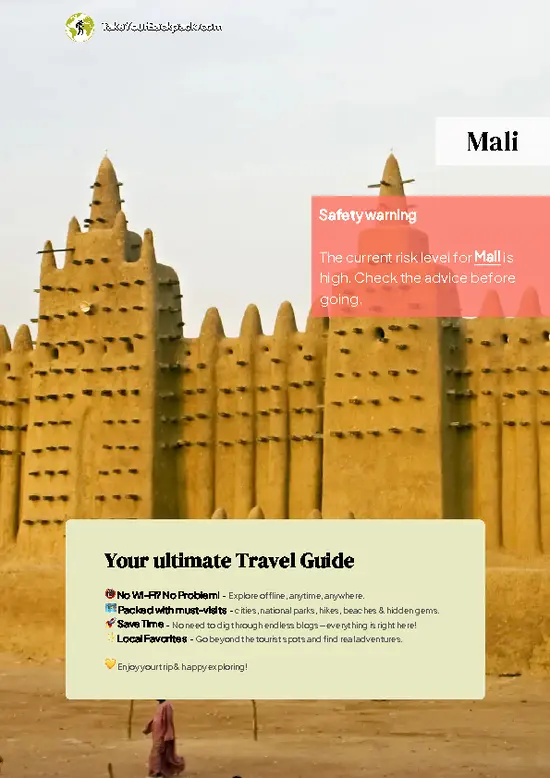
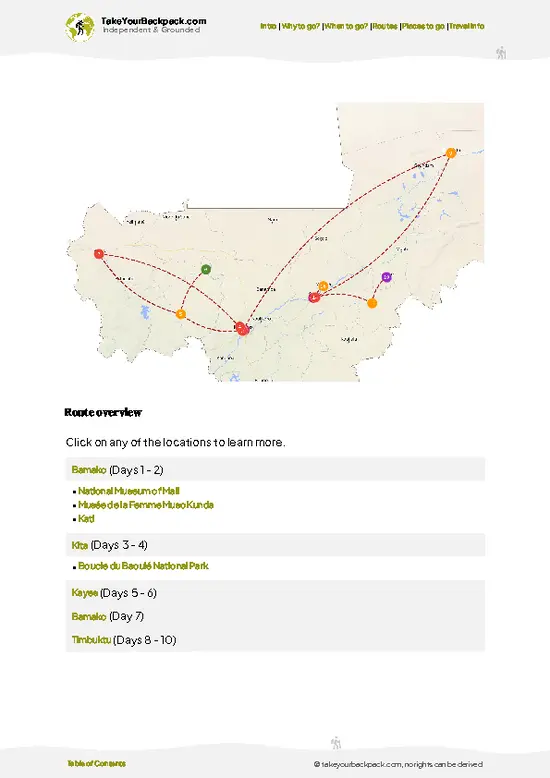
example page 0 from our offline Travel Guide for Mali
example page 1 from our offline Travel Guide for Mali
example page 2 from our offline Travel Guide for Mali
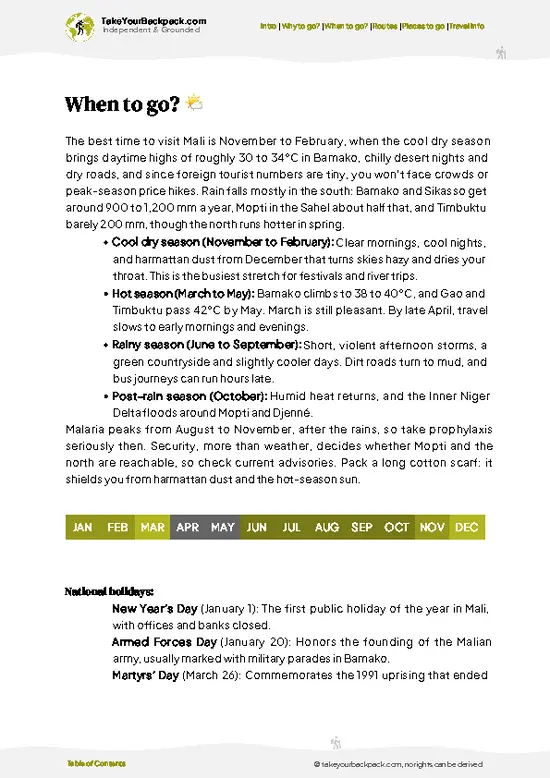
example page 3 from our offline Travel Guide for Mali
example page 4 from our offline Travel Guide for Mali
example page 5 from our offline Travel Guide for Mali
example page 6 from our offline Travel Guide for Mali
example page 7 from our offline Travel Guide for Mali
Loading the map 🌍
CLICK TO FILTER
cities
towns
landmarks
national parks
hikes
attractions
festivals
regions
SHOW COUNTRY’S BESTSHOW ALL

✨ Why go?
Ranked #4 festival in Mali
What makes this festival worth celebrating

Festival Ogobagna gives you a concentrated look at Dogon life in the capital, and that is the reason to plan around it. Seeing Dogon masked dances normally means a long trip to the cliffs, paying village fees and fitting your visit to a ceremony calendar. Here the dancers, elders and craftspeople come to you, and you can follow a performance with a conversation instead of guessing at its meaning.

The social side matters too. Dogon families dress up and bring relatives, so you end up sharing benches, food and explanations with strangers who are happy to talk. That temporary community is easy to join, even if your French is rusty.

It also works as a warm-up or a follow-up. Go before trekking the Bandiagara escarpment and the masks will mean far more when you reach the villages. Go after and … read more 👉
Festival Ogobagna gives you a concentrated look at Dogon life in the capital, and that is the reason to plan around it. Seeing Dogon masked dances normally means a long trip to the cliffs, paying village fees and fitting your visit to a ceremony calendar. Here the dancers, elders and craftspeople come to you, and you can follow a performance with a conversation instead of guessing at its meaning.

The social side matters too. Dogon families dress up and bring relatives, so you end up sharing benches, food and explanations with strangers who are happy to talk. That temporary community is easy to join, even if your French is rusty.

It also works as a warm-up or a follow-up. Go before trekking the Bandiagara escarpment and the masks will mean far more when you reach the villages. Go after and you can spot what you already saw. Compared with large festivals elsewhere, it stays cheap and unhurried.

💡 HighlightsEssential experiences to have while celebrating the Ogobagna

  1. Masked dance performances: This is the center of the festival. Dancers in carved wooden masks and fiber costumes perform the traditional repertoire, and the tall kanaga masks, with their double-cross crest, are the ones you will recognize from Dogon art. Each mask has a role in funerary and community rites, so ask a local to explain what you are watching.
  2. Stilt dancers: Dogon stilt dancers move high above the crowd with surprising speed and balance. They are easy to photograph and hard to forget, and the crowd reaction tells you when a performance is going well.
  3. Drumming and Dogon music: Percussion drives the dances and sets the pace of the whole event. Stand close enough to feel the drums in your chest, and watch how the musicians cue the dancers.
  4. Dogon food and millet beer: Millet is the staple
… read more 👉
  1. Masked dance performances: This is the center of the festival. Dancers in carved wooden masks and fiber costumes perform the traditional repertoire, and the tall kanaga masks, with their double-cross crest, are the ones you will recognize from Dogon art. Each mask has a role in funerary and community rites, so ask a local to explain what you are watching.
  2. Stilt dancers: Dogon stilt dancers move high above the crowd with surprising speed and balance. They are easy to photograph and hard to forget, and the crowd reaction tells you when a performance is going well.
  3. Drumming and Dogon music: Percussion drives the dances and sets the pace of the whole event. Stand close enough to feel the drums in your chest, and watch how the musicians cue the dancers.
  4. Dogon food and millet beer: Millet is the staple grain of the Dogon, and you will find it in porridges and in the fermented drink dolo. Eat what the families are eating and you get the best plate for the least money. Dolo is an acquired taste, sour and cloudy, so try a small cup first.
  5. Crafts and elder storytelling: Carvers and weavers set up with sculpted figures, masks and indigo-dyed cloth, and prices are negotiable and often better than in the tourist shops. Elders and storytellers explain symbols, clan histories and the meaning of the dances, and they are the best reason to stay past the main shows.
Festival Ogobagna fits comfortably into two days if you attend the main performances, and a third day lets you linger over the crafts and conversations.
Spotted a mistake or missing something? Contact us.

Things to do near Festival Ogobagna

Ratings based on Tripadvisor reviews. When you book through this link, you support our work at no extra cost to you.

🌤️ When to go?When is the celebration of Festival Ogobagna?

Festival Ogobagna is held in Bamako, Mali, usually over several days in the dry season (recent editions have fallen around February to April), with dates set by the organizers and the Dogon cultural calendar rather than a fixed day.
  • Best day: Go for the opening parade and the masked dance performances, when the Dogon community gathers in full costume and the crowd is most energized. Weekdays are calmer and easier for photos.
  • Weather: Expect hot, dry days of 33 to 38°C (91 to 100°F), cooler nights near 20 to 24°C (68 to 75°F), and almost no rain. Dust is common, so bring a scarf, sunglasses, a refillable bottle and a hat.
  • Booking: Reserve a bed two to three weeks ahead. Rates in central Bamako can rise by 20 to 30 percent while the event is on.
  • Crowds and roads: Traffic in Bamako clogs at dusk
… read more 👉
Festival Ogobagna is held in Bamako, Mali, usually over several days in the dry season (recent editions have fallen around February to April), with dates set by the organizers and the Dogon cultural calendar rather than a fixed day.
  • Best day: Go for the opening parade and the masked dance performances, when the Dogon community gathers in full costume and the crowd is most energized. Weekdays are calmer and easier for photos.
  • Weather: Expect hot, dry days of 33 to 38°C (91 to 100°F), cooler nights near 20 to 24°C (68 to 75°F), and almost no rain. Dust is common, so bring a scarf, sunglasses, a refillable bottle and a hat.
  • Booking: Reserve a bed two to three weeks ahead. Rates in central Bamako can rise by 20 to 30 percent while the event is on.
  • Crowds and roads: Traffic in Bamako clogs at dusk and over bridges across the Niger, so arrive at the venue before the afternoon rush and leave a little before the final acts end.
Take a motorbike taxi for the last stretch when roads jam.


source: climatestotravel.comJANJanuary: not recommended for travelingFEBFebruary: excellent for travelingMARMarch: not recommended for travelingAPRApril: not recommended for travelingMAYMay: not recommended for travelingJUNJune: not recommended for travelingJULJuly: not recommended for travelingAUGAugust: not recommended for travelingSEPSeptember: not recommended for travelingOCTOctober: not recommended for travelingNOVNovember: not recommended for travelingDECDecember: not recommended for traveling

✈️ The backpacker research shortcutMali Travel Guide

An offline-friendly backpacking guide with optimized travel routes, ranked highlights, transport advice, and the best areas to stay.
example page 0 from our offline Travel Guide for Mali
example page 1 from our offline Travel Guide for Mali
example page 2 from our offline Travel Guide for Mali
example page 3 from our offline Travel Guide for Mali
example page 4 from our offline Travel Guide for Mali
example page 5 from our offline Travel Guide for Mali
example page 6 from our offline Travel Guide for Mali
example page 7 from our offline Travel Guide for Mali
The digital guide (266 pages) contains:
✅ 61 highlights, ranked by travel appeal
✅ Optimized 5, 10 & 15-day travel routes
✅ Cities, national parks, landmarks, beaches
✅ How to get around
✅ Offline-friendly for travel without Wi-Fi
👉 Click to see all 30+ guide features

📅 Plan smarter in minutes, not weeks
✅ Month by month travel advice
✅ Festivals & national holidays
✅ Budget expectations

🗺️ Go to the right places, skip the overrated ones
✅ Honest pros & cons of destinations
✅ Top hikes, parks & viewpoints
✅ Lesser-known places most travelers miss
✅ Clear “worth it vs skip it” guidance

🛏️ Travel smoothly without rookie mistakes
✅ Best areas to stay
✅ Transport systems explained simply
✅ Common scams & safety advice
✅ SIM cards, money & practical tips

🌍 Understand the country, not just visit it
✅ Culture & traditions
✅ 52 Essential phrases & customs
✅ Festivals worth planning around
✅ Traveler-friendly historical context
✅ Insights that make places more meaningful

📱 Built for real travel conditions
✅ Fully downloadable PDF
✅ Works completely offline
✅ Optimized for phone use
✅ Useful in remote areas & buses
✅ Everything in one place
Stop searching, start planning
Get instant access to your full guide. 30‑day money-back guarantee.
+ Add another guide for just

By proceeding you agree to our terms.
Sent to your inbox immediately after payment • 100% Secure Checkout
Best Backpacking Travel Advisor 2025 tourism awardBest Backpacking
Travel Advisor
2025
What others say about Take Your Backpack Guides:
⭐⭐⭐⭐⭐
Fantastic, amazing amount of information!
⭐⭐⭐⭐⭐
My goodness this is amazing, it's what I've been looking for hats off too you!
⭐⭐⭐⭐⭐
I think this is absolutely BRILLIANT
⭐⭐⭐⭐
Very complete and informative. It's still missing places, but I gotta to commend you
⭐⭐⭐⭐⭐
This is truly amazing, thank you, can't wait to explore it with my kids!
⭐⭐⭐⭐⭐
Awesome resource, thank you!
⭐⭐⭐⭐⭐
This is amazing! Can't wait to explore the ones I haven't seen
⭐⭐⭐⭐
I love this! Well done, great idea.
⭐⭐⭐⭐⭐
Thanks for taking the time to make this gem!
⭐⭐⭐⭐⭐
This might be the best website I've ever seen.
⭐⭐⭐⭐⭐
Congratulations, and thank you so much for your work; it's incredibly valuable.
⭐⭐⭐⭐
In all seriousness I think you did a great job pointing out the important spots
⭐⭐⭐⭐⭐
10/10 very good
⭐⭐⭐⭐⭐
As someone who's only just starting to visit regularly this is awesome, thank you.
⭐⭐⭐⭐
Thank you very much! I'm going to visit my dad, it's going to be very useful!
⭐⭐⭐⭐⭐
This is really cool! We'll be travelling for the first time and this definitely come in handy.
⭐⭐⭐⭐⭐
You are now our minister of culture, congratulations 👨‍💼
⭐⭐⭐⭐⭐
Just wanted to tell you that this is a pearl! Going to follow your recommendations.
⭐⭐⭐⭐⭐
This is so cool. I'll definitely be using the resource for my travels soon.
⭐⭐⭐⭐⭐
This is very impressive! Good work.
⭐⭐⭐⭐⭐
This is an amazing and informative site. Very well done!

🛏️ Where to stay?Where staying makes the most sense

Hippodrome and Badalabougou are the most practical areas for backpackers who want to reach Festival Ogobagna easily, and both have a reputation for being calmer and safer than the dense city center after dark.
Badalabougou, on the south bank of the Niger, is quiet and residential with small guesthouses, plenty of cafes and taxis passing at all hours. You will meet other solo travelers, volunteers and researchers here, which makes it the best choice if you like company and easy conversation over breakfast.
Hippodrome, on the north side, is leafy and has a large choice of eateries and nightlife. It … read more 👉
Hippodrome and Badalabougou are the most practical areas for backpackers who want to reach Festival Ogobagna easily, and both have a reputation for being calmer and safer than the dense city center after dark.
Badalabougou, on the south bank of the Niger, is quiet and residential with small guesthouses, plenty of cafes and taxis passing at all hours. You will meet other solo travelers, volunteers and researchers here, which makes it the best choice if you like company and easy conversation over breakfast.
Hippodrome, on the north side, is leafy and has a large choice of eateries and nightlife. It suits people who want to go out after the performances finish, and shared taxis are easy to find. Stay on a main road and avoid walking alone late at night.
Around the Grand Marché and Medina Coura, rooms are the cheapest and the street life is lively, but it is crowded, noisy and less comfortable for first-timers carrying gear. Daytime is fine; at night take a taxi.
Whichever area you pick, choose somewhere with a night guard and a shared courtyard or rooftop, and ask the owner to book a trusted driver for festival evenings. Book early, as the better budget places fill first.

👛 Costs (as of 22 October 2026)Money, prices, and spending tips

A realistic budget for Festival Ogobagna is about €34 to 61 a day for an independent traveler, with the total below based on high-season guesthouse rates in Bamako. Travelers pay in the local currency.
CategoryBudget RangeLocal Reality
Festival tickets€0 to 8Many performances and gatherings are free or cost a small entry fee; special events can charge more.
Accommodation€12 to 25A simple guesthouse room or dorm bed; prices rise during the event, so book ahead.
Local transport€3 to 8Shared taxis and motorbike taxis cover short hops; a private taxi costs more at night.
Food & drinks€6 to 12Street grills, rice plates and juices keep meals cheap, and a restaurant dinner costs a bit more.
Miscellaneous expenses€3 to 8Water, SIM data, small handicrafts and tips for performers or guides.
Total Daily Budget€34 to 61About €45 on a typical day.
⚠️ Prices can change and everyone travels differently, so take this as a rough guide. Hope it helps you plan your adventure!

🍲 FoodEating & Drinking in Ogobagna

Eating at Festival Ogobagna is a street-food affair, with grilled meat as the headline. Skewers of beef or lamb get dusted with spicy pepper and onion, and they come off the charcoal fast, so eat them hot while the fat is still sizzling.
Look for riz gras, rice cooked in a tomato and oil sauce with vegetables, and tigadèguèna, a peanut sauce stew served with rice. Both appear in sit-down food corners ladled out in generous plates. For something authentically Dogon, try millet-based dishes and a bowl of to, a thick millet porridge eaten with a leafy sauce, usually with your right hand.
For drinks, bissap (hibiscus), gingembre (ginger juice) and sweet baobab juice come in plastic bags or bottles, chilled and welcome in the heat. Mint tea is poured in small glasses, in three rounds, each stronger … read more 👉
Eating at Festival Ogobagna is a street-food affair, with grilled meat as the headline. Skewers of beef or lamb get dusted with spicy pepper and onion, and they come off the charcoal fast, so eat them hot while the fat is still sizzling.
Look for riz gras, rice cooked in a tomato and oil sauce with vegetables, and tigadèguèna, a peanut sauce stew served with rice. Both appear in sit-down food corners ladled out in generous plates. For something authentically Dogon, try millet-based dishes and a bowl of to, a thick millet porridge eaten with a leafy sauce, usually with your right hand.
For drinks, bissap (hibiscus), gingembre (ginger juice) and sweet baobab juice come in plastic bags or bottles, chilled and welcome in the heat. Mint tea is poured in small glasses, in three rounds, each stronger and sweeter than the last. Sharing one pot is normal and friendly.
Bring small cash, since stalls rarely take cards and change for big notes can be slow. Prices are modest, and portions are large enough that two people can split a plate. Line up politely, wash your hands before eating, and stick to freshly cooked food and sealed water.

FAQCommon questions from travelers

Festival Ogobagna is held in Bamako, usually over several days in the dry season, with recent editions falling between February and April. The exact dates are set by the organizers each year, so confirm before you book flights. Plan to arrive a day early for the opening parade.
Attending Festival Ogobagna costs very little, as many performances are free and special events charge roughly €0 to 8. Most of your spending goes on a guesthouse in Bamako at about €12 to 25 a night and food at about €6 to 12 a day. A daily total of around €35 to 60 is realistic.
Tickets for Festival Ogobagna are generally not needed far in advance, since many events are open or paid at the entrance. Book your bed two to three weeks ahead, because prices in Bamako can rise 20 to 30 percent during the event. Carry small cash for any gate fees.
⚠️ Things can change over time, so always validate details locally before you go.

Other Malian festivals near Ogobagna

Explore more nearby:


💡 Not sure where to go next?
Create a personalized itinerary for Mali including Ogobagna and the places that fit your trip.

Generate my itinerary

👉 Discover all festivals

Or checkout all Mali has to offer (think cities, towns, villages, national parks, hikes, beaches, festivals)
Country photo of Mali

We 💚 feedbackParting advice and final tips

Festival Ogobagna trips up travelers who treat it like a concert and leave after the first dance set. Stay for the slow hours, when elders talk and families share food, because that is where the festival makes sense. I would bring small change, a notebook for names and meanings, and a few French phrases.

✍️ Help improve this page!
The information on this page is based on in-depth research, insights shared by experienced travelers, and feedback from the local travel community in Mali. While every effort is made to keep the information accurate and current, conditions can change — so if you spot anything incorrect or outdated, please get in touch.


🙋‍♂️ Give feedback

👋 Meet the founderWho’s Behind Take Your Backpack?

Johan, backpacker and founder of TakeYourBackpackHi, I’m Johan (Netherlands 🇳🇱), the creator of TakeYourBackpack. Over the past 3 decades, I’ve backpacked through 90+ countries across six continents, gaining extensive experience with independent travel, long-term trips, and overland routes.

This site is built on a combination of firsthand travel experience and carefully curated insights from other backpackers. Many guides are based on places I’ve personally visited, while others bring together tips, observations, and practical advice shared by trusted travelers I’ve met along the way.

The goal is to provide realistic, experience-driven guidance — not generic itineraries — so you can explore destinations with better context, clearer expectations, and more confidence.