



×

Marshall Islands🇲🇭 | villagesLikiepPlantation-era family houses, old cemetery, lagoon-side lanes, bicycles | things to do and best time to go

Explore Bikini AtollExplore Wotje

Backpacking in Likiep
🏆 Top pickvillage ranked #2
By Johan Kruseman 🇳🇱 | Updated October 22, 2026

A short flight from Majuro on Air Marshall Islands puts you on Likiep, which means no waiting weeks for a field-trip ship. The atoll sits in the northern Ratak Chain of the Marshall Islands, northwest of the capital, and its village lines the lagoon side of the main island. Expect coconut palms rattling in the trade wind, the smell of drying copra, sandy lanes where bicycles outnumber vehicles, and a lagoon that goes from milky green to deep blue within a few strokes. The hard parts are real: a small population, few shops with thin stock, limited power, and flights that shift with weather. Evenings are quiet. Families sit outside, generators hum, and you will meet other travelers mainly because there are so few of you. Likiep is a former plantation settlement with old family houses and graves, whereas neighboring Ailuk is better known for its mats and handicrafts.

Discover everything you want to know in the 📖 Marshall Islands Travel Guide.


example page 0 from our offline Travel Guide for Marshall Islands
example page 1 from our offline Travel Guide for Marshall Islands
example page 2 from our offline Travel Guide for Marshall Islands
example page 3 from our offline Travel Guide for Marshall Islands
example page 4 from our offline Travel Guide for Marshall Islands
example page 5 from our offline Travel Guide for Marshall Islands
example page 6 from our offline Travel Guide for Marshall Islands
example page 7 from our offline Travel Guide for Marshall Islands
Loading the map 🌍
CLICK TO FILTER
towns
villages
landmarks
national parks
hikes
beaches
attractions
festivals
regions
SHOW COUNTRY’S BESTSHOW ALL

✨ Why go?
Ranked #2 village in Marshall Islands
What sets this place apart

Backpackers come to Likiep because it is one of the few outer atolls where the human story is as strong as the lagoon. The village grew from a 19th-century trading venture, and the deBrum and Capelle family legacy is still visible in surnames, old house sites and the cemetery. That gives you something to walk toward each day instead of just hammock time. The second draw is the water. Calm lagoon snorkeling off the village shore needs no tour, only a mask and a local who knows which patches of coral are healthy. Most people stay several days, because flights are infrequent and the pace rewards lingering. It suits slow travelers, history readers, and solo travelers who like being invited into a conversation on a porch. It does not suit anyone needing a menu, a bar or reliable connectivity. Bring … read more 👉
Backpackers come to Likiep because it is one of the few outer atolls where the human story is as strong as the lagoon. The village grew from a 19th-century trading venture, and the deBrum and Capelle family legacy is still visible in surnames, old house sites and the cemetery. That gives you something to walk toward each day instead of just hammock time. The second draw is the water. Calm lagoon snorkeling off the village shore needs no tour, only a mask and a local who knows which patches of coral are healthy. Most people stay several days, because flights are infrequent and the pace rewards lingering. It suits slow travelers, history readers, and solo travelers who like being invited into a conversation on a porch. It does not suit anyone needing a menu, a bar or reliable connectivity. Bring food contributions, cash, and patience, and treat it as a deliberate pause from Majuro rather than a stop on a tight loop.

💡 HighlightsThe experiences that define the visit

  1. Historic family house sites and village lanes: The settlement grew around the homes of the founding trading families, and a slow walk shows weathered timber houses, cisterns and old plantation-era layouts among the palms. Ask permission before photographing around private homes. Go in early morning or late afternoon for softer light and cooler air. Free, 1 to 2 hours.
  2. Likiep cemetery: Family graves here record the Portuguese, German and Marshallese lines that shaped the atoll, with names you will hear again in conversation around the village. Walk quietly, keep to paths and do not step on grave plots. Morning is best, before the heat. Free, about 30 to 45 minutes.
  3. Lagoon snorkeling off the village shore: Shallow sandy flats drop to coral heads where reef fish, parrotfish and the occasional ray
… read more 👉
  1. Historic family house sites and village lanes: The settlement grew around the homes of the founding trading families, and a slow walk shows weathered timber houses, cisterns and old plantation-era layouts among the palms. Ask permission before photographing around private homes. Go in early morning or late afternoon for softer light and cooler air. Free, 1 to 2 hours.
  2. Likiep cemetery: Family graves here record the Portuguese, German and Marshallese lines that shaped the atoll, with names you will hear again in conversation around the village. Walk quietly, keep to paths and do not step on grave plots. Morning is best, before the heat. Free, about 30 to 45 minutes.
  3. Lagoon snorkeling off the village shore: Shallow sandy flats drop to coral heads where reef fish, parrotfish and the occasional ray cruise through clear water. Slack tide and calm, sunny mornings give the best visibility. Bring your own mask, fins and reef-safe sun protection, since rentals are not a given. Local boat rides to better patches are arranged informally, so agree a fee beforehand, often a modest fuel contribution. Allow 1 to 3 hours.
Pair the village walk and cemetery in the cool of the morning, then save the snorkel for the calm midday light. For day trips, other islets around Likiep’s own lagoon, reached by local boat, offer quiet beaches and bird-rich reef edges.
Spotted a mistake or missing something? Contact us.

🌤️ When to go?Best time to visit Likiep

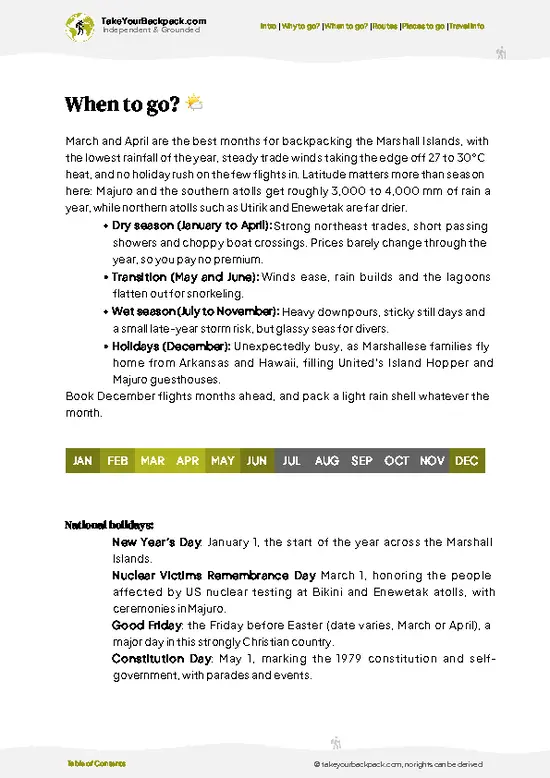
  • Dry Season (December to April): The most reliable window, with trade winds keeping afternoons around 28 to 30°C (82 to 86°F) and nights near 26°C (79°F). Lagoon water is calmest, so the boat or plane connection and snorkeling are easiest. Days run roughly 11.5 to 12 hours of light.
  • Wet Season (May to November): Showers come in short, heavy bursts, humidity sits high, and the lagoon turns choppy on windy days. Temperatures barely change, so the difference is mud, mosquitoes and delayed transport. Rainwater tanks are full, which helps with showers.
  • Crowds and Prices: Likiep sees almost no tourists in any month, so there is no peak pricing. Costs change only with freight and flight schedules, and homestay rates stay flat at a few dollars up or down.
  • Local Events: Christmas and Constitution Day (May
… read more 👉
  • Dry Season (December to April): The most reliable window, with trade winds keeping afternoons around 28 to 30°C (82 to 86°F) and nights near 26°C (79°F). Lagoon water is calmest, so the boat or plane connection and snorkeling are easiest. Days run roughly 11.5 to 12 hours of light.
  • Wet Season (May to November): Showers come in short, heavy bursts, humidity sits high, and the lagoon turns choppy on windy days. Temperatures barely change, so the difference is mud, mosquitoes and delayed transport. Rainwater tanks are full, which helps with showers.
  • Crowds and Prices: Likiep sees almost no tourists in any month, so there is no peak pricing. Costs change only with freight and flight schedules, and homestay rates stay flat at a few dollars up or down.
  • Local Events: Christmas and Constitution Day (May 1) bring families back from Majuro, which fills homes and boats.
Book your flight to Likiep well ahead and allow a few spare days, since the schedule can slip with weather.


source: climatestotravel.comJANJanuary: excellent for travelingFEBFebruary: excellent for travelingMARMarch: excellent for travelingAPRApril: excellent for travelingMAYMay: fair for travelingJUNJune: fair for travelingJULJuly: fair for travelingAUGAugust: fair for travelingSEPSeptember: fair for travelingOCTOctober: fair for travelingNOVNovember: fair for travelingDECDecember: highly recommended for traveling
when-to-go

✈️ The backpacker research shortcutMarshall Islands Travel Guide

An offline-friendly backpacking guide with optimized travel routes, ranked highlights, transport advice, and the best areas to stay.
example page 0 from our offline Travel Guide for Marshall Islands
example page 1 from our offline Travel Guide for Marshall Islands
example page 2 from our offline Travel Guide for Marshall Islands
example page 3 from our offline Travel Guide for Marshall Islands
example page 4 from our offline Travel Guide for Marshall Islands
example page 5 from our offline Travel Guide for Marshall Islands
example page 6 from our offline Travel Guide for Marshall Islands
example page 7 from our offline Travel Guide for Marshall Islands
The digital guide (125 pages) contains:
✅ 27 highlights, ranked by travel appeal
✅ Optimized 2, 3 & 5-day travel routes
✅ Cities, national parks, landmarks, beaches
✅ How to get around
✅ Offline-friendly for travel without Wi-Fi
👉 Click to see all 30+ guide features

📅 Plan smarter in minutes, not weeks
✅ Month by month travel advice
✅ Festivals & national holidays
✅ Budget expectations

🗺️ Go to the right places, skip the overrated ones
✅ Honest pros & cons of destinations
✅ Top hikes, parks & viewpoints
✅ Lesser-known places most travelers miss
✅ Clear “worth it vs skip it” guidance

🛏️ Travel smoothly without rookie mistakes
✅ Best areas to stay
✅ Transport systems explained simply
✅ Common scams & safety advice
✅ SIM cards, money & practical tips

🌍 Understand the country, not just visit it
✅ Culture & traditions
✅ 52 Essential phrases & customs
✅ Festivals worth planning around
✅ Traveler-friendly historical context
✅ Insights that make places more meaningful

📱 Built for real travel conditions
✅ Fully downloadable PDF
✅ Works completely offline
✅ Optimized for phone use
✅ Useful in remote areas & buses
✅ Everything in one place
Stop searching, start planning
Get instant access to your full guide. 30‑day money-back guarantee.
+ Add another guide for just

By proceeding you agree to our terms.
Sent to your inbox immediately after payment • 100% Secure Checkout
Best Backpacking Travel Advisor 2025 tourism awardBest Backpacking
Travel Advisor
2025
What others say about Take Your Backpack Guides:
⭐⭐⭐⭐⭐
Fantastic, amazing amount of information!
⭐⭐⭐⭐⭐
My goodness this is amazing, it's what I've been looking for hats off too you!
⭐⭐⭐⭐⭐
I think this is absolutely BRILLIANT
⭐⭐⭐⭐
Very complete and informative. It's still missing places, but I gotta to commend you
⭐⭐⭐⭐⭐
This is truly amazing, thank you, can't wait to explore it with my kids!
⭐⭐⭐⭐⭐
Awesome resource, thank you!
⭐⭐⭐⭐⭐
This is amazing! Can't wait to explore the ones I haven't seen
⭐⭐⭐⭐
I love this! Well done, great idea.
⭐⭐⭐⭐⭐
Thanks for taking the time to make this gem!
⭐⭐⭐⭐⭐
This might be the best website I've ever seen.
⭐⭐⭐⭐⭐
Congratulations, and thank you so much for your work; it's incredibly valuable.
⭐⭐⭐⭐
In all seriousness I think you did a great job pointing out the important spots
⭐⭐⭐⭐⭐
10/10 very good
⭐⭐⭐⭐⭐
As someone who's only just starting to visit regularly this is awesome, thank you.
⭐⭐⭐⭐
Thank you very much! I'm going to visit my dad, it's going to be very useful!
⭐⭐⭐⭐⭐
This is really cool! We'll be travelling for the first time and this definitely come in handy.
⭐⭐⭐⭐⭐
You are now our minister of culture, congratulations 👨‍💼
⭐⭐⭐⭐⭐
Just wanted to tell you that this is a pearl! Going to follow your recommendations.
⭐⭐⭐⭐⭐
This is so cool. I'll definitely be using the resource for my travels soon.
⭐⭐⭐⭐⭐
This is very impressive! Good work.
⭐⭐⭐⭐⭐
This is an amazing and informative site. Very well done!

🛏️ Where to stay?Best areas and accommodation options

Likiep has no hotels or hostels, so you stay in a family home or a small guesthouse arranged through the local government or a contact on the island. Expect to pay roughly US$25 to 50 a night, often with meals, so ask what is included before you agree. Message ahead from Majuro, because walking up unannounced leaves your host with nothing prepared.
The settlement sits on Likiep Island in the southeast of the atoll, and everything is within a ten-minute walk along sandy lanes. Staying near the old plantation-era buildings and the Catholic church puts you close to the dock, the small store and the … read more 👉
Likiep has no hotels or hostels, so you stay in a family home or a small guesthouse arranged through the local government or a contact on the island. Expect to pay roughly US$25 to 50 a night, often with meals, so ask what is included before you agree. Message ahead from Majuro, because walking up unannounced leaves your host with nothing prepared.
The settlement sits on Likiep Island in the southeast of the atoll, and everything is within a ten-minute walk along sandy lanes. Staying near the old plantation-era buildings and the Catholic church puts you close to the dock, the small store and the main path. Rooms are simple, with a mattress, a net or fan if the generator is running, and shared washing facilities using rainwater.
Bring cash in US dollars (the currency used in the Marshall Islands), because there are no ATMs or card readers. Pack a headlamp, insect repellent, a refillable bottle and some food gifts such as rice or coffee for your hosts. Power is limited, so bring a power bank. Dress modestly in the village, with shoulders and knees covered when not swimming.

🚌 Day tripsExploring the surroundings

Likiep is a poor base for conventional day trips, because the atoll has about 60 islets and outer motus are reached only by small skiff arranged with locals. Plan on half-day outings, ask your host to find a boat owner, and expect to cover fuel costs yourself.
Likiep Village Heritage Walk:
The settlement was built by the de Brum and Capelle families in the 1800s, and its old plantation houses, cemetery and stone-and-timber church reward an easy two-hour walk. It costs nothing, but ask a resident before entering any property or graveyard. Go early, before the midday heat builds, and look for the weathered copra-era structures near the shore.

Snorkeling the Lagoon Patch Reefs:
A skiff ride of 15 to 40 minutes takes you to coral heads inside the lagoon where reef fish and the occasional turtle … read more 👉
Likiep is a poor base for conventional day trips, because the atoll has about 60 islets and outer motus are reached only by small skiff arranged with locals. Plan on half-day outings, ask your host to find a boat owner, and expect to cover fuel costs yourself.
Likiep Village Heritage Walk:
The settlement was built by the de Brum and Capelle families in the 1800s, and its old plantation houses, cemetery and stone-and-timber church reward an easy two-hour walk. It costs nothing, but ask a resident before entering any property or graveyard. Go early, before the midday heat builds, and look for the weathered copra-era structures near the shore.

Snorkeling the Lagoon Patch Reefs:
A skiff ride of 15 to 40 minutes takes you to coral heads inside the lagoon where reef fish and the occasional turtle are common. Budget about US$20 to 40 for fuel and the boat owner’s time, split among the group. The calm months from December to April are best. First-timers often forget reef shoes and sun shirts, and lagoon sun burns fast.

Outer Motu Picnic:
Uninhabited islets on the atoll’s northern and eastern rim offer empty white beaches, coconut crabs after dark in some areas, and bird colonies. The trip takes about one to two hours each way by skiff depending on wind and chop, and costs US$30 to 60 for fuel. Carry your own water and shade, and agree on a pickup time, since there is no phone coverage out there.

Fishing with Local Families:
Join a fishing run on the lagoon edge for a half day, where trolling and line fishing bring in tuna, snapper or jacks. Offer US$15 to 30 toward fuel and bring your catch back to your host to cook.

FAQTraveler FAQ

Fly from Majuro to Likiep on Air Marshall Islands, which serves the atoll on a limited schedule, often once or twice a week. The flight takes a little over an hour, and fares are typically around US$100 to 200 each way. Field trip ships also call at the atoll, but they take a day or more and run irregularly, so allow spare days.
Yes, if you want a quiet atoll with no resorts and a tiny community of a few dozen to a couple of hundred residents. You get the old plantation-era buildings, calm lagoon snorkeling and long stretches of empty beach. Plan at least three to four nights, and expect basic rooms, limited power and cash-only spending.
Not realistically, since flights are infrequent and a same-day return from Majuro is rarely possible. Most visits last at least three to five nights to fit the schedule. Staying over also lets you hire a skiff for the outer islets, which costs roughly US$20 to 60 depending on distance.
⚠️ Things can change over time, so always validate details locally before you go.

More places to explore across Marshall Islands

Likiep isn’t the only highlight in Marshall Islands. Explore all what Marshall Islands has to offer.
Country photo of Marshall Islands

We 💚 feedbackSumming up the experience

Travelers often book a tight onward connection from Majuro and then panic when weather or a flight change strands them on Likiep. Leave several spare days at the end of your trip, carry extra cash and food, and treat a delay as another evening on the lagoon porch.

✍️ Help improve this page!
The information on this page is based on in-depth research, insights shared by experienced travelers, and feedback from the local travel community in Marshall Islands. While every effort is made to keep the information accurate and current, conditions can change — so if you spot anything incorrect or outdated, please get in touch.


🙋‍♂️ Give feedback

👋 Meet the founderWho’s Behind Take Your Backpack?

Johan, backpacker and founder of TakeYourBackpackHi, I’m Johan (Netherlands 🇳🇱), the creator of TakeYourBackpack. Over the past 3 decades, I’ve backpacked through 90+ countries across six continents, gaining extensive experience with independent travel, long-term trips, and overland routes.

This site is built on a combination of firsthand travel experience and carefully curated insights from other backpackers. Many guides are based on places I’ve personally visited, while others bring together tips, observations, and practical advice shared by trusted travelers I’ve met along the way.

The goal is to provide realistic, experience-driven guidance — not generic itineraries — so you can explore destinations with better context, clearer expectations, and more confidence.