v2.webp)
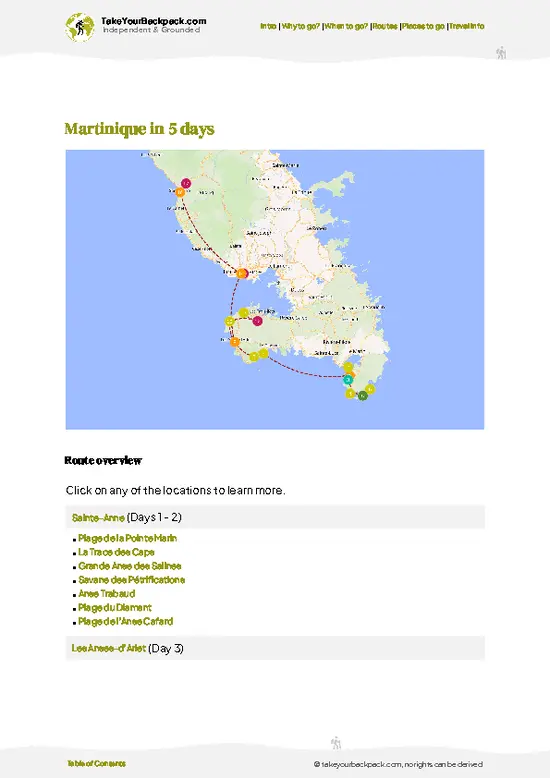
- Petrified wood fragments: The reason to come. Trunks and chunks of wood turned to silica, with visible growth rings in shades of gray, rust and cream, lie along the path. Look, photograph, never pocket.
- Dry cactus scrub: Tall columnar cacti, prickly pear and low acacia cover the ground, an odd sight on an island famous for rainforest. Morning light makes the red soil glow.
- Étang des Salines: A salt lagoon fringed with mangrove, good for herons, egrets and other waders at the water’s edge. The boardwalk-style paths around it are easy and flat.
- Anse Trabaud: A wide, wild beach on the Atlantic side with strong surf, little development and a long view of open water. Swimming is risky when the waves are up, so wade only.
- Grande Anse des Salines: The big, calm, palm-lined beach nearby, with fine pale
- Petrified wood fragments: The reason to come. Trunks and chunks of wood turned to silica, with visible growth rings in shades of gray, rust and cream, lie along the path. Look, photograph, never pocket.
- Dry cactus scrub: Tall columnar cacti, prickly pear and low acacia cover the ground, an odd sight on an island famous for rainforest. Morning light makes the red soil glow.
- Étang des Salines: A salt lagoon fringed with mangrove, good for herons, egrets and other waders at the water’s edge. The boardwalk-style paths around it are easy and flat.
- Anse Trabaud: A wide, wild beach on the Atlantic side with strong surf, little development and a long view of open water. Swimming is risky when the waves are up, so wade only.
- Grande Anse des Salines: The big, calm, palm-lined beach nearby, with fine pale sand and shallow water. It is the place to cool off after the scrub walk, though it fills on weekends.
- Coastal footpath views: Open stretches along the shore give wide views of the sea and small offshore islets, with constant trade wind that keeps the heat tolerable.
Spotted a mistake or missing something? Contact us.


 Best Backpacking
.jpg) Hi, I’m Johan (Netherlands 🇳🇱), the creator of TakeYourBackpack. Over the past 3 decades, I’ve backpacked through 90+ countries across six continents, gaining extensive experience with independent travel, long-term trips, and overland routes.
Hi, I’m Johan (Netherlands 🇳🇱), the creator of TakeYourBackpack. Over the past 3 decades, I’ve backpacked through 90+ countries across six continents, gaining extensive experience with independent travel, long-term trips, and overland routes.