×

Martinique🇲🇶 | townsLa TrinitéCaravelle reserve, Château Dubuc ruins, Tartane surf | things to do and best time to go

Explore Fort-de-FranceExplore Le Carbet

Backpacking in La Trinité
👍 Recommendedtown ranked #8
By Johan Kruseman 🇳🇱 | Updated October 22, 2026

La Trinité is best known for the Caravelle Peninsula, a long finger of dry forest and mangrove that pokes into the Atlantic, with the ruins of Château Dubuc at its tip. The town sits on Martinique’s northeast coast, on the windward side, in a deep bay with a working fishing harbor. Be straight with yourself about the town: it is small, quiet in the evenings, and has no real hostel scene. What it does well is nature. The peninsula trails, the mangrove paddling and the rough coastline are worth your time, while the town center itself needs only an hour. Meeting other backpackers is hit and miss, mostly on the trails or at the harbor cafés. A car makes everything easier, and buses thin out in the afternoon, so start early.

Discover everything you want to know in the 📖 Martinique Travel Guide.


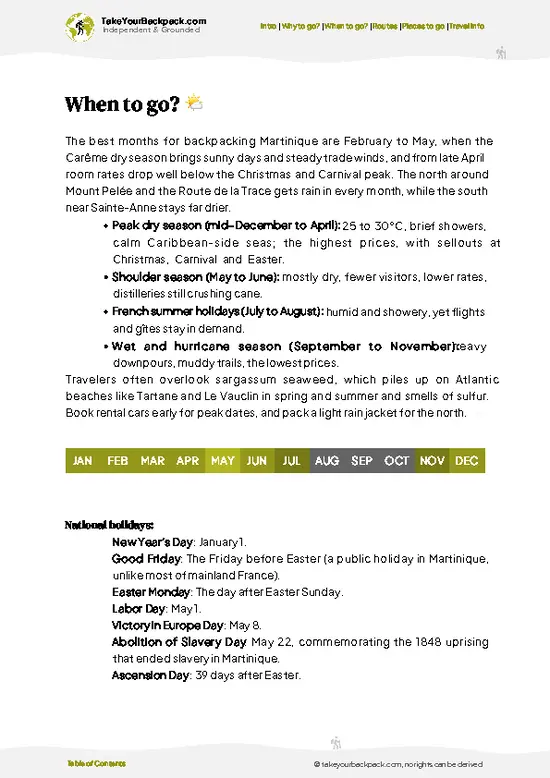
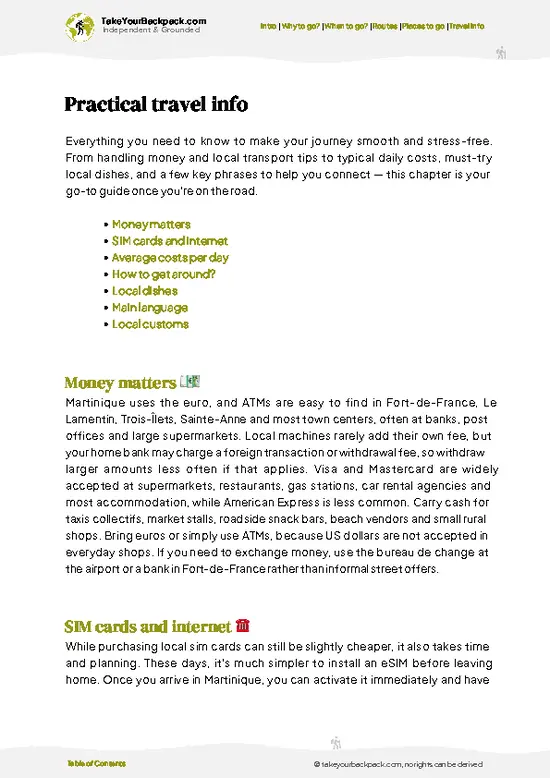
example page 0 from our offline Travel Guide for Martinique
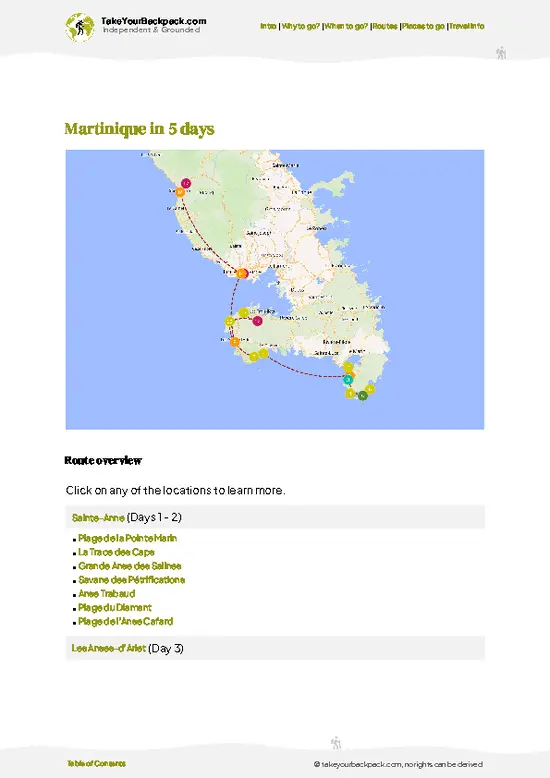
example page 1 from our offline Travel Guide for Martinique
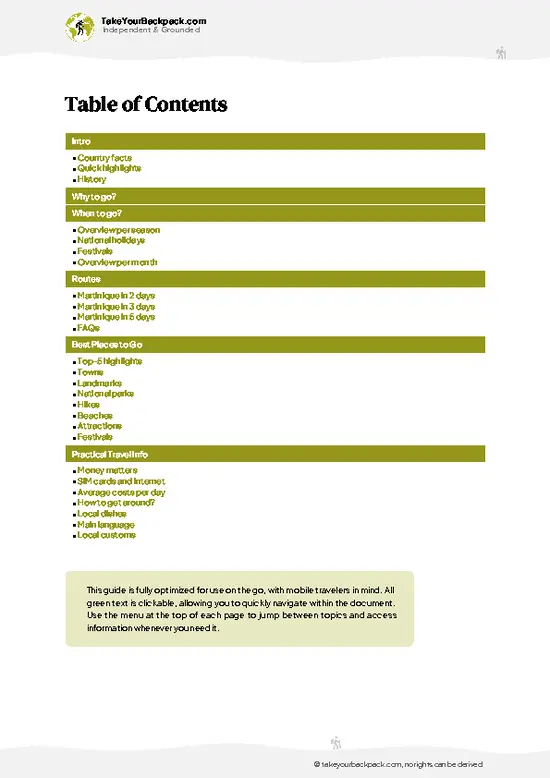
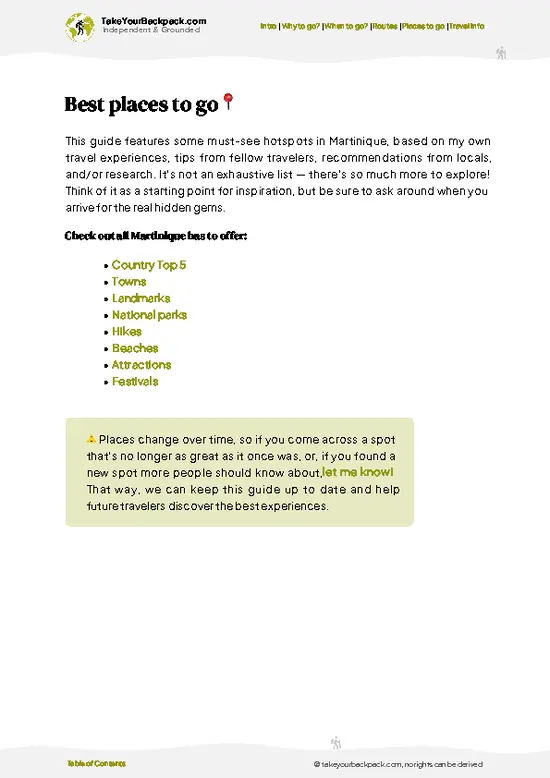
example page 2 from our offline Travel Guide for Martinique
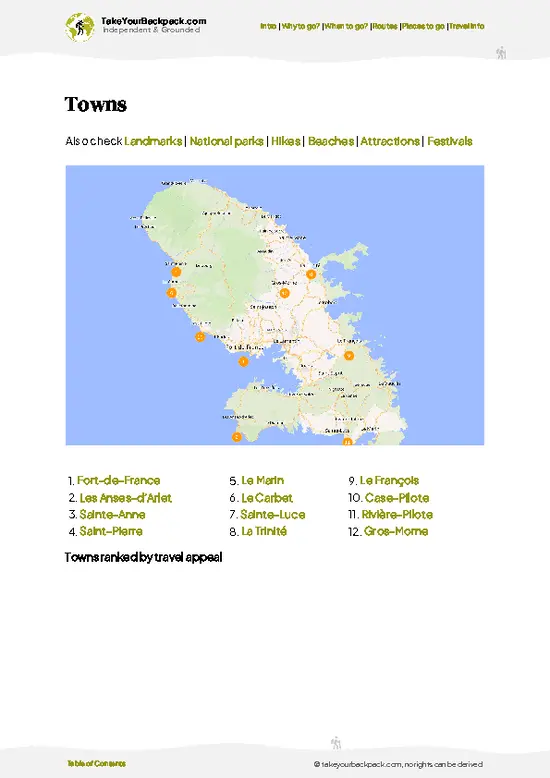
example page 3 from our offline Travel Guide for Martinique
example page 4 from our offline Travel Guide for Martinique
example page 5 from our offline Travel Guide for Martinique
example page 6 from our offline Travel Guide for Martinique
example page 7 from our offline Travel Guide for Martinique
Loading the map 🌍
CLICK TO FILTER
towns
landmarks
national parks
hikes
beaches
attractions
festivals
SHOW COUNTRY’S BESTSHOW ALL

✨ Why go?
Ranked #8 town in Martinique
What makes this town worth visiting

La Trinité works as a base because the best of Martinique’s Atlantic side starts right at its edge. The Caravelle Peninsula trails and the ruins of Château Dubuc are close, and the bay’s mangroves invite a kayak. Most backpackers stay two or three nights, long enough to hike the peninsula at a relaxed pace and still have time for the harbor, where fishermen unload in the morning and you can eat grilled catch for lunch. It is not a party town. Evenings are quiet, with a few bars and small restaurants, and you will likely spend them swapping stories with a guesthouse host or one or two other travelers. That suits hikers, solo travelers who like calm, and slow travelers who would rather listen to the surf than a sound system. If you need a hostel crowd and late nights, make it a short stop instead, … read more 👉
La Trinité works as a base because the best of Martinique’s Atlantic side starts right at its edge. The Caravelle Peninsula trails and the ruins of Château Dubuc are close, and the bay’s mangroves invite a kayak. Most backpackers stay two or three nights, long enough to hike the peninsula at a relaxed pace and still have time for the harbor, where fishermen unload in the morning and you can eat grilled catch for lunch. It is not a party town. Evenings are quiet, with a few bars and small restaurants, and you will likely spend them swapping stories with a guesthouse host or one or two other travelers. That suits hikers, solo travelers who like calm, and slow travelers who would rather listen to the surf than a sound system. If you need a hostel crowd and late nights, make it a short stop instead, perhaps with a swim and a meal on your way along the coast.

💡 HighlightsEssential experiences to have while visiting La Trinité

  1. Château Dubuc ruins: The remains of an 18th-century sugar estate, with a ruined mill, boiling house and slave quarters, set on the Caravelle Peninsula. It tells the plantation story plainly. Go in the morning for cooler walking. Entry is roughly €5 to 6, and you need 1 to 1.5 hours.
  2. Caravelle Nature Reserve trails: Walks through dry forest and mangrove to cliffs and the lighthouse, with Atlantic surf below. The coastal paths are the most scenic. Go early, bring water, and allow 2 to 4 hours. Access is free.
  3. Mangrove kayak in the bay: Paddling through the calm channels of the bay is a quiet way to see the mangroves up close. Mornings are calmer. Expect about €25 to 40 for a guided outing of 2 hours.
  4. La Trinité harbor: A working fishing port where boats come in and locals buy fish directly. It
… read more 👉
  1. Château Dubuc ruins: The remains of an 18th-century sugar estate, with a ruined mill, boiling house and slave quarters, set on the Caravelle Peninsula. It tells the plantation story plainly. Go in the morning for cooler walking. Entry is roughly €5 to 6, and you need 1 to 1.5 hours.
  2. Caravelle Nature Reserve trails: Walks through dry forest and mangrove to cliffs and the lighthouse, with Atlantic surf below. The coastal paths are the most scenic. Go early, bring water, and allow 2 to 4 hours. Access is free.
  3. Mangrove kayak in the bay: Paddling through the calm channels of the bay is a quiet way to see the mangroves up close. Mornings are calmer. Expect about €25 to 40 for a guided outing of 2 hours.
  4. La Trinité harbor: A working fishing port where boats come in and locals buy fish directly. It is free, takes about 30 to 45 minutes, and morning is best.
  5. Église Sainte-Trinité: The town church, a simple, solid landmark just above the waterfront. Entry is free, and 15 to 20 minutes is enough. Visit between other stops.
For day trips, the Presqu’île itself aside, Sainte-Marie’s Habitation Saint-James rum distillery and the Tartane beaches are both within easy reach. Château Dubuc pairs well with the Caravelle trails in a single morning, since the ruins sit along the same peninsula road.
Spotted a mistake or missing something? Contact us.

Things to do near La Trinité

Ratings based on Tripadvisor reviews. When you book through this link, you support our work at no extra cost to you.

🏘️ NeighborhoodsHow different areas shape the experience

La Trinité is compact, and you can cover the useful parts on foot in half a day, so don’t plan around it.
  • The waterfront and town center: Start here. The small marketplace and bakeries wake early, and I’d get bread and a coffee before 9 am, when the best pastries are gone. The harbor looks over the bay toward the Caravelle peninsula. Worth an hour, no more.
  • Presqu’île de la Caravelle: The real reason to come. It sits a few kilometers east, a protected peninsula with mangrove edges, dry forest trails, the ruins of Château Dubuc and a lighthouse. Go in the morning for cooler walking. Skip it at midday, when the heat on the exposed trails is punishing.
  • Tartane: A fishing village on the peninsula’s edge with the area’s best beaches and a handful of casual seafood spots. It’s lively on weekends, quiet
… read more 👉
La Trinité is compact, and you can cover the useful parts on foot in half a day, so don’t plan around it.
  • The waterfront and town center: Start here. The small marketplace and bakeries wake early, and I’d get bread and a coffee before 9 am, when the best pastries are gone. The harbor looks over the bay toward the Caravelle peninsula. Worth an hour, no more.
  • Presqu’île de la Caravelle: The real reason to come. It sits a few kilometers east, a protected peninsula with mangrove edges, dry forest trails, the ruins of Château Dubuc and a lighthouse. Go in the morning for cooler walking. Skip it at midday, when the heat on the exposed trails is punishing.
  • Tartane: A fishing village on the peninsula’s edge with the area’s best beaches and a handful of casual seafood spots. It’s lively on weekends, quiet midweek. Worth a full afternoon, and the lunch grill is better than anything in town.
  • Residential hills and Spoutourne: Mostly homes and farmland. Pleasant for a drive, but there is little to see, so don’t detour for it.

⌛️ 1 dayA smart one-day plan

8:00 AM: Place du Marché and the waterfront
Start at the fishing quay in the bay, because the boats come in early and the catch is sold off the dock before the sun gets hot. Grab a coffee and a fresh baguette from a boulangerie on the way, then walk five minutes to the main square.

9:30 AM: Église de la Sainte-Trinité
The town church sits right at the center, and the cool interior is a good place to slow down. Look at the pale facade and the bell tower, then stroll the few streets around it where locals do their errands.

11:00 AM: Tartane and Caravelle peninsula
Head east toward the peninsula by car or local bus. Take the short trail near the Château Dubuc ruins, a ruined sugar estate overlooking the Atlantic. The path is quiet, windy and mostly shaded, and few people walk it before noon.

… read more 👉
8:00 AM: Place du Marché and the waterfront
Start at the fishing quay in the bay, because the boats come in early and the catch is sold off the dock before the sun gets hot. Grab a coffee and a fresh baguette from a boulangerie on the way, then walk five minutes to the main square.

9:30 AM: Église de la Sainte-Trinité
The town church sits right at the center, and the cool interior is a good place to slow down. Look at the pale facade and the bell tower, then stroll the few streets around it where locals do their errands.

11:00 AM: Tartane and Caravelle peninsula
Head east toward the peninsula by car or local bus. Take the short trail near the Château Dubuc ruins, a ruined sugar estate overlooking the Atlantic. The path is quiet, windy and mostly shaded, and few people walk it before noon.

1:00 PM: Lunch in Tartane
Sit at a seaside table in the small fishing village and order grilled fish or a plate of accras with ti-punch. Prices are fair, portions are generous, and you can eat with sand still on your feet.

3:00 PM: The Caravelle shoreline
Walk the quieter coves where Atlantic surf crashes on dark rocks. Swim only where locals do, since currents can be strong. Bring water and a hat.

5:30 PM: Back at the marina
Return to La Trinité as the light softens over the bay. Watch sailboats settle into the harbor from a terrace, then finish with a simple dinner of Creole stew or fresh seafood before turning in.

🌤️ When to go?Seasonal considerations and timing

The best window for La Trinité is February to May, when it is dry, breezy and cheaper than Christmas.
  • Dry Season (February to May): Days run 27 to 30°C (81 to 86°F) with trade winds and little rain, ideal for the Caravelle trails. Daylight lasts roughly 11.5 to 12.5 hours.
  • Peak Holidays (December to January): Pleasant, 26 to 29°C (79 to 84°F), but crowds and prices rise as French holidaymakers arrive.
  • Wet Season (June to November): Hot and humid at 28 to 32°C (82 to 90°F), with sudden downpours. Hurricane risk peaks from August to October, though rooms and rental cars cost less.
Start Caravelle walks at 8 am in any season, before heat and showers build.

source: climatestotravel.comJANJanuary: excellent for travelingFEBFebruary: highly recommended for travelingMARMarch: excellent for travelingAPRApril: highly recommended for travelingMAYMay: good for travelingJUNJune: good for travelingJULJuly: good for travelingAUGAugust: good for travelingSEPSeptember: fair for travelingOCTOctober: fair for travelingNOVNovember: highly recommended for travelingDECDecember: excellent for traveling
martinique-city-la-trinite v1
© Google |

✈️ The backpacker research shortcutMartinique Travel Guide

An offline-friendly backpacking guide with optimized travel routes, ranked highlights, transport advice, and the best areas to stay.
example page 0 from our offline Travel Guide for Martinique
example page 1 from our offline Travel Guide for Martinique
example page 2 from our offline Travel Guide for Martinique
example page 3 from our offline Travel Guide for Martinique
example page 4 from our offline Travel Guide for Martinique
example page 5 from our offline Travel Guide for Martinique
example page 6 from our offline Travel Guide for Martinique
example page 7 from our offline Travel Guide for Martinique
The digital guide (180 pages) contains:
✅ 43 highlights, ranked by travel appeal
✅ Optimized 2, 3 & 5-day travel routes
✅ Cities, national parks, landmarks, beaches
✅ How to get around
✅ Offline-friendly for travel without Wi-Fi
👉 Click to see all 30+ guide features

📅 Plan smarter in minutes, not weeks
✅ Month by month travel advice
✅ Festivals & national holidays
✅ Budget expectations

🗺️ Go to the right places, skip the overrated ones
✅ Honest pros & cons of destinations
✅ Top hikes, parks & viewpoints
✅ Lesser-known places most travelers miss
✅ Clear “worth it vs skip it” guidance

🛏️ Travel smoothly without rookie mistakes
✅ Best areas to stay
✅ Transport systems explained simply
✅ Common scams & safety advice
✅ SIM cards, money & practical tips

🌍 Understand the country, not just visit it
✅ Culture & traditions
✅ 52 Essential phrases & customs
✅ Festivals worth planning around
✅ Traveler-friendly historical context
✅ Insights that make places more meaningful

📱 Built for real travel conditions
✅ Fully downloadable PDF
✅ Works completely offline
✅ Optimized for phone use
✅ Useful in remote areas & buses
✅ Everything in one place
Stop searching, start planning
Get instant access to your full guide. 30‑day money-back guarantee.
+ Add another guide for just

By proceeding you agree to our terms.
Sent to your inbox immediately after payment • 100% Secure Checkout
Best Backpacking Travel Advisor 2025 tourism awardBest Backpacking
Travel Advisor
2025
What others say about Take Your Backpack Guides:
⭐⭐⭐⭐⭐
Fantastic, amazing amount of information!
⭐⭐⭐⭐⭐
My goodness this is amazing, it's what I've been looking for hats off too you!
⭐⭐⭐⭐⭐
I think this is absolutely BRILLIANT
⭐⭐⭐⭐
Very complete and informative. It's still missing places, but I gotta to commend you
⭐⭐⭐⭐⭐
This is truly amazing, thank you, can't wait to explore it with my kids!
⭐⭐⭐⭐⭐
Awesome resource, thank you!
⭐⭐⭐⭐⭐
This is amazing! Can't wait to explore the ones I haven't seen
⭐⭐⭐⭐
I love this! Well done, great idea.
⭐⭐⭐⭐⭐
Thanks for taking the time to make this gem!
⭐⭐⭐⭐⭐
This might be the best website I've ever seen.
⭐⭐⭐⭐⭐
Congratulations, and thank you so much for your work; it's incredibly valuable.
⭐⭐⭐⭐
In all seriousness I think you did a great job pointing out the important spots
⭐⭐⭐⭐⭐
10/10 very good
⭐⭐⭐⭐⭐
As someone who's only just starting to visit regularly this is awesome, thank you.
⭐⭐⭐⭐
Thank you very much! I'm going to visit my dad, it's going to be very useful!
⭐⭐⭐⭐⭐
This is really cool! We'll be travelling for the first time and this definitely come in handy.
⭐⭐⭐⭐⭐
You are now our minister of culture, congratulations 👨‍💼
⭐⭐⭐⭐⭐
Just wanted to tell you that this is a pearl! Going to follow your recommendations.
⭐⭐⭐⭐⭐
This is so cool. I'll definitely be using the resource for my travels soon.
⭐⭐⭐⭐⭐
This is very impressive! Good work.
⭐⭐⭐⭐⭐
This is an amazing and informative site. Very well done!

🛏️ Where to stay?Where staying makes the most sense

The best base for budget travelers is Tartane, with La Trinité town center as the practical alternative. Dorm beds are rare in this part of Martinique, so expect guesthouses, small apartments and simple rooms, often €45 to 80 a night, with the cheaper options booking out early in high season.
Tartane puts you close to the beaches and the Caravelle trailheads, and it is quiet and safe at night, with little noise beyond weekend gatherings. A car or taxi helps for supplies, though a couple of small shops cover basics.
The town center suits those relying on public transport. It has bakeries, a market … read more 👉
The best base for budget travelers is Tartane, with La Trinité town center as the practical alternative. Dorm beds are rare in this part of Martinique, so expect guesthouses, small apartments and simple rooms, often €45 to 80 a night, with the cheaper options booking out early in high season.
Tartane puts you close to the beaches and the Caravelle trailheads, and it is quiet and safe at night, with little noise beyond weekend gatherings. A car or taxi helps for supplies, though a couple of small shops cover basics.
The town center suits those relying on public transport. It has bakeries, a market and the bus connections toward Fort-de-France, and the streets are calm after dark. It has fewer rooms than Tartane, so reserve ahead. Staying in Fort-de-France and commuting is possible, but it adds an hour or more each way and is only sensible if you want nightlife.

🚌 Getting aroundMoving around without the hassle

Relying on buses to reach the Caravelle peninsula wastes the most time, because service there is thin and rental cars solve it. La Trinité is walkable in the center, but the best sights are spread along the coast, and buses are infrequent, especially after about 5 pm and on Sundays.
  • Walking: Free and ideal for the harbor, market and streets, which take under an hour. The Caravelle trails are also best on foot once you arrive, with loops of roughly 1 to 3 hours.
  • Collective taxis and buses: Minibuses link La Trinité with Fort-de-France and nearby towns, about €3 to 6 per ride and 45 to 75 minutes to the capital depending on traffic. Services thin out in the evening, so check the last departure before you commit to a day out.
  • Rental car: Worth the money for a day or two, around €30 to 50 daily plus
… read more 👉
Relying on buses to reach the Caravelle peninsula wastes the most time, because service there is thin and rental cars solve it. La Trinité is walkable in the center, but the best sights are spread along the coast, and buses are infrequent, especially after about 5 pm and on Sundays.
  • Walking: Free and ideal for the harbor, market and streets, which take under an hour. The Caravelle trails are also best on foot once you arrive, with loops of roughly 1 to 3 hours.
  • Collective taxis and buses: Minibuses link La Trinité with Fort-de-France and nearby towns, about €3 to 6 per ride and 45 to 75 minutes to the capital depending on traffic. Services thin out in the evening, so check the last departure before you commit to a day out.
  • Rental car: Worth the money for a day or two, around €30 to 50 daily plus fuel. It gets you to Tartane, Château Dubuc and the Caravelle trailheads easily. Book ahead in high season and avoid Fort-de-France rush hour on the main road.
  • Taxi: Convenient for the short run to Tartane, roughly €10 to 20 each way. Agree the fare before you get in. It is fine for a late return but too pricey for regular use.
  • Hitchhiking: Locals do pick up walkers on quiet coastal roads, but it is unreliable, so treat it as a backup rather than a plan.

👛 Costs (as of 22 October 2026)What things cost and how to budget

La Trinité costs a backpacker about €88 a day in high season, and mid-range dorm-style beds are rare, so lodging dominates the budget.
CategoryBudget RangeLocal Reality
Dorm accommodation€40 to 55Few true dorms exist, so a basic guesthouse room or small apartment is the norm. Off-season can drop to €35.
Meals€20 to 30Bakery breakfast about €3 to 5, a plate of grilled fish or chicken at a casual spot €10 to 15, and supermarket items cost more than in mainland France.
Local transport€6 to 12Shared minibuses cost €3 to 6 a ride, and a taxi to Tartane runs €10 to 20.
Basic activities/entry fees€5 to 10Caravelle trails and beaches are mostly free, and heritage sites charge small fees.
Miscellaneous expenses€5 to 10Sunscreen, water, drinks and small extras. Euros are the currency used.
Total Daily Budget€88Per
… read more 👉
La Trinité costs a backpacker about €88 a day in high season, and mid-range dorm-style beds are rare, so lodging dominates the budget.
CategoryBudget RangeLocal Reality
Dorm accommodation€40 to 55Few true dorms exist, so a basic guesthouse room or small apartment is the norm. Off-season can drop to €35.
Meals€20 to 30Bakery breakfast about €3 to 5, a plate of grilled fish or chicken at a casual spot €10 to 15, and supermarket items cost more than in mainland France.
Local transport€6 to 12Shared minibuses cost €3 to 6 a ride, and a taxi to Tartane runs €10 to 20.
Basic activities/entry fees€5 to 10Caravelle trails and beaches are mostly free, and heritage sites charge small fees.
Miscellaneous expenses€5 to 10Sunscreen, water, drinks and small extras. Euros are the currency used.
Total Daily Budget€88Per person, per day, in high season.
To save money, buy bread, fruit and cheese from the market and bakeries for lunch, and picnic on the beach at Tartane.
⚠️ Prices can change and everyone travels differently, so take this as a rough guide. Hope it helps you plan your adventure!

🚌 Day tripsExploring the surroundings

La Trinité works well as a base for day trips, since the east coast and the north Atlantic side are within roughly an hour by car.
Château Dubuc and the Caravelle Trails:
The ruins of an 18th-century sugar estate sit on the peninsula, with a short trail through dry forest toward sea cliffs. Allow 3 to 4 hours including walking from the trailhead. A common mistake is arriving at midday in full sun, so go before 10 am. Budget about €5 to 10 for entry and snacks.

Saint-Pierre:
The town devastated by the 1902 Mont Pelée eruption has ruins, a volcano museum and black sand beaches. It takes about 1 to 1.5 hours each way by car or a bus connection via Fort-de-France, so start early. Expect €15 to 25 with transport, entry and lunch. Dry months are clearest for the views.
👉 Explore Saint-Pierre
Fort-de-France: … read more 👉
La Trinité works well as a base for day trips, since the east coast and the north Atlantic side are within roughly an hour by car.
Château Dubuc and the Caravelle Trails:
The ruins of an 18th-century sugar estate sit on the peninsula, with a short trail through dry forest toward sea cliffs. Allow 3 to 4 hours including walking from the trailhead. A common mistake is arriving at midday in full sun, so go before 10 am. Budget about €5 to 10 for entry and snacks.

Saint-Pierre:
The town devastated by the 1902 Mont Pelée eruption has ruins, a volcano museum and black sand beaches. It takes about 1 to 1.5 hours each way by car or a bus connection via Fort-de-France, so start early. Expect €15 to 25 with transport, entry and lunch. Dry months are clearest for the views.
👉 Explore Saint-Pierre
Fort-de-France:
The capital offers the covered Grand Marché, La Savane park, Schoelcher Library and the ferries to Les Trois-Îlets. It is 45 to 75 minutes away by bus, with fares around €3 to 6 each way. First-timers often leave too late, when buses thin out, so aim to be back by 5 pm.
👉 Explore Fort-de-France

🛡️ SafetyTraveler Safety Guide

La Trinité is broadly safe, and most problems are petty. Leave nothing visible in a parked rental car at Tartane, the Caravelle trailheads or Château Dubuc, where break-ins from cars happen at lonely car parks. Carry valuables on you, or leave them at your lodging. Solo travelers will find the town calm after dark, but unlit coastal roads are best driven in daylight, and walking back from Tartane at night is not wise, so book a taxi. On the trails, carry water and sun protection, stay on marked paths, and watch for strong currents on some exposed Atlantic beaches, where swimming can be rough. Scams are rare, so just agree taxi fares before you set off.

FAQTraveler FAQ

La Trinité is worth a stop of a day or two, mainly for the Caravelle peninsula, Château Dubuc and Tartane’s beaches. The trails run 1 to 3 hours and the east coast is much quieter than the south. It is not a place to linger for nightlife, but it is rewarding for nature and fishing-village atmosphere.
Two days is enough for La Trinité. One day covers the Caravelle trails, Château Dubuc and the lighthouse area, and a second suits Tartane’s beach, a seafood lunch and the town market. Add a third day only if you want a day trip to Saint-Pierre, about 1 to 1.5 hours away by car.
La Trinité can be seen as a long day trip from Fort-de-France, roughly 45 to 75 minutes each way by car or minibus, with fares around €3 to 6. A car makes it far easier, since buses to Tartane and the Caravelle are sparse and thin out after about 5 pm. Starting before 8 am gives you time for the trails and lunch.
⚠️ Things can change over time, so always validate details locally before you go.

Other Martinican towns near La Trinité

Explore more nearby:

  • Gros-Morne—Inland farmland, banana plantations, roadside rum stalls| 6 km away
  • Le François—Rum estate, sandbank islets, kitesurf lagoon| 15 km away
  • Fort-de-France—Transport hub, covered market, Fort Saint-Louis, Savane park| 19 km away

💡 Not sure where to go next?
Create a personalized itinerary for Martinique including La Trinité and the places that fit your trip.

Generate my itinerary

👉 Discover all towns

Or checkout all Martinique has to offer (think cities, towns, villages, national parks, hikes, beaches, festivals)
Country photo of Martinique

We 💚 feedbackIs it worth it?

Give La Trinité two nights. One day covers the peninsula and Château Dubuc, and the second lets you paddle the mangroves and sit at the harbor without hurrying. Rent a car if you can, and bring plenty of water for the trails.

✍️ Help improve this page!
The information on this page is based on in-depth research, insights shared by experienced travelers, and feedback from the local travel community in Martinique. While every effort is made to keep the information accurate and current, conditions can change — so if you spot anything incorrect or outdated, please get in touch.


🙋‍♂️ Give feedback

👋 Meet the founderWho’s Behind Take Your Backpack?

Johan, backpacker and founder of TakeYourBackpackHi, I’m Johan (Netherlands 🇳🇱), the creator of TakeYourBackpack. Over the past 3 decades, I’ve backpacked through 90+ countries across six continents, gaining extensive experience with independent travel, long-term trips, and overland routes.

This site is built on a combination of firsthand travel experience and carefully curated insights from other backpackers. Many guides are based on places I’ve personally visited, while others bring together tips, observations, and practical advice shared by trusted travelers I’ve met along the way.

The goal is to provide realistic, experience-driven guidance — not generic itineraries — so you can explore destinations with better context, clearer expectations, and more confidence.