×

Martinique🇲🇶 | best townsWhere to Find the 12 Best towns in Martinique

Towns in Martinique are French-Caribbean at heart: boulangeries by 6 a.m., Creole lunch counters, euro prices. The north is green, steep and quiet, the south has the beaches and the crowds, and Fort-de-France anchors the buses. Independent travel works if you accept that cost runs closer to mainland France than to its neighbors, and that a rental car often beats waiting for a collective taxi.

By Johan Kruseman 🇳🇱 | Updated October 23, 2026
Explore the best landmarks in Martinique

Why go?Understanding Their Importance

Martinique is a French département, so its towns have French infrastructure, euros, EU-standard services and safe tap water, set on a volcanic Caribbean island. That mix is rare. Centuries of sugar plantation history and the 1902 eruption of Mount Pelée shaped where towns sit and how they look, with Creole culture running through food, music and language. Geography splits the island: a rainforest and volcano north, a drier, flatter south with long beaches, and a Atlantic coast that is windier and emptier. Know before you choose it that public transport is thin outside Fort-de-France, that many shops close for a long lunch and on Sundays, and that French helps far more than English. Markets are best early, usually by 8 a.m., before the heat and the best produce disappear.
Behind the Scenes of Selection
The list of best towns in Martinique is created based on charm, local culture, atmosphere, hidden gems, and visitor appeal. If you feel a town is missing in this list, please let us know.

When to go?Timing Your Visit for the Best Experience

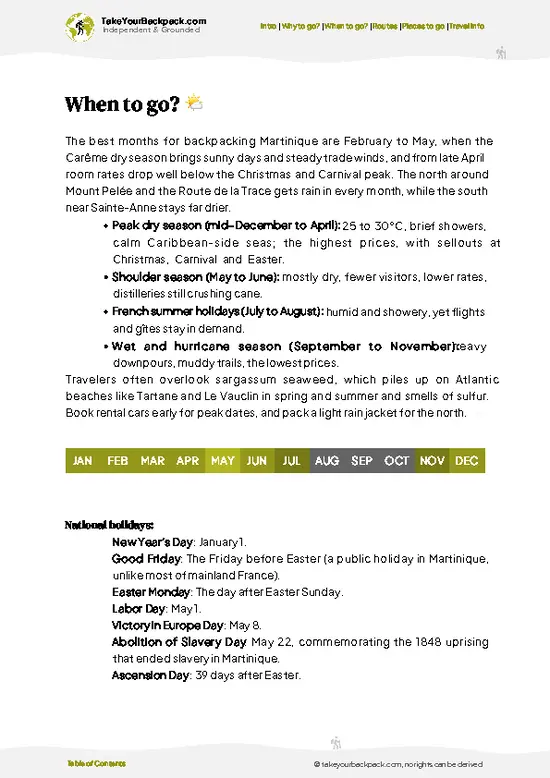
Best months and weather: The best months for towns in Martinique are December to April, the dry season, when daytime highs sit around 28 to 30°C and rain is lighter, so walking around is pleasant. Humidity is lower and the trade winds keep the coasts comfortable.Shoulder and peak: May and June, plus November, are good shoulder months with fewer visitors and lower flight and room prices, often 20 to 30 percent below peak. Peak pricing hits mid-December to early January and again around February Carnival, when rooms fill and rates climb. Hurricane season: From July to October it is hot, humid and wet, with rainfall often over 200 mm a month, and the highest hurricane risk falls in August and September. Some small guesthouses close then. The wetter, greener north gets rain year-round, so carry a light rain jacket even in February.

town hoppingSuggested Travel Strategies

How many days to plan: A trip linking several towns in Martinique needs 5 to 8 days. The island is only about 70 km long, yet winding roads make even short hops slow, so Fort-de-France to the far north or far south takes 1 to 2 hours by car. Direction and pacing: Use the capital and the nearby airport at Le Lamentin as your hub, then group the north together, the south together and the Atlantic side as its own loop. Heading north first, then returning through the center to the south, saves backtracking. Allow half a day to a full day per stop. A common mistake is cramming three towns into a day, then losing hours to traffic around Fort-de-France at rush hour, roughly 6:30 to 8:30 a.m. and 4 to 6 p.m. Instead, move early, plan one base per region, and keep Sundays for beaches because many shops are closed.

The ListThe Best towns of Martinique

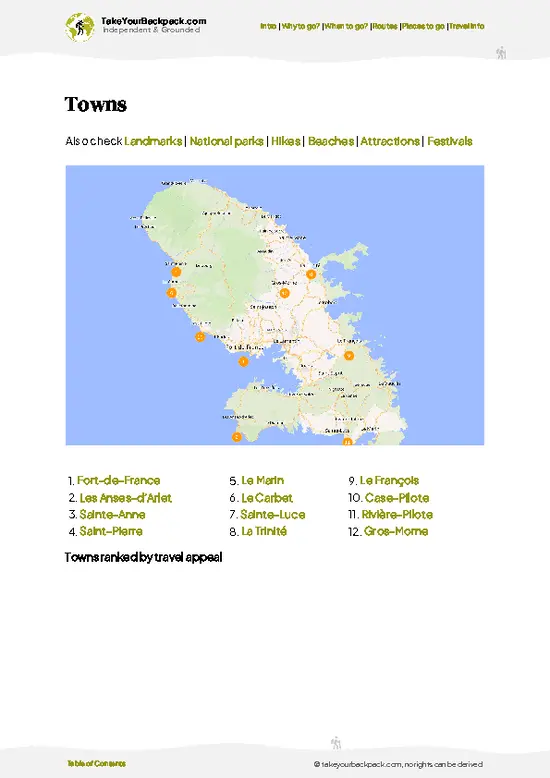
1 Fort-de-France

Transport hub, covered market, Fort Saint-Louis, Savane park

Use the capital as a one or two night base, with ferries, a loud covered market, a 17th-century fort and a shady central park.

martinique-city-fort-de-france
© Google | Joyce Mathurin

2 Les Anses-d’Arlet

Waterfront church, turtle coves, black-sand Anse Noire

Snorkel with turtles at Anse Dufour, walk the short path to black-sand Anse Noire, and buy fish from the quay at sunrise.

3 Sainte-Anne

Les Salines, Pointe Marin, village market

Walk to the palm-lined white sand of Les Salines, then return to the village for market snacks, rum shops and Creole houses.

martinique-city-sainte-anne
© Google |

4 Saint-Pierre

1902 eruption, theater ruins, volcanology museum

Walk the ruined streets and open-air theater shell, then visit the volcanology museum that explains the 1902 Mount Pelée eruption.

martinique-city-saint-pierre
© Google |

5 Le Marin

Yacht marina, boatyards, fish quay

Stock up beside one of the Caribbean’s largest marinas, join a boat trip, and catch fishermen unloading at dawn on the quay.

6 Le Carbet

Black sand, Pelée views, morning market

Swim off a long dark-sand beach beneath Montagne Pelée, then eat grilled fish and accras at family-run spots along the waterfront.

7 Sainte-Luce

Trois Rivières rum, Anse Mabouya, mangrove kayaking

Taste agricole rum at the Trois Rivières distillery, snorkel the quiet cove of Anse Mabouya, or paddle kayaks into the mangrove.

8 La Trinité

Caravelle reserve, Château Dubuc ruins, Tartane surf

Hike dry forest and cliff trails on the Caravelle peninsula, then end at sugar plantation ruins or the beach and fishing port of Tartane.

martinique-city-la-trinite
© Google |

9 Le François

Rum estate, sandbank islets, kitesurf lagoon

Tour the Habitation Clément distillery, take a boat to the shallow sandbank and islets, or try windsurfing and kitesurfing at Pointe Faula.

10 Case-Pilote

Fishing quay, Creole wooden houses, calm bay

Watch boats land the morning catch, wander past shuttered wooden houses, then snorkel the rocks at either end of the small sheltered cove.

11 Rivière-Pilote

River pools, town square, banana lanes

Cool off in river pools, taste Creole street food at the market, and walk quiet lanes past banana plots and small farms.

12 Gros-Morne

Inland farmland, banana plantations, roadside rum stalls

Drive through banana plantations and farm country, buy fruit from growers, and catch market days or patronal fêtes in a town with no shoreline.

Loading the map 🌍

Expert viewTips and Advice from Travelers

How many towns to visit: I would advise three to five towns over a week. Martinique’s roads are slow, and each region rewards a day or two, so seeing more means spending the trip in a car. Two nights in each of three bases gives you time and keeps costs sensible.Which kind suits you: Choose by style. For the cheapest and easiest option, a south-coast beach town gives you the best value: restaurants are plentiful, buses and shared taxis are easier, and you can walk to the sand. For culture and hiking, pick a northern town, where you trade convenience for rainforest, rum distilleries and quiet evenings. The capital costs more in time through traffic but is the best transport hub. The Atlantic side is the cheapest to sleep in but needs a car, which costs more in money and gives the most freedom. … read more 👉
How many towns to visit: I would advise three to five towns over a week. Martinique’s roads are slow, and each region rewards a day or two, so seeing more means spending the trip in a car. Two nights in each of three bases gives you time and keeps costs sensible.Which kind suits you: Choose by style. For the cheapest and easiest option, a south-coast beach town gives you the best value: restaurants are plentiful, buses and shared taxis are easier, and you can walk to the sand. For culture and hiking, pick a northern town, where you trade convenience for rainforest, rum distilleries and quiet evenings. The capital costs more in time through traffic but is the best transport hub. The Atlantic side is the cheapest to sleep in but needs a car, which costs more in money and gives the most freedom.What it costs: Budget €70 to 110 a day for a backpacker. Dorm-style options are rare, so a basic guesthouse room runs €50 to 80 and a lunch plate of the day €10 to 14. A car rental is roughly €35 to 55 a day plus fuel, and a shared taxi or bus ride between towns usually costs €2 to 6. Distillery visits are often free with a tasting, while some museums charge €5 to 10. Cook at the markets to save money.Safety and etiquette: Martinique is among the safer Caribbean islands, but petty theft from parked cars at beaches and trailheads happens, so leave nothing visible. Greet shopkeepers with “bonjour” before asking anything, which is expected and changes how you are treated. Dress modestly in town centers, avoid swimwear away from the beach, and respect closures on Sundays and during the long midday break. Swim only at marked beaches, since Atlantic currents are strong, and carry cash for small markets.

✈️ The backpacker research shortcutMartinique Travel Guide

An offline-friendly backpacking guide with optimized travel routes, ranked highlights, transport advice, and the best areas to stay.
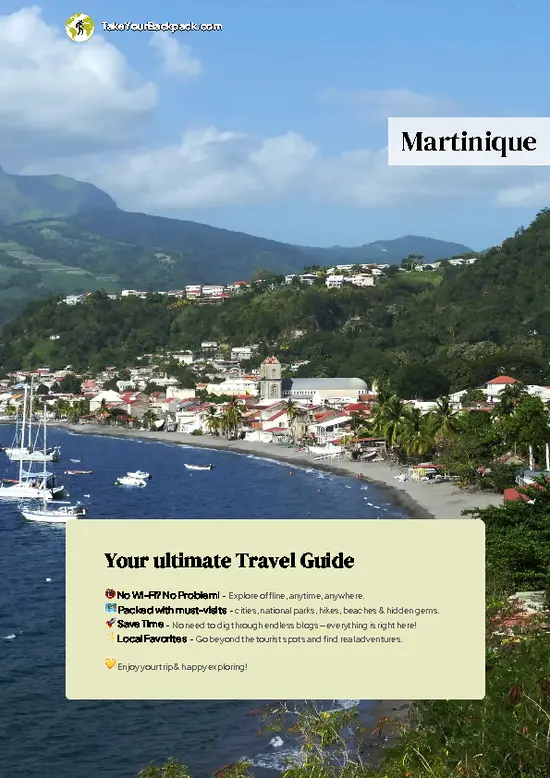
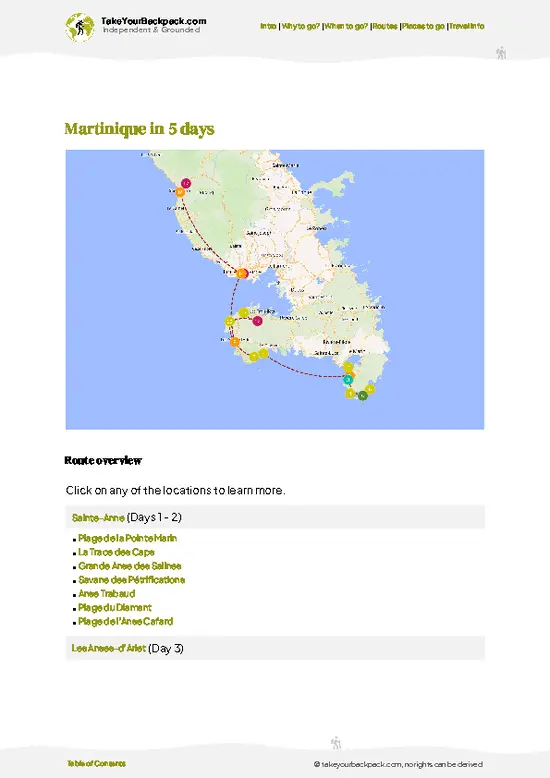
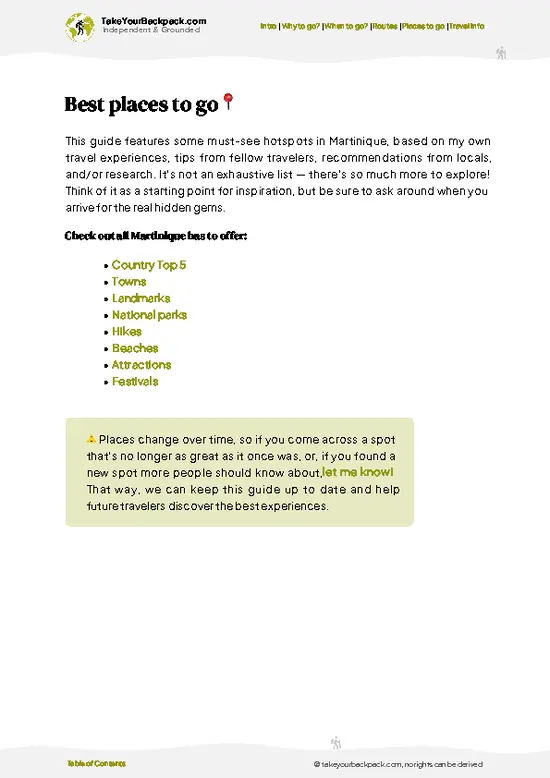
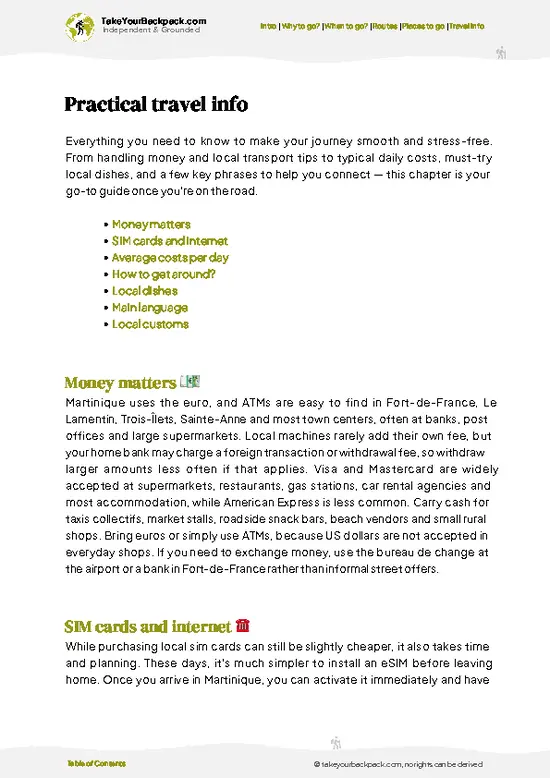
example page 0 from our offline Travel Guide for Martinique
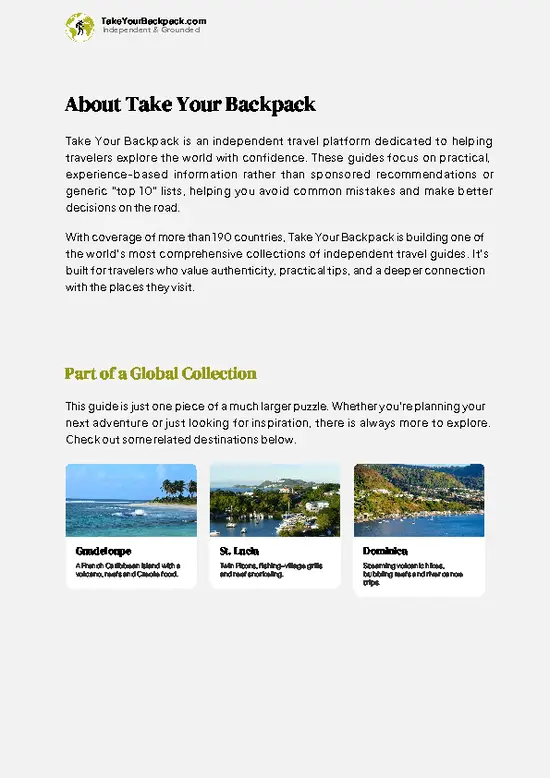
example page 1 from our offline Travel Guide for Martinique
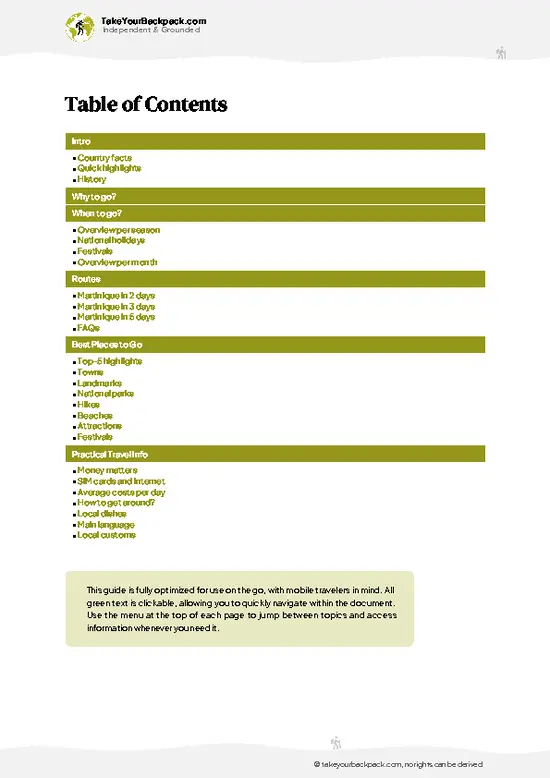
example page 2 from our offline Travel Guide for Martinique
example page 3 from our offline Travel Guide for Martinique
example page 4 from our offline Travel Guide for Martinique
example page 5 from our offline Travel Guide for Martinique
example page 6 from our offline Travel Guide for Martinique
example page 7 from our offline Travel Guide for Martinique
The digital guide (180 pages) contains:
✅ 43 highlights, ranked by travel appeal
✅ Optimized 2, 3 & 5-day travel routes
✅ Cities, national parks, landmarks, beaches
✅ How to get around
✅ Offline-friendly for travel without Wi-Fi
👉 Click to see all 30+ guide features

📅 Plan smarter in minutes, not weeks
✅ Month by month travel advice
✅ Festivals & national holidays
✅ Budget expectations

🗺️ Go to the right places, skip the overrated ones
✅ Honest pros & cons of destinations
✅ Top hikes, parks & viewpoints
✅ Lesser-known places most travelers miss
✅ Clear “worth it vs skip it” guidance

🛏️ Travel smoothly without rookie mistakes
✅ Best areas to stay
✅ Transport systems explained simply
✅ Common scams & safety advice
✅ SIM cards, money & practical tips

🌍 Understand the country, not just visit it
✅ Culture & traditions
✅ 52 Essential phrases & customs
✅ Festivals worth planning around
✅ Traveler-friendly historical context
✅ Insights that make places more meaningful

📱 Built for real travel conditions
✅ Fully downloadable PDF
✅ Works completely offline
✅ Optimized for phone use
✅ Useful in remote areas & buses
✅ Everything in one place
Stop searching, start planning
Get instant access to your full guide. 30‑day money-back guarantee.
+ Add another guide for just

By proceeding you agree to our terms.
Sent to your inbox immediately after payment • 100% Secure Checkout
Best Backpacking Travel Advisor 2025 tourism awardBest Backpacking
Travel Advisor
2025
What others say about Take Your Backpack Guides:
⭐⭐⭐⭐⭐
Fantastic, amazing amount of information!
⭐⭐⭐⭐⭐
My goodness this is amazing, it's what I've been looking for hats off too you!
⭐⭐⭐⭐⭐
I think this is absolutely BRILLIANT
⭐⭐⭐⭐
Very complete and informative. It's still missing places, but I gotta to commend you
⭐⭐⭐⭐⭐
This is truly amazing, thank you, can't wait to explore it with my kids!
⭐⭐⭐⭐⭐
Awesome resource, thank you!
⭐⭐⭐⭐⭐
This is amazing! Can't wait to explore the ones I haven't seen
⭐⭐⭐⭐
I love this! Well done, great idea.
⭐⭐⭐⭐⭐
Thanks for taking the time to make this gem!
⭐⭐⭐⭐⭐
This might be the best website I've ever seen.
⭐⭐⭐⭐⭐
Congratulations, and thank you so much for your work; it's incredibly valuable.
⭐⭐⭐⭐
In all seriousness I think you did a great job pointing out the important spots
⭐⭐⭐⭐⭐
10/10 very good
⭐⭐⭐⭐⭐
As someone who's only just starting to visit regularly this is awesome, thank you.
⭐⭐⭐⭐
Thank you very much! I'm going to visit my dad, it's going to be very useful!
⭐⭐⭐⭐⭐
This is really cool! We'll be travelling for the first time and this definitely come in handy.
⭐⭐⭐⭐⭐
You are now our minister of culture, congratulations 👨‍💼
⭐⭐⭐⭐⭐
Just wanted to tell you that this is a pearl! Going to follow your recommendations.
⭐⭐⭐⭐⭐
This is so cool. I'll definitely be using the resource for my travels soon.
⭐⭐⭐⭐⭐
This is very impressive! Good work.
⭐⭐⭐⭐⭐
This is an amazing and informative site. Very well done!

🛏️ Where to stay?Best Places to Stay in Martinique

Martinique has very few true hostels, so budget stays here mostly mean guesthouses, rooms in private homes and small self-catering gîtes, typically around €40 to €70 a night for a private room. Fort-de-France has the best bus and ferry links but empties out and feels deserted after dark. Les Trois-Îlets (especially Anse Mitan) pairs beaches and the liveliest evenings with a ferry into the capital; Sainte-Anne and Le Marin in the south sit near the best beaches and the sailing scene, while Saint-Pierre in the north is quiet and cheap, close to diving and the Montagne Pelée trails, though far from everything else.

If you enjoy meeting fellow travelers, consider choosing hostels with high ratings … read more 👉
Martinique has very few true hostels, so budget stays here mostly mean guesthouses, rooms in private homes and small self-catering gîtes, typically around €40 to €70 a night for a private room. Fort-de-France has the best bus and ferry links but empties out and feels deserted after dark. Les Trois-Îlets (especially Anse Mitan) pairs beaches and the liveliest evenings with a ferry into the capital; Sainte-Anne and Le Marin in the south sit near the best beaches and the sailing scene, while Saint-Pierre in the north is quiet and cheap, close to diving and the Montagne Pelée trails, though far from everything else.

If you enjoy meeting fellow travelers, consider choosing hostels with high ratings for atmosphere. On the other hand, if you prefer having your own space, a hotel might be a better option.

MartiniqueExplore Martinique

👋 Meet the founderWho’s Behind Take Your Backpack?

Johan, backpacker and founder of TakeYourBackpackHi, I’m Johan (Netherlands 🇳🇱), the creator of TakeYourBackpack. Over the past 3 decades, I’ve backpacked through 90+ countries across six continents, gaining extensive experience with independent travel, long-term trips, and overland routes.

This site is built on a combination of firsthand travel experience and carefully curated insights from other backpackers. Many guides are based on places I’ve personally visited, while others bring together tips, observations, and practical advice shared by trusted travelers I’ve met along the way.

The goal is to provide realistic, experience-driven guidance — not generic itineraries — so you can explore destinations with better context, clearer expectations, and more confidence.