×

Martinique🇲🇶 | attractionsTrain des PlantationsNarrated narrow-gauge loop, banana bags, cane fields, windward coast | things to do and best time to go

Explore Distillerie Saint JamesExplore La Savane des Esclaves

Backpacking in Train des Plantations
👌 Worth visitingattraction ranked #7
By Johan Kruseman 🇳🇱 | Updated October 22, 2026

The little engine gives a low horn blast, the carriages sway, and the sweet, grassy smell of cut cane drifts in with the warm Atlantic air. That is a typical start to a ride on Train des Plantations, which runs from the Saint James distillery grounds at Sainte-Marie, on Martinique’s windward northeast coast. It is slow, a little touristy and very good fun. Families and tour groups fill the seats, so you hear commentary in French first and expect the pace of a stroll. Book the first departure of the day if you can, because that is when the heat is mild and the fields are quietest. Pair the ride with the distillery next door instead of treating it as a stand-alone outing, since that is where the value is. The track runs past rows of banana plants with their blue protective bags.

Discover everything you want to know in the 📖 Martinique Travel Guide.


example page 0 from our offline Travel Guide for Martinique
example page 1 from our offline Travel Guide for Martinique
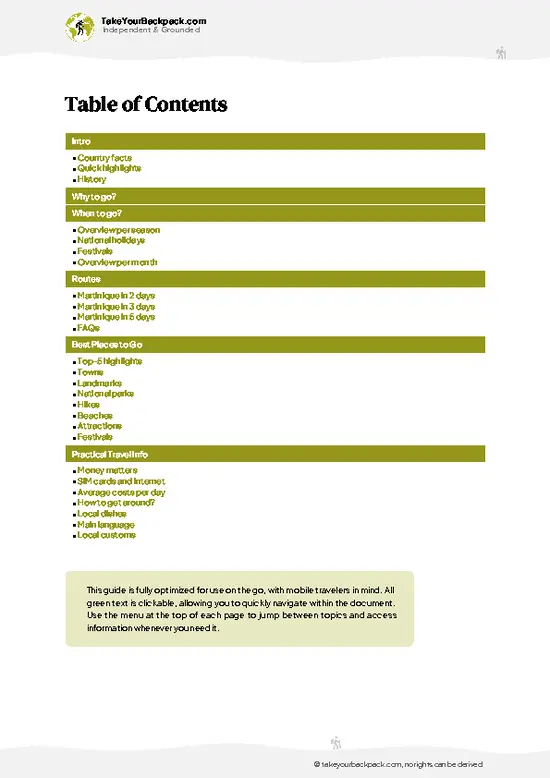
example page 2 from our offline Travel Guide for Martinique
example page 3 from our offline Travel Guide for Martinique
example page 4 from our offline Travel Guide for Martinique
example page 5 from our offline Travel Guide for Martinique
example page 6 from our offline Travel Guide for Martinique
example page 7 from our offline Travel Guide for Martinique
Loading the map 🌍
CLICK TO FILTER
towns
landmarks
national parks
hikes
beaches
attractions
festivals
SHOW COUNTRY’S BESTSHOW ALL

✨ Why go?
Ranked #7 attraction in Martinique
What sets this place apart

Train des Plantations gives you the agricultural backbone of Martinique without a hike or a rental-car detour. The line starts at the Saint James distillery grounds, so you can stack the ride, a rum museum and a tasting in one morning, which suits a day on the Atlantic side. The route rolls through banana and sugarcane fields, the two crops that shaped the island’s economy and its plantation past. You see the crops in the ground and understand why rum, bananas and the old estates matter here. It is also easy on a tired backpacker. You sit, you look, you listen. Sainte-Marie sits on the road north toward Grand’Rivière and the wilder coast, so the stop fits naturally between Fort-de-France and the Pelée side of the island.

💡 HighlightsPlaces and moments you shouldn't skip

  1. The train ride itself: a slow, narrated loop on a small tourist train through working plantation land, with the best views of cane and bananas up close.
  2. Banana plantations: rows of plants wrapped in blue bags, which protect the fruit as it ripens. You see how bananas grow, which no market stall shows you.
  3. Sugarcane fields: tall green stalks waving in the trade wind, the raw material of Martinique’s agricole rum.
  4. Musée du Rhum Saint James: the museum beside the departure point, with old distilling equipment, tools and displays on how cane juice becomes rum.
  5. Saint James distillery: a working distillery known for rhum agricole, made from fresh cane juice rather than molasses. The smell of fermenting cane hangs in the air.
  6. Rum tasting: a chance to sip aged and white rhum agricole and compare them side
… read more 👉
  1. The train ride itself: a slow, narrated loop on a small tourist train through working plantation land, with the best views of cane and bananas up close.
  2. Banana plantations: rows of plants wrapped in blue bags, which protect the fruit as it ripens. You see how bananas grow, which no market stall shows you.
  3. Sugarcane fields: tall green stalks waving in the trade wind, the raw material of Martinique’s agricole rum.
  4. Musée du Rhum Saint James: the museum beside the departure point, with old distilling equipment, tools and displays on how cane juice becomes rum.
  5. Saint James distillery: a working distillery known for rhum agricole, made from fresh cane juice rather than molasses. The smell of fermenting cane hangs in the air.
  6. Rum tasting: a chance to sip aged and white rhum agricole and compare them side by side, then buy a bottle that travels well.
  7. Atlantic coast views: breezy stretches where the line opens up to the windward sea and the green hills behind it.
Train des Plantations is best done first thing, so you ride in cooler air and then spend the hotter hours in the museum and tasting room.
Spotted a mistake or missing something? Contact us.

Things to do near Train des Plantations

Ratings based on Tripadvisor reviews. When you book through this link, you support our work at no extra cost to you.

🌤️ When to go?Choosing the right time of year

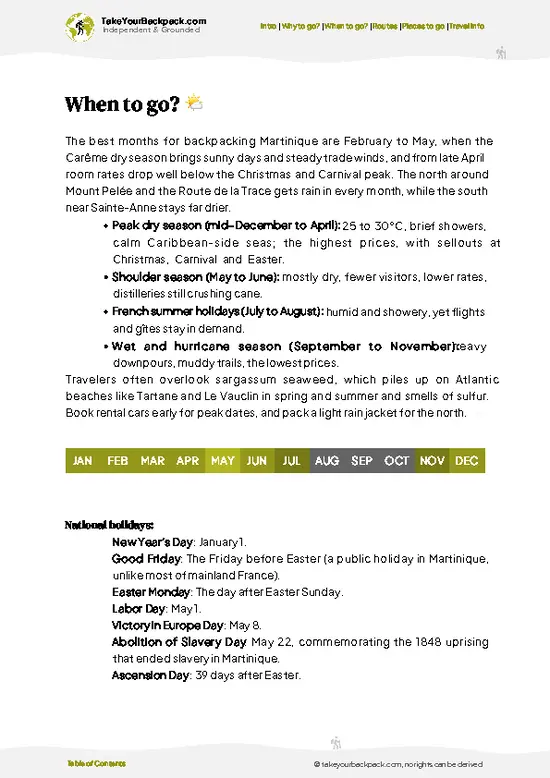
  • Dry Season (February to May): Rainfall is lowest and the sugarcane and banana fields around Trinité look their sharpest. Highs run 28 to 30°C (82 to 86°F), nights 22 to 23°C (72 to 73°F), with steady trade winds.
  • Carnival (February to March): Fort-de-France fills up, and rooms and rental cars get scarce and pricier. The train itself stays quiet.
  • Wet Season (July to November): Showers are heavy and humid, highs reach 31°C (88°F), and hurricane risk peaks in August and September. Rooms are cheaper and the park is nearly empty.
  • December to January: Cooler, breezy days of 27 to 29°C (81 to 84°F), with French school holidays pushing prices up.
Go in the morning, when it is cooler and the tropical downpours that hit in the afternoon have not yet started.

source: climatestotravel.comJANJanuary: excellent for travelingFEBFebruary: excellent for travelingMARMarch: excellent for travelingAPRApril: highly recommended for travelingMAYMay: highly recommended for travelingJUNJune: fair for travelingJULJuly: fair for travelingAUGAugust: fair for travelingSEPSeptember: below average for travelingOCTOctober: below average for travelingNOVNovember: good for travelingDECDecember: excellent for traveling
martinique-attraction-train-des-plantations
© Google |

✈️ The backpacker research shortcutMartinique Travel Guide

An offline-friendly backpacking guide with optimized travel routes, ranked highlights, transport advice, and the best areas to stay.
example page 0 from our offline Travel Guide for Martinique
example page 1 from our offline Travel Guide for Martinique
example page 2 from our offline Travel Guide for Martinique
example page 3 from our offline Travel Guide for Martinique
example page 4 from our offline Travel Guide for Martinique
example page 5 from our offline Travel Guide for Martinique
example page 6 from our offline Travel Guide for Martinique
example page 7 from our offline Travel Guide for Martinique
The digital guide (180 pages) contains:
✅ 43 highlights, ranked by travel appeal
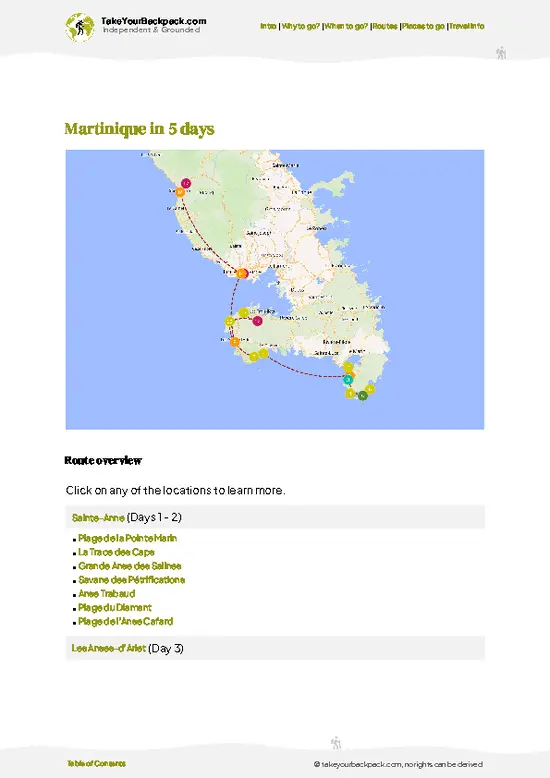
✅ Optimized 2, 3 & 5-day travel routes
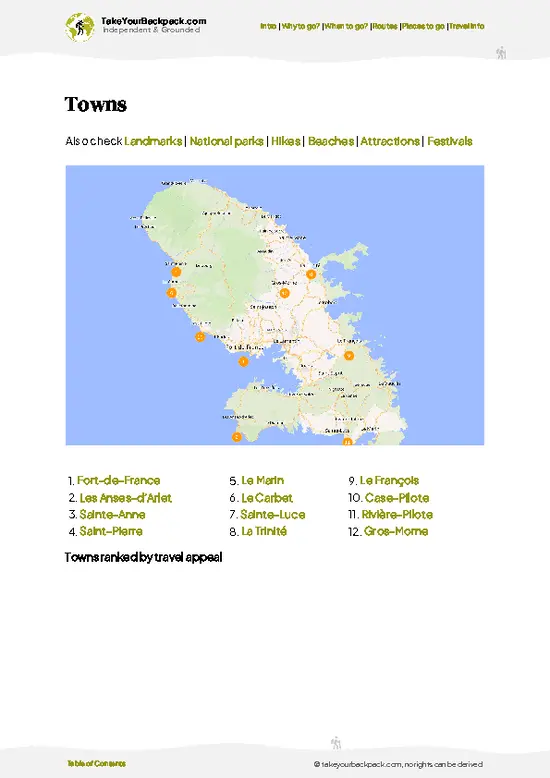
✅ Cities, national parks, landmarks, beaches
✅ How to get around
✅ Offline-friendly for travel without Wi-Fi
👉 Click to see all 30+ guide features

📅 Plan smarter in minutes, not weeks
✅ Month by month travel advice
✅ Festivals & national holidays
✅ Budget expectations

🗺️ Go to the right places, skip the overrated ones
✅ Honest pros & cons of destinations
✅ Top hikes, parks & viewpoints
✅ Lesser-known places most travelers miss
✅ Clear “worth it vs skip it” guidance

🛏️ Travel smoothly without rookie mistakes
✅ Best areas to stay
✅ Transport systems explained simply
✅ Common scams & safety advice
✅ SIM cards, money & practical tips

🌍 Understand the country, not just visit it
✅ Culture & traditions
✅ 52 Essential phrases & customs
✅ Festivals worth planning around
✅ Traveler-friendly historical context
✅ Insights that make places more meaningful

📱 Built for real travel conditions
✅ Fully downloadable PDF
✅ Works completely offline
✅ Optimized for phone use
✅ Useful in remote areas & buses
✅ Everything in one place
Stop searching, start planning
Get instant access to your full guide. 30‑day money-back guarantee.
+ Add another guide for just

By proceeding you agree to our terms.
Sent to your inbox immediately after payment • 100% Secure Checkout
Best Backpacking Travel Advisor 2025 tourism awardBest Backpacking
Travel Advisor
2025
What others say about Take Your Backpack Guides:
⭐⭐⭐⭐⭐
Fantastic, amazing amount of information!
⭐⭐⭐⭐⭐
My goodness this is amazing, it's what I've been looking for hats off too you!
⭐⭐⭐⭐⭐
I think this is absolutely BRILLIANT
⭐⭐⭐⭐
Very complete and informative. It's still missing places, but I gotta to commend you
⭐⭐⭐⭐⭐
This is truly amazing, thank you, can't wait to explore it with my kids!
⭐⭐⭐⭐⭐
Awesome resource, thank you!
⭐⭐⭐⭐⭐
This is amazing! Can't wait to explore the ones I haven't seen
⭐⭐⭐⭐
I love this! Well done, great idea.
⭐⭐⭐⭐⭐
Thanks for taking the time to make this gem!
⭐⭐⭐⭐⭐
This might be the best website I've ever seen.
⭐⭐⭐⭐⭐
Congratulations, and thank you so much for your work; it's incredibly valuable.
⭐⭐⭐⭐
In all seriousness I think you did a great job pointing out the important spots
⭐⭐⭐⭐⭐
10/10 very good
⭐⭐⭐⭐⭐
As someone who's only just starting to visit regularly this is awesome, thank you.
⭐⭐⭐⭐
Thank you very much! I'm going to visit my dad, it's going to be very useful!
⭐⭐⭐⭐⭐
This is really cool! We'll be travelling for the first time and this definitely come in handy.
⭐⭐⭐⭐⭐
You are now our minister of culture, congratulations 👨‍💼
⭐⭐⭐⭐⭐
Just wanted to tell you that this is a pearl! Going to follow your recommendations.
⭐⭐⭐⭐⭐
This is so cool. I'll definitely be using the resource for my travels soon.
⭐⭐⭐⭐⭐
This is very impressive! Good work.
⭐⭐⭐⭐⭐
This is an amazing and informative site. Very well done!

🛏️ Where to stay?Where staying makes the most sense

The best base is Trinité on the Caravelle peninsula, about 10 minutes by road from the train's departure point near Sainte-Marie, with Sainte-Marie itself as the cheaper, quieter option. Trinité has a small harbor, a market, bakeries, and a handful of guesthouses and gîtes where you will meet other budget travelers over breakfast. It is walkable and feels safe after dark, though buses thin out in the evening. Sainte-Marie suits you if you want a rural feel, banana plantations and the Saint James rum distillery nearby, but you will want a rental car to get around. If you prefer nightlife, restaurants … read more 👉
The best base is Trinité on the Caravelle peninsula, about 10 minutes by road from the train's departure point near Sainte-Marie, with Sainte-Marie itself as the cheaper, quieter option. Trinité has a small harbor, a market, bakeries, and a handful of guesthouses and gîtes where you will meet other budget travelers over breakfast. It is walkable and feels safe after dark, though buses thin out in the evening. Sainte-Marie suits you if you want a rural feel, banana plantations and the Saint James rum distillery nearby, but you will want a rental car to get around. If you prefer nightlife, restaurants and more hostel-style socializing, stay in Fort-de-France or Les Trois-Îlets in the south and drive north (about an hour to 90 minutes). Bookings are best made early for Carnival and the December holidays, as the northeast Atlantic coast has few beds. Self-catering gîtes with kitchens are the best value for stays of three nights or more.

👛 Costs (as of 22 October 2026)How expensive it really is

Train des Plantations costs about €8 per adult for the ride, and a full backpacker day around it comes to roughly €48 to 80 in total.
CategoryBudget RangeLocal Reality
Train ticket (adult)€8The little train runs through banana and pineapple fields at Domaine de Saint-James area near Sainte-Marie. Children pay less.
Rum distillery visit€0 to 6Nearby Saint-James distillery museum is the usual add-on. Tastings are often free; museum entry is low.
Transport€4 to 20Shared collective taxis and buses from Fort-de-France to Sainte-Marie cost a few euros each way. A rental car or taxi costs more but saves time.
Accommodation (high season)€20 to 35Dorm beds and simple guesthouses are limited on the Atlantic coast. Many travelers sleep in Fort-de-France or Trinité and commute. Low season runs about €15 to
… read more 👉
Train des Plantations costs about €8 per adult for the ride, and a full backpacker day around it comes to roughly €48 to 80 in total.
CategoryBudget RangeLocal Reality
Train ticket (adult)€8The little train runs through banana and pineapple fields at Domaine de Saint-James area near Sainte-Marie. Children pay less.
Rum distillery visit€0 to 6Nearby Saint-James distillery museum is the usual add-on. Tastings are often free; museum entry is low.
Transport€4 to 20Shared collective taxis and buses from Fort-de-France to Sainte-Marie cost a few euros each way. A rental car or taxi costs more but saves time.
Accommodation (high season)€20 to 35Dorm beds and simple guesthouses are limited on the Atlantic coast. Many travelers sleep in Fort-de-France or Trinité and commute. Low season runs about €15 to 28.
Food€10 to 15Bakery sandwiches and roadside lunch plates are the cheapest meals. A sit-down Creole lunch costs more. Prices are in euros.
Snacks and drinks€3 to 5Fresh juice, coffee and water from small shops along the route.
Total Daily Budget€48 to 80Lower end uses buses and shared rides; upper end adds a taxi or car share.
⚠️ Prices can change and everyone travels differently, so take this as a rough guide. Hope it helps you plan your adventure!

FAQCommon questions from travelers

Plan on about two to three hours for Train des Plantations, since the ride itself lasts roughly an hour. Add time for the banana and pineapple fields stops and a visit to the nearby Saint-James distillery near Sainte-Marie. Combined with that, it fills a relaxed half day.
Train des Plantations is reasonable value at about €8 per adult if you like slow, informative rides through working fields. It is not a thrill, but the commentary on banana and sugarcane history adds context you would not get driving past. Pairing it with the free or low-cost distillery stop nearby stretches the ticket further.
Train des Plantations is on the Atlantic side near Sainte-Marie, about 40 minutes to an hour by road from Fort-de-France. A rental car is easiest, while buses and shared taxis run from Fort-de-France to Sainte-Marie for a few euros. Services thin out in the afternoon, so leave yourself time for the return.
⚠️ Things can change over time, so always validate details locally before you go.

Other Martinican attractions near Train des Plantations

Explore more nearby:

  • Distillerie Saint James—Steam locomotives, copper stills, rum museum, harvest-season aromas| 0 km away
  • Distillerie J.M—AOC agricole rum, Macouba slopes, vieux cellar, limited vintages| 17 km away
  • Distillerie Depaz—Volcanic ash cane, Creole mansion, Pelée backdrop, aging chai| 18 km away

💡 Not sure where to go next?
Create a personalized itinerary for Martinique including Train des Plantations and the places that fit your trip.

Generate my itinerary

👉 Discover all attractions

Or checkout all Martinique has to offer (think cities, towns, villages, national parks, hikes, beaches, festivals)
Country photo of Martinique

We 💚 feedbackKey takeaways before you go

Train des Plantations catches people out when they treat it as a quick photo stop and skip the distillery next door. Do it the other way around. Ride early, then walk the museum and take a tasting afterward. I would also bring a hat and a bottle of water, since the open carriages catch the sun.

✍️ Help improve this page!
The information on this page is based on in-depth research, insights shared by experienced travelers, and feedback from the local travel community in Martinique. While every effort is made to keep the information accurate and current, conditions can change — so if you spot anything incorrect or outdated, please get in touch.


🙋‍♂️ Give feedback

👋 Meet the founderWho’s Behind Take Your Backpack?

Johan, backpacker and founder of TakeYourBackpackHi, I’m Johan (Netherlands 🇳🇱), the creator of TakeYourBackpack. Over the past 3 decades, I’ve backpacked through 90+ countries across six continents, gaining extensive experience with independent travel, long-term trips, and overland routes.

This site is built on a combination of firsthand travel experience and carefully curated insights from other backpackers. Many guides are based on places I’ve personally visited, while others bring together tips, observations, and practical advice shared by trusted travelers I’ve met along the way.

The goal is to provide realistic, experience-driven guidance — not generic itineraries — so you can explore destinations with better context, clearer expectations, and more confidence.