×

Martinique🇲🇶 | attractionsLa Savane des EsclavesRebuilt huts, crop plots, Kalinago carbet, cassava pressing | things to do and best time to go

Explore Train des PlantationsExplore Anse Dufour

Backpacking in La Savane des Esclaves
👀 For curious travelersattraction ranked #8
By Johan Kruseman 🇳🇱 | Updated October 22, 2026

Most visitors expect a museum, but La Savane des Esclaves is an open-air village rebuilt by hand by a local man, Gilbert Larose, so the plants you touch are the exhibits. It sits in Trois-Îlets, in the south of Martinique, across the bay from Fort-de-France. The wow-factor is quiet rather than spectacular: thatched huts, crop gardens and a guide who explains what survival looked like. It is small, so crowds mean one tour group at a time, and it is cheap compared with the resort attractions nearby. Go in the morning, because the site has little shade and the guides talk longer when the heat hasn’t worn everyone down. Carry cash and small change, since an independent place like this is easier to pay in person.

Discover everything you want to know in the 📖 Martinique Travel Guide.


example page 0 from our offline Travel Guide for Martinique
example page 1 from our offline Travel Guide for Martinique
example page 2 from our offline Travel Guide for Martinique
example page 3 from our offline Travel Guide for Martinique
example page 4 from our offline Travel Guide for Martinique
example page 5 from our offline Travel Guide for Martinique
example page 6 from our offline Travel Guide for Martinique
example page 7 from our offline Travel Guide for Martinique
Loading the map 🌍
CLICK TO FILTER
towns
landmarks
national parks
hikes
beaches
attractions
festivals
SHOW COUNTRY’S BESTSHOW ALL

✨ Why go?
Ranked #8 attraction in Martinique
Reasons people choose to visit here

La Savane des Esclaves gives you the human side of Martinique’s plantation history, the part the rum distilleries and the stately Creole houses leave out. Here you walk through reconstructed huts and see the gardens of manioc, sugar cane and medicinal plants that enslaved families relied on. A guide explains how each plant was used, and you often get to smell or taste it. That makes the island’s story concrete in about an hour. The site also covers the earlier Amerindian carbet (a traditional dwelling), so you see the sequence of peoples who shaped the island. It is the best-value cultural stop in the Trois-Îlets area, and it pairs well with the beaches and the nearby pottery village. If you only do one history stop in the south, this is the one that makes the rest of the island make sense.

💡 HighlightsEssential experiences to have while visiting La Savane des Esclaves

  1. The reconstructed slave huts. Small thatched dwellings show how families slept, cooked and stored what little they owned. Standing inside one makes the scale of daily hardship clear.
  2. The guided walk. A guide leads you around the village and tells the history while you move from stop to stop. Stories and demonstrations carry more than any sign could.
  3. The Amerindian carbet. This replica of a Kalinago-style dwelling shows life on the island before the plantations, which gives the colonial story its starting point.
  4. The crop gardens. Manioc, sugar cane, banana and tropical fruit grow in plots arranged as the enslaved grew them for food. Seeing the real plants beats reading a list.
  5. The medicinal plant garden. Leaves and roots used as remedies are pointed out one by one. You will learn why some of these
… read more 👉
  1. The reconstructed slave huts. Small thatched dwellings show how families slept, cooked and stored what little they owned. Standing inside one makes the scale of daily hardship clear.
  2. The guided walk. A guide leads you around the village and tells the history while you move from stop to stop. Stories and demonstrations carry more than any sign could.
  3. The Amerindian carbet. This replica of a Kalinago-style dwelling shows life on the island before the plantations, which gives the colonial story its starting point.
  4. The crop gardens. Manioc, sugar cane, banana and tropical fruit grow in plots arranged as the enslaved grew them for food. Seeing the real plants beats reading a list.
  5. The medicinal plant garden. Leaves and roots used as remedies are pointed out one by one. You will learn why some of these plants still end up in Martinican home medicine today.
  6. The cassava demonstration. The process of grating and pressing manioc to remove its toxins is shown by hand. It is a practical lesson in a technique inherited from Amerindian peoples.
  7. The tobacco and cacao displays. These crops show how cash crops and subsistence plants sat side by side, and how the enslaved were forced to grow what they could not enjoy.
La Savane des Esclaves works best if you begin with the guided walk, since the guide gives context to every hut and plant you pass afterward.
Spotted a mistake or missing something? Contact us.

Things to do near La Savane des Esclaves

Ratings based on Tripadvisor reviews. When you book through this link, you support our work at no extra cost to you.

🌤️ When to go?Seasonal considerations and timing

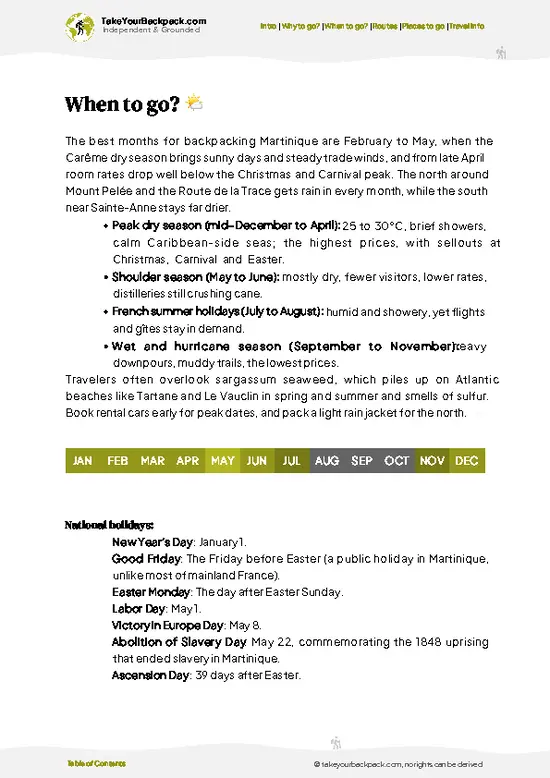
The best time for La Savane des Esclaves is the dry season, February to May, when the open-air site in Trois-Îlets stays comfortable and the footpaths are firm underfoot.
  • Dry Season (Feb to May): Highs of 28 to 30°C (82 to 86°F), lowest rainfall, and the least mud on the garden paths. Shaded huts make the heat easy to handle.
  • Rainy Season (Jun to Nov): Highs of 30 to 32°C (86 to 90°F), humid, with afternoon downpours that usually pass within an hour. August to October brings hurricane risk, and some visits are cut short.
  • Peak Holidays (Dec to Jan): Temperatures of 27 to 29°C (81 to 84°F), more cruise and tour groups, and higher prices on nearby rooms and rental cars.
  • Time of Day: Daylight lasts about 11 to 12.5 hours all year. Arrive at opening, because mornings are cooler and quieter.
Book rooms … read more 👉
The best time for La Savane des Esclaves is the dry season, February to May, when the open-air site in Trois-Îlets stays comfortable and the footpaths are firm underfoot.
  • Dry Season (Feb to May): Highs of 28 to 30°C (82 to 86°F), lowest rainfall, and the least mud on the garden paths. Shaded huts make the heat easy to handle.
  • Rainy Season (Jun to Nov): Highs of 30 to 32°C (86 to 90°F), humid, with afternoon downpours that usually pass within an hour. August to October brings hurricane risk, and some visits are cut short.
  • Peak Holidays (Dec to Jan): Temperatures of 27 to 29°C (81 to 84°F), more cruise and tour groups, and higher prices on nearby rooms and rental cars.
  • Time of Day: Daylight lasts about 11 to 12.5 hours all year. Arrive at opening, because mornings are cooler and quieter.
Book rooms a month ahead for December and January, and plan around the rain by visiting before lunch.


source: climatestotravel.comJANJanuary: excellent for travelingFEBFebruary: excellent for travelingMARMarch: excellent for travelingAPRApril: highly recommended for travelingMAYMay: fair for travelingJUNJune: fair for travelingJULJuly: fair for travelingAUGAugust: fair for travelingSEPSeptember: fair for travelingOCTOctober: fair for travelingNOVNovember: highly recommended for travelingDECDecember: excellent for traveling
when-to-go

✈️ The backpacker research shortcutMartinique Travel Guide

An offline-friendly backpacking guide with optimized travel routes, ranked highlights, transport advice, and the best areas to stay.
example page 0 from our offline Travel Guide for Martinique
example page 1 from our offline Travel Guide for Martinique
example page 2 from our offline Travel Guide for Martinique
example page 3 from our offline Travel Guide for Martinique
example page 4 from our offline Travel Guide for Martinique
example page 5 from our offline Travel Guide for Martinique
example page 6 from our offline Travel Guide for Martinique
example page 7 from our offline Travel Guide for Martinique
The digital guide (180 pages) contains:
✅ 43 highlights, ranked by travel appeal
✅ Optimized 2, 3 & 5-day travel routes
✅ Cities, national parks, landmarks, beaches
✅ How to get around
✅ Offline-friendly for travel without Wi-Fi
👉 Click to see all 30+ guide features

📅 Plan smarter in minutes, not weeks
✅ Month by month travel advice
✅ Festivals & national holidays
✅ Budget expectations

🗺️ Go to the right places, skip the overrated ones
✅ Honest pros & cons of destinations
✅ Top hikes, parks & viewpoints
✅ Lesser-known places most travelers miss
✅ Clear “worth it vs skip it” guidance

🛏️ Travel smoothly without rookie mistakes
✅ Best areas to stay
✅ Transport systems explained simply
✅ Common scams & safety advice
✅ SIM cards, money & practical tips

🌍 Understand the country, not just visit it
✅ Culture & traditions
✅ 52 Essential phrases & customs
✅ Festivals worth planning around
✅ Traveler-friendly historical context
✅ Insights that make places more meaningful

📱 Built for real travel conditions
✅ Fully downloadable PDF
✅ Works completely offline
✅ Optimized for phone use
✅ Useful in remote areas & buses
✅ Everything in one place
Stop searching, start planning
Get instant access to your full guide. 30‑day money-back guarantee.
+ Add another guide for just

By proceeding you agree to our terms.
Sent to your inbox immediately after payment • 100% Secure Checkout
Best Backpacking Travel Advisor 2025 tourism awardBest Backpacking
Travel Advisor
2025
What others say about Take Your Backpack Guides:
⭐⭐⭐⭐⭐
Fantastic, amazing amount of information!
⭐⭐⭐⭐⭐
My goodness this is amazing, it's what I've been looking for hats off too you!
⭐⭐⭐⭐⭐
I think this is absolutely BRILLIANT
⭐⭐⭐⭐
Very complete and informative. It's still missing places, but I gotta to commend you
⭐⭐⭐⭐⭐
This is truly amazing, thank you, can't wait to explore it with my kids!
⭐⭐⭐⭐⭐
Awesome resource, thank you!
⭐⭐⭐⭐⭐
This is amazing! Can't wait to explore the ones I haven't seen
⭐⭐⭐⭐
I love this! Well done, great idea.
⭐⭐⭐⭐⭐
Thanks for taking the time to make this gem!
⭐⭐⭐⭐⭐
This might be the best website I've ever seen.
⭐⭐⭐⭐⭐
Congratulations, and thank you so much for your work; it's incredibly valuable.
⭐⭐⭐⭐
In all seriousness I think you did a great job pointing out the important spots
⭐⭐⭐⭐⭐
10/10 very good
⭐⭐⭐⭐⭐
As someone who's only just starting to visit regularly this is awesome, thank you.
⭐⭐⭐⭐
Thank you very much! I'm going to visit my dad, it's going to be very useful!
⭐⭐⭐⭐⭐
This is really cool! We'll be travelling for the first time and this definitely come in handy.
⭐⭐⭐⭐⭐
You are now our minister of culture, congratulations 👨‍💼
⭐⭐⭐⭐⭐
Just wanted to tell you that this is a pearl! Going to follow your recommendations.
⭐⭐⭐⭐⭐
This is so cool. I'll definitely be using the resource for my travels soon.
⭐⭐⭐⭐⭐
This is very impressive! Good work.
⭐⭐⭐⭐⭐
This is an amazing and informative site. Very well done!

🛏️ Where to stay?Where staying makes the most sense

The best base for La Savane des Esclaves is Trois-Îlets itself, where the site is a short walk or a quick ride from the village center.
Trois-Îlets has guesthouses, small apartments and simple studios, plus a handful of restaurants and a small beach scene. It is safe, easy to walk after dark, and quiet rather than rowdy, so it suits travelers who want calm evenings.
Pointe du Bout, a few minutes away, has a marina, a ferry to Fort-de-France and the most sociable bars and cafes in the area. It is pricier and more resort-oriented, but a good pick for meeting other travelers and arranging boat trips. … read more 👉
The best base for La Savane des Esclaves is Trois-Îlets itself, where the site is a short walk or a quick ride from the village center.
Trois-Îlets has guesthouses, small apartments and simple studios, plus a handful of restaurants and a small beach scene. It is safe, easy to walk after dark, and quiet rather than rowdy, so it suits travelers who want calm evenings.
Pointe du Bout, a few minutes away, has a marina, a ferry to Fort-de-France and the most sociable bars and cafes in the area. It is pricier and more resort-oriented, but a good pick for meeting other travelers and arranging boat trips.
Les Anses-d’Arlet, a short drive south, has a fishing-village feel, calm swimming and cheaper guesthouses, though you will need a car or taxi.
Fort-de-France is the budget option, with the most hostels and dorm-style rooms, plus the busiest nightlife. Use the ferry across the bay to get to the Trois-Îlets area, and keep valuables out of sight when you wander at night.

👛 Costs (as of 22 October 2026)Money, prices, and spending tips

La Savane des Esclaves costs about €17 a day for a backpacker who pays the €12 guided visit and keeps the rest simple.
CategoryBudget RangeLocal Reality
Guided visit€12Adult price for the guided tour of the reconstructed village in Trois-Îlets. Children pay less.
Bus or shared transport€2 to 4Minibuses (taxis collectifs) run from Fort-de-France toward Trois-Îlets. Expect to walk or hop on another short ride for the last stretch.
Snack or drink€3 to 6Pay in euros. Small bakeries and snack stands in Trois-Îlets sell sandwiches and cold drinks at prices a little above mainland France.
Craft purchases€0 to 10Optional. The site shop and nearby stalls sell small handmade items.
Accommodation (high season)€0Not charged here. Beds around Trois-Îlets and Pointe du Bout are priced separately by the night
… read more 👉
La Savane des Esclaves costs about €17 a day for a backpacker who pays the €12 guided visit and keeps the rest simple.
CategoryBudget RangeLocal Reality
Guided visit€12Adult price for the guided tour of the reconstructed village in Trois-Îlets. Children pay less.
Bus or shared transport€2 to 4Minibuses (taxis collectifs) run from Fort-de-France toward Trois-Îlets. Expect to walk or hop on another short ride for the last stretch.
Snack or drink€3 to 6Pay in euros. Small bakeries and snack stands in Trois-Îlets sell sandwiches and cold drinks at prices a little above mainland France.
Craft purchases€0 to 10Optional. The site shop and nearby stalls sell small handmade items.
Accommodation (high season)€0Not charged here. Beds around Trois-Îlets and Pointe du Bout are priced separately by the night and are not included in this daily figure.
Total Daily Budget€17Entry plus transport and a light snack.
⚠️ Prices can change and everyone travels differently, so take this as a rough guide. Hope it helps you plan your adventure!

FAQTraveler FAQ

La Savane des Esclaves needs about 1.5 to 2 hours, which covers the guided tour of the reconstructed village plus time in the garden and shop. The tour itself runs roughly an hour. Pair it with a half day around Trois-Îlets, such as the beach at Anse Mitan, to fill the rest of the day.
For most visitors La Savane des Esclaves is worth the roughly €12 adult ticket because the guide explains how enslaved people lived, farmed and used medicinal plants. The tour is the main value, so skipping it for a quick wander of the grounds loses most of the context. Budget travelers who only want views will find better free options on the coast.
La Savane des Esclaves sits in Trois-Îlets, about 20 to 30 minutes by car from Fort-de-France, and the easiest way is a rental car or taxi. Without a car, take a minibus or the ferry from Fort-de-France to Trois-Îlets (about 20 minutes, around €4 to 8 return) and walk or share a short ride. Bus services thin out in the late afternoon, so plan your return before 5 pm.
⚠️ Things can change over time, so always validate details locally before you go.

Other Martinican attractions near La Savane des Esclaves

Explore more nearby:


💡 Not sure where to go next?
Create a personalized itinerary for Martinique including La Savane des Esclaves and the places that fit your trip.

Generate my itinerary

👉 Discover all attractions

Or checkout all Martinique has to offer (think cities, towns, villages, national parks, hikes, beaches, festivals)
Country photo of Martinique

We 💚 feedbackSumming up the experience

La Savane des Esclaves suits curious travelers who learn by touching, smelling and listening, and anyone who wants Martinique’s story without a glass case. Skip it if you dislike walking in sun. I would go early, wear closed shoes, and ask the guide plenty of questions, because the answers are the best part.

✍️ Help improve this page!
The information on this page is based on in-depth research, insights shared by experienced travelers, and feedback from the local travel community in Martinique. While every effort is made to keep the information accurate and current, conditions can change — so if you spot anything incorrect or outdated, please get in touch.


🙋‍♂️ Give feedback

👋 Meet the founderWho’s Behind Take Your Backpack?

Johan, backpacker and founder of TakeYourBackpackHi, I’m Johan (Netherlands 🇳🇱), the creator of TakeYourBackpack. Over the past 3 decades, I’ve backpacked through 90+ countries across six continents, gaining extensive experience with independent travel, long-term trips, and overland routes.

This site is built on a combination of firsthand travel experience and carefully curated insights from other backpackers. Many guides are based on places I’ve personally visited, while others bring together tips, observations, and practical advice shared by trusted travelers I’ve met along the way.

The goal is to provide realistic, experience-driven guidance — not generic itineraries — so you can explore destinations with better context, clearer expectations, and more confidence.