×

Mauritius🇲🇺 | best villagesDiscover the 3 Best villages Across Mauritius

Villages in Mauritius are working communities of sugar cane, fishing boats and temples, not postcard stops. The north and west coasts are busier and pricier, the south and east quieter and cheaper, and the plateau villages are cooler. Independent travelers do fine on local buses, which run from early morning. Go before 9 a.m. for markets and calm.

By Johan Kruseman 🇳🇱 | Updated October 23, 2026
Explore the best landmarks in Mauritius

Why go?Why These village Stand Out

Mauritius packs Indian, African, Chinese, French and Creole influences into an island of roughly 65 kilometers by 45, so a single bus ride can cross from a Hindu temple village to a Creole fishing hamlet. Colonial sugar estates shaped the settlement pattern, which is why so many villages sit among cane fields and around a central road, a temple, a mosque or a church. Distances are short and the public bus network is dense and cheap, so you can base yourself in one place and still reach many communities. Know before you choose: villages here are lived-in, not preserved, and dress and photo etiquette matter at religious sites. Many have few cafes or beds, so plan meals around market days and street food such as dholl puri. Pair a village visit with a nearby beach and you get the best of both.
Why These Made the Cut
The list of best villages in Mauritius is created based on authenticity, scenic beauty, community spirit, traditions, and overall character. If you feel a village is missing in this list, please let us know.

When to go?When to Plan Your Trip

Best months: May to December is the best window for villages in Mauritius because the weather is drier and cooler, with daytime highs around 24 to 28°C, so walking between lanes and temples stays comfortable. Humidity drops and cane-field roads are easier to wander.
Shoulder and wet season: January to April is hot (30 to 33°C), humid and cyclone-prone, with heavy downpours that can flood low roads. February is usually the wettest. October and November are my pick for sunny days and lower prices than the December to January peak, when beach accommodation can run 30 to 50 percent higher. The central plateau (Curepipe area) is cooler and rainier all year, often 4 to 5°C below the coast, so bring a light rain jacket. The east coast catches the trade winds and the west stays drier and calmer. Go early, before the midday heat.

village hoppingOptimizing Your Multi-Stop Itinerary

How long to allow: A trip linking several villages in Mauritius works best over 5 to 8 days, because distances are short but buses are slow. Group stops by region: north (around Grand Baie and Pamplemousses), the east and south (Mahébourg to Souillac), and the west (Flic en Flac and Chamarel). Travel anticlockwise, starting in the north or Port Louis, then Mahébourg and the south, finishing in the west, so the longer bus legs come first while you are fresh. Allow 2 to 4 hours per village stop, or half a day if there is a market or temple walk. Bus transfers between regions usually take 1.5 to 3 hours, often via the hubs of Port Louis, Curepipe or Rose Belle. Mistakes to avoid: Travelers often squeeze in three villages a day and spend it waiting at stops. Instead, pick one region per day, check … read more 👉
How long to allow: A trip linking several villages in Mauritius works best over 5 to 8 days, because distances are short but buses are slow. Group stops by region: north (around Grand Baie and Pamplemousses), the east and south (Mahébourg to Souillac), and the west (Flic en Flac and Chamarel). Travel anticlockwise, starting in the north or Port Louis, then Mahébourg and the south, finishing in the west, so the longer bus legs come first while you are fresh. Allow 2 to 4 hours per village stop, or half a day if there is a market or temple walk. Bus transfers between regions usually take 1.5 to 3 hours, often via the hubs of Port Louis, Curepipe or Rose Belle. Mistakes to avoid: Travelers often squeeze in three villages a day and spend it waiting at stops. Instead, pick one region per day, check the last bus (many stop around 5 to 6 p.m. in rural areas), and use a shared taxi for hard-to-reach southern routes.

The ListMust-Visit villages in Mauritius

1 Chamarel

Layered dunes, 100-meter waterfall, estate rum, cool uplands

Drive the switchback road above the Black River Gorges to see banded sands, a gorge-edge cascade and a cane-field distillery in half a day.

mauritius-city-chamarel
© Google |

2 Pamplemousses

Giant water lilies, sugar museum, palm avenues, tortoises

Arrive at opening to walk empty garden paths, then follow the story of sugar through an old factory and finish with rum tasting.

mauritius-city-pamplemousses
© Google |

3 Rivière du Rempart

Twice-weekly bazaar, dholl puri stalls, Hindu temples, cane country

Time a visit for market morning to graze on street snacks, then drift between a white parish church and brightly painted neighborhood temples.

Loading the map 🌍

Expert viewPro Tips for Exploring the Best

How many to visit: I would advise 4 to 6 villages in total on one trip. Fewer than four and you miss the contrast between coasts and the plateau. More than six and they blur, because buses are slow and each stop deserves a few unhurried hours. Spreading them over a week keeps you rested and leaves beach time.
Which kind to prioritize: Choose by your travel style. Culture seekers get the most from the Hindu and Creole farming villages in the interior and north, which cost almost nothing and sit on bus routes. Photographers and slow travelers should favor the south and east fishing communities, which are quieter and cheaper than the west coast. If comfort matters, a village with a nearby guesthouse beats a long day trip, since a taxi round trip often runs Rs 1,500 to 3,000 (US$33 to 65).
What … read more 👉
How many to visit: I would advise 4 to 6 villages in total on one trip. Fewer than four and you miss the contrast between coasts and the plateau. More than six and they blur, because buses are slow and each stop deserves a few unhurried hours. Spreading them over a week keeps you rested and leaves beach time.
Which kind to prioritize: Choose by your travel style. Culture seekers get the most from the Hindu and Creole farming villages in the interior and north, which cost almost nothing and sit on bus routes. Photographers and slow travelers should favor the south and east fishing communities, which are quieter and cheaper than the west coast. If comfort matters, a village with a nearby guesthouse beats a long day trip, since a taxi round trip often runs Rs 1,500 to 3,000 (US$33 to 65).
What it costs: Most backpackers manage on Rs 1,500 to 2,500 a day (US$33 to 55) with guesthouse dorms or simple rooms, street food and buses. Buses cost roughly Rs 30 to 100 per ride, and most village streets and temples are free. Small donations at temples, Rs 50 to 100, are welcome, and local guides for cane or craft walks charge around Rs 500 to 1,500. The bus is the best value for money and time on short hops; a taxi is worth the splurge only for remote southern villages.
Safety and etiquette: Mauritius is generally safe, but keep valuables hidden on crowded buses and avoid unlit lanes at night. Cover shoulders and knees, remove shoes at temples and mosques, and ask before photographing people or ceremonies. Friday prayers and festival days can close lanes, so greet locals first. A few words of Creole or French go a long way.

✈️ The backpacker research shortcutMauritius Travel Guide

An offline-friendly backpacking guide with optimized travel routes, ranked highlights, transport advice, and the best areas to stay.
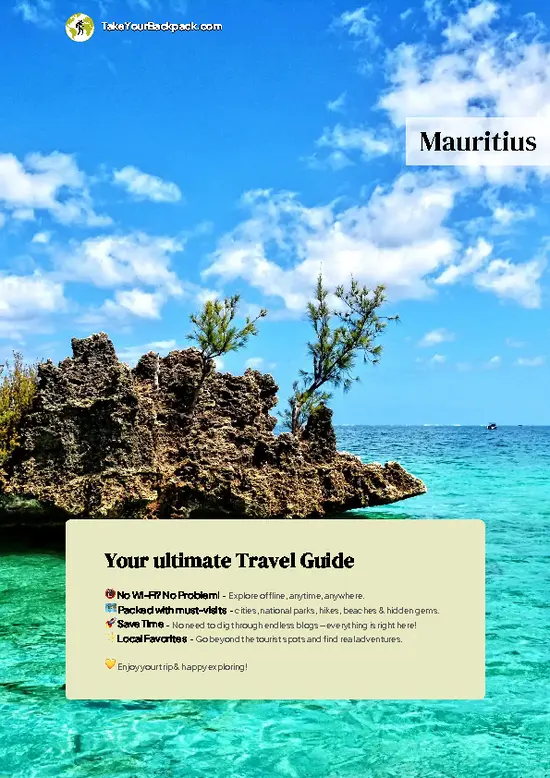
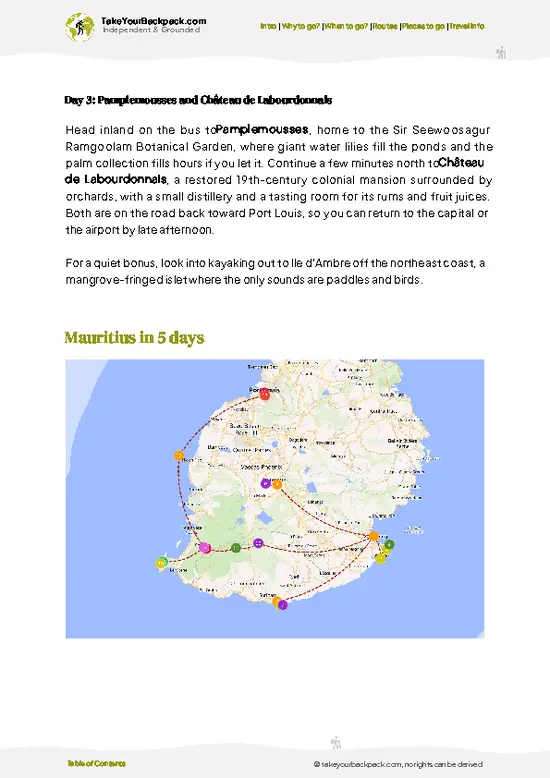
example page 0 from our offline Travel Guide for Mauritius
example page 1 from our offline Travel Guide for Mauritius
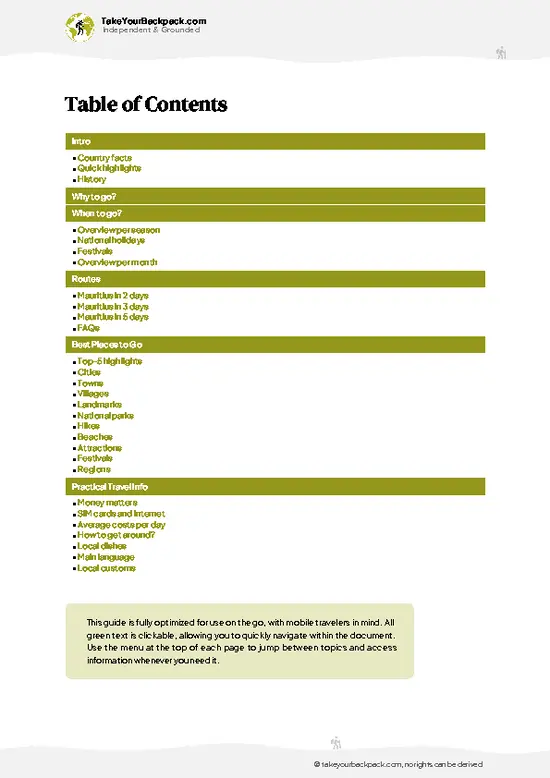
example page 2 from our offline Travel Guide for Mauritius
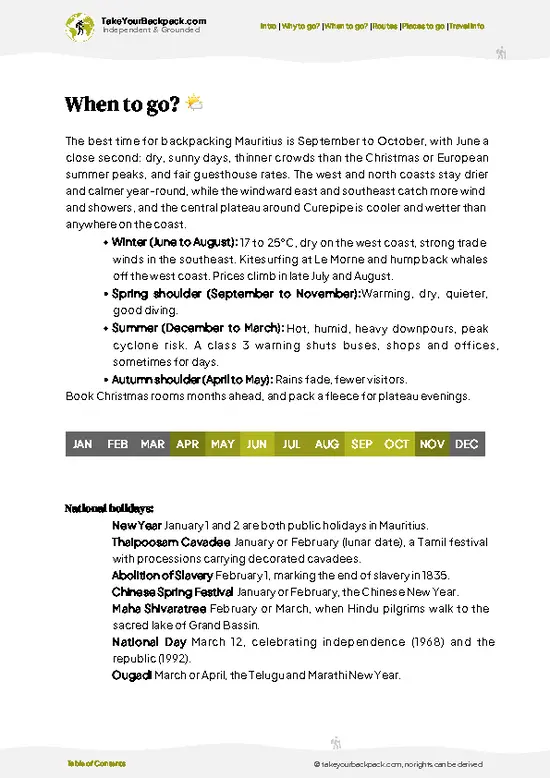
example page 3 from our offline Travel Guide for Mauritius
example page 4 from our offline Travel Guide for Mauritius
example page 5 from our offline Travel Guide for Mauritius
example page 6 from our offline Travel Guide for Mauritius
example page 7 from our offline Travel Guide for Mauritius
The digital guide (246 pages) contains:
✅ 65 highlights, ranked by travel appeal
✅ Optimized 2, 3 & 5-day travel routes
✅ Cities, national parks, landmarks, beaches
✅ How to get around
✅ Offline-friendly for travel without Wi-Fi
👉 Click to see all 30+ guide features

📅 Plan smarter in minutes, not weeks
✅ Month by month travel advice
✅ Festivals & national holidays
✅ Budget expectations

🗺️ Go to the right places, skip the overrated ones
✅ Honest pros & cons of destinations
✅ Top hikes, parks & viewpoints
✅ Lesser-known places most travelers miss
✅ Clear “worth it vs skip it” guidance

🛏️ Travel smoothly without rookie mistakes
✅ Best areas to stay
✅ Transport systems explained simply
✅ Common scams & safety advice
✅ SIM cards, money & practical tips

🌍 Understand the country, not just visit it
✅ Culture & traditions
✅ 52 Essential phrases & customs
✅ Festivals worth planning around
✅ Traveler-friendly historical context
✅ Insights that make places more meaningful

📱 Built for real travel conditions
✅ Fully downloadable PDF
✅ Works completely offline
✅ Optimized for phone use
✅ Useful in remote areas & buses
✅ Everything in one place
Stop searching, start planning
Get instant access to your full guide. 30‑day money-back guarantee.
+ Add another guide for just

By proceeding you agree to our terms.
Sent to your inbox immediately after payment • 100% Secure Checkout
Best Backpacking Travel Advisor 2025 tourism awardBest Backpacking
Travel Advisor
2025
What others say about Take Your Backpack Guides:
⭐⭐⭐⭐⭐
Fantastic, amazing amount of information!
⭐⭐⭐⭐⭐
My goodness this is amazing, it's what I've been looking for hats off too you!
⭐⭐⭐⭐⭐
I think this is absolutely BRILLIANT
⭐⭐⭐⭐
Very complete and informative. It's still missing places, but I gotta to commend you
⭐⭐⭐⭐⭐
This is truly amazing, thank you, can't wait to explore it with my kids!
⭐⭐⭐⭐⭐
Awesome resource, thank you!
⭐⭐⭐⭐⭐
This is amazing! Can't wait to explore the ones I haven't seen
⭐⭐⭐⭐
I love this! Well done, great idea.
⭐⭐⭐⭐⭐
Thanks for taking the time to make this gem!
⭐⭐⭐⭐⭐
This might be the best website I've ever seen.
⭐⭐⭐⭐⭐
Congratulations, and thank you so much for your work; it's incredibly valuable.
⭐⭐⭐⭐
In all seriousness I think you did a great job pointing out the important spots
⭐⭐⭐⭐⭐
10/10 very good
⭐⭐⭐⭐⭐
As someone who's only just starting to visit regularly this is awesome, thank you.
⭐⭐⭐⭐
Thank you very much! I'm going to visit my dad, it's going to be very useful!
⭐⭐⭐⭐⭐
This is really cool! We'll be travelling for the first time and this definitely come in handy.
⭐⭐⭐⭐⭐
You are now our minister of culture, congratulations 👨‍💼
⭐⭐⭐⭐⭐
Just wanted to tell you that this is a pearl! Going to follow your recommendations.
⭐⭐⭐⭐⭐
This is so cool. I'll definitely be using the resource for my travels soon.
⭐⭐⭐⭐⭐
This is very impressive! Good work.
⭐⭐⭐⭐⭐
This is an amazing and informative site. Very well done!

🛏️ Where to stay?Where to Base Yourself

Backpacking Mauritius means few true dorm hostels, but budget guesthouses, family-run pensions and self-catering studios are common, typically around Rs 1,200 to 2,500 (€25 to 50) a night for a double. Grand Baie in the north has the widest choice, the island’s liveliest bars and easy boat trips, though it’s the most built-up stretch, while Flic en Flac on the west coast pairs a long public beach and sunset views with a calmer evening scene. For quiet and a more local feel, Mahébourg sits 15 minutes from the airport near the southeast lagoon, and La Gaulette puts you close to Le Morne’s kitesurfing and hiking, but both go silent after dark and need buses or a scooter to reach much else.

If you … read more 👉
Backpacking Mauritius means few true dorm hostels, but budget guesthouses, family-run pensions and self-catering studios are common, typically around Rs 1,200 to 2,500 (€25 to 50) a night for a double. Grand Baie in the north has the widest choice, the island’s liveliest bars and easy boat trips, though it’s the most built-up stretch, while Flic en Flac on the west coast pairs a long public beach and sunset views with a calmer evening scene. For quiet and a more local feel, Mahébourg sits 15 minutes from the airport near the southeast lagoon, and La Gaulette puts you close to Le Morne’s kitesurfing and hiking, but both go silent after dark and need buses or a scooter to reach much else.

If you enjoy meeting fellow travelers, consider choosing hostels with high ratings for atmosphere. On the other hand, if you prefer having your own space, a hotel might be a better option.

MauritiusExpand Your Journey

👋 Meet the founderWho’s Behind Take Your Backpack?

Johan, backpacker and founder of TakeYourBackpackHi, I’m Johan (Netherlands 🇳🇱), the creator of TakeYourBackpack. Over the past 3 decades, I’ve backpacked through 90+ countries across six continents, gaining extensive experience with independent travel, long-term trips, and overland routes.

This site is built on a combination of firsthand travel experience and carefully curated insights from other backpackers. Many guides are based on places I’ve personally visited, while others bring together tips, observations, and practical advice shared by trusted travelers I’ve met along the way.

The goal is to provide realistic, experience-driven guidance — not generic itineraries — so you can explore destinations with better context, clearer expectations, and more confidence.