×

Mexico🇲🇽 | national parksCalakmul45-meter pyramid, Kaan stelae, howler monkeys, jungle road | things to do and best time to go

Explore Sian Ka’anExplore La Malinche

Backpacking in Calakmul
🏆 Top picknational park ranked #2
By Johan Kruseman 🇳🇱 | Updated October 20, 2026

The summit of Estructura II, a Maya pyramid roughly 45 meters tall, pokes through a canopy that runs unbroken toward Guatemala, and that view is why people endure the road to Calakmul. The reserve sits in the south of Campeche state in Mexico, at the end of one long jungle highway. On the ground, that means a dim forest path between plazas where howler monkeys sound like distant engines, and steep limestone stairs that deliver a sea of treetops. My mistake was arriving at midday, when the monkeys had gone quiet and the tour vans had already left with the best light. Now I enter at opening time and get the roar, the empty plazas and the stelae to myself. Calakmul suits patient, curious walkers who like ruins with wildlife attached. It will frustrate anyone who wants a quick stop, food stalls or a polished tour-bus circuit.

Discover everything you want to know in the 📖 Mexico Travel Guide.


example page 0 from our offline Travel Guide for Mexico
example page 1 from our offline Travel Guide for Mexico
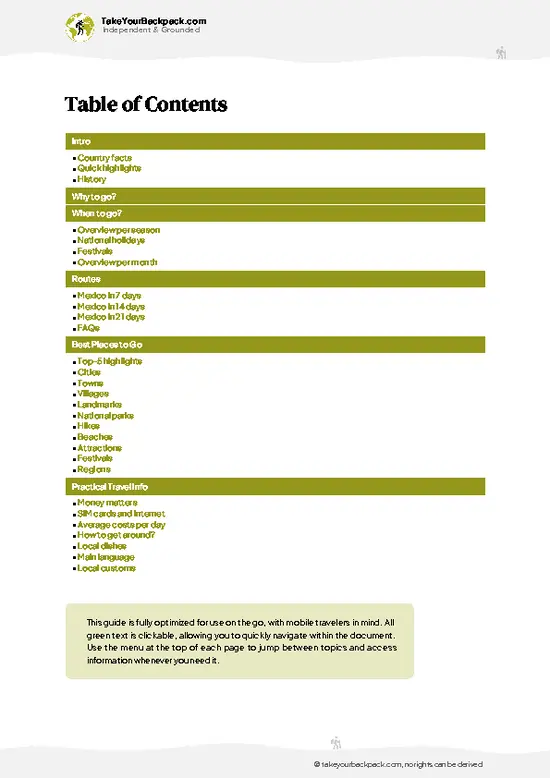
example page 2 from our offline Travel Guide for Mexico
example page 3 from our offline Travel Guide for Mexico
example page 4 from our offline Travel Guide for Mexico
example page 5 from our offline Travel Guide for Mexico
example page 6 from our offline Travel Guide for Mexico
example page 7 from our offline Travel Guide for Mexico
Loading the map 🌍
CLICK TO FILTER
cities
towns
villages
landmarks
national parks
hikes
beaches
attractions
festivals
regions
SHOW COUNTRY’S BESTSHOW ALL

✨ Why go?
Ranked #2 national park in Mexico
Why visitors keep coming back

Calakmul rewards backpackers who like working things out for themselves. The site is spread across forest rather than packed into one fenced lot, so you set your own pace and your own order. You can climb Estructura II first, while the air is still cool, then wander quiet side trails toward smaller plazas without a guide steering you. Wildlife also comes on your schedule. Spider monkeys, toucans and ocellated turkeys show up along the paths and the approach road, and a guide's fixed timetable would only get in the way. The place is also a rare chance to see a major Maya capital without crowds. This was the seat of the Kaan, or Snake, dynasty, and more than 100 carved stelae survive here, many still standing under thatched shelters. Self-guided visitors can read them at leisure. The trade-off … read more 👉
Calakmul rewards backpackers who like working things out for themselves. The site is spread across forest rather than packed into one fenced lot, so you set your own pace and your own order. You can climb Estructura II first, while the air is still cool, then wander quiet side trails toward smaller plazas without a guide steering you. Wildlife also comes on your schedule. Spider monkeys, toucans and ocellated turkeys show up along the paths and the approach road, and a guide's fixed timetable would only get in the way. The place is also a rare chance to see a major Maya capital without crowds. This was the seat of the Kaan, or Snake, dynasty, and more than 100 carved stelae survive here, many still standing under thatched shelters. Self-guided visitors can read them at leisure. The trade-off is logistics: the jungle road is long, services are thin, and you must carry your own food and water. Plan that well and you are rewarded with a site that feels like yours.

💡 HighlightsPlaces and moments you shouldn't skip

  1. Estructura II (the Great Pyramid): Rising roughly 45 meters, this is one of the largest Maya structures anywhere, and climbing its steep stone stairs puts you above a canopy that runs unbroken to the horizon in every direction. On a clear morning you can pick out Estructura I of El Mirador in neighboring Guatemala, so bring binoculars if you have them.
  2. Estructura I: A second tall pyramid on the same plaza complex, quieter than its neighbor, and a good place to sit in shade and listen to the forest. The tomb finds here were among the richest of the site.
  3. The Stelae Collection: Calakmul has more carved stelae than any other Maya site, over a hundred, many paired with altars along the Great Plaza. Most are weathered, but a few still show rulers in full regalia, and you can read the story of the
… read more 👉
  1. Estructura II (the Great Pyramid): Rising roughly 45 meters, this is one of the largest Maya structures anywhere, and climbing its steep stone stairs puts you above a canopy that runs unbroken to the horizon in every direction. On a clear morning you can pick out Estructura I of El Mirador in neighboring Guatemala, so bring binoculars if you have them.
  2. Estructura I: A second tall pyramid on the same plaza complex, quieter than its neighbor, and a good place to sit in shade and listen to the forest. The tomb finds here were among the richest of the site.
  3. The Stelae Collection: Calakmul has more carved stelae than any other Maya site, over a hundred, many paired with altars along the Great Plaza. Most are weathered, but a few still show rulers in full regalia, and you can read the story of the Snake dynasty in them.
  4. Great Plaza and the Acropolis: The open ceremonial core is where the site’s scale clicks. Walk it slowly and you pass palace platforms, ball court remnants and terraces that once held the Kaan (Snake) kingdom’s political life.
  5. Estructura VII and the Jungle Trails: Short paths between the major groups run through tall forest rather than open lawn, and the shade makes the walk pleasant even at midday. Estructura VII, off the main loop, is usually empty, which gives you the ruins without the tour groups.
  6. Howler and Spider Monkeys: Calakmul sits inside the Biosphere Reserve, the largest tropical forest reserve in Mexico, so the soundtrack is howler monkeys roaring before dawn and spider monkeys crashing through branches overhead. Ocellated turkeys strut along the access road, and toucans and parrots are routine from the pyramid tops.
  7. The Jungle Road to the Ruins: The 60 km road through the reserve is itself a highlight. Slow driving, or sitting in a shared colectivo, shows you coatis, deer and sometimes a jaguar crossing at dusk, with the forest pressing close on both sides.
  8. Murals of Estructura I and the Site Museum Pieces: Jade funerary masks recovered from Calakmul tombs are displayed in Campeche’s Fort of San Miguel, but at the site itself you can still find traces of painted stucco and relief friezes if you look closely at the oldest buildings.
Calakmul’s trails and the access road cost nothing extra beyond the single site entry, and the cheapest wander of all is the free forest road stretch outside the gate, where the monkeys and turkeys put on their show.
Spotted a mistake or missing something? Contact us.

🌤️ When to go?Seasonal considerations and timing

  • Dry Season (November to April): Calakmul’s most comfortable window, with highs of 28 to 34°C (82 to 93°F) and cooler mornings near 18 to 22°C (64 to 72°F). Trails and the 60 km access road stay passable, and the jungle is still green early in the season. Daylight runs roughly 11 to 12.5 hours.
  • Hot Months (March to May): Highs reach 35 to 40°C (95 to 104°F) and the canopy thins. Birds and mammals gather at remaining water, but climbing Structure 2 at midday is punishing, so arrive at the 8 a.m. opening.
  • Rainy Season (June to October): Expect 25 to 33°C (77 to 91°F), heavy afternoon downpours, mud and swarms of mosquitoes. Cenote-free jungle paths turn slick and hurricane remnants can close the road briefly. Visitors are scarce and lodges often cut rates by 10 to 25 percent.
  • Holiday Peaks (late
… read more 👉
  • Dry Season (November to April): Calakmul’s most comfortable window, with highs of 28 to 34°C (82 to 93°F) and cooler mornings near 18 to 22°C (64 to 72°F). Trails and the 60 km access road stay passable, and the jungle is still green early in the season. Daylight runs roughly 11 to 12.5 hours.
  • Hot Months (March to May): Highs reach 35 to 40°C (95 to 104°F) and the canopy thins. Birds and mammals gather at remaining water, but climbing Structure 2 at midday is punishing, so arrive at the 8 a.m. opening.
  • Rainy Season (June to October): Expect 25 to 33°C (77 to 91°F), heavy afternoon downpours, mud and swarms of mosquitoes. Cenote-free jungle paths turn slick and hurricane remnants can close the road briefly. Visitors are scarce and lodges often cut rates by 10 to 25 percent.
  • Holiday Peaks (late December and Semana Santa): Mexican families and tour groups raise demand, yet Calakmul stays far quieter than Chichén Itzá. Prices in nearby Xpujil rise modestly.
Book a room in Xpujil for February or early March and you get dry roads with manageable heat.


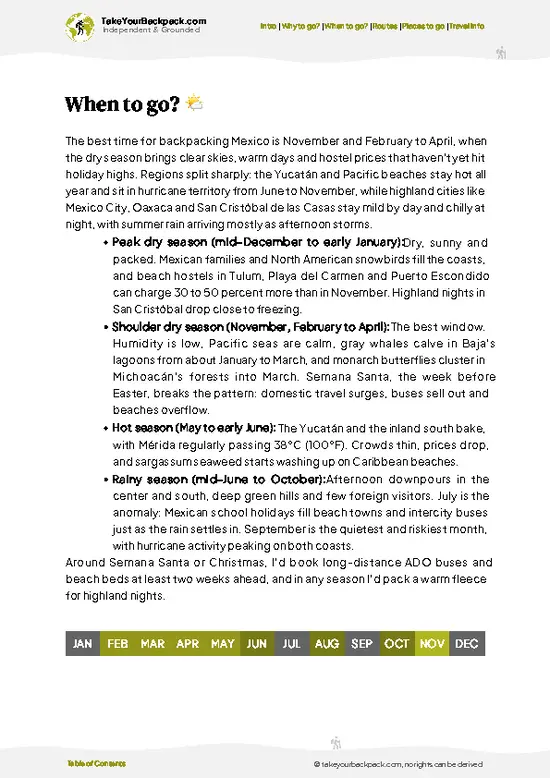
source: climatestotravel.comJANJanuary: highly recommended for travelingFEBFebruary: highly recommended for travelingMARMarch: excellent for travelingAPRApril: highly recommended for travelingMAYMay: fair for travelingJUNJune: fair for travelingJULJuly: below average for travelingAUGAugust: below average for travelingSEPSeptember: below average for travelingOCTOctober: fair for travelingNOVNovember: excellent for travelingDECDecember: highly recommended for traveling
mexico-national-park-calakmul
© Google |

✈️ The backpacker research shortcutMexico Travel Guide

An offline-friendly backpacking guide with optimized travel routes, ranked highlights, transport advice, and the best areas to stay.
example page 0 from our offline Travel Guide for Mexico
example page 1 from our offline Travel Guide for Mexico
example page 2 from our offline Travel Guide for Mexico
example page 3 from our offline Travel Guide for Mexico
example page 4 from our offline Travel Guide for Mexico
example page 5 from our offline Travel Guide for Mexico
example page 6 from our offline Travel Guide for Mexico
example page 7 from our offline Travel Guide for Mexico
The digital guide (402 pages) contains:
✅ 138 highlights, ranked by travel appeal
✅ Optimized 7, 14 & 21-day travel routes
✅ Cities, national parks, landmarks, beaches
✅ How to get around
✅ Offline-friendly for travel without Wi-Fi
👉 Click to see all 30+ guide features

📅 Plan smarter in minutes, not weeks
✅ Month by month travel advice
✅ Festivals & national holidays
✅ Budget expectations

🗺️ Go to the right places, skip the overrated ones
✅ Honest pros & cons of destinations
✅ Top hikes, parks & viewpoints
✅ Lesser-known places most travelers miss
✅ Clear “worth it vs skip it” guidance

🛏️ Travel smoothly without rookie mistakes
✅ Best areas to stay
✅ Transport systems explained simply
✅ Common scams & safety advice
✅ SIM cards, money & practical tips

🌍 Understand the country, not just visit it
✅ Culture & traditions
✅ 52 Essential phrases & customs
✅ Festivals worth planning around
✅ Traveler-friendly historical context
✅ Insights that make places more meaningful

📱 Built for real travel conditions
✅ Fully downloadable PDF
✅ Works completely offline
✅ Optimized for phone use
✅ Useful in remote areas & buses
✅ Everything in one place
Stop searching, start planning
Get instant access to your full guide. 30‑day money-back guarantee.
+ Add another guide for just

By proceeding you agree to our terms.
Sent to your inbox immediately after payment • 100% Secure Checkout
Best Backpacking Travel Advisor 2025 tourism awardBest Backpacking
Travel Advisor
2025
What others say about Take Your Backpack Guides:
⭐⭐⭐⭐⭐
Fantastic, amazing amount of information!
⭐⭐⭐⭐⭐
My goodness this is amazing, it's what I've been looking for hats off too you!
⭐⭐⭐⭐⭐
I think this is absolutely BRILLIANT
⭐⭐⭐⭐
Very complete and informative. It's still missing places, but I gotta to commend you
⭐⭐⭐⭐⭐
This is truly amazing, thank you, can't wait to explore it with my kids!
⭐⭐⭐⭐⭐
Awesome resource, thank you!
⭐⭐⭐⭐⭐
This is amazing! Can't wait to explore the ones I haven't seen
⭐⭐⭐⭐
I love this! Well done, great idea.
⭐⭐⭐⭐⭐
Thanks for taking the time to make this gem!
⭐⭐⭐⭐⭐
This might be the best website I've ever seen.
⭐⭐⭐⭐⭐
Congratulations, and thank you so much for your work; it's incredibly valuable.
⭐⭐⭐⭐
In all seriousness I think you did a great job pointing out the important spots
⭐⭐⭐⭐⭐
10/10 very good
⭐⭐⭐⭐⭐
As someone who's only just starting to visit regularly this is awesome, thank you.
⭐⭐⭐⭐
Thank you very much! I'm going to visit my dad, it's going to be very useful!
⭐⭐⭐⭐⭐
This is really cool! We'll be travelling for the first time and this definitely come in handy.
⭐⭐⭐⭐⭐
You are now our minister of culture, congratulations 👨‍💼
⭐⭐⭐⭐⭐
Just wanted to tell you that this is a pearl! Going to follow your recommendations.
⭐⭐⭐⭐⭐
This is so cool. I'll definitely be using the resource for my travels soon.
⭐⭐⭐⭐⭐
This is very impressive! Good work.
⭐⭐⭐⭐⭐
This is an amazing and informative site. Very well done!

🛏️ Where to stay?Best areas to stay in Mexico

Xpujil, about 55 km from the Calakmul gate, is the practical base for backpackers. This small highway town has a handful of budget hotels and basic cabañas, with dorm-style options rare and private rooms running about US$20 to 40 a night. Several have fans or air conditioning, and you can arrange early-morning taxis or shared transport to the ruins from town. Restaurants and a few small shops line the main road, so you can stock up on food before heading out.
Closer to the reserve, jungle lodges along the access road offer cabins, camping spots and guided wildlife outings. Expect US$40 to 90 for … read more 👉
Xpujil, about 55 km from the Calakmul gate, is the practical base for backpackers. This small highway town has a handful of budget hotels and basic cabañas, with dorm-style options rare and private rooms running about US$20 to 40 a night. Several have fans or air conditioning, and you can arrange early-morning taxis or shared transport to the ruins from town. Restaurants and a few small shops line the main road, so you can stock up on food before heading out.
Closer to the reserve, jungle lodges along the access road offer cabins, camping spots and guided wildlife outings. Expect US$40 to 90 for a cabin, with camping cheaper at some properties. These put you near the gate for dawn bird and howler monkey activity, but meals are usually at the lodge and prices are higher.
Inside the archaeological zone itself there is no lodging, so overnight stays are outside the reserve.
Farther afield, Becán and Chicanná lie near Xpujil, which means staying there lets you combine several Maya sites. Escárcega and Campeche city are larger hubs with more hostels, but they are 2 to 5 hours away by road, so use them only when passing through.

👛 Costs (as of 20 October 2026)Money, prices, and spending tips

Calakmul costs a backpacker roughly US$75 per day when based in Xpujil and using shared transport or a rented car for the ruins.
CategoryBudget RangeLocal Reality
Entrance feesUS$5 to 10Reserve access fee at the road checkpoint plus a separate archaeological site ticket at the ruins. Pay in pesos, in cash.
Accommodation (high season)US$20 to 40Simple private rooms in Xpujil. Jungle cabins near the gate cost US$40 to 90. Low-season rates are often 10 to 25 percent lower.
Local transportUS$15 to 30Shared colectivos or taxis from Xpujil to the ruins cost more than the highway ride because the road is 60 km each way. Rental cars add fuel costs.
Food and suppliesUS$10 to 20Taquerías and small restaurants in Xpujil are cheap. There is almost no food near the ruins, so bring snacks and water.
Guides and
… read more 👉
Calakmul costs a backpacker roughly US$75 per day when based in Xpujil and using shared transport or a rented car for the ruins.
CategoryBudget RangeLocal Reality
Entrance feesUS$5 to 10Reserve access fee at the road checkpoint plus a separate archaeological site ticket at the ruins. Pay in pesos, in cash.
Accommodation (high season)US$20 to 40Simple private rooms in Xpujil. Jungle cabins near the gate cost US$40 to 90. Low-season rates are often 10 to 25 percent lower.
Local transportUS$15 to 30Shared colectivos or taxis from Xpujil to the ruins cost more than the highway ride because the road is 60 km each way. Rental cars add fuel costs.
Food and suppliesUS$10 to 20Taquerías and small restaurants in Xpujil are cheap. There is almost no food near the ruins, so bring snacks and water.
Guides and extrasUS$0 to 25Guides are optional and usually arranged at the site or through lodges. Bird and wildlife outings cost more.
Total Daily BudgetUS$50 to 125About US$75 for a typical mid-range backpacker day using the figures above.


source: gob.mx
⚠️ Prices can change and everyone travels differently, so take this as a rough guide. Hope it helps you plan your adventure!

🥾 TrailsTrail guide for Calakmul national park

Calakmul has no marked, named hiking trails in the usual national-park sense. What people actually walk are the paths between the ruin groups, which are flat to gently rolling forest tracks with the occasional steep stone staircase.
  • Entrance to Gran Plaza: A shaded forest path of around 1 kilometer from the parking area, about 20 to 30 minutes of easy walking. You pass mounds and small structures along the way.
  • Estructura II climb: Steep, uneven stone steps up the main pyramid, 15 to 30 minutes with rests. Moderate, and the view from the top is the main event.
  • Full site circuit: Visiting the major
… read more 👉
Calakmul has no marked, named hiking trails in the usual national-park sense. What people actually walk are the paths between the ruin groups, which are flat to gently rolling forest tracks with the occasional steep stone staircase.
  • Entrance to Gran Plaza: A shaded forest path of around 1 kilometer from the parking area, about 20 to 30 minutes of easy walking. You pass mounds and small structures along the way.
  • Estructura II climb: Steep, uneven stone steps up the main pyramid, 15 to 30 minutes with rests. Moderate, and the view from the top is the main event.
  • Full site circuit: Visiting the major plazas and the quieter groups takes roughly 3 to 4 hours on foot. The terrain is mostly flat, but heat and humidity make it feel longer.
  • Wildlife watching: Howler monkeys, spider monkeys, toucans and ocellated turkeys are most active in the early hours. Jaguars live in the reserve but are very rarely seen.
Calakmul is remote. The ruins lie at the end of a long single road through the biosphere reserve, and there is no regular public transport along it, so most backpackers join a tour from the nearest towns, share a taxi, or drive a rental car. Collective vans and taxis from the Xpujil area are the usual budget routes. Fill the fuel tank and bring food, because services at the site are minimal.
Entry is paid in two parts, a reserve fee and a separate ruins ticket, roughly US$10 to 12 combined, payable in pesos. Calakmul is quiet compared with Chichén Itzá or Tulum, and on many days you will meet only a handful of other visitors. Go early for cooler air, active monkeys and the best chance of having a plaza to yourself. Bring insect repellent, sturdy shoes and a hat.
⚠️ Hiking info can sometimes be outdated or inaccurate. Before you hit the trail, check the latest conditions with locals. If you do spot anything that's off, I'd love to hear from you, so I can update it for fellow travelers.

🛡️ SafetyTraveler Safety Guide

Calakmul is straightforward for hikers who respect the heat and the remoteness. The biggest issue is the 60 km road from the highway to the ruins, which passes through jungle with no services, so fill the fuel tank in Xpujil, carry a spare tire and keep a lot of drinking water on hand. Mobile signal is patchy to nonexistent.
Inside the site, trails are flat and shaded, but heat and humidity build quickly. Start at opening, walk slowly between structures and carry at least 2 liters per person. The stone steps of Structure 2 are steep, uneven and slick after rain, so climb carefully and use the rope where it exists.
Wildlife is a highlight. Spider monkeys, howlers, coatis, toucans and ocellated turkeys are common, and jaguars exist but are rarely seen. Keep your distance, never feed animals and … read more 👉
Calakmul is straightforward for hikers who respect the heat and the remoteness. The biggest issue is the 60 km road from the highway to the ruins, which passes through jungle with no services, so fill the fuel tank in Xpujil, carry a spare tire and keep a lot of drinking water on hand. Mobile signal is patchy to nonexistent.
Inside the site, trails are flat and shaded, but heat and humidity build quickly. Start at opening, walk slowly between structures and carry at least 2 liters per person. The stone steps of Structure 2 are steep, uneven and slick after rain, so climb carefully and use the rope where it exists.
Wildlife is a highlight. Spider monkeys, howlers, coatis, toucans and ocellated turkeys are common, and jaguars exist but are rarely seen. Keep your distance, never feed animals and stay on marked paths. Ticks and mosquitoes are everywhere, so repellent and long, light clothing help. Snakes are present, so watch where you step and place your hands.

FAQFrequently asked questions about Calakmul

Two days works best for Calakmul if you sleep in Xpujil, giving you one full morning at the ruins and another day for Becán, Chicanná and Xpujil’s own site. The main ruins need 4 to 6 hours, including the climb up Structure 2. Add a third day if you want wildlife outings or a visit to the Hormiguero site.
Yes, but it takes planning. Calakmul’s ruins lie about 60 km down a jungle road from the highway near Xpujil, so most backpackers join a tour, take a taxi or colectivo from Xpujil (roughly 1 hour each way) or share a rental car. Public buses reach Xpujil from Campeche (about 4 to 5 hours) and Chetumal (about 2.5 hours), but none go to the ruins.
Yes. Calakmul charges a reserve access fee at the road checkpoint and a separate ticket at the ruins, together roughly US$10 to 15 per person in cash pesos. No hiking permit is required for the ruins. Guided wildlife or special-access outings are arranged separately through lodges and local operators.
⚠️ Things can change over time, so always validate details locally before you go.

Other Mexican national parks near Calakmul

Explore more nearby:

  • Sian Ka’an—Muyil lagoons, Maya canal, Punta Allen, Boca Paila track| 284 km away
  • Pantanos de Centla—Usumacinta wetlands, launch trips, manatee habitat, howler monkeys| 286 km away
  • Lagunas de Montebello—59 lakes, color shifts, Tziscao border shore, Cinco Lagos| 300 km away

💡 Not sure where to go next?
Create a personalized itinerary for Mexico including Calakmul and the places that fit your trip.

Generate my itinerary

👉 Discover all national parks

Or checkout all Mexico has to offer (think cities, towns, villages, national parks, hikes, beaches, festivals)
Country photo of Mexico

We 💚 feedbackFinal thoughts on exploring Calakmul

Calakmul’s tourist focus falls on the big pyramid, but the shaded paths between the plazas are where the place really comes alive. I would spend the second half of your visit on those trails, walking slowly and listening, because monkeys and birds turn up there more often than on the open stairs. Carry your own food and water, and leave the climb for the cool early hours.

✈️ When did I visit Mexico?
As part of my 1.5 year travel around the world trip, I visited Mexico in February and March 2016. Had to hurry a bit as I didn’t want to miss the free performance of the Rolling Stones in Cuba.

✍️ Help improve this page!
The information on this page is based on my own backpacking experience in Mexico, supplemented with up-to-date research and feedback from other travelers. Travel details can change, so if you notice anything outdated or incomplete, feel free to let me know.


🙋‍♂️ Give feedback

👋 Meet the founderWho’s Behind Take Your Backpack?

Johan, backpacker and founder of TakeYourBackpackHi, I’m Johan (Netherlands 🇳🇱), the creator of TakeYourBackpack. Over the past 3 decades, I’ve backpacked through 90+ countries across six continents, gaining extensive experience with independent travel, long-term trips, and overland routes.

This site is built on a combination of firsthand travel experience and carefully curated insights from other backpackers. Many guides are based on places I’ve personally visited, while others bring together tips, observations, and practical advice shared by trusted travelers I’ve met along the way.

The goal is to provide realistic, experience-driven guidance — not generic itineraries — so you can explore destinations with better context, clearer expectations, and more confidence.