×

Moldova🇲🇩 | national parksLower PrutLake Beleu, pelicans, Prut floodplain, Danube confluence | things to do and best time to go

Explore Pădurea DomneascăExplore Codrii

Backpacking in Lower Prut
🏆 Top picknational park ranked #2
By Johan Kruseman 🇳🇱 | Updated November 6, 2026

Reed stems creak, a heron lifts off with a flat slap of wings, and the air over the water smells of mud, willow leaves and warm silt. That is a normal minute at Lower Prut, a protected wetland reserve in the far south of Moldova, where the Prut River runs toward the Danube. The hiking is modest: flat floodplain tracks and boat rides on Lake Beleu rather than climbs. The reward is birdlife, with pelicans, herons, ibises and eagles. Crowds are close to nonexistent, and facilities are thin. The reserve is strictly protected, so you can’t wander in freely. Arrange entry through the reserve administration or a local guide in advance, because rangers control access to the core zone to keep nesting birds undisturbed. Bring your own water and insect repellent, since shops are few and mosquitoes thrive in summer. Roads here end in dust, frogs and a long green horizon of poplars.

Part of Backpacking in Moldova: all 66 places on one map, with routes and the best time to go.
Discover everything you want to know in the 📖 Moldova Travel Guide.
Loading the map 🌍
CLICK TO FILTER
cities
towns
villages
landmarks
national parks
hikes
attractions
festivals
SHOW COUNTRY’S BESTSHOW ALL

✨ Why go?
Ranked #2 national park in Moldova
What sets this place apart

Lower Prut suits backpackers who prefer quiet wetlands to ticking off monuments. The reserve protects a floodplain of reed beds, willow and poplar forest and the shallow expanse of Lake Beleu, a recognized international wetland. Here you can watch birds for hours without another visitor in sight, which almost never happens in Europe’s better-known delta areas.

The second pull is independence on your own terms. Nothing is packaged: you pick the season, the pace and the guide, and a local boatman or ranger will often know exactly where the pelicans are feeding that week. Spring and autumn migration put thousands of waterbirds on the water, and spoonbills, glossy ibises and pygmy cormorants all turn up. Village life nearby adds contrast, with vineyards, orchards and farm carts along the lanes. … read more 👉
Lower Prut suits backpackers who prefer quiet wetlands to ticking off monuments. The reserve protects a floodplain of reed beds, willow and poplar forest and the shallow expanse of Lake Beleu, a recognized international wetland. Here you can watch birds for hours without another visitor in sight, which almost never happens in Europe’s better-known delta areas.

The second pull is independence on your own terms. Nothing is packaged: you pick the season, the pace and the guide, and a local boatman or ranger will often know exactly where the pelicans are feeding that week. Spring and autumn migration put thousands of waterbirds on the water, and spoonbills, glossy ibises and pygmy cormorants all turn up. Village life nearby adds contrast, with vineyards, orchards and farm carts along the lanes. If you want a place where Moldova’s wild side shows, away from the wine cellars, this corner of the Prut valley delivers it. Pack binoculars and patience, and book a ranger-led visit rather than hoping to wing it.

💡 HighlightsPlaces and moments you shouldn't skip

  1. Lake Beleu: The reserve’s core, a shallow, reed-fringed lake reached by flat-bottomed boat. Water lilies, floating islands and constant birdsong make it the main reason to come.
  2. Pelican sightings: Great white and Dalmatian pelicans feed in the shallows, most often during migration seasons. Their size against the low horizon is hard to miss.
  3. Prut floodplain forest: Old willow and poplar stands along the river, draped with vines and thick with warblers and woodpeckers. The ground can be muddy after rain, and the shade is welcome in summer.
  4. Reed-bed heron and ibis colonies: Grey herons, little egrets, glossy ibises and spoonbills nest and feed among the reeds. Early morning gives the best light and the most activity.
  5. White-tailed eagle watching: These large raptors patrol the lake and river, especially
… read more 👉
  1. Lake Beleu: The reserve’s core, a shallow, reed-fringed lake reached by flat-bottomed boat. Water lilies, floating islands and constant birdsong make it the main reason to come.
  2. Pelican sightings: Great white and Dalmatian pelicans feed in the shallows, most often during migration seasons. Their size against the low horizon is hard to miss.
  3. Prut floodplain forest: Old willow and poplar stands along the river, draped with vines and thick with warblers and woodpeckers. The ground can be muddy after rain, and the shade is welcome in summer.
  4. Reed-bed heron and ibis colonies: Grey herons, little egrets, glossy ibises and spoonbills nest and feed among the reeds. Early morning gives the best light and the most activity.
  5. White-tailed eagle watching: These large raptors patrol the lake and river, especially in colder months when waterfowl gather. Look for the broad, rectangular wings circling high over the water.
  6. Prut-Danube confluence at Giurgiulești: The point where the Prut meets the Danube, giving Moldova its only stretch of Danube shoreline. Freighters, anglers and open water make a wide, windy contrast to the sheltered reserve.
For a first visit, Lake Beleu is the one to prioritize, since a boat trip there puts pelicans, herons and floodplain reeds in a single outing. Lower Prut is at its most rewarding on the water.
Spotted a mistake or missing something? Contact us.

🌤️ When to go?Weather, crowds, and seasonal trade-offs

April to early June and September to October are the months to aim for, when migrating birds crowd the wetlands and the air is comfortable.
  • Spring (March to May): Highs climb from 8°C (46°F) to 22°C (72°F). Migrating waterfowl peak in March and April, and the Prut floodplain can be muddy or partly flooded after snowmelt. Daylight runs 12 to 15 hours by May.
  • Summer (June to August): Highs of 28 to 33°C (82 to 91°F) and up to 15.5 hours of light. Mosquitoes and midges are heavy near Lake Beleu, and shade is scarce. Guesthouse prices in Cahul stay flat, and crowds are minimal.
  • Autumn (September to October): Highs of 14 to 25°C (57 to 77°F), clear skies, and a second wave of migrating birds. Reed beds turn gold. Daylight shrinks from 12 to 10 hours.
  • Winter (December to February): Lows of -6 to 0°C
… read more 👉
April to early June and September to October are the months to aim for, when migrating birds crowd the wetlands and the air is comfortable.
  • Spring (March to May): Highs climb from 8°C (46°F) to 22°C (72°F). Migrating waterfowl peak in March and April, and the Prut floodplain can be muddy or partly flooded after snowmelt. Daylight runs 12 to 15 hours by May.
  • Summer (June to August): Highs of 28 to 33°C (82 to 91°F) and up to 15.5 hours of light. Mosquitoes and midges are heavy near Lake Beleu, and shade is scarce. Guesthouse prices in Cahul stay flat, and crowds are minimal.
  • Autumn (September to October): Highs of 14 to 25°C (57 to 77°F), clear skies, and a second wave of migrating birds. Reed beds turn gold. Daylight shrinks from 12 to 10 hours.
  • Winter (December to February): Lows of -6 to 0°C (21 to 32°F), only 8.5 to 9 hours of light, and wind off the flats. Some access tracks turn to slick mud. Prices are lowest, and you will likely have the reserve to yourself.
Aim for late April or late September for the best mix of birdlife, mild weather and fewer insects.


source: climatestotravel.comJANJanuary: below average for travelingFEBFebruary: below average for travelingMARMarch: good for travelingAPRApril: highly recommended for travelingMAYMay: excellent for travelingJUNJune: excellent for travelingJULJuly: fair for travelingAUGAugust: fair for travelingSEPSeptember: excellent for travelingOCTOctober: excellent for travelingNOVNovember: good for travelingDECDecember: below average for traveling
moldova-national-park-lower-prut
© Google |

✈️ The backpacker research shortcutMoldova Travel Guide

What the free pages can't give you: ready-made routes, every place ranked, and it works offline. All in 1 guide.
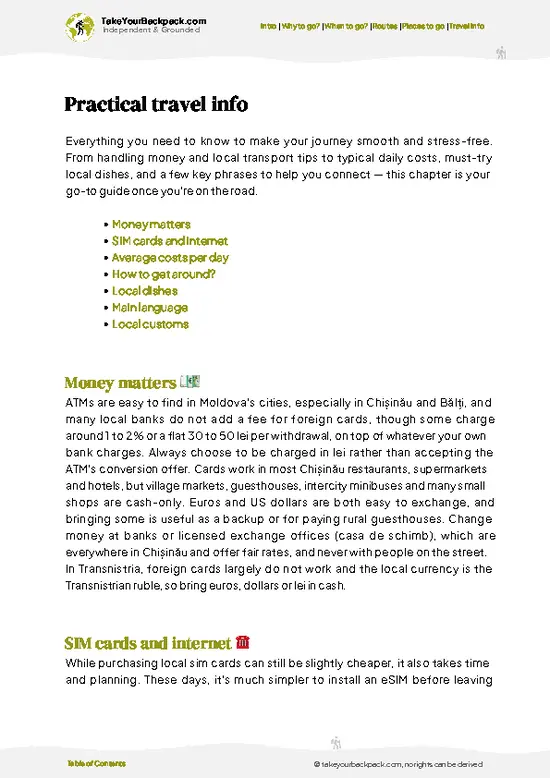
example page 0 from our offline Travel Guide for Moldova
example page 1 from our offline Travel Guide for Moldova
example page 2 from our offline Travel Guide for Moldova
example page 3 from our offline Travel Guide for Moldova
example page 4 from our offline Travel Guide for Moldova
example page 5 from our offline Travel Guide for Moldova
example page 6 from our offline Travel Guide for Moldova
example page 7 from our offline Travel Guide for Moldova
The digital guide (210 pages) contains:-page digital guide:
✅ Ready-made 2, 3 & 5-day routes
✅ All 66 places ranked, so you skip the overrated ones
✅ Works offline, all in 1 guide
✅ Cities, national parks, landmarks, beaches
✅ How to get around
👉 Click to see all 30+ guide features

📅 Plan smarter in minutes, not weeks
✅ Month by month travel advice
✅ Festivals & national holidays
✅ Budget expectations

🗺️ Go to the right places, skip the overrated ones
✅ Honest pros & cons of destinations
✅ Top hikes, parks & viewpoints
✅ Lesser-known places most travelers miss
✅ Clear “worth it vs skip it” guidance

🛏️ Travel smoothly without rookie mistakes
✅ Best areas to stay
✅ Transport systems explained simply
✅ Common scams & safety advice
✅ SIM cards, money & practical tips

🌍 Understand the country, not just visit it
✅ Culture & traditions
✅ 52 Essential phrases & customs
✅ Festivals worth planning around
✅ Traveler-friendly historical context
✅ Insights that make places more meaningful

📱 Built for real travel conditions
✅ Fully downloadable PDF
✅ Works completely offline
✅ Optimized for phone use
✅ Useful in remote areas & buses
✅ All in 1 guide
Stop searching, start planning
Get instant access to your full guide. 30‑day money-back guarantee.


By proceeding you agree to our terms.
Sent to your inbox immediately after payment • 100% Secure Checkout
Best Backpacking Travel Advisor 2025 tourism awardBest Backpacking
Travel Advisor
2025
What others say about Take Your Backpack Guides:
⭐⭐⭐⭐⭐
Fantastic, amazing amount of information!
⭐⭐⭐⭐⭐
My goodness this is amazing, it's what I've been looking for hats off too you!
⭐⭐⭐⭐⭐
I think this is absolutely BRILLIANT
⭐⭐⭐⭐
Very complete and informative. It's still missing places, but I gotta to commend you
⭐⭐⭐⭐⭐
This is truly amazing, thank you, can't wait to explore it with my kids!
⭐⭐⭐⭐⭐
Awesome resource, thank you!
⭐⭐⭐⭐⭐
This is amazing! Can't wait to explore the ones I haven't seen
⭐⭐⭐⭐
I love this! Well done, great idea.
⭐⭐⭐⭐⭐
Thanks for taking the time to make this gem!
⭐⭐⭐⭐⭐
This might be the best website I've ever seen.
⭐⭐⭐⭐⭐
Congratulations, and thank you so much for your work; it's incredibly valuable.
⭐⭐⭐⭐
In all seriousness I think you did a great job pointing out the important spots
⭐⭐⭐⭐⭐
10/10 very good
⭐⭐⭐⭐⭐
As someone who's only just starting to visit regularly this is awesome, thank you.
⭐⭐⭐⭐
Thank you very much! I'm going to visit my dad, it's going to be very useful!
⭐⭐⭐⭐⭐
This is really cool! We'll be travelling for the first time and this definitely come in handy.
⭐⭐⭐⭐⭐
You are now our minister of culture, congratulations 👨‍💼
⭐⭐⭐⭐⭐
Just wanted to tell you that this is a pearl! Going to follow your recommendations.
⭐⭐⭐⭐⭐
This is so cool. I'll definitely be using the resource for my travels soon.
⭐⭐⭐⭐⭐
This is very impressive! Good work.
⭐⭐⭐⭐⭐
This is an amazing and informative site. Very well done!

🛏️ Where to stay?Choosing the right base

Cahul, about 37 km and under an hour by road from the reserve, is the best base, because it has the widest range of beds, food and transport. Nothing inside the Lower Prut Scientific Reserve itself is set up for overnight stays, and wild camping inside the protected zone is not allowed.

In Cahul you will find small hotels and guesthouses at roughly €18 to 30 a night for a double, plus a few cheaper rooms and apartments at €12 to 20. Book ahead by phone or on Booking.com if you arrive on a weekend, when weddings fill rooms. The town has a central market, a bus station with minibuses to Chișinău … read more 👉
Cahul, about 37 km and under an hour by road from the reserve, is the best base, because it has the widest range of beds, food and transport. Nothing inside the Lower Prut Scientific Reserve itself is set up for overnight stays, and wild camping inside the protected zone is not allowed.

In Cahul you will find small hotels and guesthouses at roughly €18 to 30 a night for a double, plus a few cheaper rooms and apartments at €12 to 20. Book ahead by phone or on Booking.com if you arrive on a weekend, when weddings fill rooms. The town has a central market, a bus station with minibuses to Chișinău (around 3 hours), and cafes serving mămăligă and grilled meat.

For something quieter, look at village guesthouses in Manta and Slobozia Mare, which sit close to the floodplain and Lake Beleu. Hosts there often cook dinner and can point you to a local boatman. Rooms run about €12 to 25 with breakfast. Availability is thin outside summer, so message the host a day or two before.

Giurgiulești, at the southern tip of the country by the Danube and Prut, has a handful of basic rooms and is handy if you want to see the border triangle. Most backpackers still do better sleeping in Cahul and heading out each morning.

👛 Costs (as of 6 November 2026)What things cost and how to budget

Lower Prut costs a backpacker roughly €39 to 69 a day, with beds in Cahul and village guesthouses making up most of the spend. Travelers pay in Moldovan lei, but the figures below are in euros.
CategoryBudget RangeLocal Reality
Entrance/permit€1 to 3A small fee is paid to the reserve administration, and a permit is needed for the protected zone.
Accommodation (high season)€18 to 30Double room in a Cahul guesthouse or a village homestay in Manta, often with breakfast.
Accommodation (low season)€12 to 22Rooms are easy to find and hosts often negotiate from October to March.
Local transport€2 to 5Minibuses from Cahul to nearby villages cost a couple of euros, and a taxi for the last stretch adds more.
Food and supplies€10 to 16Market produce, bakery snacks and a cafe meal of grilled meat or soup with
… read more 👉
Lower Prut costs a backpacker roughly €39 to 69 a day, with beds in Cahul and village guesthouses making up most of the spend. Travelers pay in Moldovan lei, but the figures below are in euros.
CategoryBudget RangeLocal Reality
Entrance/permit€1 to 3A small fee is paid to the reserve administration, and a permit is needed for the protected zone.
Accommodation (high season)€18 to 30Double room in a Cahul guesthouse or a village homestay in Manta, often with breakfast.
Accommodation (low season)€12 to 22Rooms are easy to find and hosts often negotiate from October to March.
Local transport€2 to 5Minibuses from Cahul to nearby villages cost a couple of euros, and a taxi for the last stretch adds more.
Food and supplies€10 to 16Market produce, bakery snacks and a cafe meal of grilled meat or soup with a side.
Guide or boat trip€8 to 15A local guide or boatman for the lake and floodplain, cheaper when split between two or three people.
Total Daily Budget€39 to 69Lower end if you eat at the market and share a guide.


source: moldova.travel
⚠️ Prices can change and everyone travels differently, so take this as a rough guide. Hope it helps you plan your adventure!

🥾 TrailsScenic routes and wildlife spotting in Lower Prut

Lower Prut is a scientific reserve, so hiking here means short guided walks on flat floodplain paths and boat outings rather than long marked trails. Everything is low-lying, mostly under a few meters above water level, and easy for any fitness level, though mud and heat can slow you down.
  • Lake Beleu boat outing: A ranger or local boatman takes you through reed channels and onto open water. Allow 2 to 3 hours. Difficulty is easy, and you will see herons, ibises, cormorants and often pelicans.
  • Floodplain forest walk: A guided stroll beneath willow and poplar canopy near the river. Expect 1 to 2 hours
… read more 👉
Lower Prut is a scientific reserve, so hiking here means short guided walks on flat floodplain paths and boat outings rather than long marked trails. Everything is low-lying, mostly under a few meters above water level, and easy for any fitness level, though mud and heat can slow you down.
  • Lake Beleu boat outing: A ranger or local boatman takes you through reed channels and onto open water. Allow 2 to 3 hours. Difficulty is easy, and you will see herons, ibises, cormorants and often pelicans.
  • Floodplain forest walk: A guided stroll beneath willow and poplar canopy near the river. Expect 1 to 2 hours on soft, sometimes muddy ground. Easy, with woodpeckers, orioles and, in spring, a loud chorus of frogs.
  • Reed-edge birdwatching: Slow walking and sitting at the margins of the wetland with binoculars. Half a morning works well. Easy, with the best activity at dawn.
  • Village and orchard lanes: Walking the dirt roads between nearby villages, past vineyards, fields and the riverbank. Two to three hours, flat and sunny, with little shade.
  • Wildlife: Besides birds, look for otters’ tracks, wild boar signs, jackals and many amphibians. Sightings of mammals are rare and depend on guidance and quiet.
Lower Prut is far from the capital, and public transport only gets you as far as the district town and then local minibuses toward the villages. Getting to the reserve itself is easiest with a hired driver or a ride arranged through a local contact. Visits need prior permission from the reserve administration, so expect to arrange timing before you arrive. Crowds are practically absent, even in peak summer. Entry rules and any fees depend on the permit and guide you arrange, and you should pay in Moldovan currency, in small amounts, usually well under €10 per person for a guided visit. Pack water, sun protection and strong repellent, and wear waterproof footwear.
⚠️ Hiking info can sometimes be outdated or inaccurate. Before you hit the trail, check the latest conditions with locals. If you do spot anything that's off, I'd love to hear from you, so I can update it for fellow travelers.

🛡️ SafetyScams, Hazards, and Annoyances

Lower Prut is a flat, low-risk wetland where the main problems are insects, heat, mud and the border. The reserve is a protected floodplain with few marked trails, so navigation matters more than difficulty. Download an offline map before you leave Cahul, because signal fades near Lake Beleu and tracks can look alike among the reeds.

Summer brings strong sun with almost no shade, plus heavy mosquitoes and ticks. Carry at least 2 liters of water, a hat, repellent and long, light clothing. After rain or spring floods, dirt tracks turn to slick clay, so wear boots with grip and expect slow going.

Wildlife is mostly birds, along with the odd wild boar or jackal at dusk. Keep your distance from nesting colonies and stay quiet. The reserve is on the Romania and Ukraine frontier, so keep your passport … read more 👉
Lower Prut is a flat, low-risk wetland where the main problems are insects, heat, mud and the border. The reserve is a protected floodplain with few marked trails, so navigation matters more than difficulty. Download an offline map before you leave Cahul, because signal fades near Lake Beleu and tracks can look alike among the reeds.

Summer brings strong sun with almost no shade, plus heavy mosquitoes and ticks. Carry at least 2 liters of water, a hat, repellent and long, light clothing. After rain or spring floods, dirt tracks turn to slick clay, so wear boots with grip and expect slow going.

Wildlife is mostly birds, along with the odd wild boar or jackal at dusk. Keep your distance from nesting colonies and stay quiet. The reserve is on the Romania and Ukraine frontier, so keep your passport on you, stay on permitted tracks and never photograph border installations. Arrange a local guide or permit through the reserve administration to avoid being turned back.

FAQCommon questions from travelers

One full day is enough for Lower Prut if you only want the wetland and a few hours of birdwatching, though two days lets you add Lake Beleu and the villages of Manta and Slobozia Mare. Base yourself in Cahul, under an hour away by road. Spring and autumn migration are the times when a second day pays off most.
Lower Prut is possible without a car, but the last stretch needs a taxi or a lift. Minibuses run from Chișinău to Cahul in about 3 hours for roughly €6 to 9. From Cahul, local minibuses reach Manta and Slobozia Mare for a couple of euros, and a taxi to the reserve edge costs about €5 to 12 one way, so agree on a pickup time before you go.
Lower Prut is a protected scientific reserve and a Ramsar wetland, so you need permission from the reserve administration to enter the core area. The fee is small, about €1 to 3, and a guide or boatman for Lake Beleu is roughly €8 to 15 a trip. Carry your passport, as the area borders Romania and Ukraine, and contact the administration a few days ahead to arrange access.
⚠️ Things can change over time, so always validate details locally before you go.

Other Moldovan national parks near Lower Prut

Explore more nearby:

  • Codrii—Oak and hornbeam forest, Lozova nature museum, ranger-led ecotrail, Căpriana Monastery| 167 km away
  • Plaiul Fagului—Pale beech trunks, Codri ridges, snowdrop spring, copper autumn| 188 km away
  • Orhei National Park—Răut gorge, Butuceni lanes, cliff monastery, Golden Horde bath ruins| 201 km away

💡 Not sure where to go next?
Create a personalized itinerary for Moldova including Lower Prut and the places that fit your trip.

Generate my itinerary

👉 Discover all national parks

Or checkout all Moldova has to offer (think cities, towns, villages, national parks, hikes, beaches, festivals)
Country photo of Moldova

We 💚 feedbackIs it worth it?

Lower Prut works best as a single overnight in the area, giving you one late afternoon, one dawn and a boat morning on Lake Beleu. A second night is useful only if you are serious about birds. Go in spring or autumn for migration, wear boots that tolerate mud, and fix your permit before you leave the district town.

✍️ Help improve this page!
The information on this page is based on in-depth research, insights shared by experienced travelers, and feedback from the local travel community in Moldova. While every effort is made to keep the information accurate and current, conditions can change — so if you spot anything incorrect or outdated, please get in touch.


🙋‍♂️ Give feedback

👋 Meet the founderWho’s Behind Take Your Backpack?

Johan, backpacker and founder of TakeYourBackpackHi, I’m Johan (Netherlands 🇳🇱), the creator of TakeYourBackpack. Over the past 30 years, I’ve backpacked through 88 countries across six continents, gaining extensive experience with independent travel, long-term trips, and overland routes.

This site is built on a combination of firsthand travel experience and carefully curated insights from other backpackers. Many guides are based on places I’ve personally visited, while others bring together tips, observations, and practical advice shared by trusted travelers I’ve met along the way.

The goal is to provide realistic, experience-driven guidance — not generic itineraries — so you can explore destinations with better context, clearer expectations, and more confidence.