v2.webp)
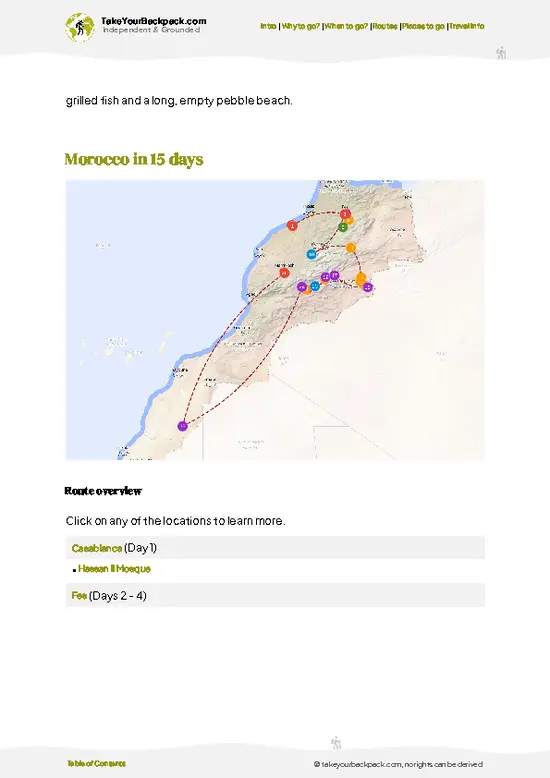
- The Blue Medina and Bab el-Ain: This is what Chefchaouen is known for, a maze of whitewashed and blue-washed lanes climbing the hillside, with potted plants, carved doors and weavers’ shops. Enter through Bab el-Ain and keep walking uphill rather than staying near the square. Go at first light or in the last hour before dark for empty alleys and soft color. Free, and 2 to 3 hours is enough, though getting lost is half the point.
- Plaza Uta el-Hammam: The main square of the old town, lined with café terraces under the walls of the kasbah and the red-tinged Grand Mosque with its octagonal minaret. Mornings are quiet and good for coffee and a bread breakfast, while evenings bring locals out. Free to enter, and you can easily spend an hour here with a drink at US$1 to 3.
- The Kasbah and its museum:
- The Blue Medina and Bab el-Ain: This is what Chefchaouen is known for, a maze of whitewashed and blue-washed lanes climbing the hillside, with potted plants, carved doors and weavers’ shops. Enter through Bab el-Ain and keep walking uphill rather than staying near the square. Go at first light or in the last hour before dark for empty alleys and soft color. Free, and 2 to 3 hours is enough, though getting lost is half the point.
- Plaza Uta el-Hammam: The main square of the old town, lined with café terraces under the walls of the kasbah and the red-tinged Grand Mosque with its octagonal minaret. Mornings are quiet and good for coffee and a bread breakfast, while evenings bring locals out. Free to enter, and you can easily spend an hour here with a drink at US$1 to 3.
- The Kasbah and its museum: Built in the 15th century as a fortress, it has a walled garden, a small ethnographic museum and a tower you can climb for views over the roofs to the mountains. Entry is roughly US$5 to 6. Allow about an hour, and go when the day-trippers are at lunch.
- Ras el-Maa: The spring at the eastern edge of the medina where the river tumbles out of the hills, with small cafés and the communal washing basins where local women still do laundry. Free, best in the morning when the water is loudest and the path is not crowded. Plan on 1 to 1.5 hours including the walk along the stream.
- The Spanish Mosque: A whitewashed mosque, never used for prayer, on the hill across the valley, reached by a steady 25 to 40 minute climb from Ras el-Maa. The view over the blue town against the Rif is the best in the area, and the late afternoon is the time to go. It is free, and the round trip takes 1.5 to 2 hours. Bring water and decent shoes.
Spotted a mistake or missing something? Contact us.

Private photo tour with a local pro photographer

Moroccan Cooking Class with a Local Family & Market Visit

The Real Chefchaouen: Customized Walking Tour in the Blue city

Walking Night Tour at Blue City with Local Guide

From Chefchaouen: Shared Transfer to Fes or Tangier

Atlas Mountains 2-Day Trek: Azzaden Valley Escape

3-Day Trekking from Chefchaouen – Rif Mountains Adventure

Enjoy an Authentic Afternoon Walk with a Local

Private Photography tour in Chefchaouen with Local Photographer


 Best Backpacking
.jpg) Hi, I’m Johan (Netherlands 🇳🇱), the creator of TakeYourBackpack. Over the past 3 decades, I’ve backpacked through 90+ countries across six continents, gaining extensive experience with independent travel, long-term trips, and overland routes.
Hi, I’m Johan (Netherlands 🇳🇱), the creator of TakeYourBackpack. Over the past 3 decades, I’ve backpacked through 90+ countries across six continents, gaining extensive experience with independent travel, long-term trips, and overland routes.