v2.webp)
- Tetouan Medina: The UNESCO-listed old town, with whitewashed lanes, craft quarters and few touts. Go in the morning when shops open. Free to enter, allow 2 to 3 hours.
- Souk el Hout and Bab Okla: A produce and fish market by the medina gate where mountain farmers sell cheese and herbs. Best before noon. Free, about 1 hour.
- Royal Palace façade (Place Hassan II): The lively main square outside the palace, beautiful in the evening when families gather. Free, 30 minutes.
- Archaeological Museum: Small collection with Roman finds from Lixus and Mediterranean sites, plus a Moorish-style courtyard. Entry is about US$2, allow 45 minutes.
- Ethnographic Museum (Dar el Bacha area): Traditional costume, furniture and tilework in a restored historic house. Entry about US$2, around 1 hour.
- School of Arts and Crafts
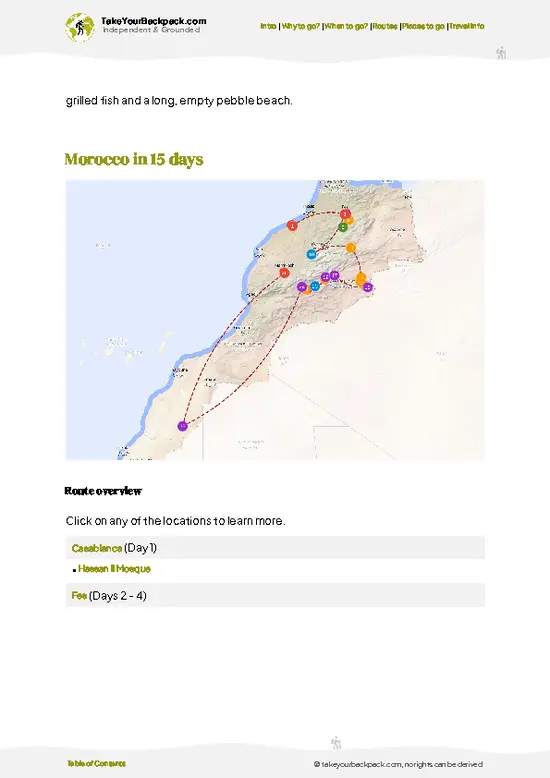
- Tetouan Medina: The UNESCO-listed old town, with whitewashed lanes, craft quarters and few touts. Go in the morning when shops open. Free to enter, allow 2 to 3 hours.
- Souk el Hout and Bab Okla: A produce and fish market by the medina gate where mountain farmers sell cheese and herbs. Best before noon. Free, about 1 hour.
- Royal Palace façade (Place Hassan II): The lively main square outside the palace, beautiful in the evening when families gather. Free, 30 minutes.
- Archaeological Museum: Small collection with Roman finds from Lixus and Mediterranean sites, plus a Moorish-style courtyard. Entry is about US$2, allow 45 minutes.
- Ethnographic Museum (Dar el Bacha area): Traditional costume, furniture and tilework in a restored historic house. Entry about US$2, around 1 hour.
- School of Arts and Crafts (Ecole des Arts et Métiers): Students practice woodwork, zellige and painting in a historic building. Visit on a weekday morning. Entry about US$1 to 2, 1 hour.
- Tanneries and Dyers Quarter: A working leather district, smaller and calmer than Fez, where you can watch hides being processed. Go in the morning. Small tip expected, about 30 minutes.
- Feddan Square and Cathedral area: Spanish-era streets with arcades and cafés, good for a late coffee stop. Free, 30 minutes.
Spotted a mistake or missing something? Contact us.

Private Transport Chefchaouen to Tangier & Tangier to Chefchaouen

Tetouan City Tour with Abir

Private Hammam and Toning Massage Tetouan
Private Transport: Chefchaouen to Tetouan & Tetouan to Chefchaoue

from Tetouan: 1 day excursion to chefchaouen & Tetouan

Private Full-Day Trip From Tangier To Chefchaouen

Private walking Tour of Tetouan

Discover Tangier in a Full Day Tour with Camel ride

Northern Circuit 5 days 4 nights


 Best Backpacking
.jpg) Hi, I’m Johan (Netherlands 🇳🇱), the creator of TakeYourBackpack. Over the past 3 decades, I’ve backpacked through 90+ countries across six continents, gaining extensive experience with independent travel, long-term trips, and overland routes.
Hi, I’m Johan (Netherlands 🇳🇱), the creator of TakeYourBackpack. Over the past 3 decades, I’ve backpacked through 90+ countries across six continents, gaining extensive experience with independent travel, long-term trips, and overland routes.